









- What stages does the cross-border services ecosystem include? How do website building, promotion, payment, and compliance work togetherJun 22, 2026View details
- How will email marketing costs change in 2026Jun 22, 2026View details
- The China-US tariff arrangement has reached a preliminary consensus, and the trade association will be establishedJun 15, 2026View details
- Should overseas brand marketing start with ads or contentJun 21, 2026View details
- What determines B2C cross-border e-commerce website development costs? A breakdown of features, interfaces, and deployment methodsJun 17, 2026View details
- China-Morocco zero-tariff access, a breakthrough in the cost of Moroccan goods exports to ChinaJun 11, 2026View details
- What signal should be released for the suspension of exports to JapanJun 10, 2026View details
- China's May LNG imports rebounded, with increased volumes from Russia and Canada filling the Middle East supply gapJun 10, 2026View details
How should SEO tools be combined to avoid buying a bunch of idle features
When purchasing search engine optimization tools, the biggest concern is feature bloat with little visible return. For financial approvers, the key is not buying more, but aligning goals, budget, and output cycle appropriately to avoid idle investment and truly improve marketing efficiency and return on investment.
Why financial approval is better suited to using a “checklist approach” to evaluate search engine optimization tools
When many companies purchase search engine optimization tools, the business department often raises the requirement first, and then finance reviews the budget. But the problem is that SEO tool names are similar, functions overlap heavily, and pricing methods vary, including by account, by website, by keyword volume, by annual payment, and other forms. Without a checklist-based evaluation, it is easy to end up with a situation where “the demo looks great, but real-world use falls short.”
For financial approvers, search engine optimization tools are not simply software purchases, but investments in marketing efficiency. What matters is not how long the feature page is, but whether this combination of tools can reduce manual work, support website growth, shorten the data decision-making cycle, and connect with the company’s existing website development, content production, and lead conversion processes. Especially in integrated website + marketing service scenarios, whether the tools are truly usable is often more important than whether they have “the most complete features.”
Start with these 5 items: core evaluation criteria that must be confirmed before purchase
- First, check whether the goal is clear. Is it to increase organic traffic, monitor rankings, plan content, or conduct technical diagnostics? If the goal is unclear, the more search engine optimization tools you buy, the higher the chance they will sit unused.
- Second, check whether the user group is fixed. If the company does not have dedicated SEO personnel internally, complex tools usually have a low utilization rate. During approval, priority should be given to solutions that are easy to use, deliverable, and capable of generating standardized reports.
- Third, check whether it can integrate with existing systems. If a tool cannot connect with the website backend, data dashboards, advertising systems, or the content team workflow, it may create information silos and increase hidden costs.
- Fourth, check whether the results cycle matches the budget cycle. SEO is usually not a project with immediate payback. During approval, it is necessary to distinguish between foundational diagnostic investments and long-term operational investments, avoiding both rejecting reasonable investments based on short-term ROI standards and justifying inefficient purchases in the name of long-term value.
- Fifth, check whether it has the ability to replace manual work. Search engine optimization tools truly worth purchasing should at least replace part of the repetitive labor in data collection, issue detection, keyword organization, competitor analysis, or report output.
Match tools by use case, so you do not end up buying a “feature warehouse”
During financial approval, the most effective method is not to compare brands one by one, but to first break down search engine optimization tools by use case. In general, companies do not need to purchase a full suite all at once. Instead, they should start with the “essential tools layer” and then add capabilities according to each stage.
1. Essential foundation layer: website diagnostics + data monitoring
This is the combination most companies need first. The former is used to identify issues such as website indexing, speed, structure, broken links, and title tags, while the latter is used to track traffic changes, page performance, and conversion trends. Without this layer, no matter how much content and keyword placement is done later, it is still difficult to determine whether the problem lies in the website itself or in execution.
2. Advanced growth layer: keyword research + competitor analysis
When a company already has a stable website and regular basic content updates, purchasing this type of search engine optimization tool becomes more cost-effective. These tools help the team determine which keywords are valuable, which pages have opportunities, and where competitors’ traffic entry points are. For finance, the approval focus for this type of tool is “whether it can support content strategy and sales lead growth,” rather than whether the keyword database is large enough.
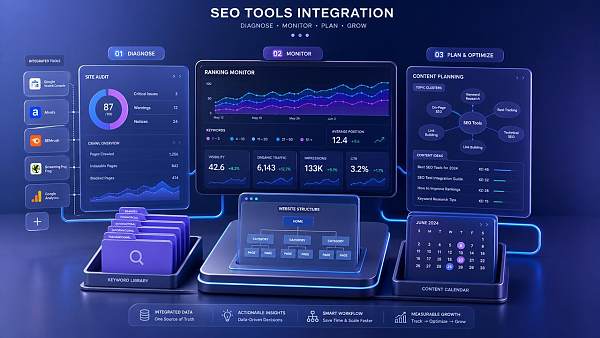
3. Efficiency and collaboration layer: content planning + report output
If a company already has a marketing team, website operations, and outsourced collaborators, it can consider content collaboration and automated reporting tools. The value of such tools is not that they are “more professional,” but that they reduce communication loss and allow finance, marketing, and management to see data through a unified lens. They are especially suitable for approval in companies operating multiple websites or across multiple regions.
A practical checklist for financial approvers: which features are worth paying for, and which are likely to sit idle
The following checklist items are suitable for direct use when evaluating search engine optimization tool solutions:
- Whether there is a clear usage frequency: prioritize features that will be used weekly or monthly, and be cautious about paying for advanced modules that are only reviewed once per quarter.
- Whether it directly supports decision-making: features that help determine what to change on a page, what content to write, and where to allocate the budget are more worth keeping.
- Whether it requires professional interpretation: if a feature is so complex that no one can use it once the service provider leaves, that indicates excessive tool dependency and increased procurement risk.
- Whether there is obvious duplication: when different platforms all provide basic ranking data, traffic estimates, and site scans, the company should retain the one with the most stable data and the most user-friendly interface.
- Whether it can generate management reports: if a tool can only be used by operators and cannot output results that management can understand, its approval value is discounted.
- Whether training and service are included: for non-technical companies, service capability is sometimes more important than the tool itself.
At different business stages, the matching priorities for search engine optimization tools are not the same
If a company is in the stage of official website development or redesign, it should prioritize purchasing tools for technical diagnostics, page structure checks, and indexing monitoring, because the website foundation will directly determine the efficiency of subsequent optimization. If the company already has a certain level of traffic but inquiry growth is slow, then more emphasis should be placed on keyword analysis, content opportunity discovery, and landing page performance monitoring.
For companies engaged in global marketing or building multilingual website networks, the value of search engine optimization tools is also reflected in localized data perspectives, regional competitor analysis, and unified cross-site management. This is why more and more companies tend to choose integrated solutions that combine website and marketing services, rather than purchasing multiple standalone software tools separately. Service providers such as EasyAB Information Technology (Beijing) Co., Ltd., which specialize in intelligent website development, SEO optimization, social media marketing, and advertising placement, have the advantage of measuring tools, execution, and growth goals within the same system, reducing the problem of “knowing how to buy but not how to use” after procurement.
4 risk reminders most likely to be overlooked
- Only looking at unit price, not total cost of ownership. Account expansion, historical data, add-on modules, and training services may all increase expenses later.
- Only looking at functions, not the execution chain. If a company does not have the capability for content updates, page maintenance, and technical support, even the strongest search engine optimization tools will be difficult to put to full use.
- Only looking at traffic, not conversion. During approval, the proposal should be required to explain the logical connection between organic traffic growth and lead quality improvement.
- Ignoring the service capability of the supplier. Many companies are not actually lacking tools, but lacking practical guidance and ongoing optimization support.
Execution recommendation: turn tool procurement into an auditable and reviewable investment
It is recommended that financial approvers require the business department to submit four types of information when applying for search engine optimization tools: first, target metrics, such as organic traffic, indexed pages, ranking of key keywords, or inquiry growth; second, users and responsible persons; third, the expected results timeline and review milestones; fourth, if the tool is not purchased, whether the problem can be solved manually or through existing systems.
If a company hopes to view marketing tool investment from a higher-level perspective, it can also refer to some research perspectives on governance, growth, and efficiency collaboration. For example, when discussing long-term operational capability and organizational upgrading, Analysis of Practical Paths for ESG to Support the Development of New Quality Productive Forces in Enterprises and similar content can help management understand technology investment from the perspectives of resource allocation and sustainable development, rather than viewing digital marketing procurement only as a short-term expense.
6 questions you can ask directly during approval
- What specific current business problem does this set of search engine optimization tools solve?
- If only 3 high-frequency functions are kept, what are they?
- Who internally will use it continuously, and who is responsible for the results?
- How long is expected before phased signals can be seen, rather than the final outcome?
- Among existing tools or services, is there already a replaceable capability?
- After purchase, is supporting website development, content, technical optimization, or outsourced execution also required?
Summary: reasonable matching is more important than blindly pursuing a large all-in-one suite
For financial approvers, the correct procurement logic for search engine optimization tools is not to buy everything in one step, but to first build a minimum viable combination around goals and execution capability: start with diagnostics and monitoring, then add keywords and competitors, and finally add collaboration features based on team maturity. As long as evaluation is based on goals, frequency, ability to replace manual work, and review value, the idle rate can be significantly reduced.
If a company is preparing to move further, it is recommended to first clarify these items: current website status, target market, keyword scope, existing marketing team setup, budget cycle, expected time to results, and whether website development, SEO, content, and advertising need to be integrated into an all-in-one solution. Clarifying these issues before deciding which search engine optimization tools to purchase is usually more effective at avoiding ineffective investment than directly comparing prices.
Related Articles
 Are you really hitting the right target with Google FB for truck bed exports?
 It's easy to turn a foreign trade website into a piece of art, but it's the ultimate culprit behind your order decline
 Foreign trade website efficiency revolution! Yiyingbao component upgrade + inquiry optimization, inquiries surge!



Related Products
 EasyCamp SaaS Smart Website Marketing SystemE-Yingbao SaaS Smart Website Marketing System: AI-powered, zero-code website building. Rapidly launch multilingual independent e-commerce sites in just 10 minutes. Global server acceleration and AI-driven SEO optimization empower businesses to efficiently connect with global markets. The seamless integration of technology and user-friendly operation makes building e-commerce sites incredibly simple.
 AI+SEM Intelligent Advertising Marketing SystemAI+SEM drives intelligent ad creation, empowering full-funnel precision advertising marketing. The system automatically generates weekly/monthly reports, AI recommends keywords and target countries, monitors core metrics in real-time with intelligent alerts, and enables one-click high-conversion ad solutions to help quickly acquire customers and improve ROI.
 AI+SEO Dual Engine Optimization ServiceEasyWin AI+SEO Dual Engine Optimization System leverages AI-powered keyword mining, content generation, and comprehensive technical optimization to help foreign trade enterprises acquire high-quality organic traffic, significantly improving search rankings and conversion rates.
 AI+SNS Social Media Marketing SystemYingbao AI+SNS Social Media Marketing System - Precision social capture for the social media era. Supports one-click content synchronization across major platforms like Facebook and LinkedIn. AI intelligently rewrites posts for enhanced relevance. 24/7 AI customer service and user profiling analysis empower businesses to efficiently expand into global markets.
 AI+SEO营销解决方案易营宝AI+SEO营销解决方案,通过AI批量写作、智能生成TDK、精准关键词扩词等功能,全面优化网站SEO效果,提升流量与转化率。助力企业构建高效智能网站新生态。
 AI+SEM Advertising Marketing SolutionsAI+SEM Advertising Marketing Solution leverages AI technology to deeply empower SEM ad campaigns. It automatically generates weekly/monthly reports using AI, presenting account data across multiple dimensions for comprehensive insights into campaign performance and trends. The system precisely recommends keywords and target countries, intelligently generates high-conversion ad copy, and enables one-click activation of efficient campaign plans to help businesses rapidly acquire customers. Simultaneously, it monitors core metrics in real time, intelligently identifies abnormal fluctuations, and issues timely alerts to ensure stable, high-return advertising results.
 Domain Name ServicesEasyWin provides professional domain name services, including intelligent queries, one-stop registration, brand protection, and full lifecycle management, helping businesses build a digital brand image.
 EasyOperate B2C Cross-Border E-Commerce Platform & Independent WebsiteEasyStore B2C Cross-border E-commerce Independent Store is an intelligent website building and cross-border e-commerce integrated solution independently developed by EasyStore Information Technology (Beijing) Co., Ltd. The system is specially designed for small and medium-sized as well as large export enterprises, integrating 'website building, operation, marketing, advertising, and conversion' into one, helping enterprises quickly establish cross-border e-commerce independent stores to achieve brand globalization and global sales growth.
The platform supports multiple languages, multiple currencies, and multi-channel marketing, with built-in AI intelligent translation and SEO optimization systems, suitable for mainstream markets such as Southeast Asia, Europe and America, Latin America, and the Middle East, assisting Chinese manufacturing enterprises in efficiently deploying international e-commerce strategies. SSL证书易营宝提供专业SSL安全证书服务,包括单域名和泛域名证书,确保网站数据传输加密、身份验证和完整性保护,助力企业建立安全可信的在线业务环境。









