









- What multilingual website services are available in Sanya? Which model is more suitable for local businesses going global?Jul 08, 2026View details
- How to view the complete list of China SaaS companies in the top 100? Practical methods for screening website-building and marketing service providersJul 08, 2026View details
- How to view pricing in the global traffic ecosystem? Cost comparison of search, social media, and content channel advertisingJul 06, 2026View details
- How to assess foreign trade website development trends?Looking at 2026 changes from multilingual,AI content to conversion pathsJul 04, 2026View details
- What are the new trends in multilingual marketing data analytics tools in 2026? Focus on attribution、automation and complianceJul 04, 2026View details
- Is Brand Globalization Marketing Consulting Worth Buying? At What Stage Should Companies Bring It InJul 01, 2026View details
Does AI build support SEO optimization? Hands-on checklist and optimization limitations
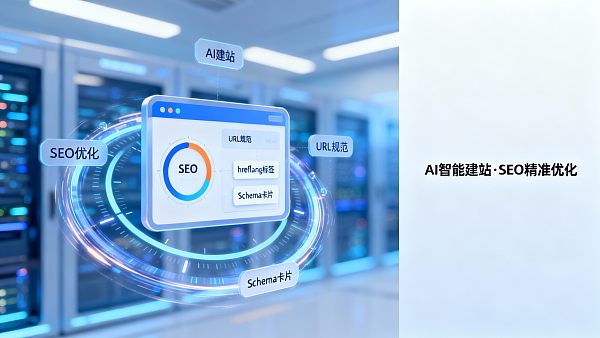
Does AI Website Building Support SEO Optimization? This article provides a practical checklist and limitations analysis to assist enterprises in decision-making and implementation. First, definitions and overview: What is a multilingual website? A multilingual website refers to a collection of pages under the same brand or domain that offers multiple language versions, accurately presenting content to different markets through language switching, hreflang tags, independent subdomains, or directory structures. Addressing core questions like "How to build a multilingual website?" and "How does a multilingual website aid foreign trade?" requires enterprises to simultaneously consider content localization, technical implementation, and search engine indexing rules. The core value of AI website building lies in automatically generating multilingual content, automating TDK (Title, Description, Keywords) and structured data creation, and leveraging global CDN acceleration to enhance user experience and search rankings. While the answer to "Does AI website building support SEO optimization?" is generally affirmative, achieving specific goals depends on the system's comprehensive support and execution quality for URL standardization, hreflang, Schema markup, sitemaps, and mobile-first strategies. This article will dissect these aspects from an industry perspective and provide a practical checklist for decision-makers and implementers.
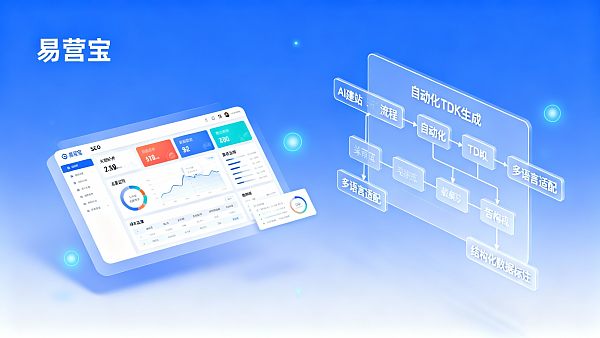
Industry Background & Market Analysis: Why and How to Evaluate AI Website Building's SEO Capabilities
Market analysis shows sustained growth in demand for multilingual websites from international traffic and cross-border e-commerce. Why should enterprises invest in multilingual websites? The answer lies in acquiring non-local organic traffic, improving conversion rates, and reducing customer acquisition costs. Traditional localization methods are costly and slow to iterate, whereas AI website building compresses cycles through NLP and automated translation engines, continuously generating high-quality content while supporting multi-scenario deployments like corporate sites, brand-owned e-commerce platforms, and regional portals. Since its founding in 2013, EasyYunbao has built an AI-driven, one-stop intelligent marketing platform integrating smart website building, SEO optimization, AI keyword expansion, automated TDK generation, and AI-generated images, forming a closed-loop capability. For teams seeking rapid global expansion, options like EasyYunbao's B2C cross-border marketplace or standalone sites with multilingual auto-adaptation and global CDN acceleration can achieve multilingual launches quickly while balancing site performance and search engine friendliness.
Comparative Analysis: Key Differences Between AI Website Building and Traditional Methods, and Their SEO Impact
Comparative analysis reveals significant differences in speed, automation, and consistency. AI website building auto-generates meta tags, standardized URLs, XML sitemaps, Schema.org structured data, and multilingual hreflang annotations, ensuring search engine readability from deployment outset. Traditional methods rely on manual strategy formulation and page-by-page optimization, incurring higher time costs and oversight risks. Regarding "Is AI website building suitable for corporate sites?" and "Is AI website building viable for SMEs?"—AI solutions are ideal for corporate sites needing rapid market validation and continuous content iteration, while SMEs can leverage drag-and-drop builders with automated SEO features to launch at lower costs and gain basic organic traffic. Note that AI website building has limitations: nuanced semantic adjustments in automated translations, granular structured data strategies, and high-value page originality still require human or specialized team optimization to meet complex industry or high-compliance requirements.
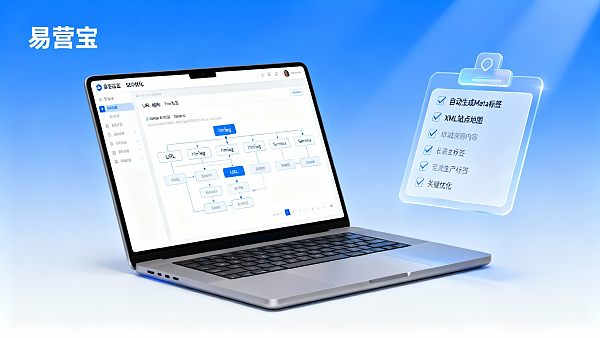
Technical Performance & Procurement Guide: Practical Checklist
During procurement and implementation, project leads and operators should verify: 1) Whether URL strategies support subdomains, subdirectories, or ccTLDs without language version conflicts; 2) Automatic hreflang generation and maintenance; 3) Availability of Schema structured data and product/service/organization markup templates; 4) XML Sitemap generation with language-specific submission to search consoles; 5) AMP or mobile acceleration support for improved mobile experience; 6) Global CDN, auto-SSL, and DDoS protection for site reliability; 7) Allowance for human review and localization overrides in AI text/translation engines. These technical points directly determine the depth of "Does AI website building support SEO optimization?"—balance automation level with controllability during procurement to avoid locked parameters limiting secondary optimization.
Application Scenarios, Case Studies & Common Misconceptions
Typical scenarios include Southeast Asian apparel, home goods, and digital cross-border sellers, plus欧美brand-owned e-commerce platforms, each prioritizing multilingual/multi-currency displays, logistics, and payment integrations differently. Case studies show AI+automated SEO platforms improve brand site speed, organic traffic, and conversion paths. Three common misconceptions: equating automation with zero human review, judging AI translations as equal to localized copywriting, and underestimating hreflang/indexing synchronization complexity. FAQ examples: "Are AI-built websites reliable?" Platform maturity and post-sale support determine reliability; "How much do AI-built websites cost?" Pricing varies widely by functionality and deployment—request scenario-based quotes. These cases emphasize the "automation + localized services" model, exemplified by EasyYunbao's years of integrating tech innovation with regionalized services to help enterprises expand globally.
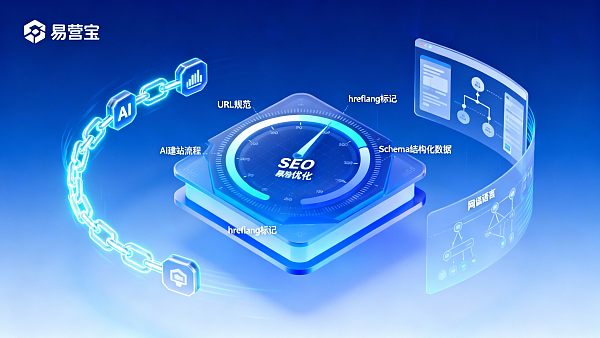
Final Checklist, Limitations Summary & Contact Us
Executable checklist: 1) Confirm site structure/language strategy and test indexing; 2) Validate auto-generated meta, URLs, Schema, and sitemaps against target market search engine norms; 3) Manual polishing and keyword strategies (AI-expanded keywords + human review) for high-value pages; 4) Deploy CDN, SSL, mobile acceleration, and monitor Core Web Vitals; 5) Set up multilingual site redirects, Canonical, and hreflang flows to avoid duplicate indexing; 6) Establish content production/quality review mechanisms to prevent low-quality automation penalties. Limitations: Automated tools still require human input for semantic nuance, industry compliance, and brand tone; some niche markets need stricter localization workflows. Why choose us? Since 2013, EasyYunbao has specialized in AI-driven marketing, covering smart website building, SEO, social media, and ads, combining "AI keyword expansion + auto-TDK + AI-generated images" with global CDN networks to deliver localized implementation services alongside technical capabilities. Contact us for free evaluations or customized solutions.
- Website Development
- Corporate website
- Yiyingbao
- SEO
- Independent Website
- Smart Website Building
- Multilingual website
- cross-border e-commerce
- How to build a multilingual website?
- How can a multilingual website help with foreign trade?
- Why should businesses create multilingual websites?
- What is a multilingual website?
- Is AI website building suitable for small and medium-sized enterprises?
- Does AI website support SEO optimization?
- How much does AI website building generally cost?
Related Articles
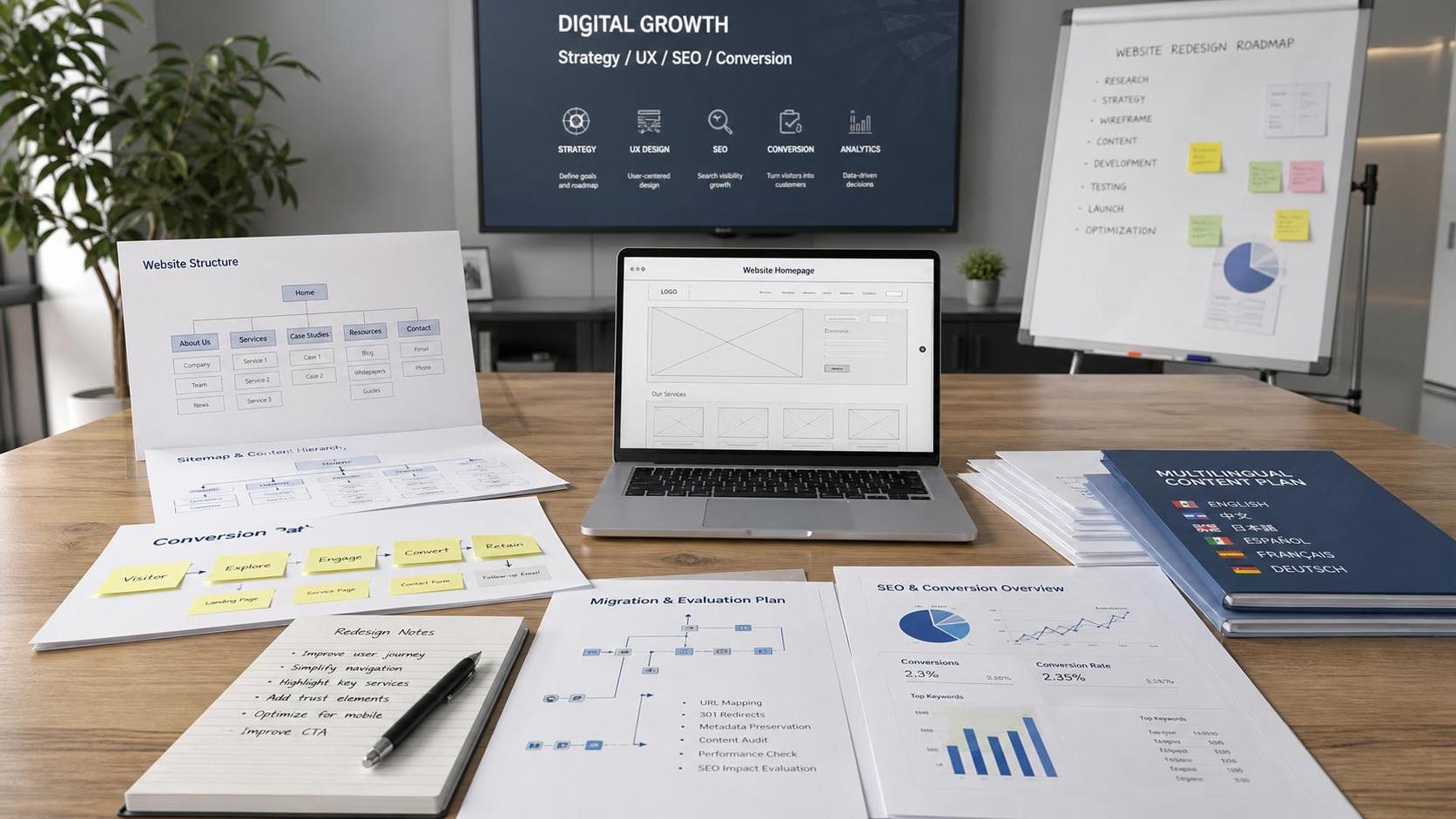
 What should you think about before redesigning your company website? Category structure, conversion goals, and migration risks.
 What Determines Responsive Website Development Costs? Page Count, Functionality, and Language Versions Are Key
 Is responsive design absolutely necessary for cross-border e-commerce independent websites? Analysis of factors influencing mobile conversion rates.


Related Products
 EasyCamp SaaS Smart Website Marketing SystemE-Yingbao SaaS Smart Website Marketing System: AI-powered, zero-code website building. Rapidly launch multilingual independent e-commerce sites in just 10 minutes. Global server acceleration and AI-driven SEO optimization empower businesses to efficiently connect with global markets. The seamless integration of technology and user-friendly operation makes building e-commerce sites incredibly simple.
 AI+SEM Intelligent Advertising Marketing SystemAI+SEM drives intelligent ad creation, empowering full-funnel precision advertising marketing. The system automatically generates weekly/monthly reports, AI recommends keywords and target countries, monitors core metrics in real-time with intelligent alerts, and enables one-click high-conversion ad solutions to help quickly acquire customers and improve ROI.
 AI+SEO Dual Engine Optimization ServiceEasyWin AI+SEO Dual Engine Optimization System leverages AI-powered keyword mining, content generation, and comprehensive technical optimization to help foreign trade enterprises acquire high-quality organic traffic, significantly improving search rankings and conversion rates.
 AI+SNS Social Media Marketing SystemYingbao AI+SNS Social Media Marketing System - Precision social capture for the social media era. Supports one-click content synchronization across major platforms like Facebook and LinkedIn. AI intelligently rewrites posts for enhanced relevance. 24/7 AI customer service and user profiling analysis empower businesses to efficiently expand into global markets.
 AI+SEO营销解决方案易营宝AI+SEO营销解决方案,通过AI批量写作、智能生成TDK、精准关键词扩词等功能,全面优化网站SEO效果,提升流量与转化率。助力企业构建高效智能网站新生态。
 AI+SEM Advertising Marketing SolutionsAI+SEM Advertising Marketing Solution leverages AI technology to deeply empower SEM ad campaigns. It automatically generates weekly/monthly reports using AI, presenting account data across multiple dimensions for comprehensive insights into campaign performance and trends. The system precisely recommends keywords and target countries, intelligently generates high-conversion ad copy, and enables one-click activation of efficient campaign plans to help businesses rapidly acquire customers. Simultaneously, it monitors core metrics in real time, intelligently identifies abnormal fluctuations, and issues timely alerts to ensure stable, high-return advertising results.
 Domain Name ServicesEasyWin provides professional domain name services, including intelligent queries, one-stop registration, brand protection, and full lifecycle management, helping businesses build a digital brand image.
 EasyOperate B2C Cross-Border E-Commerce Platform & Independent WebsiteEasyStore B2C Cross-border E-commerce Independent Store is an intelligent website building and cross-border e-commerce integrated solution independently developed by EasyStore Information Technology (Beijing) Co., Ltd. The system is specially designed for small and medium-sized as well as large export enterprises, integrating 'website building, operation, marketing, advertising, and conversion' into one, helping enterprises quickly establish cross-border e-commerce independent stores to achieve brand globalization and global sales growth.
The platform supports multiple languages, multiple currencies, and multi-channel marketing, with built-in AI intelligent translation and SEO optimization systems, suitable for mainstream markets such as Southeast Asia, Europe and America, Latin America, and the Middle East, assisting Chinese manufacturing enterprises in efficiently deploying international e-commerce strategies. SSL证书易营宝提供专业SSL安全证书服务,包括单域名和泛域名证书,确保网站数据传输加密、身份验证和完整性保护,助力企业建立安全可信的在线业务环境。









