









- The China-US tariff arrangement has reached a preliminary consensus, and the trade association will be establishedJun 15, 2026View details
- China-Morocco zero-tariff access, a breakthrough in the cost of Moroccan goods exports to ChinaJun 11, 2026View details
- What signal should be released for the suspension of exports to JapanJun 10, 2026View details
- China's May LNG imports rebounded, with increased volumes from Russia and Canada filling the Middle East supply gapJun 10, 2026View details
- Will GEO change its SEO strategy?Jun 04, 2026View details
- What types of businesses are end-to-end solutions suitable for?Jun 03, 2026View details
Which global website SaaS platform is the best? Features and reputation rankings of well-known international platforms
Introduction
Which global website-building SaaS platform is the best? In today's world, where cross-border e-commerce continues to heat up and brand globalization has become the dominant trend, businesses are increasingly focused on how to create multilingual independent websites at lower costs and higher efficiency to achieve global exposure and lead conversion for their brands. This article will delve into the features and reputations of mainstream SaaS website-building systems abroad, comprehensively assess core issues such as "Is localized content production for independent websites difficult?" and "Are advertising costs for independent websites high?" and, combined with the AI-driven intelligent website-building strategy of E-Yunbao Information Technology (Beijing) Co., Ltd., provide businesses with systematic global website-building references.
1. Definition and Overview: The Core Value of SaaS Website-Building Systems
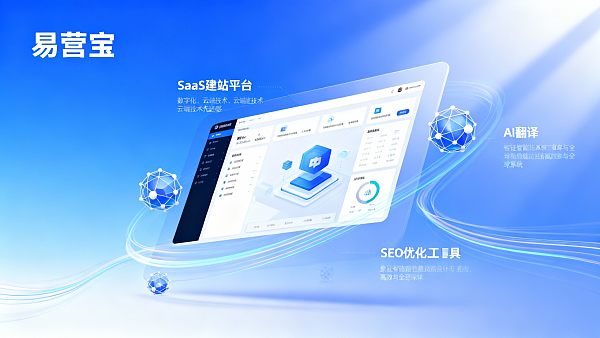
A website-building SaaS (Software-as-a-Service) platform refers to an integrated service that provides website construction, content management, SEO optimization, and marketing functions through cloud technology. Businesses do not need to develop or deploy servers themselves; they can quickly launch websites by selecting templates online, managing domains, and configuring SEO parameters. Compared to traditional self-built websites, the SaaS model has significant advantages in cost, maintenance, and security, especially for cross-border e-commerce and B2B trade enterprises, as it greatly lowers the technical barriers to entering global markets. Well-known international platforms include Wix, Shopify, Squarespace, WordPress.com, and Webflow, each differing in functionality, scalability, and social media integration. For example, Shopify excels in e-commerce features, Wix stands out in design flexibility and AI-assisted design tools, while Webflow is favored by designers and developers for its professional CMS capabilities. However, when facing challenges such as multilingual website building, compliant promotions, and overseas data privacy management, the localization support of general platforms is often insufficient, making it difficult to meet the demands of Chinese foreign trade enterprises for "quick ad placement + strong conversion." At this point, localized platforms based on AI and big data—such as E-Yunbao's intelligent website-building system—are becoming new choices for businesses going global, leveraging their integrated capabilities of "AI translation + global CDN acceleration + SEO optimization."
2. Industry Background and Market Analysis: The Global SaaS Website-Building Landscape and Competitive Trends
According to the latest report from Statista, the global SaaS website-building market reached $25 billion in 2023 and is expected to exceed $45 billion by 2028, with a compound annual growth rate of over 12%. North America and Europe still dominate, but the Asia-Pacific region is growing the fastest, directly correlating with the rise of cross-border e-commerce and brand globalization. Increasingly, Chinese manufacturing, tech brands, and B2B suppliers rely on independent websites to capture global traffic, accelerating the shift from "template-based website building" to the era of "intelligent website building + automated marketing." Behind the question "Is localized content production for independent websites difficult?" lies the challenges businesses face in adapting multilingual copy, image styles, and search engine optimization. Particularly when dealing with different search ecosystems like Yandex, Google, and Bing, the differences in local keyword systems and ad pricing logic are significant, making intelligent algorithms and AI-generated content the new breakthrough. Since its founding in 2013, E-Yunbao Information Technology (Beijing) Co., Ltd. has built a complete ecosystem covering website building, SEO, social media marketing, and AI ad diagnostics, leveraging a decade of industry experience and a big data platform. Its website-building system reconstructs the出海 (going global) approach for foreign trade enterprises with three key features: intelligence, cloud-based operation, and global acceleration. Notably, traditional foreign platforms often have limitations in China's payment systems, content compliance, and customer support, while local SaaS platforms collaborate with Google, Meta, Yandex, and AWS to create a hybrid model that meets international standards while aligning with domestic usage habits.
3. Application Scenarios: Multilingual Independent Websites and Global Marketing Layouts for Cross-Border Enterprises
In the digital competition of cross-border e-commerce and foreign trade enterprises, questions like "How long does it take to quickly build a foreign trade website?" and "Are B2B website construction costs high?" have become top concerns for decision-makers. SaaS platforms compress the weeks- or months-long website-building cycle into hours through visual editors and modular components, while AI technology enables image generation and automatic keyword expansion, allowing businesses to precisely adapt to different countries' cultures, languages, and consumer preferences. For example, a manufacturing company used E-Yunbao's AI marketing engine to synchronize English and Russian independent websites with "AI keyword expansion + automated TDK generation" technology, conducting data comparisons on Yandex ad performance and ultimately achieving a 40% increase in traffic conversion rates. For businesses operating multiple brands or regional markets, the system supports multilingual site clusters, enabling easy content reuse and localized version updates. Additionally, the importance of "independent website social media marketing strategies" is increasingly emphasized, with APIs for platforms like Facebook, LinkedIn, and Instagram enabling automated posting, fan engagement, and data feedback, creating a complete conversion loop between public and private domains. As Google Ads and Meta raise content quality standards, AI-powered ad managers play a more prominent role in diagnosing ad structures and material quality, helping businesses maximize click-through and conversion rates while controlling budgets, effectively addressing the issue of "high ad placement costs for independent websites."
4. Comparative Analysis: Mainstream SaaS Platforms Abroad vs. E-Yunbao's Intelligent Website-Building System
When evaluating "Which global website-building SaaS platform is the best?" beyond brand recognition, the system's comprehensive performance and localization capabilities are more critical. For example, Shopify excels in e-commerce transactions, supporting multi-currency settlements and app ecosystems; Wix emphasizes design flexibility and AI page generation; WordPress.com wins developer favor with its rich plugins but has higher maintenance costs; Webflow focuses on interactive animations and visual presentation, while Squarespace has advantages in content management. For Chinese cross-border enterprises, E-Yunbao's unique strengths lie in: (1) Multilingual content management and AI translation engines that automatically adapt to global market languages, enabling intelligent website building + global coverage; (2) Global server clusters that improve website loading speeds by 40% on average, significantly optimizing user experience; (3) Built-in AI ad managers that automatically analyze performance across Google, Yandex, and Meta platforms; (4) AI-powered creative factories that generate high-CTR ad copy and multilingual materials, drastically reducing manual operational costs. Importantly, as a Google Premier Partner and Yandex core collaborator, E-Yunbao adheres to ISO/IEC 27001 standards for data security, privacy compliance, and CDN node protection. The platform also undergoes 12 annual iterations, ensuring system performance and search engine rule synchronization through self-developed AI algorithms, providing long-term SEO growth guarantees. Overall, international platforms excel in universality, while E-Yunbao stands out in precision, intelligence, and deep localization integration.
5. Procurement and Selection Guide: How Businesses Can Choose the Right SaaS Website-Building Platform
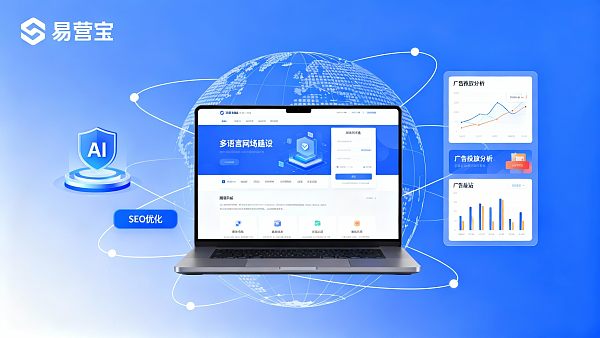
For business decision-makers, selecting a SaaS website-building platform requires evaluating not only functional completeness but also technical support, data security, pricing tiers, scalability, and marketing system integration. General recommendations include: First, assess the system's language adaptability and SEO optimization engine—does it support quick replication and TDK optimization for multilingual independent websites? Second, examine server node distribution and global access speeds—can it cover target markets via CDN technology? Third, evaluate local integration capabilities with social and ad platforms—can it automatically connect to channels like Facebook, LinkedIn, and Yandex Ads? Fourth, consider AI intelligence levels, including automated website performance and search visibility detection, optimization suggestions, and multilingual content generation. For businesses seeking integrated solutions, systems with AI marketing engines and ad analytics will have greater advantages. For example, E-Yunbao's intelligent website-building system not only features an AI-driven content marketing engine but also helps businesses continuously improve site performance through data analysis. Additionally, domestic and international platforms differ in pricing models: foreign platforms often use monthly subscriptions, while local providers like E-Yunbao offer flexible project-based and enterprise annual packages, enhancing budget control and service transparency. For projects related to universities and research institutions, some companies also combine information research products, such as Research on Enterprise Business Management in the Context of Digital Transformation, to help clients explore the application value of digital management and website-building system synergy.
6. Trends and Future Outlook: AI, Blockchain, and Decentralized Marketing Ecosystems
As AI, blockchain, and big data technologies mature, SaaS website-building platforms are transitioning from traditional "tool-based systems" to "intelligent marketing ecosystems." On one hand, AI will deepen its involvement in content generation, localized translation, and image optimization, enhancing the originality and search-friendliness of independent websites. On the other hand, decentralized data storage and privacy protection mechanisms will become new focal points, ensuring stable cross-border website operations under multinational compliance environments. Over the next three years, SaaS systems will gradually achieve full-process automated operations, from building to ad placement to social media interactions, all optimized by algorithms in real time. For cross-border e-commerce, this means brands can capture global markets at lower customer acquisition costs. Trend-wise, the fusion of AI + blockchain is redefining marketing ecosystems. E-Yunbao has launched an AI Digital Marketing Academy, training thousands of professionals annually to build a talent ecosystem. Simultaneously, its expansion into Latin America and Africa will help Chinese enterprises achieve "Belt and Road" digital出海 (going global). Facing questions like "Are template websites suitable for foreign trade enterprises?" and "Are SaaS website-building systems suitable for cross-border e-commerce?" the future answer leans toward "yes," but stronger competitiveness lies in combining AI strategies to continuously optimize content and ad decisions. Through global CDN nodes built with AWS and Alibaba Cloud, businesses can easily deploy content distribution across regions, achieving zero business interruptions. Notably, AI systems are integrating with research outcomes like Research on Enterprise Business Management in the Context of Digital Transformation, providing data-driven decision-making and完善 (perfecting) intelligent operation models for businesses.
7. Why Choose E-Yunbao: An AI-Driven Global Growth Partner
Guided by the vision of "Making the world pave the way for Chinese brands," E-Yunbao Information Technology (Beijing) Co., Ltd. adheres to the core philosophy of "Customer success > everything," leveraging a decade of深耕 (deep cultivation) in AI and big data technologies. Headquartered in Beijing with branches in the U.S. and Singapore, the company collaborates with Google, Meta, and Yandex to build a global traffic ecosystem, assisting over 100,000 enterprises in achieving digital出海 (going global). Unlike单纯的 (mere) website service providers, E-Yunbao更像 (is more like) a business growth engine: here, intelligent website building is just the starting point, with AI ad optimization, social media matrix operations, and SEO content generation serving as accelerators. Whether you aim to reduce overseas ad costs or seek high-quality traffic conversion, E-Yunbao can tailor strategies through intelligent algorithms and human-machine collaboration. Moving forward, the company will continue exploring the融合 (integration) of AI and blockchain, building an open decentralized marketing ecosystem to create a sustainable digital growth system for global clients. If your business is at a critical stage of global布局 (layout) or wants to深入了解 (deeply understand) intelligent website-building solutions, feel free to contact us anytime to开启 (embark on)高效 (efficient) collaboration for the future.
- Website Development
- Website Builder Platform
- Social Media Marketing
- Multilingual standalone site
- B2B website
- Google Ads
- Search Engine Optimization
- Website loading speed
- Yandex Advertising
- Template website
- Yiyingbao
- SEO
- Independent Website
- Smart website builder system
- SEO Optimization
- Smart Website Development
- AI Translation
- EasySite Intelligent Website Builder
- AI Marketing Engine
- AI Translation Engine
- Global CDN Acceleration
- Yandex ad placement
- Global Traffic Ecosystem
- Global Website Building SaaS Platform
- SaaS Website Building System
- Social Media Marketing Strategy
- Quickly Build a Foreign Trade Website
- cross-border e-commerce
- AI Marketing
- AI Ad Optimization
Related Articles



Related Products
 EasyCamp SaaS Smart Website Marketing SystemE-Yingbao SaaS Smart Website Marketing System: AI-powered, zero-code website building. Rapidly launch multilingual independent e-commerce sites in just 10 minutes. Global server acceleration and AI-driven SEO optimization empower businesses to efficiently connect with global markets. The seamless integration of technology and user-friendly operation makes building e-commerce sites incredibly simple.
 AI+SEM Intelligent Advertising Marketing SystemAI+SEM drives intelligent ad creation, empowering full-funnel precision advertising marketing. The system automatically generates weekly/monthly reports, AI recommends keywords and target countries, monitors core metrics in real-time with intelligent alerts, and enables one-click high-conversion ad solutions to help quickly acquire customers and improve ROI.
 AI+SEO Dual Engine Optimization ServiceEasyWin AI+SEO Dual Engine Optimization System leverages AI-powered keyword mining, content generation, and comprehensive technical optimization to help foreign trade enterprises acquire high-quality organic traffic, significantly improving search rankings and conversion rates.
 AI+SNS Social Media Marketing SystemYingbao AI+SNS Social Media Marketing System - Precision social capture for the social media era. Supports one-click content synchronization across major platforms like Facebook and LinkedIn. AI intelligently rewrites posts for enhanced relevance. 24/7 AI customer service and user profiling analysis empower businesses to efficiently expand into global markets.
 AI+SEO营销解决方案易营宝AI+SEO营销解决方案,通过AI批量写作、智能生成TDK、精准关键词扩词等功能,全面优化网站SEO效果,提升流量与转化率。助力企业构建高效智能网站新生态。
 AI+SEM Advertising Marketing SolutionsAI+SEM Advertising Marketing Solution leverages AI technology to deeply empower SEM ad campaigns. It automatically generates weekly/monthly reports using AI, presenting account data across multiple dimensions for comprehensive insights into campaign performance and trends. The system precisely recommends keywords and target countries, intelligently generates high-conversion ad copy, and enables one-click activation of efficient campaign plans to help businesses rapidly acquire customers. Simultaneously, it monitors core metrics in real time, intelligently identifies abnormal fluctuations, and issues timely alerts to ensure stable, high-return advertising results.
 Domain Name ServicesEasyWin provides professional domain name services, including intelligent queries, one-stop registration, brand protection, and full lifecycle management, helping businesses build a digital brand image.
 EasyOperate B2C Cross-Border E-Commerce Platform & Independent WebsiteEasyStore B2C Cross-border E-commerce Independent Store is an intelligent website building and cross-border e-commerce integrated solution independently developed by EasyStore Information Technology (Beijing) Co., Ltd. The system is specially designed for small and medium-sized as well as large export enterprises, integrating 'website building, operation, marketing, advertising, and conversion' into one, helping enterprises quickly establish cross-border e-commerce independent stores to achieve brand globalization and global sales growth.
The platform supports multiple languages, multiple currencies, and multi-channel marketing, with built-in AI intelligent translation and SEO optimization systems, suitable for mainstream markets such as Southeast Asia, Europe and America, Latin America, and the Middle East, assisting Chinese manufacturing enterprises in efficiently deploying international e-commerce strategies. SSL证书易营宝提供专业SSL安全证书服务,包括单域名和泛域名证书,确保网站数据传输加密、身份验证和完整性保护,助力企业建立安全可信的在线业务环境。









