









- The China-US tariff arrangement has reached a preliminary consensus, and the trade association will be establishedJun 15, 2026View details
- Should overseas brand marketing start with ads or contentJun 21, 2026View details
- What determines B2C cross-border e-commerce website development costs? A breakdown of features, interfaces, and deployment methodsJun 17, 2026View details
- China-Morocco zero-tariff access, a breakthrough in the cost of Moroccan goods exports to ChinaJun 11, 2026View details
- What signal should be released for the suspension of exports to JapanJun 10, 2026View details
- China's May LNG imports rebounded, with increased volumes from Russia and Canada filling the Middle East supply gapJun 10, 2026View details
- Will GEO change its SEO strategy?Jun 04, 2026View details
- What types of businesses are end-to-end solutions suitable for?Jun 03, 2026View details
2026 Corporate Website SEO Trends: Which Methods Are Outdated
In 2026, the biggest change in corporate website SEO is not “whether optimization has been done,” but “whether what you are doing is still effective optimization.” If a corporate website still remains at the stage of stuffing TDK, building backlinks in bulk, copying content, and only looking at indexing rather than conversion, then ranking fluctuations, declining lead quality, and rising customer acquisition costs are almost inevitable results. For business decision-makers and execution teams, what is truly worth paying attention to is not a checklist of tactics, but: which old methods are clearly outdated, and which new capabilities will directly affect website traffic, inquiries, and deals.
Especially in the broader context of integrated website + marketing services, corporate website SEO is no longer a matter of isolated optimization points, but a systematic project driven collaboratively by responsive website SEO optimization, content quality, technical performance, user experience, AI-assisted production, and data analysis. This article will start from users’ real search intent and directly answer several questions businesses care about most: what the trends in corporate website SEO will be in 2026, which methods should stop receiving investment, and what constitutes a more sustainable path to growth.
1. Judging Corporate Website SEO Trends in 2026: Shifting from “Doing Rankings” to “Creating Value”
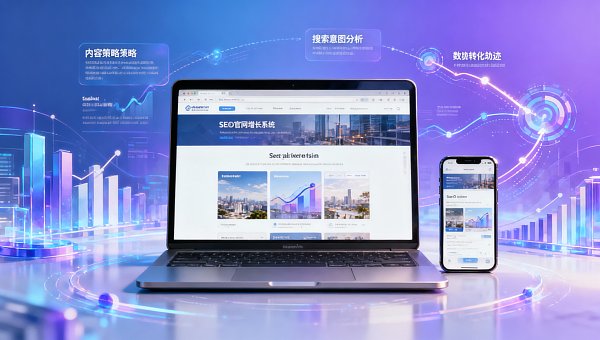
First, here is a clear judgment: corporate website SEO in 2026 will no longer be about who is better at “exploiting algorithm loopholes,” but about who can more consistently provide clear, trustworthy, and conversion-oriented information.
In recent years, search engines have continued to strengthen several directions: understanding users’ real intent, identifying page quality, evaluating website credibility, and paying attention to browsing experience and the original value of content. This means that the core evaluation standard of corporate website SEO is shifting from “whether keywords have appeared” to “whether the page truly solves the problem.”
For businesses, this shift has three direct impacts:
- Traffic logic has changed: the value of broad traffic is declining, while the value of precise traffic and high-intent searches is increasing.
- Content logic has changed: content written only for search engines is finding it harder to obtain stable rankings, while content written for user decision-making is more likely to become a long-term asset.
- Website logic has changed: the official website is no longer just a display page, but the core hub for customer acquisition, trust building, and conversion handling.
Therefore, corporate website SEO in 2026 is more like a growth system: website architecture lays the foundation, responsive website SEO optimization improves experience, the content matrix captures demand, the AI+SEO dual-engine optimization system improves efficiency, and then data feedback drives continuous iteration.
2. Which SEO Methods Are Becoming Outdated and Will Only Waste Budget If Continued
This is the issue most businesses care about. The following methods are not “completely impossible to use,” but as primary investment directions they are already clearly outdated, and may even produce negative effects.
1. Only focusing on stuffing keywords into TDK
Title, description, and keyword tags are still important, but they are only the basics, not decisive factors. The problem with many corporate websites is that they interpret SEO as “filling the homepage title with core keywords.” As a result, the homepage may seem to cover many keywords, but in reality it is neither natural, nor beneficial for clicks, nor capable of matching diversified search intent.
A more effective approach in 2026 is: split keyword layout according to page function and search intent. The homepage should talk about the brand and core business, product pages should address application scenarios, solution pages should address industry problems, and article pages should capture educational search needs. This is far more effective than cramming terms into a single page.
2. Mass scraping, pseudo-original writing, and large-scale publishing of low-quality AI content
AI will become an important production tool for SEO, but “low-quality AI mass generation” will not become an effective growth method. Many websites appear to have a huge volume of content, but in fact their viewpoints are empty, their structures repetitive, and their experiential information lacking. Such content can neither impress users nor easily achieve stable rankings.
A truly valuable AI+SEO dual-engine optimization system should use AI to improve the efficiency of topic selection, outlining, semantic coverage, and data analysis, and then have a professional team add industry experience, cases, judgment, and actionable recommendations. Simply put, AI can improve efficiency, but it cannot replace professional content judgment.
3. Only pursuing backlink quantity without considering source quality
In the past, the backlink mindset of “the more you publish, the more effective it is” carried less risk. Now the risks are getting higher and higher. Irrelevant industry platforms, low-quality directory sites, and bulk link exchanges not only struggle to bring real authority growth, but may also weaken the website’s overall trustworthiness.
What is more worth investing in is content-driven natural citations, exposure in vertical industry media, recommendations from partners’ official websites, case dissemination, and growth in brand searches. These signals are more aligned with the long-term development logic of corporate website SEO.
4. Prioritizing the PC site while lagging in mobile experience
If a corporate website opens slowly on mobile, has messy layouts, hard-to-click buttons, and complicated form submissions, then even with rankings it will still be difficult to generate conversions. Responsive website SEO optimization is no longer a bonus item, but a basic requirement. This is especially true for B2B, manufacturing, and engineering project websites, where many first visits and internal shares happen on mobile.
What is outdated is not the PC website, but the mindset of “treating mobile as an accessory.”
5. Only looking at indexing and rankings, not inquiries and deals
When many businesses report SEO results every month, they still focus on “how many pages were indexed, how many keywords ranked, and how much traffic increased.” These indicators do have reference value, but they cannot replace business results. In 2026, what matters more is looking at:
- Which keywords bring high-intent visits
- Which pages drive inquiries, lead capture, or phone calls
- Which content helps sales conversion
- Whether the customer acquisition cost from SEO traffic is better than paid channels
Without a conversion-funnel perspective, SEO can easily become something that “looks very hardworking, but does not actually create growth.”
3. What Businesses Truly Care About Is Not the Algorithm, but Whether the Website Can Drive Growth
For business decision-makers, project leaders, and operations teams, there are four core things to look at when judging whether SEO is worth continued investment.
1. Whether it can continuously acquire precise traffic
The value of high-quality SEO is not to bring in irrelevant people, but to make it easier for people with real needs to find you. For example, users searching for “corporate website SEO,” “responsive website SEO optimization,” “foreign trade website optimization solutions,” or “how to create an industry solution page” are often already at a relatively clear demand stage.
If the official website’s content and structural design are reasonable, those searches can be converted into effective business opportunities.
2. Whether it can reduce long-term customer acquisition costs
Compared with relying entirely on advertising, the value of SEO lies in forming long-term assets. Once high-quality content, technical optimization, and page trust-building are established, they can continue to bring organic traffic and brand searches, reducing dependence on one-time paid clicks.
This is also why more and more businesses are operating their official websites as “digital infrastructure.” Just as much professional research-oriented content can accumulate value over the long term in vertical industries, some special-topic pages around business management and industry strategy are more likely to form stable search entry points than purely promotional pages. Content such as Discussion on Optimization Strategies for Capital Management in Power Enterprises Based on Cash Flow Forecasting, if placed within an appropriate industry knowledge system, is also more likely to capture professional search demand in niche fields.
3. Whether it can improve brand trust and decision-making efficiency
Official website SEO does not have only one layer of value, namely “finding traffic.” Before contacting sales, many customers have already used search to judge whether a company is professional, reliable, and experienced in the industry. An official website with clear structure, solid content, authentic cases, and smooth loading will significantly shorten the trust-building cycle.
4. Whether it can work in synergy with sales, advertising, and social media
Mature businesses do not view SEO in isolation. Official website SEO captures search demand, advertising amplifies short-term exposure, and social media marketing is responsible for brand reach and relationship management. Once the three are connected, a user may first discover the brand through advertising, verify it again through search, and then submit an inquiry through the official website. That is the complete path.
4. More Effective Corporate Website SEO Practices for 2026: How They Should Be Implemented
If a business is preparing to drive website growth in 2026, it is recommended to focus on advancing the following aspects.
1. Rebuild keyword strategy first, and stop focusing only on a few big terms
Keyword planning should be upgraded from “terms” to “scenarios” and “intent.” It can be divided into four layers:
- Brand terms: used to capture brand awareness and reputation verification
- Business terms: used for acquiring customers for core services, such as corporate website SEO and website building optimization
- Problem terms: used to educate users, such as what to do if website traffic is low, or whether a responsive website affects SEO
- Industry terms: used for conversion in vertical scenarios, such as manufacturing website optimization solutions and B2B corporate website redesign SEO
The benefit of doing this is that it can cover both high-intent customers and users in the earlier stages of decision-making.
2. Design content according to the user decision journey, not just write news updates
For a long time, many official website content sections have contained only company news, holiday greetings, and signing announcements. This type of content offers limited help for SEO. A more effective content structure usually includes:
- Service description pages
- Industry solution pages
- Case pages
- FAQ pages
- Knowledge article pages
- Download/white paper/guide pages
Execution teams can understand content as a “problem-solving system”: whatever problems customers search for, the official website provides corresponding answers, and naturally guides inquiry actions after those answers.
3. Do responsive website SEO optimization well and solve experience weaknesses first
This part is often the most underestimated. Page loading speed, mobile adaptation, internal linking logic, navigation clarity, form simplicity, and the way cases are loaded all directly affect time on site and conversion rates.
If the website structure is complex and access is slow, users will still be lost even if the content is fairly good. Businesses should give priority to checking:
- Whether the homepage and core landing pages load too slowly
- Whether reading on mobile is comfortable
- Whether CTA buttons are obvious
- Whether there are blank pages, dead links, or duplicate pages
- Whether the URL, breadcrumb navigation, and on-site search are clear
4. Use AI to improve efficiency, but retain human judgment
In 2026, AI’s best role in SEO is that of an “assistant,” not a “replacement.” It is suitable for:
- Search intent clustering
- Topic discovery
- Content outline generation
- Suggestions for updating old content
- Data monitoring and anomaly alerts
But when it comes to industry insight, case authenticity, business expression, conversion copywriting, and professional judgment, human oversight is still necessary. Otherwise, the content can easily “look complete, but actually be useless.”
5. Establish a conversion-oriented data monitoring system
It is recommended that businesses upgrade SEO monitoring at least from the “traffic level” to the “business operations level,” focusing on tracking:
- Traffic to high-value pages
- Form submissions, phone clicks, and online inquiries brought by organic search
- Conversion rates of different keyword groups
- Changes in rankings and inquiries after content updates
- The cycle and quality from SEO leads to closed deals
Only by connecting data with sales results can businesses truly know whether the SEO budget should be increased and where it should be increased.
5. When Businesses Choose SEO Services or Promote It Internally, How Should They Judge Reliability
Whether choosing an external service provider or building internal team capabilities, the evaluation standard should not remain at old promises like “guaranteeing first-page rankings.”
More reliable evaluation methods include:
- Whether they first diagnose the industry, competitors, and existing website
- Whether they can provide an integrated plan covering content, technology, structure, and conversion
- Whether they emphasize long-term asset building rather than short-term keyword manipulation
- Whether they have AI+SEO dual-engine optimization system capabilities
- Whether they can explain the relationship between each task and lead growth
- Whether they have real cases and verifiable results
This is especially true for industries with longer business chains and longer decision-making cycles. Because when official website SEO is done well, what it brings is not a one-time traffic spike, but stable inquiries and stronger brand trust. Some industry-specific content can even become a long-term customer acquisition entry point. For example, professional topics such as Discussion on Optimization Strategies for Capital Management in Power Enterprises Based on Cash Flow Forecasting, if matched with industry site structure, search demand, and user reading paths, may continuously accumulate traffic value in niche fields.
6. Conclusion: In 2026, What Is Outdated Is Not SEO, but Old SEO Thinking
The trends in corporate website SEO for 2026 are already very clear: the era of driving growth through keyword stuffing, low-quality content, crude backlink building, and surface-level metrics is ending. The truly effective method is to place corporate website SEO back into the business growth framework, use responsive website SEO optimization to strengthen experience, use high-quality content to capture search demand, use AI to improve efficiency, and use data to verify conversion results.
For business decision-makers, what matters most is not chasing concepts, but judging whether the official website is becoming a sustainable customer acquisition asset; for execution teams, the key is not doing more actions, but doing the right actions. In the future, the businesses that can continue to achieve search growth are often not those “best at SEO,” but those that best understand users, value the official website most, and are most capable of connecting content, technology, and conversion.
Related Articles



Related Products
 EasyCamp SaaS Smart Website Marketing SystemE-Yingbao SaaS Smart Website Marketing System: AI-powered, zero-code website building. Rapidly launch multilingual independent e-commerce sites in just 10 minutes. Global server acceleration and AI-driven SEO optimization empower businesses to efficiently connect with global markets. The seamless integration of technology and user-friendly operation makes building e-commerce sites incredibly simple.
 AI+SEM Intelligent Advertising Marketing SystemAI+SEM drives intelligent ad creation, empowering full-funnel precision advertising marketing. The system automatically generates weekly/monthly reports, AI recommends keywords and target countries, monitors core metrics in real-time with intelligent alerts, and enables one-click high-conversion ad solutions to help quickly acquire customers and improve ROI.
 AI+SEO Dual Engine Optimization ServiceEasyWin AI+SEO Dual Engine Optimization System leverages AI-powered keyword mining, content generation, and comprehensive technical optimization to help foreign trade enterprises acquire high-quality organic traffic, significantly improving search rankings and conversion rates.
 AI+SNS Social Media Marketing SystemYingbao AI+SNS Social Media Marketing System - Precision social capture for the social media era. Supports one-click content synchronization across major platforms like Facebook and LinkedIn. AI intelligently rewrites posts for enhanced relevance. 24/7 AI customer service and user profiling analysis empower businesses to efficiently expand into global markets.
 AI+SEO营销解决方案易营宝AI+SEO营销解决方案,通过AI批量写作、智能生成TDK、精准关键词扩词等功能,全面优化网站SEO效果,提升流量与转化率。助力企业构建高效智能网站新生态。
 AI+SEM Advertising Marketing SolutionsAI+SEM Advertising Marketing Solution leverages AI technology to deeply empower SEM ad campaigns. It automatically generates weekly/monthly reports using AI, presenting account data across multiple dimensions for comprehensive insights into campaign performance and trends. The system precisely recommends keywords and target countries, intelligently generates high-conversion ad copy, and enables one-click activation of efficient campaign plans to help businesses rapidly acquire customers. Simultaneously, it monitors core metrics in real time, intelligently identifies abnormal fluctuations, and issues timely alerts to ensure stable, high-return advertising results.
 Domain Name ServicesEasyWin provides professional domain name services, including intelligent queries, one-stop registration, brand protection, and full lifecycle management, helping businesses build a digital brand image.
 EasyOperate B2C Cross-Border E-Commerce Platform & Independent WebsiteEasyStore B2C Cross-border E-commerce Independent Store is an intelligent website building and cross-border e-commerce integrated solution independently developed by EasyStore Information Technology (Beijing) Co., Ltd. The system is specially designed for small and medium-sized as well as large export enterprises, integrating 'website building, operation, marketing, advertising, and conversion' into one, helping enterprises quickly establish cross-border e-commerce independent stores to achieve brand globalization and global sales growth.
The platform supports multiple languages, multiple currencies, and multi-channel marketing, with built-in AI intelligent translation and SEO optimization systems, suitable for mainstream markets such as Southeast Asia, Europe and America, Latin America, and the Middle East, assisting Chinese manufacturing enterprises in efficiently deploying international e-commerce strategies. SSL证书易营宝提供专业SSL安全证书服务,包括单域名和泛域名证书,确保网站数据传输加密、身份验证和完整性保护,助力企业建立安全可信的在线业务环境。









