









- How to assess foreign trade website development trends?Looking at 2026 changes from multilingual,AI content to conversion pathsJul 04, 2026View details
- What are the new trends in multilingual marketing data analytics tools in 2026? Focus on attribution、automation and complianceJul 04, 2026View details
- Is Brand Globalization Marketing Consulting Worth Buying? At What Stage Should Companies Bring It InJul 01, 2026View details
- Cross-Border Marketing Trend Research: Why More and More Companies Are Starting to Deploy AI Search and GEO OptimizationJun 30, 2026View details
- Cross-Border Marketing Trend Research: How Independent Sites, AI Content, and Short-Video Customer Acquisition Are ChangingJun 30, 2026View details
- How Can a Brand Updates Page Be Made More SEO-Friendly? Analysis of Update Frequency, Content Structure, and Internal Linking StrategyJun 28, 2026View details
Cross-border website launch checklist: How to perform a checklist for foreign trade independent site project managers

As a project manager, you need to ensure that cross-border e-commerce website building projects are delivered according to quality, compliance, and performance goals within limited time and budget. This checklist focuses on actionable checkpoints for building independent foreign trade websites, covering key dimensions such as requirements analysis, SaaS website building system selection, responsive website platform compatibility, multilingual website building strategies for foreign trade, SEO, and security controls. This article is suitable for users/operators, enterprise decision-makers, quality control personnel, and project leaders, aiming to help you standardize the "build-test-launch-operation" process, reduce rework costs, and shorten the production cycle. During the process, it is recommended to integrate the checklist into project management tools, taking into account the company's existing technology stack, target market, and compliance requirements, to achieve traceable milestones and assign responsibility to individuals.

I. Project Initiation and Requirements Confirmation: Scope, SLA, and Multilingual Strategy
At the outset of the project, clearly define business objectives and KPIs (traffic volume, conversion rate, inquiry cost, etc.) and incorporate these metrics into the contract and Service Level Agreement (SLA). Requirements confirmation should include target country/region, target language, payment and logistics integration, legal compliance (GDPR, CCPA, etc.), and third-party system integration (ERP, CRM, warehousing). When selecting a SaaS platform for an independent foreign trade website, prioritize evaluating the translation accuracy and SEO friendliness of the multilingual website building platform, and confirm whether it supports URL partitioning (e.g., subdirectories/subdomains) and hreflang tag management. The project plan should be broken down into iterative milestones: requirements freezing, style and template confirmation, data and interface development, content migration, testing and pre-launch, and official release. Each milestone should clearly define deliverables, acceptance criteria, and responsible parties to ensure the cross-border website achieves its expected commercial value within the target timeframe.
II. Technical Architecture and Performance Testing: Responsive Design, CDN, and Mobile-First Design
From a technical perspective, prioritize responsive enterprise website building systems to ensure a consistent conversion path across desktop and mobile devices. Core check items include: server distribution and CDN coverage, automated TLS/SSL certificate processing, DNS configuration, third-party API concurrency limits, and caching strategies. Performance testing should cover First Content Render (FCP), Time to First Byte (TTFB), and Time to Interaction (TTI), and be verified using real network links in key target markets. SaaS website building systems must provide automated performance monitoring and rollback mechanisms to ensure rapid remediation of regression issues after deployment. Security audits include dependency library vulnerability scanning, WAF configuration, DDoS protection, and encrypted storage and transmission of sensitive data. If multilingual and regional deployments are adopted, pay attention to the impact of server distance on SEO and user experience, deploying global nodes or adding edge nodes based on core markets to achieve a win-win situation for page loading speed and SEO score in cross-border website building.
III. Content Localization and SEO Optimization: TDK, Link Structure, and Semantic Layout
Content and SEO are the core of a successful multilingual website for foreign trade. Implementation strategies include keyword mapping (building long-tail keyword sets by market and language), localization of page TDK (Title, Description, Keywords), structured data annotation, and building internal semantic links. Ensure each language version has an independent, indexable URL, and use `hreflang` to indicate the target language/region relationship. Meta tags and image ALT tags must be translated and include target keywords to avoid semantic discrepancies caused by simple machine translation. Content production should combine AI-driven intelligent writing with human proofreading to ensure accurate industry terminology and conformity to local expression habits. Before launch, conduct site search engine crawling simulations and log analysis to check for bot blocking, duplicate content, and canonical conflicts. For foreign trade companies that need advertising to drive traffic, consider integrating external promotion services to accelerate the traffic loop. For example, use global advertising tools like Google Ads for ad placement and landing page matching to achieve precise pay-per-click targeting and continuous landing page optimization to improve overall inquiry volume and conversion efficiency.
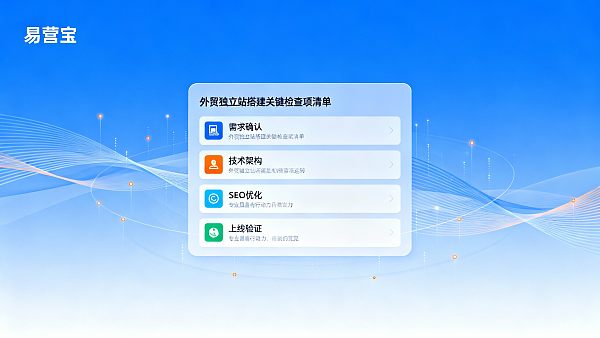
IV. Data Validation, QA Processes, and Contingency Plans: Minimizing Deployment Risks
Before going live, comprehensive data verification and QA must be completed to ensure the stability of the end-to-end process for product pages, pricing, inventory, logistics information, and form submissions. Testing includes functional testing, cross-browser compatibility, sandboxing and payment verification of the payment chain, email notifications and CRM push notifications, form anti-spam and CAPTCHA, and overseas payment compliance verification (currency, taxes, invoices). A rollback strategy and canary release mechanism should be established, along with a clear go-live time window and communication matrix, including a list of contacts for troubleshooting and response timelines for outsourced suppliers. For security and compliance incidents, standardized contingency plans (isolation, patching, notifications) should be prepared, and high-frequency monitoring should be conducted within 7 days of go-live, adjusting CDN and WAF strategies as needed to ensure the stable operation of the foreign trade website solution under real traffic pressure. At the end of the project, a "Go-Live Acceptance Report" should be produced, recording the issue list, repair results, and subsequent optimization suggestions, forming a reusable project delivery template.
Summary and Next Steps: Implementation and Continuous Optimization
In summary, successful cross-border website development relies on rigorous requirement definition, verifiable technical solutions, localized content, and comprehensive launch and contingency plans. Project managers should embed key checkpoints into the acceptance criteria of each iteration and continuously optimize through a data-driven improvement loop. EasyCreative's intelligent website building and full-link marketing capabilities provide integrated support across technology, content, traffic, and advertising, helping businesses quickly launch and continuously expand in multilingual markets. For further evaluation of your independent foreign trade website implementation plan or to obtain tool support, please contact us to learn more about our solutions and receive customized execution advice. Contact us now for a free launch diagnostic and implementation checklist to help you transform your cross-border website from a plan into a continuously growing business engine.
- Website Development
- Website Builder Platform
- Foreign Trade Website Development
- SSL Certificate
- Multilingual website development
- Yiyingbao
- SEO
- Independent Website
- SEO Optimization
- Smart Website Building
- Independent foreign trade website
- Multilingual website
- Cross-border E-commerce Website
- SaaS Website Building System
- Responsive website platform
- Cross-Border Website Development
- How to build an independent foreign trade website
- Multilingual Website Construction for Foreign Trade
- Foreign Trade Standalone Site SaaS
- Responsive Enterprise Website Building System
- Multilingual Website Construction Platform
- Foreign Trade Website Solutions
- Responsive Website Building
- cross-border e-commerce
Related Articles
 Foreign trade websites "look good but don’t convert"? Yiyingbao’s global language automatic adaptation, inquiries surge!
 Foreign trade website efficiency revolution! Yiyingbao component upgrade + inquiry optimization, inquiries surge!
 EasYingbao fully automated watermark + intelligent SEO manager, helping you capture inquiries more steadily!



Related Products
 EasyCamp SaaS Smart Website Marketing SystemE-Yingbao SaaS Smart Website Marketing System: AI-powered, zero-code website building. Rapidly launch multilingual independent e-commerce sites in just 10 minutes. Global server acceleration and AI-driven SEO optimization empower businesses to efficiently connect with global markets. The seamless integration of technology and user-friendly operation makes building e-commerce sites incredibly simple.
 AI+SEM Intelligent Advertising Marketing SystemAI+SEM drives intelligent ad creation, empowering full-funnel precision advertising marketing. The system automatically generates weekly/monthly reports, AI recommends keywords and target countries, monitors core metrics in real-time with intelligent alerts, and enables one-click high-conversion ad solutions to help quickly acquire customers and improve ROI.
 AI+SEO Dual Engine Optimization ServiceEasyWin AI+SEO Dual Engine Optimization System leverages AI-powered keyword mining, content generation, and comprehensive technical optimization to help foreign trade enterprises acquire high-quality organic traffic, significantly improving search rankings and conversion rates.
 AI+SNS Social Media Marketing SystemYingbao AI+SNS Social Media Marketing System - Precision social capture for the social media era. Supports one-click content synchronization across major platforms like Facebook and LinkedIn. AI intelligently rewrites posts for enhanced relevance. 24/7 AI customer service and user profiling analysis empower businesses to efficiently expand into global markets.
 AI+SEO营销解决方案易营宝AI+SEO营销解决方案,通过AI批量写作、智能生成TDK、精准关键词扩词等功能,全面优化网站SEO效果,提升流量与转化率。助力企业构建高效智能网站新生态。
 AI+SEM Advertising Marketing SolutionsAI+SEM Advertising Marketing Solution leverages AI technology to deeply empower SEM ad campaigns. It automatically generates weekly/monthly reports using AI, presenting account data across multiple dimensions for comprehensive insights into campaign performance and trends. The system precisely recommends keywords and target countries, intelligently generates high-conversion ad copy, and enables one-click activation of efficient campaign plans to help businesses rapidly acquire customers. Simultaneously, it monitors core metrics in real time, intelligently identifies abnormal fluctuations, and issues timely alerts to ensure stable, high-return advertising results.
 Domain Name ServicesEasyWin provides professional domain name services, including intelligent queries, one-stop registration, brand protection, and full lifecycle management, helping businesses build a digital brand image.
 EasyOperate B2C Cross-Border E-Commerce Platform & Independent WebsiteEasyStore B2C Cross-border E-commerce Independent Store is an intelligent website building and cross-border e-commerce integrated solution independently developed by EasyStore Information Technology (Beijing) Co., Ltd. The system is specially designed for small and medium-sized as well as large export enterprises, integrating 'website building, operation, marketing, advertising, and conversion' into one, helping enterprises quickly establish cross-border e-commerce independent stores to achieve brand globalization and global sales growth.
The platform supports multiple languages, multiple currencies, and multi-channel marketing, with built-in AI intelligent translation and SEO optimization systems, suitable for mainstream markets such as Southeast Asia, Europe and America, Latin America, and the Middle East, assisting Chinese manufacturing enterprises in efficiently deploying international e-commerce strategies. SSL证书易营宝提供专业SSL安全证书服务,包括单域名和泛域名证书,确保网站数据传输加密、身份验证和完整性保护,助力企业建立安全可信的在线业务环境。









