









- Hengqin Cooperation Zone Shares Cross-Border E-Commerce Developments, Focusing on Macao-Hengqin Collaboration and International MarketsOct 24, 2026View details
- A Shenyang study highlights the development of the “cross-border e-commerce + industrial cluster” modelOct 24, 2026View details
- Three China Advertising Association GEO group standards take effect on October 23Oct 24, 2026View details
- Amazon Raises Fulfillment Fees Twice, Yet the Median Platform Fee Remains Around 40%Oct 22, 2026View details
- AliExpress and YouTube Partner to Expand Marketing Opportunities for Chinese Brands Going GlobalOct 22, 2026View details
- Publicis says AI marketing is developing at two speeds, with agentic AI helping win clientsOct 21, 2026View details
Why do French and English ads have such different conversion rates? How can you identify the cause?
When conversion rates differ significantly between French and English ads, do not rush to rewrite the copy when investigating the cause. First confirm that both ad groups are measuring the same type of conversion and that their traffic conditions are comparable. Then check each step in the journey: ad click → page visit → inquiry or checkout initiated → conversion completed. The point at which the gap begins to widen usually helps narrow down the cause.
Also review the cost per qualified inquiry or completed sale. If English ads generate more form submissions but also more unqualified inquiries, looking at conversion rate alone could shift the budget toward lower-quality traffic.
Rule out measurement differences and confirm that conversions have actually declined
Conversion rates must use consistent numerators and denominators. Ad platforms often measure ad interactions, while website analytics tools may measure sessions. The two cannot be compared directly. If the French group counts successful form submissions but the English group also counts clicks on the submit button, the gap may be due to tracking settings.
Align the conversion events, reporting periods, attribution windows, and rules for counting repeat conversions across both ad groups, and confirm that they use the same optimization goal. B2B websites can distinguish between “form submissions” and “qualified inquiries,” while online stores should distinguish between “add to cart” and “successful payment.” Do not compare actions from different stages as if they were the same.
Next, complete the full user journey once on both the French and English pages. Check whether events fire and whether the backend receives the form submission or order. Pay particular attention to whether French form submissions fail because of field validation, whether the thank-you page is missing tracking code, and whether referral information is lost during cross-domain checkout.
If the two groups receive traffic from different regions, also check for differences in user consent status and tracking coverage. If the number of orders received by the backend has not declined but the ad platform reports significantly fewer conversions, address the measurement issue first. B2B inquiries and sales also take time to materialize, so do not directly compare a newly launched French campaign with an English campaign that has already accumulated a full set of conversions.
Separate language differences from traffic differences
French and English ads often target different countries, devices, and audiences at the same time. The results therefore reflect a combination of factors and cannot be attributed to language alone. For example, if the English group includes branded searches and remarketing while the French group mainly reaches people encountering the brand for the first time, it is not surprising that the latter has a lower conversion rate.
After exporting the data, first break it down by the following dimensions:
- Countries and regions: Review markets such as France and French-speaking Canada separately rather than grouping them all into one “French market.”
- Channels and traffic sources: Compare search ads, social media ads, branded keywords, non-branded keywords, and remarketing separately.
- Devices and pages: Check whether the gap is concentrated on mobile devices or on a particular product landing page.
- Search terms and audiences: Check for traffic related to tutorials, recruitment, free resources, or other searches that do not align with your business goals.
If the overall gap is large but narrows significantly when comparing the same regions, devices, and traffic types, adjust the traffic mix first. Ad language settings do not necessarily reflect users’ native languages, so also consider search terms and the pages users actually visit.
Compare click volume and conversion count as well. A small change in the number of conversions can cause a large fluctuation in the rate, so avoid stopping campaigns in a particular language based on short-term data. Also, do not segment the data too finely, or there may not be enough data in each group to support a reliable assessment.
Follow the conversion path to find where users first drop off
Build a simple funnel for both languages: ad clicks, landing page visits, key actions, and successful submissions or payments. Compare the number of users and the progression rate at each step, using consistent event definitions throughout.
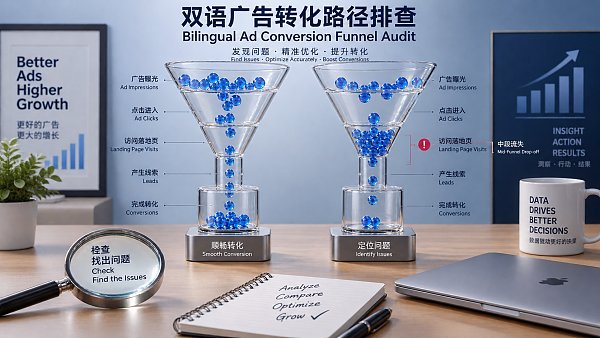
Users do not reach the page properly after clicking: Check page load speed, link redirects, automatic language switching, and mobile compatibility. Opening an English page from a French ad, or repeatedly redirecting users based on their browser language, can disrupt the browsing experience. Tracking blockers may also cause missing visit data, so verify what happens when the page is actually opened.
Users reach the page but rarely take action: Focus on whether the ad promise matches the above-the-fold content. If the ad emphasizes fast delivery but the page says nothing about lead times, or users search for a specific model but the page only presents a company introduction, they may leave at the first step.
Users start filling out a form or checking out but do not complete it: Check required fields, phone number formats, error messages, shipping costs, and payment methods. In particular, check whether error messages on the French page are still in English and whether validation accepts commonly used local addresses and phone numbers.
If visit and action rates are similar in both languages, and the gap mainly occurs at the submission or payment stage, fixing functionality and transaction terms is more targeted than rewriting the entire set of ads.
Check whether localization communicates clearly, not just whether the translation is correct
Grammatically correct copy does not necessarily match local users’ search habits. First check that search terms, ad headlines, and product names on the page use consistent industry terminology. Then make sure the call-to-action clearly tells users what will happen next.
For example, an inquiry page should explain what users will receive after submitting the form and what information they need to provide. If the page only says “Contact us” without providing lead times, minimum order quantities, service coverage, or after-sales information, users may leave because they lack the information they need to make a decision. Online stores should display currency, delivery coverage, taxes and fees, and return policies in appropriate places.
Localization reviews should cover ads, above-the-fold content, forms, error messages, and post-submission pages. Translating only the main copy while leaving English buttons or unsuitable delivery information can still hurt conversions. Coverage in existing markets must also be described accurately; copy must not promise service capabilities that are not yet available.
Make changes based on evidence, then verify the results
Document each issue as “problem area—possible cause—validation action.” For example, if the completion rate for French mobile forms is low, fix field validation first. If French search terms do not reflect purchase intent, adjust keywords and negative keywords first. Address one primary hypothesis in each round and keep a record of changes. Avoid changing audiences, bids, copy, and landing pages all at once, as that makes it difficult to identify the cause.
Whenever possible, test pages using the same language and similar traffic conditions. Do not use French traffic from France and English traffic from the United States to directly evaluate copy performance. When reviewing business results, track qualified inquiries, subsequent sales, or order profit in addition to submission rates to avoid getting “more conversions, but less value.”
If different teams manage the ads and website, align conversion definitions and change logs. 易营宝 offers services such as multilingual website development and overseas ad campaigns. An integrated solution of this kind can be considered to coordinate the investigation; when evaluating providers, focus on whether they can jointly review ad sources, page experience, and actual business results.
As a next step, export data for both ad groups over the same period and complete the conversion journey once in French and once in English. After identifying the first step where the gap becomes clear, decide whether to adjust tracking, traffic, copy, or the landing page.
Related Articles
 How Can You Exclude Existing Customers from Facebook Ad Retargeting?
 How can you evaluate a landing page agency's conversion tracking capabilities?
 How much does it cost to run Google paid ads in Japan?


Related Products
 Yiyingbao SaaS Intelligent Website Building and Marketing SystemYiyingbao SaaS Intelligent Website Building and Marketing System, AI-powered no-code website building, rapid creation of multilingual B2B international websites in 10 minutes, global server acceleration, AI-powered SEO optimization, helping businesses connect efficiently with global markets. The perfect integration of technology and operation makes building an international trade website remarkably simple
 AI+SEM Intelligent Advertising Marketing SystemAI+SEM drives intelligent ad creation, empowering full-funnel precision advertising marketing. The system automatically generates weekly/monthly reports, AI recommends keywords and target countries, monitors core metrics in real-time with intelligent alerts, and enables one-click high-conversion ad solutions to help quickly acquire customers and improve ROI.
 AI+SEO Dual-Engine System Optimization ServicesYiyingbao’s AI+SEO dual-engine optimization system helps foreign trade enterprises acquire high-quality organic traffic through AI-powered keyword research, content generation, and comprehensive technical optimization, significantly improving search rankings and conversion rates.
 AI+SNS Social Media Marketing SystemYingbao AI+SNS Social Media Marketing System - Precision social capture for the social media era. Supports one-click content synchronization across major platforms like Facebook and LinkedIn. AI intelligently rewrites posts for enhanced relevance. 24/7 AI customer service and user profiling analysis empower businesses to efficiently expand into global markets.
 AI+SEO营销解决方案易营宝AI+SEO营销解决方案,通过AI批量写作、智能生成TDK、精准关键词扩词等功能,全面优化网站SEO效果,提升流量与转化率。助力企业构建高效智能网站新生态。
 AI+SEM Advertising Marketing SolutionsAI+SEM Advertising Marketing Solution leverages AI technology to deeply empower SEM ad campaigns. It automatically generates weekly/monthly reports using AI, presenting account data across multiple dimensions for comprehensive insights into campaign performance and trends. The system precisely recommends keywords and target countries, intelligently generates high-conversion ad copy, and enables one-click activation of efficient campaign plans to help businesses rapidly acquire customers. Simultaneously, it monitors core metrics in real time, intelligently identifies abnormal fluctuations, and issues timely alerts to ensure stable, high-return advertising results.
 Domain Name ServicesEasyWin provides professional domain name services, including intelligent queries, one-stop registration, brand protection, and full lifecycle management, helping businesses build a digital brand image.
 EasyOperate B2C Cross-Border E-Commerce Platform & Independent WebsiteEasyStore B2C Cross-border E-commerce Independent Store is an intelligent website building and cross-border e-commerce integrated solution independently developed by EasyStore Information Technology (Beijing) Co., Ltd. The system is specially designed for small and medium-sized as well as large export enterprises, integrating 'website building, operation, marketing, advertising, and conversion' into one, helping enterprises quickly establish cross-border e-commerce independent stores to achieve brand globalization and global sales growth.
The platform supports multiple languages, multiple currencies, and multi-channel marketing, with built-in AI intelligent translation and SEO optimization systems, suitable for mainstream markets such as Southeast Asia, Europe and America, Latin America, and the Middle East, assisting Chinese manufacturing enterprises in efficiently deploying international e-commerce strategies. SSL证书易营宝提供专业SSL安全证书服务,包括单域名和泛域名证书,确保网站数据传输加密、身份验证和完整性保护,助力企业建立安全可信的在线业务环境。









