









- Which customer acquisition channels will be affected by cross-border marketing trends in 2026?Sep 06, 2026View details
- Which homogenization risks should be considered in an analysis of the AI-powered website building industry?Aug 30, 2026View details
- How Will AI Marketing Trends 2026 Change Advertising Budget AllocationAug 28, 2026View details
- Is the EV SSL certificate market shrinking or upgrading? How should companies assess certificate procurement?Aug 11, 2026View details
- Why the old AMP SEO 2020 practices no longer work and what has changed in current optimization prioritiesAug 02, 2026View details
- How to Choose Topics for an Industry News Section to Attract More Organic Search TrafficJul 29, 2026View details
- Digital Marketing Shenzhen Market Insights: Why Are Companies Expanding Overseas Looking for Growth Teams in Shenzhen?Jul 31, 2026View details
- Can Zhejiang foreign trade independent websites still be developed today? Look at changes in traffic and lead generationJul 28, 2026View details
Why does SSL certificate cost vary by validation method?
SSL certificate validation methods directly affect the cost of an SSL certificate. However, budgets should not be based solely on the annual fee shown on the purchase page: while all certificates enable HTTPS encryption, they differ in the identity verification, issuance process, deployment scope, and operational responsibilities involved. For businesses operating overseas corporate websites, independent sites, or advertising landing pages, purchasing an excessively advanced certificate can lead to long-term underuse, while purchasing one that is too basic may increase hidden costs in customer trust, renewal management, and multi-site expansion.
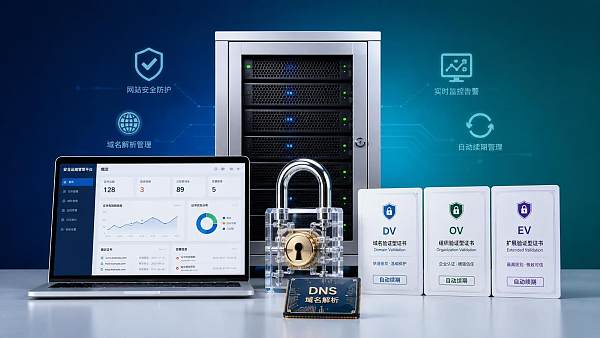
Here is a guideline that facilitates approval: if a website only needs to prove control of a domain name and does not handle transactions, member information, or highly sensitive operations, a domain validation certificate is usually sufficient. If the website needs to present a clear legal entity identity to visitors, or if the procurement process requires more complete audit records, then consider an organization validation or extended validation certificate. Validation levels are not "encryption strength levels"; they differ in "the depth to which the issuing authority verifies the identity of the applicant entity."
Why Validation Methods Affect SSL Certificate Costs
The most fundamental function of an SSL certificate is to encrypt data transmission between the browser and the website and enable the browser to confirm that visitors are connected to the corresponding domain name. This involves two types of work: one is verifying the applicant's control over the domain name, and the other is verifying whether the applicant entity is a real, identifiable organization. The former can be completed relatively quickly through DNS records, email, or website files; the latter requires the submission and verification of company information, contact details, and authorization relationships, increasing manual processing and review responsibilities.
Therefore, differences in certificate prices are not fundamentally about "how many lock icons" there are, nor do they mean that higher fees necessarily provide stronger encryption algorithms. Most mainstream certificates follow similar industry standards for transmission encryption. Price differences mainly arise from identity verification services, brand services, insurance or support terms, the number of domain names that can be covered, and the purchaser's requirements for risk documentation.
A common misunderstanding during approval is to regard DV, OV, and EV as three tiers of website security capability. In fact, defending against website attacks also depends on server patching, account permissions, WAF, backups, payment flows, and code security. SSL certificates address only part of the issues of transmission encryption and identity verification and cannot replace a complete security governance system. Upgrading solely because an "advanced certificate is safer" often does not correspond to the actual risks.
Assess Certificate Levels by Business Risk First
For multilingual corporate websites targeting overseas markets, where the main goals are to showcase products, receive form inquiries, and gain organic traffic, DV certificates usually meet the basic requirements for HTTPS, browser compatibility, and search engine crawling. Whether users trust a page is influenced more by the completeness of brand information, privacy policies, contact details, page loading quality, and content credibility than by the certificate validation type itself.
If a site is used for formal quotations, supplier portals, distributor logins, or file exchanges, the value of OV becomes clearer. It cannot eliminate fraud risks, but it allows verified organizational information to be displayed in the certificate details, which helps retain internal procurement documentation and is suitable for situations where the website entity needs to be confirmed in external cooperation.
EV is better suited to operations with clear identity verification requirements, rather than being considered a standard configuration for all online stores. How browsers present EV identity indicators may change, and visitors may not actively check certificate details. If the only reason for upgrading is the expectation of a significant increase in conversion, there is insufficient supporting evidence. If its purpose is to meet contractual, audit, brand protection, or stricter internal risk requirements, the budget is easier to justify.
Validation Type Is Often Not the Only Factor Affecting Total Cost
The quotation for a single certificate is easy to compare, but total cost of ownership is often underestimated. Before procurement, at least the following items should be included in the same budget sheet:
- Domain coverage: Whether to protect only one primary domain name or also cover www, multiple subdomains, and country-specific domains. A wildcard certificate can cover multiple subdomains at the same level, but it does not automatically cover all levels or all separate domain names.
- Multi-site architecture: If the brand website, online store, advertising landing pages, and help center are deployed on different platforms, it is necessary to clarify in advance whether certificate issuance, installation, and renewal responsibilities are centralized.
- Validity period and renewal: A certificate is not an asset that can be purchased once and left unmanaged for a long time. Changes to domain DNS, contacts, organizational information, or the server environment may affect renewal and replacement.
- Deployment support: Managed website-building platforms may already include automatic certificates and renewals; for self-hosted servers, the time costs of installation, monitoring, troubleshooting, and emergency replacement must be considered.
- Migration and ownership: Certificate accounts, private keys, and renewal notifications should remain under the enterprise's control to avoid being unable to update them promptly after changing website service providers.
In particular, businesses using intelligent website-building platforms, cross-border online stores, and advertising landing pages often update their sites frequently. In this case, whether certificates can be deployed and renewed automatically is usually more important than the annual price difference. Certificate expiration that triggers browser warnings can directly interrupt form submissions, payments, or advertising conversions; the cost of a single business interruption may exceed the difference in certificate procurement costs over many years.
Integrate Certificate Procurement into Website Operations Processes
In service systems such as Yiyingbao that cover intelligent website building, multilingual websites, cross-border online stores, SEO, and advertising landing pages, SSL should not be treated as a temporary technical configuration added before launch. Domain ownership, site environments, CDN configurations, redirect rules, and renewal alerts should form a traceable checklist. This can prevent validation failures caused by mixing old and new domain names and help control duplicate procurement when expanding into multiple national markets.
For organizations that need to incorporate security expenditures into standardized approval procedures, they can draw on the risk prevention approach emphasized in Research on the Development of Internal Control Systems for Public Institutions Based on Risk Prevention and Control: rather than looking only at the purchase amount, they should also clearly define who confirms the application, deployment, renewal, changes, and responsibility handovers. This approach does not limit certificate brands, but it can reduce management gaps such as "the certificate has been purchased but no one renews it" or "the service provider manages it on behalf of the company, but the company has no authority to handle it."
Use Four Questions Before Approval to Eliminate Unsuitable Options
- Does the website only display content, or does it collect customer information, accept orders, or allow account logins? Business risk determines whether stronger organizational identity verification is needed.
- Is HTTPS in the browser address bar already provided centrally by the website-building platform? If the platform already includes a trusted certificate and automatic updates, separate procurement may result in duplicate spending.
- How many subdomains, language sites, or campaign pages will be added in the coming year? If the domain structure is unclear, determine the architecture first before choosing a single-domain, multi-domain, or wildcard solution.
- When the certificate is nearing expiration, who can receive notifications and has the authority to complete the required actions? Without an assigned responsible person and permission arrangements, even high-level certificates can create operational risks.
Ultimately, an SSL certificate budget should match the website's actual use rather than simply pursuing the lowest cost of an SSL certificate or the highest validation level. First confirm whether the platform already provides a usable certificate, then determine the solution based on business data sensitivity, organizational identity display requirements, domain scale, and renewal management capabilities. This makes the procurement rationale clearer and aligns security investment more closely with actual value.
Related Articles



Related Products
 Yiyingbao SaaS Intelligent Website Building and Marketing SystemYiyingbao SaaS Intelligent Website Building and Marketing System, AI-powered no-code website building, rapid creation of multilingual B2B international websites in 10 minutes, global server acceleration, AI-powered SEO optimization, helping businesses connect efficiently with global markets. The perfect integration of technology and operation makes building an international trade website remarkably simple
 AI+SEM Intelligent Advertising Marketing SystemAI+SEM drives intelligent ad creation, empowering full-funnel precision advertising marketing. The system automatically generates weekly/monthly reports, AI recommends keywords and target countries, monitors core metrics in real-time with intelligent alerts, and enables one-click high-conversion ad solutions to help quickly acquire customers and improve ROI.
 AI+SEO Dual-Engine System Optimization ServicesYiyingbao’s AI+SEO dual-engine optimization system helps foreign trade enterprises acquire high-quality organic traffic through AI-powered keyword research, content generation, and comprehensive technical optimization, significantly improving search rankings and conversion rates.
 AI+SNS Social Media Marketing SystemYingbao AI+SNS Social Media Marketing System - Precision social capture for the social media era. Supports one-click content synchronization across major platforms like Facebook and LinkedIn. AI intelligently rewrites posts for enhanced relevance. 24/7 AI customer service and user profiling analysis empower businesses to efficiently expand into global markets.
 AI+SEO营销解决方案易营宝AI+SEO营销解决方案,通过AI批量写作、智能生成TDK、精准关键词扩词等功能,全面优化网站SEO效果,提升流量与转化率。助力企业构建高效智能网站新生态。
 AI+SEM Advertising Marketing SolutionsAI+SEM Advertising Marketing Solution leverages AI technology to deeply empower SEM ad campaigns. It automatically generates weekly/monthly reports using AI, presenting account data across multiple dimensions for comprehensive insights into campaign performance and trends. The system precisely recommends keywords and target countries, intelligently generates high-conversion ad copy, and enables one-click activation of efficient campaign plans to help businesses rapidly acquire customers. Simultaneously, it monitors core metrics in real time, intelligently identifies abnormal fluctuations, and issues timely alerts to ensure stable, high-return advertising results.
 Domain Name ServicesEasyWin provides professional domain name services, including intelligent queries, one-stop registration, brand protection, and full lifecycle management, helping businesses build a digital brand image.
 EasyOperate B2C Cross-Border E-Commerce Platform & Independent WebsiteEasyStore B2C Cross-border E-commerce Independent Store is an intelligent website building and cross-border e-commerce integrated solution independently developed by EasyStore Information Technology (Beijing) Co., Ltd. The system is specially designed for small and medium-sized as well as large export enterprises, integrating 'website building, operation, marketing, advertising, and conversion' into one, helping enterprises quickly establish cross-border e-commerce independent stores to achieve brand globalization and global sales growth.
The platform supports multiple languages, multiple currencies, and multi-channel marketing, with built-in AI intelligent translation and SEO optimization systems, suitable for mainstream markets such as Southeast Asia, Europe and America, Latin America, and the Middle East, assisting Chinese manufacturing enterprises in efficiently deploying international e-commerce strategies. SSL证书易营宝提供专业SSL安全证书服务,包括单域名和泛域名证书,确保网站数据传输加密、身份验证和完整性保护,助力企业建立安全可信的在线业务环境。









