









- Can the average annual growth rate reflect real opportunities in overseas markets?Oct 07, 2026View details
- Which customer acquisition channels will be affected by cross-border marketing trends in 2026?Sep 06, 2026View details
- Which homogenization risks should be considered in an analysis of the AI-powered website building industry?Aug 30, 2026View details
- How Will AI Marketing Trends 2026 Change Advertising Budget AllocationAug 28, 2026View details
- Is the EV SSL certificate market shrinking or upgrading? How should companies assess certificate procurement?Aug 11, 2026View details
- Why the old AMP SEO 2020 practices no longer work and what has changed in current optimization prioritiesAug 02, 2026View details
Which customer acquisition channels will be affected by cross-border marketing trends in 2026?
In 2026, cross-border customer acquisition channels will not simply replace old ones with new ones. Search will still capture high-intent demand, advertising will still be suitable for rapid market testing, and social media will remain an important space for building trust and expanding reach. What is changing is that the path customers take to discover brands, validate suppliers, and submit inquiries is becoming shorter and more fragmented. For business decision-makers, the question is no longer whether to use a particular channel, but whether their existing website, content, and data capabilities can support search, social media, advertising, and AI entry points working together.
If companies still regard their independent websites as advertising landing pages, SEO as a simple ranking project, and social media as a content publishing channel, customer acquisition efficiency in 2026 will likely continue to be dragged down by traffic costs and lead quality. Changes in channels will ultimately return to a fundamental question: whether a company can continuously provide credible, searchable, understandable, and convertible product and service information.
Search traffic will not disappear, but being clicked is no longer the only outcome
Traditional search remains highly valuable, especially for B2B procurement queries with clear intent related to specifications, applications, certifications, lead times, and supplier selection. When procurement professionals search for equipment, components, or solutions, they often still need to visit an official website to verify company capabilities, product details, and contact options. For manufacturers and foreign trade companies, creating indexable content around specific product categories, application industries, and technical issues remains the foundation of long-term customer acquisition.
However, search results pages are now providing answers to more information needs. Users may first obtain an initial assessment through summaries, Q&A modules, or AI-generated results before deciding whether to visit a website. This may reduce clicks for some broad informational keywords, but it will amplify the impact of brand content quality: whether content clearly answers questions, whether product pages include structured information on specifications, applicable scope, materials, delivery, and services, and whether the website enables search systems to accurately understand what the company offers will all affect subsequent visibility.
Therefore, the focus of SEO will shift from “how many keywords are covered” to “whether key decision-making questions are addressed.” Rather than stacking similar product descriptions, companies should prioritize organizing the information customers repeatedly confirm before submitting an inquiry, such as how to select a product model, configuration differences under different operating conditions, common technical misunderstandings during procurement, and what needs to be confirmed for samples and bulk delivery. Such website content can serve organic search while also becoming credible assets repeatedly used by sales, advertising, and social media.
AI search entry points will change how content is organized, rather than replace official websites
Generative search and AI Q&A are entering the information-gathering process of overseas users and are particularly suitable for handling questions that require summarized comparisons, such as “how to choose suppliers in a certain category” or “whether a particular solution is suitable for a certain market.” Companies should not regard GEO as another keyword ranking game. When AI systems cite, summarize, or recommend information, they rely more on whether the content has clear entity descriptions, logical boundaries, and verifiable details.
This places more specific requirements on websites. Company introductions cannot remain limited to brand slogans; product pages cannot contain only renderings and broad selling points; and multilingual pages cannot be merely mechanical translations. Every important page should enable both visitors and machines to answer several basic questions: What is this product or service? Who is it for? What problem does it solve? What are its core specifications or limitations? What support does the company provide? How can users contact the company or obtain materials next?
Take an automotive brand’s corporate portal as an example. Users often cross-check design preferences, performance specifications, vehicle configurations, real-world user reviews, and service networks. When product stories, overhead details, technical specifications, tabbed galleries, and social media interactions are scattered across unrelated pages, both search performance and conversion lose context. For high-decision-cost products such as automobiles, visual presentations need to form a continuous narrative together with specifications, scenarios, and calls to action. The same logic applies to industrial equipment, customized components, and cross-border consumer brands.

The role of paid advertising will shift more toward validation and amplification
Rising advertising budgets do not necessarily mean that market opportunities are growing; they may simply indicate that competition has become more crowded. By 2026, the value of Google Ads, social media advertising, and remarketing will be concentrated more on three areas: rapidly validating whether demand exists in a particular country or segment, amplifying product pages and content topics that have already proven effective, and bringing unconverted visitors back to more suitable decision-making pages.
For many companies, the issue with campaign delivery is not account operation, but a mismatch between advertising landing pages and target audiences. Ads targeting engineering procurement that lead to a homepage containing only brand imagery usually make leads difficult to qualify. Ads targeting distributors or retail consumers that display only complex technical materials can likewise reduce willingness to take action. After an ad click, the page must deliver the information promised by the ad: country or language, product use, core differences, supporting evidence, and inquiry method. A missing item may cause the budget to remain limited to generating visits.
A more practical standard can be used to evaluate advertising during decision-making: whether it helps the company obtain reusable market insights. If an ad group consistently brings similar visits and similar inquiries, the company should incorporate the questions raised, specifications of concern, and regional differences into its website content. If there are many clicks but no meaningful conversations, it should also review whether there are gaps in audience definition, price expectations, product fit, and page information. Advertising should not bear the customer acquisition task alone; it is better suited to become the fastest layer of market feedback.
Social media is evolving from an “exposure channel” into a trust-validation touchpoint
For B2B businesses, overseas social media usually means more than directly acquiring form submissions. After finding a company through search, buyers, partners, or potential employees often further review whether its social media accounts are continuously updated, display real products and applications, and respond to industry topics. For businesses with long sales cycles, products requiring explanation, or needs for local partnership support, this validation directly affects initial trust.
Short videos, product demonstrations, process clips, before-and-after application comparisons, and professional perspectives from the team are suitable for building specific awareness on social media. Complete specifications, case-study logic, downloadable materials, and inquiry paths should still return to the corporate website. The two serve different functions. If all content remains on social media platforms, companies will find it difficult to accumulate searchable and retainable owned assets; if they maintain only their official website without external interaction, their brands can easily appear lacking in updates and real-world presence.
- Companies with complex products and high average order values should prioritize using social media to explain applications, demonstrate details, and continue communication, rather than only pursuing view counts.
- Brands targeting multiple national markets should distinguish the language, aesthetic preferences, and content taboos of core markets, rather than using one version for all regions.
- Social media traffic landing pages should include clear next actions, such as obtaining specification sheets, scheduling a consultation, or viewing product lines, rather than sending visitors back to the homepage.
For channel coordination, first assess whether the website can serve as a unified destination
The pressure created by cross-border marketing trends is essentially the fragmentation of the customer acquisition journey: users may arrive through search, AI Q&A, video, advertising, or peer recommendations, yet expect to determine within a short time whether a company is worth contacting. If companies separately procure website development, SEO, advertising, and social media services, while their pages, content, lead tags, and data standards are disconnected, management costs often rise as more channels are added.
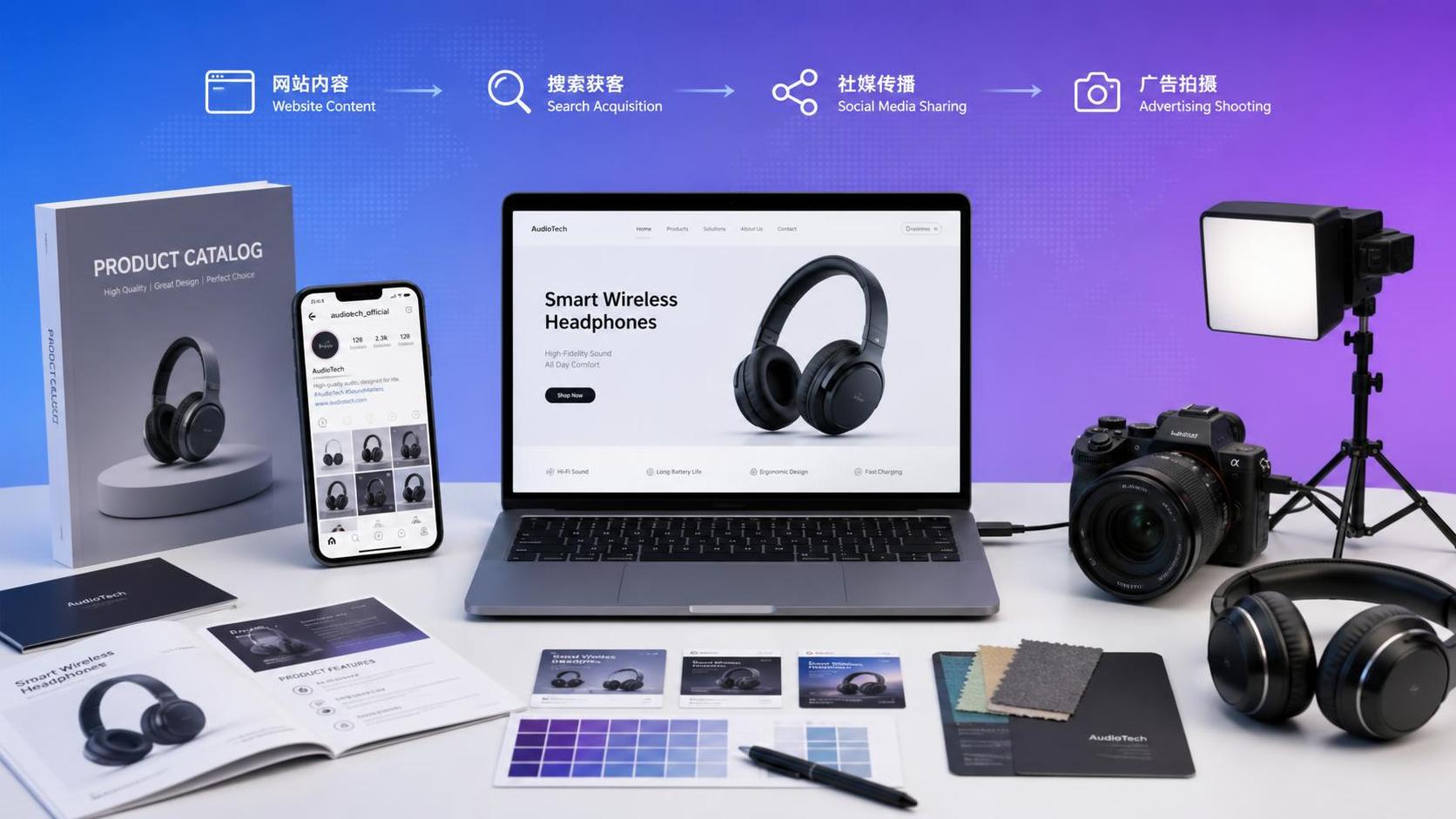
A practice better suited to the pace of 2026 is to first identify high-value markets and core customer types, then build websites and content around their decision-making processes: search captures active demand, AI visibility expands the opportunities for information to be discovered, advertising tests and accelerates, and social media builds and sustains trust. Companies can then use unified lead standards to determine which sources generate qualified business opportunities, rather than comparing only clicks, followers, or form submission volumes.
No channel is a universal solution. For companies that already have stable organic traffic, prioritizing AI-readable content and conversion pages is often more valuable than blindly expanding volume. For companies entering new markets, advertising and localized content can be invested in earlier. For complex B2B businesses, product information, technical proof, and post-inquiry responsiveness will always have a greater impact on customer acquisition quality than short-term metrics from a single channel.
Related Articles


Related Products
 Yiyingbao SaaS Intelligent Website Building and Marketing SystemYiyingbao SaaS Intelligent Website Building and Marketing System, AI-powered no-code website building, rapid creation of multilingual B2B international websites in 10 minutes, global server acceleration, AI-powered SEO optimization, helping businesses connect efficiently with global markets. The perfect integration of technology and operation makes building an international trade website remarkably simple
 AI+SEM Intelligent Advertising Marketing SystemAI+SEM drives intelligent ad creation, empowering full-funnel precision advertising marketing. The system automatically generates weekly/monthly reports, AI recommends keywords and target countries, monitors core metrics in real-time with intelligent alerts, and enables one-click high-conversion ad solutions to help quickly acquire customers and improve ROI.
 AI+SEO Dual-Engine System Optimization ServicesYiyingbao’s AI+SEO dual-engine optimization system helps foreign trade enterprises acquire high-quality organic traffic through AI-powered keyword research, content generation, and comprehensive technical optimization, significantly improving search rankings and conversion rates.
 AI+SNS Social Media Marketing SystemYingbao AI+SNS Social Media Marketing System - Precision social capture for the social media era. Supports one-click content synchronization across major platforms like Facebook and LinkedIn. AI intelligently rewrites posts for enhanced relevance. 24/7 AI customer service and user profiling analysis empower businesses to efficiently expand into global markets.
 AI+SEO营销解决方案易营宝AI+SEO营销解决方案,通过AI批量写作、智能生成TDK、精准关键词扩词等功能,全面优化网站SEO效果,提升流量与转化率。助力企业构建高效智能网站新生态。
 AI+SEM Advertising Marketing SolutionsAI+SEM Advertising Marketing Solution leverages AI technology to deeply empower SEM ad campaigns. It automatically generates weekly/monthly reports using AI, presenting account data across multiple dimensions for comprehensive insights into campaign performance and trends. The system precisely recommends keywords and target countries, intelligently generates high-conversion ad copy, and enables one-click activation of efficient campaign plans to help businesses rapidly acquire customers. Simultaneously, it monitors core metrics in real time, intelligently identifies abnormal fluctuations, and issues timely alerts to ensure stable, high-return advertising results.
 Domain Name ServicesEasyWin provides professional domain name services, including intelligent queries, one-stop registration, brand protection, and full lifecycle management, helping businesses build a digital brand image.
 EasyOperate B2C Cross-Border E-Commerce Platform & Independent WebsiteEasyStore B2C Cross-border E-commerce Independent Store is an intelligent website building and cross-border e-commerce integrated solution independently developed by EasyStore Information Technology (Beijing) Co., Ltd. The system is specially designed for small and medium-sized as well as large export enterprises, integrating 'website building, operation, marketing, advertising, and conversion' into one, helping enterprises quickly establish cross-border e-commerce independent stores to achieve brand globalization and global sales growth.
The platform supports multiple languages, multiple currencies, and multi-channel marketing, with built-in AI intelligent translation and SEO optimization systems, suitable for mainstream markets such as Southeast Asia, Europe and America, Latin America, and the Middle East, assisting Chinese manufacturing enterprises in efficiently deploying international e-commerce strategies. SSL证书易营宝提供专业SSL安全证书服务,包括单域名和泛域名证书,确保网站数据传输加密、身份验证和完整性保护,助力企业建立安全可信的在线业务环境。









