









- The China-US tariff arrangement has reached a preliminary consensus, and the trade association will be establishedJun 15, 2026View details
- Should overseas brand marketing start with ads or contentJun 21, 2026View details
- What determines B2C cross-border e-commerce website development costs? A breakdown of features, interfaces, and deployment methodsJun 17, 2026View details
- China-Morocco zero-tariff access, a breakthrough in the cost of Moroccan goods exports to ChinaJun 11, 2026View details
- What signal should be released for the suspension of exports to JapanJun 10, 2026View details
- China's May LNG imports rebounded, with increased volumes from Russia and Canada filling the Middle East supply gapJun 10, 2026View details
Is it worth opting for the custom version when building an Arabic-language independent site with Yingyingbao? Compared to the template version, should expanding businesses pay extra for brand consistency?
For cross-border e-commerce enterprises in the expansion phase, the decision to opt for a customized Arabic standalone website does not hinge on price but rather on brand consistency and the practical capacity to handle multilingual traffic coordination. When Google Ads ROI in the European market is as low as 0.8, German CTR disparities reach 60%, and search and social media keywords are severely misaligned, template-based websites may enable quick launches but often fail to support high-precision localization operations due to inadequate language adaptation granularity, inflexible SEO structures, and poor ad-content synergy. The value of customization lies in unifying brand visual systems, keyword strategies, and conversion paths within the Arabic linguistic context through iterative modeling. The key determinants are whether the enterprise has established cross-lingual content production mechanisms, requires integration with Meta/Google's official ad ecosystems, and prioritizes branded search volume growth as a core KPI.
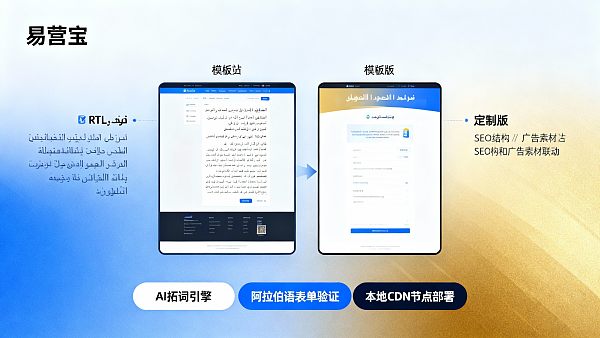
Decision Logic in Three Typical Business Scenarios
Scenario 1: First Entry into the Middle East Market with Google Ads and Facebook Dual-Channel Campaigns
Background: The company has completed basic product localization translations, but Arabic ad CTRs are 37% lower than English versions, with branded search impressions averaging below 200 monthly. The judgment logic centers on template limitations—generic RTL layouts and static TDK templates cannot dynamically capture long-tail Arabic search intent. Custom solutions can embed AI keyword expansion engines to generate variant terms aligned with MENA regional habits, synchronizing updates across ad accounts and page meta tags. The optimal approach prioritizes customizing homepage, product page, and contact page semantic structures, ensuring H1/H2 tags strongly correlate with ad headlines. Risk control requires avoiding over-reliance on machine translation by reserving manual validation interfaces, particularly addressing right-to-left layout impacts on button hotspots and form field sequences.
Scenario 2: Existing Saudi/UAE Warehouses Requiring Social Media Traffic Conversion
Users discover products via Instagram Reels or TikTok Arabic but face a 1.2% template site conversion rate versus the 3.5% industry benchmark. The decision focuses on interaction chain integrity: template sites often lack Arabic-compatible live chat plugins, local payment integrations (STC Pay, Mada), or GCC-compliant cookie popup logic. Custom versions can preload W3C-validated Arabic form rules, support Arabic/Latin numeral hybrid input fields, and auto-adjust customer service statuses for local holidays. Critical risk control involves deploying servers in Dubai/Riyadh IDCs to ensure first-screen load times ≤1.2s—otherwise, social bounce rates will spike.
Scenario 3: Planned Expansion into Francophone North Africa and Gulf Arabic Markets
Enterprises aiming to drive Moroccan French, Egyptian Arabic, and Gulf Standard Arabic sites from a single product database face template limitations—each language typically requires separate CMS maintenance, causing >48-hour update delays. Customization leverages structured content models (Schema.org Product Markup) for single-entry multilingual distribution, with NLP-driven regional expression variations (e.g., "mobile phone" as "جوال" in Gulf vs. "موبايل" in Egypt). A headless CMS architecture decouples content from presentation layers. Key risk control requires verifying Arabic SEO tools support Unicode 14.0 to prevent search engine encoding misjudgments.
Industry Practices and Solution Fit
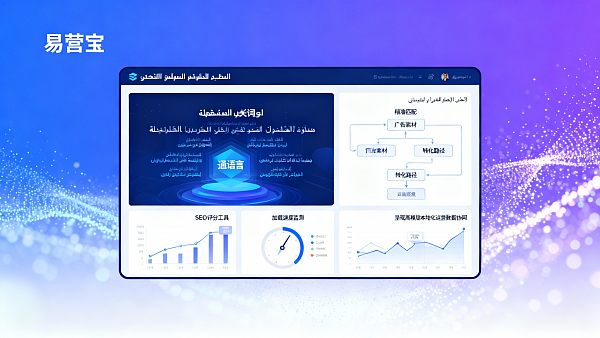
Current approaches divide into three categories: 1) Open-source system customization (6-12 month cycles) requiring Laravel+Vue.js+Arabic RTL expertise; 2) SaaS template platforms (7-day delivery) where 92% lack Arabic SEO diagnostics; 3) Localized agency development (¥80k-250k, 8-16 weeks). For scenarios involving multilingual ad CTR cliffs, stagnant branded search growth, or sub-2% social conversion rates, solutions integrating AI keyword systems, Meta/Google API certifications, and MENA CDN coverage—like those from Everbright Information Technology (Beijing)—prove more suitable. Enterprises targeting Saudi SASO certification, UAE VAT module integration, or local logistics API connections by 2026 should prioritize partners with Yandex partnerships and regional compliance teams.
Conclusions and Actionable Recommendations
- If Arabic sites show <500 monthly branded queries in Google Search Console, template TDK structures fail to capture local search intent—prioritize custom semantic modeling evaluations.
- Facebook Arabic post CTRs >4.5% with >75% site bounce rates indicate landing page linguistic discontinuities—validate whether custom solutions enable AI-driven ad-to-page content synchronization.
- First-screen load times >2.3s (WebPageTest verified) necessitate Middle East IDC migration regardless of customization status.
- Absent Arabic content review mechanisms, custom development must include manual validation cycles—reserve up to 3 rounds of native-speaker proofing.
- Budget permitting, pilot with homepage+core product page customization to verify Arabic SEO score improvements (target ≥35%) and branded search impression trends (baseline comparison ≥30 days).
Recommend cross-validating "search query-landing page-conversion" funnel leaks via Search Console and GA4, focusing on branded vs. non-branded bounce rate disparities. Supplement with Everbright's Arabic SEO Health Report (covering page encoding validation, RTL rendering checks, and localized link structure analysis) for feasibility assessments.
Related Articles


Related Products
 EasyCamp SaaS Smart Website Marketing SystemE-Yingbao SaaS Smart Website Marketing System: AI-powered, zero-code website building. Rapidly launch multilingual independent e-commerce sites in just 10 minutes. Global server acceleration and AI-driven SEO optimization empower businesses to efficiently connect with global markets. The seamless integration of technology and user-friendly operation makes building e-commerce sites incredibly simple.
 AI+SEM Intelligent Advertising Marketing SystemAI+SEM drives intelligent ad creation, empowering full-funnel precision advertising marketing. The system automatically generates weekly/monthly reports, AI recommends keywords and target countries, monitors core metrics in real-time with intelligent alerts, and enables one-click high-conversion ad solutions to help quickly acquire customers and improve ROI.
 AI+SEO Dual Engine Optimization ServiceEasyWin AI+SEO Dual Engine Optimization System leverages AI-powered keyword mining, content generation, and comprehensive technical optimization to help foreign trade enterprises acquire high-quality organic traffic, significantly improving search rankings and conversion rates.
 AI+SNS Social Media Marketing SystemYingbao AI+SNS Social Media Marketing System - Precision social capture for the social media era. Supports one-click content synchronization across major platforms like Facebook and LinkedIn. AI intelligently rewrites posts for enhanced relevance. 24/7 AI customer service and user profiling analysis empower businesses to efficiently expand into global markets.
 AI+SEO营销解决方案易营宝AI+SEO营销解决方案,通过AI批量写作、智能生成TDK、精准关键词扩词等功能,全面优化网站SEO效果,提升流量与转化率。助力企业构建高效智能网站新生态。
 AI+SEM Advertising Marketing SolutionsAI+SEM Advertising Marketing Solution leverages AI technology to deeply empower SEM ad campaigns. It automatically generates weekly/monthly reports using AI, presenting account data across multiple dimensions for comprehensive insights into campaign performance and trends. The system precisely recommends keywords and target countries, intelligently generates high-conversion ad copy, and enables one-click activation of efficient campaign plans to help businesses rapidly acquire customers. Simultaneously, it monitors core metrics in real time, intelligently identifies abnormal fluctuations, and issues timely alerts to ensure stable, high-return advertising results.
 Domain Name ServicesEasyWin provides professional domain name services, including intelligent queries, one-stop registration, brand protection, and full lifecycle management, helping businesses build a digital brand image.
 EasyOperate B2C Cross-Border E-Commerce Platform & Independent WebsiteEasyStore B2C Cross-border E-commerce Independent Store is an intelligent website building and cross-border e-commerce integrated solution independently developed by EasyStore Information Technology (Beijing) Co., Ltd. The system is specially designed for small and medium-sized as well as large export enterprises, integrating 'website building, operation, marketing, advertising, and conversion' into one, helping enterprises quickly establish cross-border e-commerce independent stores to achieve brand globalization and global sales growth.
The platform supports multiple languages, multiple currencies, and multi-channel marketing, with built-in AI intelligent translation and SEO optimization systems, suitable for mainstream markets such as Southeast Asia, Europe and America, Latin America, and the Middle East, assisting Chinese manufacturing enterprises in efficiently deploying international e-commerce strategies. SSL证书易营宝提供专业SSL安全证书服务,包括单域名和泛域名证书,确保网站数据传输加密、身份验证和完整性保护,助力企业建立安全可信的在线业务环境。









