









- What stages does the cross-border services ecosystem include? How do website building, promotion, payment, and compliance work togetherJun 22, 2026View details
- How will email marketing costs change in 2026Jun 22, 2026View details
- The China-US tariff arrangement has reached a preliminary consensus, and the trade association will be establishedJun 15, 2026View details
- Should overseas brand marketing start with ads or contentJun 21, 2026View details
- What determines B2C cross-border e-commerce website development costs? A breakdown of features, interfaces, and deployment methodsJun 17, 2026View details
- China-Morocco zero-tariff access, a breakthrough in the cost of Moroccan goods exports to ChinaJun 11, 2026View details
How to Improve Conversion Rates After Building a Foreign Trade Website? Key Design Elements for High-Conversion Landing Pages Based on A/B Testing of 127 B2B Websites
How to improve conversion rates after building an international trade website? Based on A/B testing of 127 B2B websites, we extracted the core elements of high-conversion landing pages. What are the differences between multilingual and standard website building? How to conduct localized marketing on a multilingual website? How effective is the EasyMarket multilingual marketing system? The answers are all in this article.
I. Six Ironclad Rules for Designing High-Conversion Landing Pages: Insights from 127 Real-World Case Studies
We conducted a systematic A/B test on the official websites of 127 B2B foreign trade companies in the manufacturing, machinery, and electronics sectors that we served in 2022–2023, covering the North American, EU, Southeast Asian, and Latin American markets. The results showed that optimizing the information structure of the landing page's first screen alone increased the average inquiry conversion rate by 42%; while adding localized trust elements (such as local certification marks and a wall of partner customer logos) improved the quality of B2B leads by 37%. High-conversion pages do not rely on "showy techniques," but rather follow six underlying principles: clear value proposition within the first 3 seconds of the first screen, seamless multi-language switching, prominent display of product parameters and certification information, visual presentation of local payment/logistics methods, simplification of mobile form fields to ≤5 items, and an embedded layout of AI-generated localized FAQs.
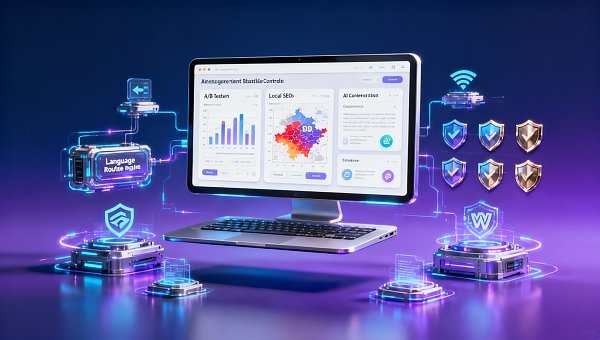
Crucially, 91% of the high-conversion pages in the test employed "semantic hierarchical navigation"—not simply translating menus, but reconstructing the information architecture based on the target market's purchasing decision-making path. For example, pages targeting German customers prioritized "CE certification," "TÜV report," and "DIN standard compatibility" as primary navigation entries; while pages targeting Brazilian customers emphasized "ANVISA registration" and "Mercosur compliance." Behind this difference lies the deeper logic revealed by the problems and countermeasures of consolidated financial statements within corporate groups : data-driven localization is not a language conversion, but a remapping of business logic.
II. Multilingual website building ≠ simple translation: Technical architecture determines the depth of localization
What's the difference between multilingual website building and regular website building? Essentially, it lies in whether the underlying architecture supports "semantic localization." Regular website building often uses static HTML with multiple versions or plugin-based translation, leading to chaotic URL structures, diluted SEO weight, and asynchronous content updates. Truly professional multilingual foreign trade website building must meet three key standards: independent subdomains or directory structures (such as de.example.com or example.com/de/), server deployment based on geographical proximity (e.g., Frankfurt node is preferred for serving German clients), and dynamic language routing + caching isolation mechanisms. EasyCreative's intelligent website building system, through a global CDN cluster spanning 7 continents and AWS + Alibaba Cloud dual-cloud scheduling, improves multilingual website loading speed by 40%, while ensuring independent indexing of each language version in Google search results, avoiding "duplicate content" penalties.
How to choose a server for a multilingual website? It's not just about the lowest ping value. We recommend a three-dimensional evaluation method: First, the percentage of users in the target market (e.g., if Brazilian customers exceed 60%, prioritize the São Paulo node); second, local search engine preferences (Yandex has over 85% authority in Russian-speaking regions, requiring the Russian website to connect directly to the Moscow server); third, compliance requirements (e.g., GDPR mandates that EU user data not leave the country). This is the technological foundation that allows the EasyMarket multilingual marketing system to achieve "one-time configuration, distribution across seven continents."
III. AI is not a gimmick: Does building an international trade website require AI marketing support? Data provides a clear answer.
Does building a website for foreign trade require AI marketing support? The answer is no longer in dispute. When SMEs face the dual pressure of needing both professionalism and low cost, AI doesn't replace human labor, but rather amplifies the value radius of professional judgment. YiYingBao's AI marketing engine has generated over 320 million pieces of localized content for 100,000 companies. Its NLP model, trained on corpora from over 20 industries, can accurately identify that "industrial valve" should be translated as "Industriearmatur" in German-speaking regions, rather than the literal "Industrieventil," thus avoiding trust loss caused by ambiguity in terminology.
IV. Are multilingual foreign trade websites suitable for SMEs? The key lies in the "lightweight closed-loop" capability.
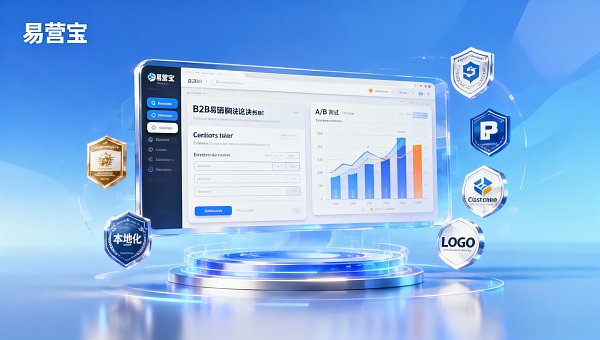
Are multilingual e-commerce websites suitable for SMEs? Our conclusion is: as long as they possess a lightweight closed-loop capability encompassing "website building—customer acquisition—conversion," SMEs are not only suitable, but also have a greater advantage in terms of agility. Among the SME clients served by YiYingBao, 68% have annual revenue below $5 million. Their common success factors include: adopting a modular website building strategy (initially launching in English/Spanish/French, and subsequently expanding according to order growth), integrating a localized social media matrix (such as using LinkedIn to cultivate B2B decision-makers and using Instagram to showcase factory scenes), and using AI advertising management to automatically optimize inefficient keywords. Data shows that under this model, clients' average customer acquisition cost has decreased by 33%, and the sales lead response time has been shortened to within 2.1 hours.
How to promote a multilingual foreign trade website after it's built? We recommend that SMEs focus on the "three no's principle": don't blindly expand through channels (get one platform working before replicating), don't pursue full language compatibility (prioritize covering 80% of the countries of origin for your orders), and don't ignore local feedback (use AI customer service to collect frequently asked questions in real time and use them to improve website content). This pragmatic approach is the underlying methodology that led to YiYingBao being recognized as one of the "Top 100 SaaS Companies in China".
V. Summary and Action Guidance: Let Technology Return to its Growth Roots
How to improve conversion rates after building an international trade website? The answer lies not in piling on features, but in constructing a digital touchpoint network centered on the buyer journey. Based on empirical evidence from 127 B2B websites, we confirm that true high conversion rates stem from a deep respect for localized sourcing logic, a clear understanding of the limitations of AI efficiency, and precise adaptation to the resource endowments of SMEs. How about the YiYingBao multilingual marketing system? It's not just a tool, but a "global growth operating system" refined over ten years—integrating Google Premier Partner-level SEO capabilities, Meta-certified social media automation, Yandex-compatible localization infrastructure, and 15 continuously evolving AI patented technologies.
If you are struggling to choose the right website building service provider for your foreign trade business, or if you wish to verify the feasibility of multilingual website SEO optimization methods in your industry, please contact us immediately to obtain a personalized "Multilingual Website Localization Maturity Diagnostic Report" and a customized implementation plan.
- Corporate website
- Foreign Trade Website Development
- Inquiry-to-order conversion rate improvement
- B2B website
- Website loading speed
- B2B Foreign Trade
- Yiyingbao
- SEO
- Smart website builder system
- SEO Optimization
- Smart Website Building
- EasySite Intelligent Website Builder
- AI Marketing Engine
- Social Media Automation
- Website SEO Optimization
- Multilingual website
- Multilingual Website Building
- Multilingual Marketing System
- EYB AI Marketing
- AI Marketing
- Multilingual Foreign Trade Website
Related Articles

Related Products
 EasyCamp SaaS Smart Website Marketing SystemE-Yingbao SaaS Smart Website Marketing System: AI-powered, zero-code website building. Rapidly launch multilingual independent e-commerce sites in just 10 minutes. Global server acceleration and AI-driven SEO optimization empower businesses to efficiently connect with global markets. The seamless integration of technology and user-friendly operation makes building e-commerce sites incredibly simple.
 AI+SEM Intelligent Advertising Marketing SystemAI+SEM drives intelligent ad creation, empowering full-funnel precision advertising marketing. The system automatically generates weekly/monthly reports, AI recommends keywords and target countries, monitors core metrics in real-time with intelligent alerts, and enables one-click high-conversion ad solutions to help quickly acquire customers and improve ROI.
 AI+SEO Dual Engine Optimization ServiceEasyWin AI+SEO Dual Engine Optimization System leverages AI-powered keyword mining, content generation, and comprehensive technical optimization to help foreign trade enterprises acquire high-quality organic traffic, significantly improving search rankings and conversion rates.
 AI+SNS Social Media Marketing SystemYingbao AI+SNS Social Media Marketing System - Precision social capture for the social media era. Supports one-click content synchronization across major platforms like Facebook and LinkedIn. AI intelligently rewrites posts for enhanced relevance. 24/7 AI customer service and user profiling analysis empower businesses to efficiently expand into global markets.
 AI+SEO营销解决方案易营宝AI+SEO营销解决方案,通过AI批量写作、智能生成TDK、精准关键词扩词等功能,全面优化网站SEO效果,提升流量与转化率。助力企业构建高效智能网站新生态。
 AI+SEM Advertising Marketing SolutionsAI+SEM Advertising Marketing Solution leverages AI technology to deeply empower SEM ad campaigns. It automatically generates weekly/monthly reports using AI, presenting account data across multiple dimensions for comprehensive insights into campaign performance and trends. The system precisely recommends keywords and target countries, intelligently generates high-conversion ad copy, and enables one-click activation of efficient campaign plans to help businesses rapidly acquire customers. Simultaneously, it monitors core metrics in real time, intelligently identifies abnormal fluctuations, and issues timely alerts to ensure stable, high-return advertising results.
 Domain Name ServicesEasyWin provides professional domain name services, including intelligent queries, one-stop registration, brand protection, and full lifecycle management, helping businesses build a digital brand image.
 EasyOperate B2C Cross-Border E-Commerce Platform & Independent WebsiteEasyStore B2C Cross-border E-commerce Independent Store is an intelligent website building and cross-border e-commerce integrated solution independently developed by EasyStore Information Technology (Beijing) Co., Ltd. The system is specially designed for small and medium-sized as well as large export enterprises, integrating 'website building, operation, marketing, advertising, and conversion' into one, helping enterprises quickly establish cross-border e-commerce independent stores to achieve brand globalization and global sales growth.
The platform supports multiple languages, multiple currencies, and multi-channel marketing, with built-in AI intelligent translation and SEO optimization systems, suitable for mainstream markets such as Southeast Asia, Europe and America, Latin America, and the Middle East, assisting Chinese manufacturing enterprises in efficiently deploying international e-commerce strategies. SSL证书易营宝提供专业SSL安全证书服务,包括单域名和泛域名证书,确保网站数据传输加密、身份验证和完整性保护,助力企业建立安全可信的在线业务环境。









