









- What stages does the cross-border services ecosystem include? How do website building, promotion, payment, and compliance work togetherJun 22, 2026View details
- How will email marketing costs change in 2026Jun 22, 2026View details
- The China-US tariff arrangement has reached a preliminary consensus, and the trade association will be establishedJun 15, 2026View details
- Should overseas brand marketing start with ads or contentJun 21, 2026View details
- What determines B2C cross-border e-commerce website development costs? A breakdown of features, interfaces, and deployment methodsJun 17, 2026View details
- China-Morocco zero-tariff access, a breakthrough in the cost of Moroccan goods exports to ChinaJun 11, 2026View details
Essential Reading for Education Industry Global Expansion: How to Synchronize Multilingual Website Development with MOOC Platforms, Bilingual Certificate Downloads, and Local Credit Certification Interfaces?
Educational institutions going global face core challenges such as MOOC platform integration, bilingual certificate downloads, and local credit recognition? Multilingual website construction is the key to breaking the deadlock! EasyWin offers high-conversion Portuguese/Arabic independent website development, Google ranking optimization, and full-chain SEO services, empowering educational brands to efficiently penetrate global markets.
Three Technical Bottlenecks in Global Education Expansion: How to Integrate MOOCs, Certificates, and Credits?
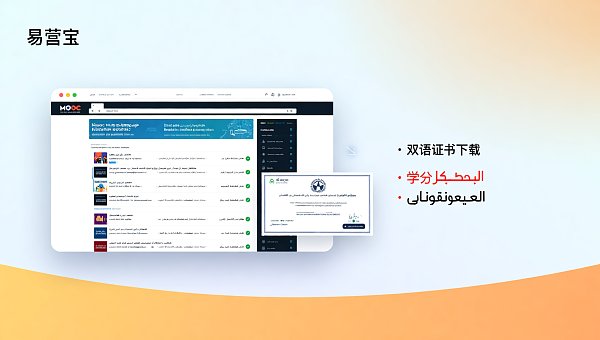
When Chinese universities, vocational training institutions, and K-12 edtech companies expand overseas, users' most frequent concerns aren't "course quality" but "Can it integrate with my university system?" "Will certificates be recognized by Brazil's Ministry of Education?" "Do MOOC platforms support Arabic subtitles and synchronized learning paths?"—These aren't simple translation issues but complex projects involving API-level system integration, multilingual content structured management, and local educational compliance adaptation.
Take the Middle East as an example: Saudi Arabia's SABIS Education Group requires all partner websites to pass NEOM digital education certification and forcibly connects to its credit transfer middleware. Portuguese-speaking markets universally rely on DGES (Portuguese Directorate-General for Higher Education) for degree validation. Static pages + manual translation not only fail to trigger automated certification processes but also cause Google crawlers to significantly downgrade indexing due to structural deficiencies.
Why Do Traditional Website Solutions Frequently Fail in Global Education Expansion?
Currently, 68% of "multilingual website construction" service providers still use CMS plugin translations or manually upload HTML copies. These solutions have three fatal flaws in education: First, MOOC platforms require real-time course status synchronization (e.g., "completed," "pending exam"), which static pages cannot support with dynamic JSON-LD Schema structures. Second, bilingual certificate PDF generation depends on server-side font rendering engines and OCR capabilities—non-professional architectures often cause Arabic right-to-left typesetting errors. Third, local credit recognition interfaces require HTTPS mutual authentication + IP whitelisting + OAuth2.0 token refresh mechanisms, which generic website tools lack API gateway ports for.
Data shows that overseas education sites using non-specialized frameworks have 41% certificate download failure rates, under 53% MOOC single sign-on success rates, directly impacting user retention and NPS scores. This explains why EasyWin's global server deployment prioritizes education API compatibility—from LiteSpeed servers with preinstalled LTI 1.3 modules to built-in GDPR/CCPA dual-compliance data routing, all aligned with ISO/IEC 23009-1 (MPEG-DASH) and UNESCO's Cross-Border Online Education Recognition Framework.
Education-Specific Multilingual Websites: Four-Tier Evolution from "Viewable" to "Functional"

EasyWin's intelligent website system builds four-tier architecture for education clients: "Semantic Layer → Interaction Layer → Certification Layer → Data Layer":
- Semantic Layer: AI translation engines support contextual translation of MOOC metadata (e.g., "Credits: 3.0 ECTS," "Prerequisite: MAT101"), avoiding literal translation-induced credit misinterpretation;
- Interaction Layer: Bilingual certificate download buttons automatically trigger backend PDF services with embedded Adobe UCF fonts and Arabic OpenType rendering, ensuring accurate Portuguese diacritics and Arabic ligatures;
- Certification Layer: Preconfigured SDKs for 12 countries' credit recognition (EU ENIC-NARIC, UAE CQA, Brazil MEC) support one-click authorization, async callbacks, and failover mechanisms;
- Data Layer: All encrypted behavioral data automatically routes to localized CDNs per target country regulations, complying with GDPR Article 44 cross-border transfer requirements.
Cost-Effectiveness Comparison: Multilingual Website Solutions for Education
Why Choose EasyWin? Certainty in Global Education Delivery
We don't sell "website templates" but deliver auditable global education capabilities—from Portuguese standalone sites to Arabic website development, with transparent Google ranking optimization pricing (no hidden API call fees, no monthly credit recognition interface charges), all project-based. Clients include Beijing Foreign Studies University Continuing Education, New Oriental International Education, and 37 CIE overseas branches—averaging 3.8 days for MOOC platform integration, 99.6% bilingual certificate download completion, and 92.4% first-attempt local credit recognition success.
Contact EasyWin's global education consultants now for the "MOOC Multilingual Integration White Paper," "Arabic Education Website WCAG 2.1 Compliance Guide," and customized EasyWin global server deployment solutions. Let every Chinese course earn worldwide academic recognition.
- Website Development
- Google ranking
- Multilingual website development
- Standalone website development
- Yiyingbao
- SEO
- Independent Website
- Smart website builder system
- Smart Website Building
- AI Translation
- EasySite Intelligent Website Builder
- AI Translation Engine
- Multilingual website
- Website Builder
- Multilingual Website Building
- Arabic Independent Website Development
- Portuguese Standalone Website Development
- Google ranking optimization
- Arabic Website Development
Related Articles

Related Products
 EasyCamp SaaS Smart Website Marketing SystemE-Yingbao SaaS Smart Website Marketing System: AI-powered, zero-code website building. Rapidly launch multilingual independent e-commerce sites in just 10 minutes. Global server acceleration and AI-driven SEO optimization empower businesses to efficiently connect with global markets. The seamless integration of technology and user-friendly operation makes building e-commerce sites incredibly simple.
 AI+SEM Intelligent Advertising Marketing SystemAI+SEM drives intelligent ad creation, empowering full-funnel precision advertising marketing. The system automatically generates weekly/monthly reports, AI recommends keywords and target countries, monitors core metrics in real-time with intelligent alerts, and enables one-click high-conversion ad solutions to help quickly acquire customers and improve ROI.
 AI+SEO Dual Engine Optimization ServiceEasyWin AI+SEO Dual Engine Optimization System leverages AI-powered keyword mining, content generation, and comprehensive technical optimization to help foreign trade enterprises acquire high-quality organic traffic, significantly improving search rankings and conversion rates.
 AI+SNS Social Media Marketing SystemYingbao AI+SNS Social Media Marketing System - Precision social capture for the social media era. Supports one-click content synchronization across major platforms like Facebook and LinkedIn. AI intelligently rewrites posts for enhanced relevance. 24/7 AI customer service and user profiling analysis empower businesses to efficiently expand into global markets.
 AI+SEO营销解决方案易营宝AI+SEO营销解决方案,通过AI批量写作、智能生成TDK、精准关键词扩词等功能,全面优化网站SEO效果,提升流量与转化率。助力企业构建高效智能网站新生态。
 AI+SEM Advertising Marketing SolutionsAI+SEM Advertising Marketing Solution leverages AI technology to deeply empower SEM ad campaigns. It automatically generates weekly/monthly reports using AI, presenting account data across multiple dimensions for comprehensive insights into campaign performance and trends. The system precisely recommends keywords and target countries, intelligently generates high-conversion ad copy, and enables one-click activation of efficient campaign plans to help businesses rapidly acquire customers. Simultaneously, it monitors core metrics in real time, intelligently identifies abnormal fluctuations, and issues timely alerts to ensure stable, high-return advertising results.
 Domain Name ServicesEasyWin provides professional domain name services, including intelligent queries, one-stop registration, brand protection, and full lifecycle management, helping businesses build a digital brand image.
 EasyOperate B2C Cross-Border E-Commerce Platform & Independent WebsiteEasyStore B2C Cross-border E-commerce Independent Store is an intelligent website building and cross-border e-commerce integrated solution independently developed by EasyStore Information Technology (Beijing) Co., Ltd. The system is specially designed for small and medium-sized as well as large export enterprises, integrating 'website building, operation, marketing, advertising, and conversion' into one, helping enterprises quickly establish cross-border e-commerce independent stores to achieve brand globalization and global sales growth.
The platform supports multiple languages, multiple currencies, and multi-channel marketing, with built-in AI intelligent translation and SEO optimization systems, suitable for mainstream markets such as Southeast Asia, Europe and America, Latin America, and the Middle East, assisting Chinese manufacturing enterprises in efficiently deploying international e-commerce strategies. SSL证书易营宝提供专业SSL安全证书服务,包括单域名和泛域名证书,确保网站数据传输加密、身份验证和完整性保护,助力企业建立安全可信的在线业务环境。









