









- What Does a Global Traffic Ecosystem Service Provider Do? What Are the Differences from a Single Advertising AgencyJul 16, 2026View details
- What should you focus on in the latest enterprise SaaS report? From renewal rates and delivery costs to overseas growth opportunitiesJul 12, 2026View details
- What signals are worth paying attention to in a cross-border marketing trend report? B2B companies should look at these 6 signalsJul 11, 2026View details
- How to Read a Cross-Border Marketing Trends Report? Five Key Dimensions for Evaluating Channel OpportunitiesJul 11, 2026View details
- Which channel has the highest ROI in the global traffic ecosystem? Comparative analysis of search, social media, and advertisingJul 10, 2026View details
- What multilingual website services are available in Sanya? Which model is more suitable for local businesses going global?Jul 08, 2026View details
Revealing the Price Differences of Multilingual Foreign Trade Websites: Template-Based vs. Custom Development, Direct Download of ROI Calculation Sheet
Why do multilingual foreign trade websites vary in price by several times? Template-based websites vs. custom development—which offers higher ROI? This article provides an in-depth analysis of the cost logic behind rapid deployment, SEO optimization, social media marketing, and global server deployment for multilingual foreign trade websites, along with an exclusive gift: the *Multilingual Foreign Trade Website ROI Calculation Tool* available for free download!
1. The Root Cause of Price Differences: Not "Expensive Features" but "Closed-Loop Value"
Many procurement officers notice that foreign trade websites labeled "supporting 10 languages" can range from ¥12,000 to ¥280,000. Is the difference really in the front-end UI? Not quite. The core factor determining the price of a multilingual foreign trade website is whether the system can support the full-cycle closed loop of "website-building-lead generation-conversion-repurchase." Template-based websites typically only cover basic page generation and static translation, while custom development without integrated AI SEO engines, multilingual ad material libraries, or localized social media scheduling capabilities remains a "semi-finished product." According to EasyYun's 2023 service data, enterprises adopting full-cycle intelligent website solutions saw a 41% reduction in average customer acquisition costs within six months and a 2.3x increase in first-year customer LTV.
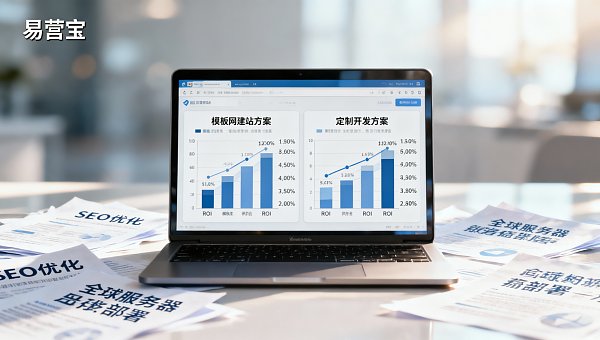
More critical is the technical infrastructure gap. A so-called "multilingual foreign trade website with global servers" is far more than just purchasing overseas VPS. True global acceleration requires CDN nodes covering core markets like Europe, North America, Southeast Asia, and Latin America, along with intelligent routing based on user geolocation. EasyYun's joint deployment of AWS and Alibaba Cloud across seven continental server clusters ensures that visitors to Spanish-language sites from Mexico experience a TTFB (Time to First Byte) consistently under 180ms—directly impacting Google Core Web Vitals scores and organic traffic weight.
2. ROI Comparison: The True Cost Ledger of Template-Based Websites vs. Custom Development
Using a mid-sized manufacturing enterprise with $5M annual revenue as an example, we compare the 3-year total cost of ownership (TCO) for both approaches:
Note: The above data is based on industry-average labor rates and verified efficiency improvements from EasyYun clients. While custom solutions require higher upfront investment, their true ROI surpasses template-based solutions by the second year, as revealed by the "implicit cost visualization" logic demonstrated in *Fixed Asset Management Challenges and Solutions*.
3. Overlooked Cost Items: Compliance, Security, and Scalability
Procurement teams often focus on website quotes while neglecting three hidden costs: GDPR/CCPA compliance adaptation, localized payment gateway integration, and API expansion barriers. For instance, a Shenzhen-based multilingual foreign trade website client lost 37% of Latin American orders due to lacking dual-channel Stripe/Mercado Pago integration. Another enterprise using open-source templates suffered a 47-hour search engine ranking penalty from automatic SSL certificate renewal failure. EasyYun's AI website system includes built-in privacy policy generators for 12 countries, one-click integration modules for 23 local payment gateways, and millisecond-level disaster recovery switching via AWS/Aliyun hybrid cloud architecture—these aren't "premium features" but foundational infrastructure for global operations.
Particularly noteworthy is the long-term nature of multilingual website SEO optimization. Machine-translated "pseudo-localized" content is now explicitly flagged by Google as low-quality signals. EasyYun's AI translation engine combines industry terminology databases with local search intent analysis, ensuring German sites not only use correct grammar but also match German B2B buyer preferences like "Industrielle Komponenten" instead of literal "industrial parts." This deep semantic adaptation helped clients' German sites improve keyword rankings by an average of 5.8 positions.
4. How to Choose a Reliable Multilingual Foreign Trade Website Vendor? 3 Hard Metrics
Facing hundreds of vendors claiming "specialization in multilingual foreign trade websites," decision-makers should validate:
- ✓ Google Premier Partner & Meta Official Agency status—determining ad strategy depth and API access levels;
- ✓ Verifiable global server SLA commitments—e.g., "99.95% uptime in Asia-Pacific" requires third-party monitoring reports;
✓ Support for multilingual website social marketing and ad attribution—must integrate Meta Ads, Google Analytics 4, and standalone site behavior data to avoid "black box conversion."

As a China SaaS Top 100 company, EasyYun has served over 100,000 enterprises with rapid multilingual foreign trade website deployment, covering manufacturing, cross-border e-commerce, education equipment, and 20+ niche sectors. Its Shenzhen-based multilingual website team includes local delivery managers for end-to-end language proofing, localized payment testing, and tax compliance preparation.
5. Immediate Action: Get Your Custom ROI Calculation Model
Price isn't the starting point—value is. The price difference in multilingual foreign trade websites reflects gaps in technical depth and business insight. Template websites solve "existence," custom development solves "quality," while EasyYun's all-in-one intelligent marketing platform solves "profitability."
Download EasyYun's exclusive *Multilingual Foreign Trade Website ROI Calculator* now. This tool incorporates 200+ industry benchmarks—input your annual revenue, target markets, and current acquisition channels to automatically generate 3-year ROI projections, optimal technology recommendations, and risk alerts. The spreadsheet supports Excel online editing and multilingual version switching, helping procurement officers, project managers, and executives reach consensus.
Let the world make way for Chinese brands—starting with a website that truly understands global business. Contact EasyYun consultants now to get your multilingual foreign trade website AI solution and ROI calculator!
- Website Development
- Foreign Trade Website Development
- SSL Certificate
- Social Media Marketing
- SEO for Foreign Trade Websites
- Yiyingbao
- SEO
- Independent Website
- SEO Optimization
- Smart Website Building
- AI Translation
- AI Translation Engine
- Website SEO Optimization
- AI Website Building
- cross-border e-commerce
- Multilingual Foreign Trade Website
Related Articles
Related Products
 EasyCamp SaaS Smart Website Marketing SystemE-Yingbao SaaS Smart Website Marketing System: AI-powered, zero-code website building. Rapidly launch multilingual independent e-commerce sites in just 10 minutes. Global server acceleration and AI-driven SEO optimization empower businesses to efficiently connect with global markets. The seamless integration of technology and user-friendly operation makes building e-commerce sites incredibly simple.
 AI+SEM Intelligent Advertising Marketing SystemAI+SEM drives intelligent ad creation, empowering full-funnel precision advertising marketing. The system automatically generates weekly/monthly reports, AI recommends keywords and target countries, monitors core metrics in real-time with intelligent alerts, and enables one-click high-conversion ad solutions to help quickly acquire customers and improve ROI.
 AI+SEO Dual Engine Optimization ServiceEasyWin AI+SEO Dual Engine Optimization System leverages AI-powered keyword mining, content generation, and comprehensive technical optimization to help foreign trade enterprises acquire high-quality organic traffic, significantly improving search rankings and conversion rates.
 AI+SNS Social Media Marketing SystemYingbao AI+SNS Social Media Marketing System - Precision social capture for the social media era. Supports one-click content synchronization across major platforms like Facebook and LinkedIn. AI intelligently rewrites posts for enhanced relevance. 24/7 AI customer service and user profiling analysis empower businesses to efficiently expand into global markets.
 AI+SEO营销解决方案易营宝AI+SEO营销解决方案,通过AI批量写作、智能生成TDK、精准关键词扩词等功能,全面优化网站SEO效果,提升流量与转化率。助力企业构建高效智能网站新生态。
 AI+SEM Advertising Marketing SolutionsAI+SEM Advertising Marketing Solution leverages AI technology to deeply empower SEM ad campaigns. It automatically generates weekly/monthly reports using AI, presenting account data across multiple dimensions for comprehensive insights into campaign performance and trends. The system precisely recommends keywords and target countries, intelligently generates high-conversion ad copy, and enables one-click activation of efficient campaign plans to help businesses rapidly acquire customers. Simultaneously, it monitors core metrics in real time, intelligently identifies abnormal fluctuations, and issues timely alerts to ensure stable, high-return advertising results.
 Domain Name ServicesEasyWin provides professional domain name services, including intelligent queries, one-stop registration, brand protection, and full lifecycle management, helping businesses build a digital brand image.
 EasyOperate B2C Cross-Border E-Commerce Platform & Independent WebsiteEasyStore B2C Cross-border E-commerce Independent Store is an intelligent website building and cross-border e-commerce integrated solution independently developed by EasyStore Information Technology (Beijing) Co., Ltd. The system is specially designed for small and medium-sized as well as large export enterprises, integrating 'website building, operation, marketing, advertising, and conversion' into one, helping enterprises quickly establish cross-border e-commerce independent stores to achieve brand globalization and global sales growth.
The platform supports multiple languages, multiple currencies, and multi-channel marketing, with built-in AI intelligent translation and SEO optimization systems, suitable for mainstream markets such as Southeast Asia, Europe and America, Latin America, and the Middle East, assisting Chinese manufacturing enterprises in efficiently deploying international e-commerce strategies. SSL证书易营宝提供专业SSL安全证书服务,包括单域名和泛域名证书,确保网站数据传输加密、身份验证和完整性保护,助力企业建立安全可信的在线业务环境。









