









- The China-US tariff arrangement has reached a preliminary consensus, and the trade association will be establishedJun 15, 2026View details
- China-Morocco zero-tariff access, a breakthrough in the cost of Moroccan goods exports to ChinaJun 11, 2026View details
- What signal should be released for the suspension of exports to JapanJun 10, 2026View details
- China's May LNG imports rebounded, with increased volumes from Russia and Canada filling the Middle East supply gapJun 10, 2026View details
- Will GEO change its SEO strategy?Jun 04, 2026View details
- What types of businesses are end-to-end solutions suitable for?Jun 03, 2026View details
- 2026 Global Growth Channel TrendsJun 02, 2026View details
- Changes in Search Engine Ranking Factors in 2026Jun 06, 2026View details
Which areas should be optimized first in Meta advertising
When many companies run Meta ads, their first reaction is often “the budget is not enough” or “the bid is too low”, but judging from actual campaign results, what should really be optimized first is often not how much money is being spent, but whether the foundational setup has been properly built. For Meta ecosystem advertising such as Facebook and Instagram, if audience targeting is inaccurate, creatives have not been tested, the landing page has weak conversion support, and data tracking is incomplete, then even if you keep increasing the budget, the cost per conversion will still be very difficult to bring down in any meaningful way.
If you are looking into “which parts of Meta ad optimization should be prioritized first”, the core answer can be stated upfront: first check and optimize data tracking, audience strategy, ad creatives, and landing page experience, and only then consider budget scaling and account expansion. For business decision-makers, this affects return on investment and growth stability; for execution teams, it determines whether optimization actions are actually effective; for distributors, after-sales teams, and end-customer-related personnel, it affects lead quality, follow-up conversion efficiency, and overall business coordination.
Before rushing to increase the budget, which foundational parts of Meta ads should be optimized first
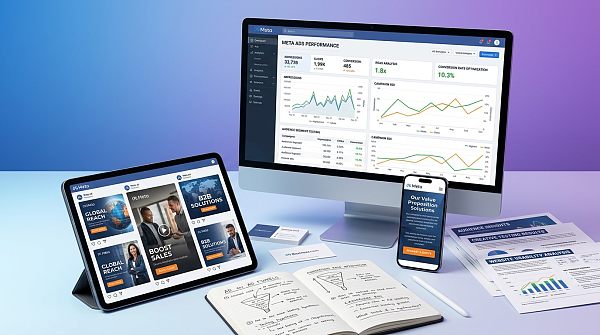
Users searching for this question usually are not looking for a broad set of advertising theories, but want to know: when ad performance is poor, where should they make changes first to see improvements as quickly as possible. Based on the common issues found across a large number of business campaigns, the recommended optimization order is usually as follows:
First, check whether data tracking is accurate. If Pixel, Conversion API, event setup, and UTM parameters are all incomplete, then the “results” shown in the backend may themselves already be distorted. Without accurate data, subsequent optimization of audiences, creatives, and bidding can easily go in the wrong direction.
Second, check whether audience targeting is too broad or too narrow. Many accounts fail to scale not because the platform is not delivering volume, but because the audience settings do not match the real buyer group. If targeting is too broad, the system’s learning cost is high; if targeting is too rigid, volume will not build up either.
Third, evaluate whether the creatives have the ability to drive “attention + clicks + trust”. Ad creatives are not effective just because they look good. Truly effective creatives need to capture attention within the first 3 seconds and clearly communicate the product value, target audience, and reason to take action within a short period of time.
Fourth, optimize the landing page’s conversion support capability. If the ad click-through rate is decent but conversions are poor, the problem is often not with the ad itself, but with the landing page’s loading speed, information structure, form design, trust signals, or mobile experience.
Fifth, only then discuss budget scaling. Once the previous key parts are running smoothly, gradually increasing the budget will produce more stable results. Otherwise, you are simply magnifying the problem.
Why data tracking should come first
Many operators are used to changing copy, swapping audiences, and adjusting budgets first, but if the data collection itself is biased, the optimization direction may be completely wrong. In Meta ad campaigns, common data issues include:
- Pixel is not fully installed, and key pages are not triggering events
- Core conversion events such as form submissions, add-to-cart, inquiries, and purchases are defined inconsistently
- Multi-channel promotion does not use parameter-based differentiation, resulting in chaotic source attribution
- The gap between website-side data and Meta backend data is too large, making it impossible to judge the real conversion path
For business managers, the significance of data tracking is not just “viewing reports”, but directly affecting budget decisions, channel allocation, and sales coordination. Especially in an integrated website + marketing services scenario, advertising is only the traffic entry point; real growth decisions rely on the coordinated analysis of website behavior data, CRM lead quality, sales feedback, and back-end conversion performance.
If a company is also sorting out its internal processes, risk control, or supervision system, it will likewise find that “building standards and tracking mechanisms first” is a common logic across many types of work. For example, in the field of management research, Research on Optimization Strategies for the Financial and Accounting Supervision System of Administrative Institutions also emphasizes the importance of systematization and traceability. Applied to advertising, the logic is similar: without a clear data supervision and feedback mechanism, even the smartest optimization techniques are difficult to reuse consistently.
How to adjust audience targeting so optimization does not lead to less and less volume
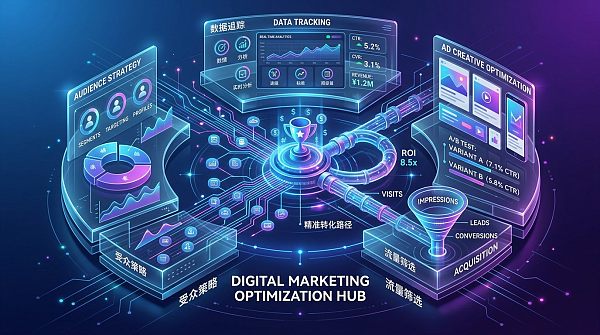
The Meta platform’s algorithm is very powerful, but that does not mean audiences can be completely “left to run freely”. In actual campaigns, many account problems come from overly subjective audience strategies or unscientific testing methods.
A more practical approach is to optimize audiences by dividing them into three layers:
- Cold-start audiences: interests, behaviors, broad groups, and lookalike audiences, used to test market response and creative fit
- Mid-funnel engagement audiences: people who watched videos, clicked ads, or visited the website but did not convert, used to improve conversion efficiency
- High-intent remarketing audiences: people who added to cart, initiated inquiries, or submitted forms but did not complete the transaction, used to shorten the decision cycle
What business decision-makers care more about is: what kind of audience strategy is more cost-efficient? The answer is usually not “the most precise”, but “testable, iterable, and scalable”. If you lock down age, region, interests, occupation, and other conditions too narrowly from the start, the system actually has too little room to learn. It is recommended to first establish several core test combinations, and then gradually narrow them based on click-through rate, conversion rate, cost per result, and lead quality.
For distributors, agents, or companies with a distribution system, special attention should also be paid to regional differences. Users in different regions do not have the same sensitivity to price, delivery speed, after-sales capability, and brand awareness, so audience packs should not be treated uniformly. For end-consumer-oriented products, audience segmentation should rely more on scenarios, pain points, and purchase motivations, rather than only basic demographic attributes.
Why creative optimization often works faster than adjusting bids
In Facebook ad optimization, creatives are often the primary factor affecting click-through rate and conversion rate. This is because whether users are willing to stop, become interested, and trust your solution is first shaped by the creative content they see.
A high-quality Meta ad creative usually needs to answer 4 questions:
- What are you selling, and can people understand it at a glance
- Who is it suitable for, and can the target user quickly identify themselves with it
- Why is it worth clicking, and can it present clear benefits
- Why is it trustworthy, and can it provide cases, data, or endorsements
When execution teams conduct creative testing, it is not recommended to change too many variables at once. A more efficient method is single-variable testing, for example:
- First test different opening hooks: pain-point-based, result-based, and comparison-based
- Then test different visual formats: talking-head presentation, product demo, image carousel, and short video clips
- Finally test different calls to action: consult now, get the plan, view quotation, and free trial
Many poor ad results are not because the product is bad, but because the creative persuasion path is wrong. For example, if a B2B company only displays a company introduction, users are often indifferent; but if it directly highlights “more stable delivery timelines”, “lower customer acquisition costs”, and “easier localization for overseas campaigns”, it is much more likely to generate high-quality leads.
If you want your ad campaigns and website conversion support to form a more complete closed loop, the content expression must also align with the page structure. Whatever the ad promises, the landing page should expand on as a priority. Otherwise, if expectations before and after the click are inconsistent, the bounce rate will usually rise.
If you get clicks but no conversions, the problem is mostly with the landing page and conversion path
Many companies see that ad CTR is decent and assume the creative has already succeeded, but actual inquiries or transactions still fail to materialize. At this point, what should be examined most is not continuing to swap out ads, but checking the landing page handoff.
A high-converting landing page usually has the following characteristics:
- Fast loading speed: especially on mobile, where a few extra seconds of load time will significantly drive user loss
- Clear above-the-fold information: let users immediately understand who you are and what problem you can solve
- Simple conversion actions: do not use too many form fields, and make the inquiry entry point obvious
- Complete trust elements: case studies, customer reviews, qualifications, service commitments, and after-sales explanations are all critical
- Consistent with ad messaging: avoid having the ad say A while the page says B
For readers related to quality control, safety management, and after-sales maintenance, they often care more about service reliability, execution standards, follow-up support, and risk control. Therefore, if your target customers include these roles, the page cannot focus only on price and features; it must also clearly present information such as delivery process, quality assurance, and after-sales response mechanisms.
This is also why an “integrated website + marketing services” approach is more likely to deliver long-term results than advertising alone. Advertising is responsible for traffic generation, the website is responsible for conversion support, the data system is responsible for feedback, and the sales process is responsible for conversion. All four are indispensable.
How business managers can judge what part of the ad account should be optimized now
If you are a business owner, marketing manager, or business decision-maker, you may not need to personally adjust every ad set, but you should know how to identify roughly which layer the problem lies in. A simple diagnostic framework is as follows:
- Low impressions: first check audience size, bidding strategy, account health, and creative relevance
- Low click-through rate: focus on optimizing creative format, headline copy, and above-the-fold hook
- Many clicks but few conversions: focus on checking the landing page and form flow
- Many leads but poor close rate: focus on checking audience quality, information screening mechanisms, and sales follow-up efficiency
- Strong early performance but later decline: focus on investigating creative fatigue, excessively high frequency, and insufficient remarketing coverage
From the perspective of ROI, Meta ad optimization is not just about “pushing down the cost per conversion”, but more importantly about increasing the proportion of qualified leads and improving downstream close rates. Sometimes leads that seem cheap actually convert poorly in the end; meanwhile, leads that seem slightly more expensive may deliver better overall ROI if customer quality is higher.
Therefore, companies cannot focus only on a single metric in the ad backend. They need to evaluate advertising cost, website behavior, inquiry quality, sales conversion, and repeat purchase value together. Only in this way can optimization actions go beyond surface-level improvements.
By the way, when companies are advancing standardized management or strengthening internal control awareness, research content such as Research on Optimization Strategies for the Financial and Accounting Supervision System of Administrative Institutions can also often help managers understand the thinking that “system building comes before local optimization”. Advertising growth works the same way: build the right framework first, then talk about efficient scaling.
Truly effective Meta ad optimization is not about doing more actions, but about doing actions in the right order
Returning to the original question, which parts of Meta ad optimization should be prioritized first? The most practical answer is: first fix data tracking, then optimize audience strategy, then test creative performance, next improve landing page conversion support, and only finally consider budget scaling and account duplication.
The value of doing this lies in the fact that you are not relying on luck to generate orders, but building a more stable growth mechanism. For execution teams, this means optimization actions have clearer direction; for managers, it means budget spending is more controllable; for channel partners, after-sales teams, and end-customer-oriented businesses, it means lead quality, communication efficiency, and conversion results all become easier to improve.
If a company hopes to continuously improve Meta ad performance in a global marketing environment, individual tactics are certainly important, but what matters even more is linking advertising, website, content, data, and the sales process together. Only when the entire front-to-back chain runs smoothly can the value of Meta advertising truly be fully realized.
Related Articles



Related Products
 EasyCamp SaaS Smart Website Marketing SystemE-Yingbao SaaS Smart Website Marketing System: AI-powered, zero-code website building. Rapidly launch multilingual independent e-commerce sites in just 10 minutes. Global server acceleration and AI-driven SEO optimization empower businesses to efficiently connect with global markets. The seamless integration of technology and user-friendly operation makes building e-commerce sites incredibly simple.
 AI+SEM Intelligent Advertising Marketing SystemAI+SEM drives intelligent ad creation, empowering full-funnel precision advertising marketing. The system automatically generates weekly/monthly reports, AI recommends keywords and target countries, monitors core metrics in real-time with intelligent alerts, and enables one-click high-conversion ad solutions to help quickly acquire customers and improve ROI.
 AI+SEO Dual Engine Optimization ServiceEasyWin AI+SEO Dual Engine Optimization System leverages AI-powered keyword mining, content generation, and comprehensive technical optimization to help foreign trade enterprises acquire high-quality organic traffic, significantly improving search rankings and conversion rates.
 AI+SNS Social Media Marketing SystemYingbao AI+SNS Social Media Marketing System - Precision social capture for the social media era. Supports one-click content synchronization across major platforms like Facebook and LinkedIn. AI intelligently rewrites posts for enhanced relevance. 24/7 AI customer service and user profiling analysis empower businesses to efficiently expand into global markets.
 AI+SEO营销解决方案易营宝AI+SEO营销解决方案,通过AI批量写作、智能生成TDK、精准关键词扩词等功能,全面优化网站SEO效果,提升流量与转化率。助力企业构建高效智能网站新生态。
 AI+SEM Advertising Marketing SolutionsAI+SEM Advertising Marketing Solution leverages AI technology to deeply empower SEM ad campaigns. It automatically generates weekly/monthly reports using AI, presenting account data across multiple dimensions for comprehensive insights into campaign performance and trends. The system precisely recommends keywords and target countries, intelligently generates high-conversion ad copy, and enables one-click activation of efficient campaign plans to help businesses rapidly acquire customers. Simultaneously, it monitors core metrics in real time, intelligently identifies abnormal fluctuations, and issues timely alerts to ensure stable, high-return advertising results.
 Domain Name ServicesEasyWin provides professional domain name services, including intelligent queries, one-stop registration, brand protection, and full lifecycle management, helping businesses build a digital brand image.
 EasyOperate B2C Cross-Border E-Commerce Platform & Independent WebsiteEasyStore B2C Cross-border E-commerce Independent Store is an intelligent website building and cross-border e-commerce integrated solution independently developed by EasyStore Information Technology (Beijing) Co., Ltd. The system is specially designed for small and medium-sized as well as large export enterprises, integrating 'website building, operation, marketing, advertising, and conversion' into one, helping enterprises quickly establish cross-border e-commerce independent stores to achieve brand globalization and global sales growth.
The platform supports multiple languages, multiple currencies, and multi-channel marketing, with built-in AI intelligent translation and SEO optimization systems, suitable for mainstream markets such as Southeast Asia, Europe and America, Latin America, and the Middle East, assisting Chinese manufacturing enterprises in efficiently deploying international e-commerce strategies. SSL证书易营宝提供专业SSL安全证书服务,包括单域名和泛域名证书,确保网站数据传输加密、身份验证和完整性保护,助力企业建立安全可信的在线业务环境。









