









- What should you focus on in the latest enterprise SaaS report? From renewal rates and delivery costs to overseas growth opportunitiesJul 12, 2026View details
- What signals are worth paying attention to in a cross-border marketing trend report? B2B companies should look at these 6 signalsJul 11, 2026View details
- How to Read a Cross-Border Marketing Trends Report? Five Key Dimensions for Evaluating Channel OpportunitiesJul 11, 2026View details
- Which channel has the highest ROI in the global traffic ecosystem? Comparative analysis of search, social media, and advertisingJul 10, 2026View details
- What multilingual website services are available in Sanya? Which model is more suitable for local businesses going global?Jul 08, 2026View details
- How to view the complete list of China SaaS companies in the top 100? Practical methods for screening website-building and marketing service providersJul 08, 2026View details
- How to view pricing in the global traffic ecosystem? Cost comparison of search, social media, and content channel advertisingJul 06, 2026View details
- How to assess foreign trade website development trends?Looking at 2026 changes from multilingual,AI content to conversion pathsJul 04, 2026View details
How to Create a More Effective Social Media Marketing Strategy
How can you develop a more effective social media marketing strategy? The key isn't "posting more content," but rather clarifying three questions: Who are your target customers? On which platform do they make their decisions? Can your content and conversion path handle the traffic? For business decision-makers, the most important concerns are return on investment, channel selection, and replicable growth; for implementers, the focus is more on content creation, pacing, and data analysis. Truly effective approaches typically don't rely on a single platform, but rather integrate Facebook marketing strategies, LinkedIn business marketing, YouTube video marketing, and search engine optimization services to create a closed loop of "exposure—trust—inquiry—conversion."
Don't rush into launching: Effective social media marketing strategies start with understanding search intent and business objectives.
When users search for "how to develop a more effective social media marketing strategy," their core intention is usually not to read a platform introduction, but to solve practical problems: which platforms to choose, how to allocate the budget, how to arrange the content, why it's not working, and how to increase inquiries and sales.
This issue is particularly pronounced for clients in the integrated website and marketing services industry. Because social media marketing, if separated from a website, SEO, landing pages, and data tracking, often only generates superficial exposure and struggles to generate sustained conversions. Therefore, the first step in strategy development is not "what to post today," but rather clarifying the following four objectives:
- Brand exposure: Suitable for new product launches, market education, and building industry awareness.
- Sales customer acquisition: Focus on lead volume, inquiry cost, and conversion rate.
- Channel expansion: Suitable for recruiting and screening distributors, agents, and resellers.
- Customer operations: focusing on existing customers, after-sales support, reputation maintenance, and repeat purchases.
If businesses don't define their primary objectives first, they risk selecting too many platforms, publishing a lot of content, but failing to assess the quality of the data. A more effective approach is to work backward from business results to develop a marketing strategy: for brand building, focus on reach and content matrix; for inquiries, focus on landing page and conversion design; for high-quality customers, focus on audience targeting and professional content output.
Different target readers have different concerns, so a single strategy cannot be applied universally.
Many companies' social media performance is unsatisfactory, not because the platform is bad, but because the content and audience are mismatched. Different groups have completely different focuses, and marketing messages should be designed accordingly.
Enterprise decision-makers value supply capacity, case studies, cost control, delivery stability, and long-term cooperation value; users and operators are more concerned with whether the product is easy to use, whether the parameters are clear, and whether the operation is convenient; quality control personnel/safety management personnel focus on certification, stability, standardization, and risk control; after-sales maintenance personnel are concerned with support efficiency, spare parts supply, and maintenance difficulty; distributors/agents value profit margins, brand support, and market policies; and end consumers are more easily impressed by intuitive experience, word-of-mouth reviews, and usage scenarios.
This means that social media marketing strategies should not only focus on what businesses "want to say," but also on what customers "want to confirm." For example:
- For B2B clients, LinkedIn's enterprise marketing is better suited for delivering professional perspectives, case studies, and industry insights.
- For products that require demonstration and education, YouTube video marketing is better suited for showcasing features, application scenarios, and after-sales tutorials.
- With its broad reach and interactive communication capabilities, Facebook marketing strategies are better suited for event promotion, brand content dissemination, and reaching potential customers.
For businesses in industries with numerous product models, complex parameters, and long procurement chains, structured content presentation is particularly important. For example, when electronic component companies drive traffic through social media, the inability to efficiently display a vast number of product models on their platforms will significantly limit lead generation. In such scenarios, combining electronic component industry solutions with intelligent categorization, parameterized display, and precise marketing capabilities can improve user experience and facilitate a smoother conversion of social media traffic into effective inquiries.
How to choose a platform more effectively: Not by covering everything, but by strategically positioning yourself according to the customer's decision-making path.
Many companies initially aim to "work on all platforms," but in reality, budgets, teams, and content production capabilities are limited. A more efficient approach is to select primary platforms, secondary platforms, and conversion channels based on the customer's decision-making path.
Category 1: Facebook Marketing Strategies
It's suitable for brand exposure, event promotion, remarketing, and reaching target audiences with specific interests. Its advantages lie in its broad reach, mature advertising system, and suitability for testing different creative materials. For businesses looking to quickly validate market feedback, Facebook can serve as a traffic testing ground.
- Suitable for: Customer acquisition, event registration, brand expansion
- Suitable content: Case studies (text and images), short videos, customer feedback, product highlights
- Key points to note: Audience targeting, ad creative testing, and landing page consistency.
Category Two: LinkedIn Corporate Marketing
It is more suitable for B2B companies, manufacturing companies, service companies, and brands that need to build professional trust. LinkedIn users usually have professional identities and a higher density of decision-making information, so the content should not be too entertainment-oriented, but should emphasize professionalism, contextual value, and business results.
- Suitable for: high-quality leads, corporate partnerships, and channel expansion.
- Suitable content: White papers, industry insights, solutions, customer case studies
- Key points to note: Company homepage construction, reaching key personnel, and conveying authoritative content.
Category 3: YouTube Video Marketing
Suitable for products and services that require explanation, demonstration, and education. Users exhibit strong search behavior on YouTube, making it suitable for both brand exposure and fulfilling mid-to-late-stage needs such as "how to use," "how to choose," and "comparison reviews." For complex products, video content often builds trust more easily than simple text and images.
- Suitable objectives: Brand education, search traffic acquisition, improving conversion trust
- Suitable content: Product demonstrations, application cases, installation tutorials, FAQ videos
- Key points to note: Title keywords, cover page click-through rate, and integration of video and official website.
Simply put, if your customers need to "see you," start with Facebook; if they need to "trust you," focus on LinkedIn; and if they need to "understand you," increase your presence on YouTube. Combining these three platforms usually yields more stable results than relying on a single platform.
Why do many companies still fail to convert leads despite using social media? The problem often lies in these four stages.
The common reason for poor social media marketing isn't insufficient content quantity, but rather a broken communication channel. The following four problems are the most frequent:
1. Content and objectives do not match . You want inquiries, but keep sending brand slogans; you want to build professional trust, but only send holiday posters. This kind of content is unlikely to drive users to the next step.
2. Homogenized Content Across Platforms <br />The same content is mechanically copied across all platforms, ignoring the differences in platform context. LinkedIn requires professional expression, Facebook emphasizes interaction and engagement, while YouTube prioritizes information completeness and viewing experience.
3. Weak Landing Page Retention <br />Social media brings traffic, but the official website loads slowly, has cluttered content, hidden inquiry entry points, and incomplete product parameters, ultimately leading to user churn. Social media is not an isolated action; it must be designed in conjunction with website experience, conversion pages, and search engine optimization services.
4. Lack of a continuous review mechanism <br />Many teams only look at likes and views, but not click-through rate, dwell time, conversion rate, and inquiry quality, making it impossible to optimize strategies. Truly valuable data is not "hype," but "results."
A more practical approach to social media marketing: a five-step process from goal setting to execution.
If businesses want to truly implement their strategies, they can follow these five steps:
Step 1: Determine the core conversion goals . Clearly define whether the most important goals at this stage are exposure, lead generation, conversion, channel recruitment, or customer maintenance. Don't pursue too many goals simultaneously within a single cycle.
Step 2: Build Audience Profiles <br />At a minimum, identify the target industry, job roles, core pain points, common problems, decision-making cycles, and concerns. The clearer the profile, the easier it is for the content to resonate with their needs.
Step 3: Build a content matrix . It is recommended to design it in three layers: "Cognitive Content + Trust Content + Conversion Content".
- Knowledge Content: Industry Trends, Common Misconceptions, Application Scenarios
- Trust content includes: client case studies, technical specifications, qualifications and capabilities, and service processes.
- Conversion content: Appointment consultation, product trial, quotation entry, event page
Step 4: Develop a Release and Implementation Schedule <br />Organic releases and advertising campaigns should be coordinated. Organic content is used to build brand awareness, while advertising is used to amplify high-performing content. It is recommended to test with a small budget first, and then focus on scaling up high-quality creative content.
Step 5: Establish review metrics . At a minimum, track exposure, interaction rate, click-through rate, landing page conversion rate, number of inquiries, percentage of valid leads, and final sales contribution. This is how you determine where the "effectiveness" lies.
For companies with complex product systems, in addition to the social media content itself, the information architecture within the website is also crucial. For example, in industries with numerous models and high demand for multi-dimensional specification filtering, a lack of clear parameterized display capabilities on the website will significantly impact conversion rates. In this case, the combination of structured display and precise marketing capabilities is more valuable than simply increasing the frequency of posting.
Should social media marketing be done in conjunction with SEO? For long-term growth, the answer is almost certainly yes.
If a company only focuses on social media and neglects search engine optimization (SEO), its growth often relies on continuous advertising. Conversely, if it only focuses on SEO and ignores social media, its brand reach and content dissemination will be slow. A more effective approach is to combine both.
Specifically:
- Social media is responsible for quickly reaching the target audience, amplifying brand content, and testing market feedback.
- SEO is responsible for handling proactive search demands, building long-term traffic, and improving the credibility of the official website;
- The official website and landing page are responsible for converting inquiries into leads and managing those leads.
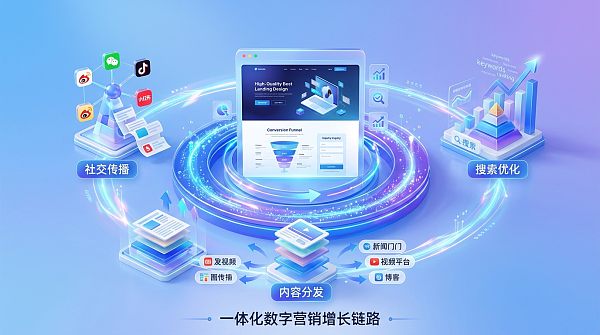
For example, a YouTube video can cover the search query "how to choose a product"; an official website article can lead to in-depth reading on "solution comparison"; LinkedIn content can strengthen the company's professional credibility; and Facebook ads can remarket to those who have visited the official website. What is formed in this way is not scattered actions, but a complete growth chain.
For companies aiming for global growth, this combination of "social media + website + SEO + advertising" is particularly important. It can both acquire customers in the short term and build long-term assets, preventing growth from relying entirely on changes in the rules of a single platform.
Three things businesses should prioritize when formulating strategies
If resources are limited, you might as well prioritize doing these three things well:
- Choose the right platform first, then expand your content . Don't try to cover all platforms at once; focus on the channels that are closest to your target customers' decision-making scenarios.
- First, establish a clear conversion path, then focus on superficial data . Without a clear landing page, forms, consultation entry points, and data tracking, even high exposure will hardly translate into results.
- First, continuously review and analyze the situation, then increase the budget . Invest the budget in content and target audiences that have already proven effective, rather than increasing it based on gut feeling.
This is why more and more companies are choosing integrated digital marketing services: platform operation, content production, website hosting, SEO optimization, and advertising are not separate processes. Only through system collaboration can "traffic" truly be transformed into "growth."
In summary, the most effective social media marketing strategy isn't about "doing as much as possible," but rather about "creating the right combination around your target customers and business results." Business decision-makers should focus on platform relevance, return on investment, and lead quality; while executives should emphasize content matrix, posting frequency, and data analysis. By synergizing Facebook marketing strategies, LinkedIn business marketing, YouTube video marketing, and search engine optimization services, coupled with a clear website structure and content organization, social media marketing is more likely to move from exposure to conversion and generate long-term sustainable growth.
Related Articles



Related Products
 EasyCamp SaaS Smart Website Marketing SystemE-Yingbao SaaS Smart Website Marketing System: AI-powered, zero-code website building. Rapidly launch multilingual independent e-commerce sites in just 10 minutes. Global server acceleration and AI-driven SEO optimization empower businesses to efficiently connect with global markets. The seamless integration of technology and user-friendly operation makes building e-commerce sites incredibly simple.
 AI+SEM Intelligent Advertising Marketing SystemAI+SEM drives intelligent ad creation, empowering full-funnel precision advertising marketing. The system automatically generates weekly/monthly reports, AI recommends keywords and target countries, monitors core metrics in real-time with intelligent alerts, and enables one-click high-conversion ad solutions to help quickly acquire customers and improve ROI.
 AI+SEO Dual Engine Optimization ServiceEasyWin AI+SEO Dual Engine Optimization System leverages AI-powered keyword mining, content generation, and comprehensive technical optimization to help foreign trade enterprises acquire high-quality organic traffic, significantly improving search rankings and conversion rates.
 AI+SNS Social Media Marketing SystemYingbao AI+SNS Social Media Marketing System - Precision social capture for the social media era. Supports one-click content synchronization across major platforms like Facebook and LinkedIn. AI intelligently rewrites posts for enhanced relevance. 24/7 AI customer service and user profiling analysis empower businesses to efficiently expand into global markets.
 AI+SEO营销解决方案易营宝AI+SEO营销解决方案,通过AI批量写作、智能生成TDK、精准关键词扩词等功能,全面优化网站SEO效果,提升流量与转化率。助力企业构建高效智能网站新生态。
 AI+SEM Advertising Marketing SolutionsAI+SEM Advertising Marketing Solution leverages AI technology to deeply empower SEM ad campaigns. It automatically generates weekly/monthly reports using AI, presenting account data across multiple dimensions for comprehensive insights into campaign performance and trends. The system precisely recommends keywords and target countries, intelligently generates high-conversion ad copy, and enables one-click activation of efficient campaign plans to help businesses rapidly acquire customers. Simultaneously, it monitors core metrics in real time, intelligently identifies abnormal fluctuations, and issues timely alerts to ensure stable, high-return advertising results.
 Domain Name ServicesEasyWin provides professional domain name services, including intelligent queries, one-stop registration, brand protection, and full lifecycle management, helping businesses build a digital brand image.
 EasyOperate B2C Cross-Border E-Commerce Platform & Independent WebsiteEasyStore B2C Cross-border E-commerce Independent Store is an intelligent website building and cross-border e-commerce integrated solution independently developed by EasyStore Information Technology (Beijing) Co., Ltd. The system is specially designed for small and medium-sized as well as large export enterprises, integrating 'website building, operation, marketing, advertising, and conversion' into one, helping enterprises quickly establish cross-border e-commerce independent stores to achieve brand globalization and global sales growth.
The platform supports multiple languages, multiple currencies, and multi-channel marketing, with built-in AI intelligent translation and SEO optimization systems, suitable for mainstream markets such as Southeast Asia, Europe and America, Latin America, and the Middle East, assisting Chinese manufacturing enterprises in efficiently deploying international e-commerce strategies. SSL证书易营宝提供专业SSL安全证书服务,包括单域名和泛域名证书,确保网站数据传输加密、身份验证和完整性保护,助力企业建立安全可信的在线业务环境。









