









- What multilingual website services are available in Sanya? Which model is more suitable for local businesses going global?Jul 08, 2026View details
- How to view the complete list of China SaaS companies in the top 100? Practical methods for screening website-building and marketing service providersJul 08, 2026View details
- How to view pricing in the global traffic ecosystem? Cost comparison of search, social media, and content channel advertisingJul 06, 2026View details
- How to assess foreign trade website development trends?Looking at 2026 changes from multilingual,AI content to conversion pathsJul 04, 2026View details
- What are the new trends in multilingual marketing data analytics tools in 2026? Focus on attribution、automation and complianceJul 04, 2026View details
- Is Brand Globalization Marketing Consulting Worth Buying? At What Stage Should Companies Bring It InJul 01, 2026View details
- Cross-Border Marketing Trend Research: Why More and More Companies Are Starting to Deploy AI Search and GEO OptimizationJun 30, 2026View details
- Cross-Border Marketing Trend Research: How Independent Sites, AI Content, and Short-Video Customer Acquisition Are ChangingJun 30, 2026View details
What are some common pitfalls in the SSL certificate application process?
Many businesses, when applying for SSL certificates, immediately think, "Just buy one and install it." However, in practice, common problems often lie not in "having a certificate," but in "whether the certificate is correct, whether the domain name is matched, whether verification is successful, whether deployment is complete, and whether renewal is uninterrupted." Falling into these pitfalls can lead to anything from browser insecurity warnings and reduced conversion rates to website access issues, SEO fluctuations, and even leaving a negative impression on clients and partners. This article will analyze the high-frequency pitfalls in the SSL certificate application process from three perspectives: search intent, business risks, and practical procedures, helping business managers, website operators, security personnel, and maintenance staff avoid these pitfalls.
First, identify the key points: What users really want to know is not the process itself, but rather "which pitfalls will affect security, indexing, and business operations."

Judging from actual search behavior, users searching for "common pitfalls in the SSL certificate application process" are usually not primarily interested in understanding the textbook steps, but rather in quickly avoiding problems that could lead to losses. For example:
- Why am I still getting a security warning after applying for the certificate?
- Why do website traffic and indexing fluctuate after HTTP redirection to HTTPS?
- The certificate has been clearly installed, so why are some pages, mini-programs, and APIs still showing errors?
- What are the consequences of forgetting to renew?
- How to choose between different types of certificates, and is it worth spending more money?
- How to avoid deployment errors in environments with multiple domains, wildcard domains, CDN, and load balancing.
For business decision-makers, the primary concerns are risk, cost, and business impact; for executives, the primary concerns are verification, deployment, compatibility, renewal, and troubleshooting; and for security and quality control personnel, the primary concerns are compliance, stability, and certificate management mechanisms. Therefore, truly valuable content should not merely cover the superficial process of "registering an account—submitting an application—downloading a certificate," but should clearly explain common errors, diagnostic methods, and remedial actions.
The first major pitfall: If you don't choose the right certificate type, every step afterward may be a waste of time.
The first and most frequent problem in the SSL certificate application process is choosing the wrong certificate. Many companies only look at the price and ignore the use case, resulting in a certificate that is not suitable for their business.
Common certificate types include:
- DV Certificate : Verifies domain control, quick application, suitable for basic display websites;
- OV Certificate : Verifies company information, suitable for brand websites and B2B showcases;
- EV Certificate : More stringent verification, suitable for scenarios with higher requirements for brand trust and compliance;
- Single domain certificate : protects only one main domain;
- Multi-domain certificate : Suitable for unified management of multiple different domains;
- Wildcard certificates : suitable for scenarios with multiple subdomains, such as www, m, api, shop, etc.
There are three common misconceptions:
- Using a single domain certificate on multiple subdomains results in some sites being unprotected;
- The business requires corporate endorsement, but only applied for the lowest level certificate, which lacks sufficient trust.
- Despite having multiple sites planned for the future, they only purchase based on the current minimum needs, leading to repeated investments later.
If your website not only serves as a brand showcase but also handles customer acquisition, inquiries, distribution, and business development, then a certificate is not just a "security feature" but also a foundation of trust. For example, agricultural, product, and food brands often enhance credibility by using high-quality images and text, news blogs, and service commitment modules when creating export websites or distribution and business development sites. If such websites display a "not secure" warning in browsers, it will directly harm business conversions. For site templates that emphasize brand showcase, product grid categorization, customized application forms, and responsive design, especially in agriculture, agricultural products, and food , it is crucial to consider unified security coverage across the main site, sub-sites, form pages, and mobile devices during the certificate selection phase.
The second major pitfall: Errors in the domain verification process, causing the application to get stuck or repeatedly fail.
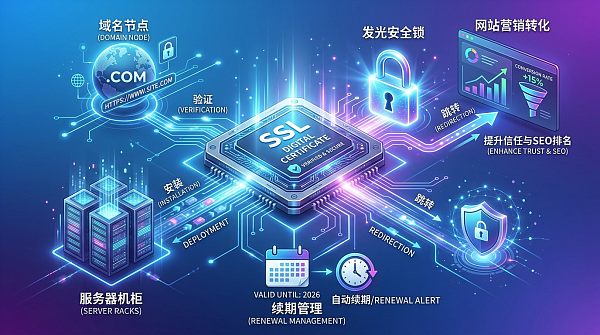
Applying for an SSL certificate isn't difficult; the real challenge lies in domain verification. Many practitioners mistakenly believe that "submitting and waiting for review" is sufficient, but in reality, their applications are frequently rejected due to choosing the wrong verification method.
Common verification methods include:
- DNS verification: Proving domain ownership by adding DNS records;
- File verification: Upload a verification file to the specified directory on the website;
- Email verification: Confirm via the domain-related management email address.
The most common pitfalls here include:
- The verification failed because the DNS resolution was not working properly when the application was submitted for review.
- CDN or caching interfered with the file verification path;
- The website has redirection rules, and the verification file cannot be accessed correctly;
- The administrator email address, which is not frequently used, was used, and the verification email was missed.
- Domain DNS permissions and operation and maintenance permissions are scattered, resulting in low collaboration efficiency.
If a company's website is jointly maintained by the marketing department, IT department, and a third-party website development service provider, verification failures are often not due to insufficient technical capabilities, but rather to unclear boundaries of responsibility. It is recommended to confirm three things before applying: who has domain management authority, who can modify server configurations, and who will be responsible for the final verification result. This will help avoid process delays.
The third major pitfall: The certificate is installed, but the website is not "truly secure."
Many website administrators assume SSL deployment is complete when they see a padlock icon in the address bar. However, this is only the first step. The real common problem is that "HTTPS appears to be enabled, but insecure resources still exist."
The most typical example is the mixed content problem, where the page is HTTPS, but images, JS, CSS, videos, and form interfaces still call HTTP resources. This has several consequences:
- The browser continues to display risk warnings or other alerts;
- Page styles are messed up, and scripts are not working.
- Form submission errors are affecting inquiry and order conversion rates.
- Search engines' judgments on page quality and security are affected.
Common troubleshooting approaches include:
- Check if there are any HTTP resource paths in the webpage source code;
- Check if images, plugins, and third-party analytics code are still using HTTP.
- Check whether the API, payment, and form interfaces fully support HTTPS.
- Check that CDN, Nginx, Apache, and the load balancer are all configured synchronously.
Marketing websites, brand websites, and content-based sites are particularly prone to issues with numerous page elements and complex backlinks, making them susceptible to problems such as "homepage working normally, detail page not working," "PC working normally, mobile not working," and "main site working normally, form page not working." If these issues are not addressed promptly, user experience and conversion rates will continue to decline.
The fourth major pitfall: Only installing certificates, without performing SEO migration and search engine signal unification.
This type of problem is one that many businesses easily overlook, yet it has the greatest impact on marketing effectiveness. If SEO migration isn't implemented simultaneously after enabling HTTPS, issues such as fragmented indexing, splitting of website authority, and traffic fluctuations may occur.
Frequently asked questions include:
- The simultaneous access of both HTTP and HTTPS versions results in duplicate pages.
- There is no unified redirection between the www and non-www versions;
- The sitemap is still submitting old links;
- The canonical tag has not been updated;
- Absolute paths within the site are not being replaced in batches.
- The search engine webmaster platform has not submitted the new attributes.
For businesses that rely on SEO for customer acquisition, an SSL certificate is not just a simple technical step, but a "site standardization upgrade." Especially for websites that primarily focus on content marketing, industry news, and product showcases, an improper migration could negatively impact their previously accumulated search performance in the short to medium term.
A more prudent approach is to complete the redirect strategy, resource replacement, sitemap update, and monitoring plan before installing the certificate; then conduct crawl tests, dead link checks, and index monitoring after installation. This ensures that security upgrades and SEO optimization are integrated, rather than "installing and then fixing."
The fifth major pitfall: Neglecting renewal, monitoring, and certificate asset management, ultimately leading to failure during the busiest times.
Many companies take the initial certificate application very seriously, but then treat the renewal as a "minor matter," often resulting in the certificate expiring suddenly during promotional periods, peak seasons for business development, or periods of increased search traffic.
Common risks associated with certificate renewal include:
- The renewal reminder email was ignored;
- The original person in charge left the company, and no one is taking over the work;
- Multiple domains, multiple systems, and a chaotic certificate ledger;
- The automatic renewal did not actually take effect;
- The device was not redeployed to the corresponding server or CDN node after the renewal.
The impact of expired certificates is often greater than many people imagine: the official website becomes inaccessible, customers are hesitant to submit information, the quality of advertising landing pages declines, customer service explanation costs increase, and distributors and agents begin to doubt the brand's professionalism.
It is recommended that companies establish at least the following mechanisms:
- Create a certificate list, recording the domain name, type, issuance date, expiration date, and deployment location;
- Set up multi-role notifications, instead of relying on a single email address;
- For critical business sites, renewals should begin 30 days in advance.
- An actual visit should be conducted after renewal, rather than just checking if it has been "issued";
- Incorporate certificate management into website operation and maintenance and security inspection processes.
How should businesses determine whether they should apply on their own or entrust the process to a professional team?
This is also the question many business decision-makers really want to know when searching for related content. The answer isn't absolute; it depends on the website's size, architectural complexity, and business risks.
Situations suitable for self-service typically include:
- A single official website with a simple structure;
- There is no complicated CDN, load balancing, and multi-node deployment;
- There are stable internal maintenance personnel;
- It has a high tolerance for downtime risks.
Situations where it is more appropriate to entrust the work to a professional team include:
- It has multiple sites, multiple subdomains, or overseas nodes;
- The website undertakes key tasks such as SEO customer acquisition, advertising placement, and business conversion.
- It is necessary to balance security, performance, search engine optimization, and brand image.
- Cross-departmental collaboration within enterprises is costly and lacks a unified person in charge.
For integrated website and marketing service scenarios, SSL certificates are never an isolated issue; they are closely related to website quality, SEO fundamentals, page trustworthiness, and user conversion efficiency. This is especially true for industry websites that emphasize natural narrative layouts, large image displays, service commitment modules, and brand content marketing. If security configurations are unstable, even the best visuals and content will struggle to achieve their intended effect.
Practical advice: A checklist to help you avoid pitfalls when applying for an SSL certificate.
If you want to get it approved on the first try and minimize rework, you can check the following items before, during, and after the application:
Before applying:
- Confirm the number of domain names, the range of subdomains, and future expansion needs;
- Confirm whether you choose DV, OV, or EV;
- Confirm the server environment, CDN, WAF, and load balancing status;
- Clearly define who is responsible for the domain name, who is responsible for the server, and who is responsible for acceptance testing.
Application in progress:
- Choose the most suitable verification method;
- Ensure that the DNS or file path can be accessed normally from the outside;
- Keep application and verification records for troubleshooting purposes;
- Pay attention to the review emails and issuance status.
After deployment:
- Check if HTTPS is enabled across the entire site;
- Check for mixed content;
- Check if the 301 redirects are consistent;
- Update sitemap, canonical, and internal links;
- Test forms, APIs, payment methods, and mobile pages;
- Set up renewal reminders and asset ledgers.
In summary, the real challenge in the SSL certificate application process lies not in the "application" itself, but in ensuring the right type of certificate, smooth verification, complete deployment, synchronized SEO, and controllable renewal. For businesses, SSL is not an isolated technical action, but rather the infrastructure for website security, brand trust, and search engine marketing performance. Focusing solely on price and process often leads to higher costs later; considering business impact and long-term operational stability significantly reduces risk. Whether you are a business manager or an executive, grasping the four key points of "choosing the right one, installing the right one, redirecting to the right location, and monitoring the right location" will help you avoid most common pitfalls and ensure your website security truly serves brand growth and marketing conversion.
Related Articles
 What multilingual website services are available in Sanya? Which model is more suitable for local businesses going global?
 How to view the complete list of China SaaS companies in the top 100? Practical methods for screening website-building and marketing service providers
 There are so many used heavy-duty construction machines for foreign trade. How exactly should we acquire customers?



Related Products
 EasyCamp SaaS Smart Website Marketing SystemE-Yingbao SaaS Smart Website Marketing System: AI-powered, zero-code website building. Rapidly launch multilingual independent e-commerce sites in just 10 minutes. Global server acceleration and AI-driven SEO optimization empower businesses to efficiently connect with global markets. The seamless integration of technology and user-friendly operation makes building e-commerce sites incredibly simple.
 AI+SEM Intelligent Advertising Marketing SystemAI+SEM drives intelligent ad creation, empowering full-funnel precision advertising marketing. The system automatically generates weekly/monthly reports, AI recommends keywords and target countries, monitors core metrics in real-time with intelligent alerts, and enables one-click high-conversion ad solutions to help quickly acquire customers and improve ROI.
 AI+SEO Dual Engine Optimization ServiceEasyWin AI+SEO Dual Engine Optimization System leverages AI-powered keyword mining, content generation, and comprehensive technical optimization to help foreign trade enterprises acquire high-quality organic traffic, significantly improving search rankings and conversion rates.
 AI+SNS Social Media Marketing SystemYingbao AI+SNS Social Media Marketing System - Precision social capture for the social media era. Supports one-click content synchronization across major platforms like Facebook and LinkedIn. AI intelligently rewrites posts for enhanced relevance. 24/7 AI customer service and user profiling analysis empower businesses to efficiently expand into global markets.
 AI+SEO营销解决方案易营宝AI+SEO营销解决方案,通过AI批量写作、智能生成TDK、精准关键词扩词等功能,全面优化网站SEO效果,提升流量与转化率。助力企业构建高效智能网站新生态。
 AI+SEM Advertising Marketing SolutionsAI+SEM Advertising Marketing Solution leverages AI technology to deeply empower SEM ad campaigns. It automatically generates weekly/monthly reports using AI, presenting account data across multiple dimensions for comprehensive insights into campaign performance and trends. The system precisely recommends keywords and target countries, intelligently generates high-conversion ad copy, and enables one-click activation of efficient campaign plans to help businesses rapidly acquire customers. Simultaneously, it monitors core metrics in real time, intelligently identifies abnormal fluctuations, and issues timely alerts to ensure stable, high-return advertising results.
 Domain Name ServicesEasyWin provides professional domain name services, including intelligent queries, one-stop registration, brand protection, and full lifecycle management, helping businesses build a digital brand image.
 EasyOperate B2C Cross-Border E-Commerce Platform & Independent WebsiteEasyStore B2C Cross-border E-commerce Independent Store is an intelligent website building and cross-border e-commerce integrated solution independently developed by EasyStore Information Technology (Beijing) Co., Ltd. The system is specially designed for small and medium-sized as well as large export enterprises, integrating 'website building, operation, marketing, advertising, and conversion' into one, helping enterprises quickly establish cross-border e-commerce independent stores to achieve brand globalization and global sales growth.
The platform supports multiple languages, multiple currencies, and multi-channel marketing, with built-in AI intelligent translation and SEO optimization systems, suitable for mainstream markets such as Southeast Asia, Europe and America, Latin America, and the Middle East, assisting Chinese manufacturing enterprises in efficiently deploying international e-commerce strategies. SSL证书易营宝提供专业SSL安全证书服务,包括单域名和泛域名证书,确保网站数据传输加密、身份验证和完整性保护,助力企业建立安全可信的在线业务环境。









