









- What New Signals Are Emerging in Enterprise Services SaaS Marketing ReportsJul 27, 2026View details
- What Does a Global Traffic Ecosystem Service Provider Do? What Are the Differences from a Single Advertising AgencyJul 16, 2026View details
- What should you focus on in the latest enterprise SaaS report? From renewal rates and delivery costs to overseas growth opportunitiesJul 12, 2026View details
- What signals are worth paying attention to in a cross-border marketing trend report? B2B companies should look at these 6 signalsJul 11, 2026View details
- How to Read a Cross-Border Marketing Trends Report? Five Key Dimensions for Evaluating Channel OpportunitiesJul 11, 2026View details
- Which channel has the highest ROI in the global traffic ecosystem? Comparative analysis of search, social media, and advertisingJul 10, 2026View details
- What multilingual website services are available in Sanya? Which model is more suitable for local businesses going global?Jul 08, 2026View details
- How to view the complete list of China SaaS companies in the top 100? Practical methods for screening website-building and marketing service providersJul 08, 2026View details
Is LinkedIn marketing training worthwhile to learn systematically?
Is systematic LinkedIn marketing training worthwhile? If your goal is to acquire overseas customers, build a professional brand image, and improve the quality of sales leads, then the answer is usually yes, but it depends on the company's stage, the team's capabilities, and whether there are clear business objectives. For company decision-makers, the key is not "whether to learn," but "whether systematic learning can be transformed into customer acquisition capabilities." For the execution team, the focus is on whether they can truly implement LinkedIn corporate marketing, social media marketing strategies, and SEO content optimization into content, accounts, outreach, and conversion processes.
Especially in B2B, manufacturing, cross-border services, and brand globalization scenarios, LinkedIn is not simply a "posting platform," but a channel that combines brand endorsement, customer reach, content dissemination, and business opportunity cultivation. Because of this, many companies are beginning to reassess: should they let employees figure it out on their own, or provide systematic training to establish a replicable LinkedIn marketing methodology?
To sum it up: What kind of companies benefit most from systematically learning LinkedIn marketing?

Not all businesses need to invest in full LinkedIn marketing training, but for the following types of businesses, systematic learning is usually more valuable:
- Companies with clear overseas market expansion goals and a desire to establish stable inquiry channels
- There is weak coordination between sales, marketing, and operations, requiring a team with unified methods and standardized procedures.
- Companies that are already building websites, implementing SEO, or running ads, but are experiencing low customer acquisition efficiency through social media.
- Organizations that aim to build professional personal brands through their senior executives, sales staff, and technical personnel.
- Companies that aim for global brand growth and want to combine content marketing with customer development
If a company currently lacks even basic customer profiling, product positioning, and a website landing page, the value of training will be significantly diminished. This is because LinkedIn marketing is not a single technique, but a combination of actions involving traffic acquisition, trust building, and conversion. Without a foundational system, even the best training can easily remain at the level of "learning but not being able to apply."
What business decision-makers care about most is not the course content, but the return on investment.
From a management perspective, to determine whether LinkedIn marketing training is worthwhile, four key questions can be considered:
1. Can the cost of trial and error be reduced?
Many internal teams within companies register accounts, post content, try adding friends, and send private messages, but after a few months they find that the quality of leads is unstable, and even the account's authority fails to improve. One of the values of systematic training is to avoid common mistakes in advance, such as unclear account positioning, content that only focuses on product parameters, overly aggressive sales outreach, and a lack of trustworthiness on the personal page.
2. Can a standardized process be established?
It's risky for businesses to rely solely on one "LinkedIn expert." Truly worthwhile training should break down LinkedIn business marketing into a standardized process, including account setup, content planning, customer screening, connection strategies, interaction rhythm, private messaging scripts, lead follow-up, and data analysis. Only with a streamlined process can a team replicate the results.
3. Can it be integrated with the existing customer acquisition system?
LinkedIn itself is not an isolated channel. It's better suited to forming a closed loop with your official website, landing page, SEO content, email marketing, CRM management, and more. For example, clients might first see professional content on LinkedIn, then visit your official website to learn about case studies, and finally submit a form or schedule a consultation. Training that only teaches platform operation without teaching how to integrate it with your official website and brand assets will have limited value.
4. Is it suitable for your business cycle?
LinkedIn marketing is not typically a short-term strategy that promises quick results. It's better suited for businesses with higher average order values, longer decision-making cycles, and a need to build professional trust. If a company sells price-driven, impulse-purchase products, LinkedIn training may not be as important as advertising or e-commerce conversion optimization.
What the execution team really needs to learn is not just how to create content, but the complete customer acquisition journey.
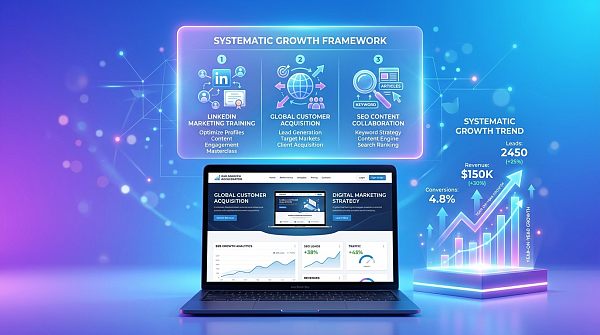
When people mention LinkedIn marketing training, their first thought is, "Does it teach how to post?" In reality, truly effective systematic learning should focus on the following modules:
Account and Homepage Construction
Whether it's a company homepage or an employee's personal homepage, the primary task isn't to make it "look good," but to establish a sense of professionalism and trust. Elements such as profile picture, cover image, job description, business introduction, case studies, keyword placement, and contact information all directly influence whether potential clients are willing to learn more.
Customer profiling and content direction
Different roles have completely different focuses. Corporate decision-makers value business value, risk control, and supply capabilities; quality control and safety management personnel focus more on standards, processes, and stability; after-sales maintenance personnel are more concerned with support efficiency; and distributors and agents focus more on cooperation opportunities, brand support, and market opportunities. The significance of systematic training lies in helping teams learn to "write content according to their target audience," rather than uniformly releasing corporate press releases.
Combining content strategy with SEO thinking
High-quality LinkedIn content isn't simply copying website text; it's about providing solutions, case studies, experience, and insights tailored to client problems. Especially when a company is also doing website SEO, LinkedIn content can serve to "expand exposure" and "build initial trust," while website articles, feature pages, and case study pages handle deeper search queries.
For example, when a company is developing its overseas brand, in addition to creating high-quality social media content, it also needs to ensure its brand infrastructure is robust, including a good website experience, brand domain protection, and multiple domain extension registrations. For companies that value their digital brand, capabilities like domain name services are not actually separate from LinkedIn marketing: when customers jump from social media to the official website, a stable, professional, and trustworthy brand domain name is itself part of the conversion process.
Proactively reach out to sales personnel
The biggest mistake many teams make when learning LinkedIn is immediately sending out mass outreach emails. Systematic training should help staff understand the proper rhythm and timing for each step: connection request, initial interaction, establishing a connection, content pre-launch, private messaging, and follow-up. Especially in B2B marketing, an overly sales-oriented approach will significantly reduce response rates.
Data review and optimization
Valuable training doesn't stop at "what actions were taken," but rather returns to the data: what is the connection success rate? What is the content interaction rate? Have personal homepage visits increased? Are the clicks from traffic redirected to the official website stable? Have lead conversion costs decreased? Only by reviewing performance can a team's capabilities continuously improve.
In what situations is it not advisable to blindly enroll in LinkedIn marketing training?
While systematic learning is valuable, it's not suitable for everyone to immediately engage in it. In the following situations, it's recommended to first solidify your basic knowledge before considering training:
- The company lacks a clear target audience for overseas customers and doesn't know who it wants to reach.
- Insufficient product competitiveness and case studies, coupled with a lack of supporting content output.
- The official website is too weak, so even if customers are attracted, they have no way to learn more about it.
- Without dedicated personnel to execute the training, it is difficult to truly implement the plan.
- Management is looking for quick deals and lacks patience for content development.
To put it more bluntly, LinkedIn marketing training is not a "lifesaver," but rather an "amplifier." The more solid a company's foundation, the more obvious the effects of systematic learning; the more disorganized the foundation, the more likely the training will become a one-off learning expense.
How to determine if a LinkedIn marketing training program is reliable?
If you have already decided to learn systematically, when selecting training programs, we suggest focusing on the following points:
Is it centered on business outcomes, or just platform functionality?
Reliable training should focus on business results such as inquiries, lead quality, brand influence, and sales collaboration, rather than just button placement, platform rules, and superficial techniques.
Does it cover both corporate and individual account strategies?
LinkedIn business marketing is rarely a solo effort from the company page; often, the personal accounts of executives, sales staff, and technical consultants are more effective at reaching customers. If a course only focuses on company accounts and doesn't address the integration of personal brands, its practical value will be diminished.
Does it include content methodology and industry case studies?
Good training will tell you: what content to write for different positions, what content is suitable for building trust, what content helps with conversion, and how to differentiate your message for manufacturing, service, and technology companies.
Does it emphasize the execution pace and post-implementation review?
The biggest problem with training is that "people understand it while listening, but can't apply it afterward." Therefore, it's best to choose a systematic course that includes templates, SOPs, content calendars, outreach scripts, and debriefing mechanisms, rather than just sharing concepts.
Why is LinkedIn marketing increasingly needed to be considered in conjunction with website, SEO, and brand equity?
Today, it's difficult for businesses to achieve sustained growth through a single channel in their overseas marketing efforts. LinkedIn acts as a touchpoint, the official website as the platform, SEO as a long-term traffic asset, advertising as an acceleration tool, and social media content as the means to build awareness and trust.
In other words, the true value of systematically learning LinkedIn marketing lies not just in knowing how to use a platform, but in enabling the team to understand how "social media marketing strategies" can be embedded throughout the entire digital marketing chain. For example:
- LinkedIn content is used to reach potential clients and build a professional image.
- The official website's case study page and service page are responsible for handling visits and enhancing trust.
- SEO content is responsible for responding to users' proactive search needs.
- Sales follow-up and CRM are responsible for driving lead conversion.
When companies connect these elements, training delivers not just scattered skills, but a more systematic growth capability. For companies aiming for long-term brand operation, in addition to content and customer acquisition systems, comprehensive brand domain name management is equally important. Especially when expanding overseas or operating in multiple markets, proactively managing domain name registration, spell protection, DNS resolution, and renewal can prevent the passive loss of brand assets. Supporting capabilities like domain name services can precisely help companies more steadily solidify their front-end marketing results into their brand identity.
Conclusion: Whether it's worth learning systematically depends on whether you want to "give it a try" or actually achieve results.
Returning to the initial question: Is systematic LinkedIn marketing training worthwhile? If a company is merely trying it out of curiosity, lacking clear internal goals, execution resources, and a corresponding official website and content, then the benefits of systematic training may not be high. However, if your company is expanding into overseas markets, values a professional brand image, and hopes to establish a stable B2B customer acquisition mechanism, then investing in systematic LinkedIn marketing training is worthwhile.
For corporate decision-makers, the key is whether training leads to lower trial-and-error costs, higher collaboration efficiency, and clearer returns on investment. For the execution team, the key is whether they learn truly implementable methods, rather than simply being able to "post content." The true value of training is only realized when LinkedIn corporate marketing, social media marketing strategies, and SEO content optimization are placed within the same growth framework.
Related Articles


Related Products
 EasyCamp SaaS Smart Website Marketing SystemE-Yingbao SaaS Smart Website Marketing System: AI-powered, zero-code website building. Rapidly launch multilingual independent e-commerce sites in just 10 minutes. Global server acceleration and AI-driven SEO optimization empower businesses to efficiently connect with global markets. The seamless integration of technology and user-friendly operation makes building e-commerce sites incredibly simple.
 AI+SEM Intelligent Advertising Marketing SystemAI+SEM drives intelligent ad creation, empowering full-funnel precision advertising marketing. The system automatically generates weekly/monthly reports, AI recommends keywords and target countries, monitors core metrics in real-time with intelligent alerts, and enables one-click high-conversion ad solutions to help quickly acquire customers and improve ROI.
 AI+SEO Dual Engine Optimization ServiceEasyWin AI+SEO Dual Engine Optimization System leverages AI-powered keyword mining, content generation, and comprehensive technical optimization to help foreign trade enterprises acquire high-quality organic traffic, significantly improving search rankings and conversion rates.
 AI+SNS Social Media Marketing SystemYingbao AI+SNS Social Media Marketing System - Precision social capture for the social media era. Supports one-click content synchronization across major platforms like Facebook and LinkedIn. AI intelligently rewrites posts for enhanced relevance. 24/7 AI customer service and user profiling analysis empower businesses to efficiently expand into global markets.
 AI+SEO营销解决方案易营宝AI+SEO营销解决方案,通过AI批量写作、智能生成TDK、精准关键词扩词等功能,全面优化网站SEO效果,提升流量与转化率。助力企业构建高效智能网站新生态。
 AI+SEM Advertising Marketing SolutionsAI+SEM Advertising Marketing Solution leverages AI technology to deeply empower SEM ad campaigns. It automatically generates weekly/monthly reports using AI, presenting account data across multiple dimensions for comprehensive insights into campaign performance and trends. The system precisely recommends keywords and target countries, intelligently generates high-conversion ad copy, and enables one-click activation of efficient campaign plans to help businesses rapidly acquire customers. Simultaneously, it monitors core metrics in real time, intelligently identifies abnormal fluctuations, and issues timely alerts to ensure stable, high-return advertising results.
 Domain Name ServicesEasyWin provides professional domain name services, including intelligent queries, one-stop registration, brand protection, and full lifecycle management, helping businesses build a digital brand image.
 EasyOperate B2C Cross-Border E-Commerce Platform & Independent WebsiteEasyStore B2C Cross-border E-commerce Independent Store is an intelligent website building and cross-border e-commerce integrated solution independently developed by EasyStore Information Technology (Beijing) Co., Ltd. The system is specially designed for small and medium-sized as well as large export enterprises, integrating 'website building, operation, marketing, advertising, and conversion' into one, helping enterprises quickly establish cross-border e-commerce independent stores to achieve brand globalization and global sales growth.
The platform supports multiple languages, multiple currencies, and multi-channel marketing, with built-in AI intelligent translation and SEO optimization systems, suitable for mainstream markets such as Southeast Asia, Europe and America, Latin America, and the Middle East, assisting Chinese manufacturing enterprises in efficiently deploying international e-commerce strategies. SSL证书易营宝提供专业SSL安全证书服务,包括单域名和泛域名证书,确保网站数据传输加密、身份验证和完整性保护,助力企业建立安全可信的在线业务环境。









