









- The China-US tariff arrangement has reached a preliminary consensus, and the trade association will be establishedJun 15, 2026View details
- China-Morocco zero-tariff access, a breakthrough in the cost of Moroccan goods exports to ChinaJun 11, 2026View details
- What signal should be released for the suspension of exports to JapanJun 10, 2026View details
- China's May LNG imports rebounded, with increased volumes from Russia and Canada filling the Middle East supply gapJun 10, 2026View details
- Will GEO change its SEO strategy?Jun 04, 2026View details
- What types of businesses are end-to-end solutions suitable for?Jun 03, 2026View details
- 2026 Global Growth Channel TrendsJun 02, 2026View details
- Changes in Search Engine Ranking Factors in 2026Jun 06, 2026View details
How to Make YouTube Video Marketing More Likely to Gain Traction
To succeed in YouTube video marketing, the key is not just filming content but integrating social media marketing strategies, SEO keyword research, and YouTube Ads to precisely reach target customers and continuously amplify brand exposure and inquiry conversion. For enterprises, the core of 'gaining traction' on YouTube is not a random viral hit, but establishing a replicable content distribution and conversion mechanism: first identifying what users are searching for and want to see, and then using appropriate video structures, posting rhythms, and advertising coordination to gradually turn views into brand awareness, business leads, and sales opportunities.
Understand First: When users search for "How to gain traction more easily in YouTube video marketing," what problem are they really trying to solve?

From the perspective of search intent, these readers usually don't want to hear platitudes like "content must be high quality." They want to know: Why does the video have no traffic after being posted? What content is more likely to be recommended? How to balance organic traffic and advertising? And how to turn views into inquiries and orders.
For different roles, the focus also varies:
- Corporate Decision Makers are more concerned with ROI, customer acquisition efficiency, whether brand exposure can continuously accumulate, and whether the team should be in-house or outsourced.
- Operations/Execution Staff are more concerned with how to optimize topics, keywords, titles, thumbnails, posting rhythm, completion rate, and engagement rate.
- Distributors, Agents, After-sales, and Quality Control Personnel focus more on whether product demos, operating instructions, troubleshooting, and case endorsements can help customers understand product value and reduce communication costs.
- End Consumers care more about whether the video is authentic and whether it can quickly answer "Is this suitable for me?"
Therefore, a truly valuable YouTube marketing article should not stop at the common sense that "filming videos is important," but should revolve around the logic of gaining traction, execution methods, conversion paths, and risk control.
YouTube Video Marketing: Why some accounts gain traction easily while others get no results
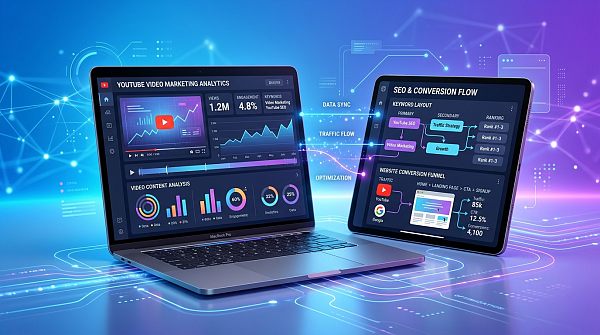
Many enterprises mistakenly believe that YouTube success depends on equipment, editing level, or advertising budget. In fact, the real gap is usually determined by the following 4 factors:
- Is the content aligned with search intent?
Users come to YouTube not just to "browse videos," but also to "search for answers." Tutorials, reviews, comparisons, cases, pitfall avoidance, troubleshooting, and industry trends are more likely to capture active search traffic. - Can you hook viewers in the first 30 seconds?
The recommendation system looks at CTR, watch time, and completion rate. If the opening is too long or the information density is low, it's difficult to continue scaling even if the topic is good. - Is the channel focused and consistent?
A channel that talks about brand stories today, posts product specs tomorrow, and chases unrelated hot topics the day after makes it hard for the platform to judge who to recommend you to. Vertical content is more likely to form a stable audience. - Is the traffic directed toward business goals?
Views are not the result; inquiries, lead generation, website visits, dealer cooperation, and after-sales efficiency improvements are the true goals of corporate YouTube marketing.
In other words, the answer to how to gain traction in YouTube video marketing is not to "post more," but to "post the right content + use the right structure + use the right channels + establish a closed-loop conversion."
Which types of content should enterprises prioritize in YouTube video marketing?
If your goal is stable growth rather than a lucky viral hit, it is recommended to prioritize the following types of video content:
1. Search-based content: Capturing active demand
This type of content is most suitable for SEO strategy, such as:
- How to use the product
- How to maintain equipment
- How to choose industry solutions
- What is the difference between Product A and Product B
- How to handle common failures
The advantage of these videos is their long lifecycle and ability to continuously bring in precision traffic. Especially for manufacturing, equipment, and B2B service enterprises, search-based content often brings in more effective inquiries than simple brand promotional films.
2. Proof-based content: Enhancing trust
This includes customer cases, factory footage, testing processes, delivery scenes, after-sales QA, and QC processes. They help potential customers confirm that you don't just "talk the talk" but can "walk the walk." For industries that value quality, safety, and stability, this type of content is particularly important.
3. Conversion-based content: Driving consultation or sales
Such as product demos, solution introductions, application scenario explanations, price logic analysis, and selection guides. The purpose of these videos is not simple views, but to lower the decision-making threshold so that interested customers are willing to take the next step and contact you.
4. Distribution-oriented content: Magnifying reach
Short video clips can be extracted from long videos and posted to YouTube Shorts and other social platforms to expand reach, and then drive interested users back to the full video, official website, or landing page. This is also a common practice for social media marketing and video content linkage.
If the enterprise involves vertical industry solution displays, it is also important to synchronize and accumulate them within the official website's content system. For example, for equipment manufacturing and overseas promotion scenarios, pages like Laser Engraving Machine Industry Solutions are suitable for use with YouTube content: the video is responsible for attraction and explanation, while the website is responsible for reception and conversion.
To make videos gain traction more easily, how exactly should titles, thumbnails, and keywords be handled?
This is the most frequently asked question at the execution level and the most easily misunderstood part. YouTube SEO is not about simply stacking keywords, but about making the platform clearer about what problem your video is solving.
Title: Satisfy clicks first, then ensure accuracy
An effective title usually meets 3 points:
- Contains core keywords, such as "YouTube Video Marketing," "YouTube Ads," "Product Demo," "Selection Guide," etc.
- Clear result orientation, such as "Increase Inquiries," "Improve Views," "Avoid Pitfalls."
- Avoid excessive exaggeration to ensure content consistency with the title.
For example, compared to "How enterprises do marketing well," something like "B2B Corporate YouTube Marketing: How to get the first batch of inquiries from 0 to 1" is more specific and has higher search value.
Thumbnail: Convey core information, don't just chase aesthetics
High-CTR thumbnails usually have these characteristics:
- Focused theme, just one key point is enough.
- Minimal and clear text, legible even on mobile devices.
- Character expressions, product close-ups, and result comparison charts are more likely to attract attention.
- Consistent style, conducive to channel recognition.
Keywords: Organize content around real search terms
Keyword placement is recommended in the following locations:
- Title
- First two lines of description
- Chapter titles
- Subtitles and voiceover content
- Tags and related topic words
The key is not to stuff them, but to cover expressions that users actually search for, such as "equipment installation tutorial," "laser engraving machine demo," "how to choose laser engraving machine supplier," etc. If an enterprise has a clear industry direction, keywords can be further segmented around application scenarios, national markets, procurement stages, and after-sales issues.
Views are up but not enough; how to turn YouTube traffic into inquiries and customers
This is a step that enterprises cannot afford to ignore. Many accounts don't lack traffic; they lack a conversion path.
To improve conversion, it is recommended to start from the following aspects:
1. Set clear Call to Action (CTA) for every video
Don't just say "Welcome to follow." If the goal is customer acquisition, clearly tell users what to do next, such as:
- Visit the official website for detailed specifications
- Download the product catalog
- Contact a consultant for a solution
- Book a demo or quote
2. Consistency between video content and landing page
If the video discusses a specific application scenario, the landing page should also continue to explain the solutions, advantages, cases, and contact information for that scenario, rather than jumping users to a cluttered homepage.
3. Establish a content matrix, not just single outputs
A potential customer rarely makes a decision after watching just one video. More common is: first watch a short video to learn, then watch a case video to build trust, then enter the official website to compare specs, and finally contact sales. Therefore, YouTube video marketing should advance in coordination with websites, SEO articles, social media content, and advertising.
4. Use data to judge "which type of content is most valuable"
Don't just focus on views; also look at:
- Average watch time
- Click-through rate (CTR)
- Website jump rate
- Form submission rate
- Inquiry quality
- Conversion performance in different countries/regions
This type of data helps enterprises determine which content is just popular and which content truly brings business value.
Should you run YouTube Ads? In what situations is "Organic Traffic + Advertising" more effective?
If an enterprise wants to verify the market faster, reach customers in specific countries, or amplify certain high-value content, YouTube Ads are usually worth doing. But the premise is: first have basic high-quality video materials and clear conversion goals.
Think of advertising as an "accelerator," not a "lifesaver." If the video itself is unwatchable, simply throwing money at it will rarely be effective in the long run.
Scenarios suitable for advertising include:
- New product launch, requiring fast awareness
- Key market expansion, requiring precise coverage of regional customers
- Promotion before and after exhibitions to capture leads
- Testing different selling points to see which one brings in more inquiries
In execution, you can adopt the method of "test naturally first, then amplify with ads": see which videos have better CTR, watch time, and engagement, and then concentrate the budget on the well-performing materials. This is usually more stable than blind advertising from the start.
How should different enterprise stages realistically allocate YouTube marketing resources?
Not all enterprises need heavy investment from the start. A more realistic approach is to allocate resources according to stages:
Starting Stage
Prioritize setting up channel basics, clarifying content direction, completing keyword research, and creating 5 to 10 videos with search and conversion value to verify the direction.
Growth Stage
Start forming regular column updates, establish a linkage mechanism for long videos + short videos + website landing pages, and introduce basic advertising to test different markets and audiences.
Maturity Stage
Focus on refined operations, including multi-language content, localized advertising, remarketing, channel cooperation, and CRM lead tracking. At this point, YouTube is no longer just a content platform but a key node in the overseas customer acquisition system.
If the enterprise's industry has high requirements for product display, category navigation, and global customer search experience, then on the content reception side, more systematic solutions can also be considered. For example, building a website system around product display efficiency, smart classification, and overseas conversion path optimization ensures that the traffic brought by YouTube is not wasted.
Conclusion: To make YouTube video marketing gain traction more easily, the focus is on "right content," not "blind quantity"
How to gain traction more easily in YouTube video marketing? The core conclusion can be summarized in one sentence: Attract users with content that matches search intent, retain users with clear video structures, amplify traffic with SEO and advertising, and complete conversion with websites and landing pages.
For enterprises, what is truly worth pursuing is not a single accidental viral hit, but a sustainable, replicable video marketing system that brings business results. As long as the content direction, keyword layout, distribution strategy, and conversion path are correctly established, YouTube can not only improve brand exposure but also become an important channel for stably acquiring business opportunities.
Related Articles



Related Products
 EasyCamp SaaS Smart Website Marketing SystemE-Yingbao SaaS Smart Website Marketing System: AI-powered, zero-code website building. Rapidly launch multilingual independent e-commerce sites in just 10 minutes. Global server acceleration and AI-driven SEO optimization empower businesses to efficiently connect with global markets. The seamless integration of technology and user-friendly operation makes building e-commerce sites incredibly simple.
 AI+SEM Intelligent Advertising Marketing SystemAI+SEM drives intelligent ad creation, empowering full-funnel precision advertising marketing. The system automatically generates weekly/monthly reports, AI recommends keywords and target countries, monitors core metrics in real-time with intelligent alerts, and enables one-click high-conversion ad solutions to help quickly acquire customers and improve ROI.
 AI+SEO Dual Engine Optimization ServiceEasyWin AI+SEO Dual Engine Optimization System leverages AI-powered keyword mining, content generation, and comprehensive technical optimization to help foreign trade enterprises acquire high-quality organic traffic, significantly improving search rankings and conversion rates.
 AI+SNS Social Media Marketing SystemYingbao AI+SNS Social Media Marketing System - Precision social capture for the social media era. Supports one-click content synchronization across major platforms like Facebook and LinkedIn. AI intelligently rewrites posts for enhanced relevance. 24/7 AI customer service and user profiling analysis empower businesses to efficiently expand into global markets.
 AI+SEO营销解决方案易营宝AI+SEO营销解决方案,通过AI批量写作、智能生成TDK、精准关键词扩词等功能,全面优化网站SEO效果,提升流量与转化率。助力企业构建高效智能网站新生态。
 AI+SEM Advertising Marketing SolutionsAI+SEM Advertising Marketing Solution leverages AI technology to deeply empower SEM ad campaigns. It automatically generates weekly/monthly reports using AI, presenting account data across multiple dimensions for comprehensive insights into campaign performance and trends. The system precisely recommends keywords and target countries, intelligently generates high-conversion ad copy, and enables one-click activation of efficient campaign plans to help businesses rapidly acquire customers. Simultaneously, it monitors core metrics in real time, intelligently identifies abnormal fluctuations, and issues timely alerts to ensure stable, high-return advertising results.
 Domain Name ServicesEasyWin provides professional domain name services, including intelligent queries, one-stop registration, brand protection, and full lifecycle management, helping businesses build a digital brand image.
 EasyOperate B2C Cross-Border E-Commerce Platform & Independent WebsiteEasyStore B2C Cross-border E-commerce Independent Store is an intelligent website building and cross-border e-commerce integrated solution independently developed by EasyStore Information Technology (Beijing) Co., Ltd. The system is specially designed for small and medium-sized as well as large export enterprises, integrating 'website building, operation, marketing, advertising, and conversion' into one, helping enterprises quickly establish cross-border e-commerce independent stores to achieve brand globalization and global sales growth.
The platform supports multiple languages, multiple currencies, and multi-channel marketing, with built-in AI intelligent translation and SEO optimization systems, suitable for mainstream markets such as Southeast Asia, Europe and America, Latin America, and the Middle East, assisting Chinese manufacturing enterprises in efficiently deploying international e-commerce strategies. SSL证书易营宝提供专业SSL安全证书服务,包括单域名和泛域名证书,确保网站数据传输加密、身份验证和完整性保护,助力企业建立安全可信的在线业务环境。









