









- The China-US tariff arrangement has reached a preliminary consensus, and the trade association will be establishedJun 15, 2026View details
- What determines B2C cross-border e-commerce website development costs? A breakdown of features, interfaces, and deployment methodsJun 17, 2026View details
- China-Morocco zero-tariff access, a breakthrough in the cost of Moroccan goods exports to ChinaJun 11, 2026View details
- What signal should be released for the suspension of exports to JapanJun 10, 2026View details
- China's May LNG imports rebounded, with increased volumes from Russia and Canada filling the Middle East supply gapJun 10, 2026View details
- Will GEO change its SEO strategy?Jun 04, 2026View details
B2B Foreign Trade Solution Selection Recommendations: How to Balance Quotation, Delivery, and Scalability
Introduction
In the wave of digitalization, choosing the right B2B foreign trade solution has become a key factor for enterprises to expand into the global market. Faced with diverse business needs and complex overseas competition, companies must not only consider pricing and delivery cycles but also focus on system scalability and long-term ROI. This article will revolve around "B2B Foreign Trade Solution Selection Recommendations," combining the decade-long expertise of E-Commerce Information Technology (Beijing) Co., Ltd., to analyze how to strike a balance between budget, performance, and future expansion. Additionally, the article will provide systematic and practical decision-making references for foreign trade enterprises from the perspectives of website construction, SEO optimization, Yandex advertising, and social media marketing, helping companies efficiently expand into overseas markets.
I. Definition and Overview: The Essence and Selection Logic of B2B Foreign Trade Solutions

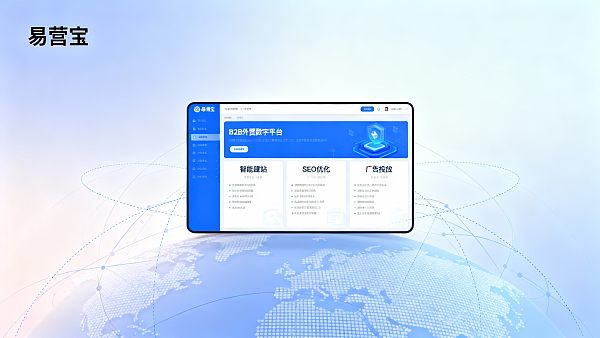
A B2B foreign trade solution refers to a systematic platform that supports transactions and communication between enterprises and international clients through digital means, typically including modules such as intelligent website building, SEO optimization, advertising placement, and social media operations. It is not only the foundational infrastructure for enterprises going global but also a comprehensive growth system. Unlike B2C websites, which emphasize user experience, B2B platforms prioritize information accuracy, trust credentials, and high conversion efficiency. For the question of "which B2B foreign trade solution provider is reliable," the key lies in whether its underlying technical architecture supports multilingual and multi-regional deployment and possesses flexible expansion capabilities. E-Commerce Information Technology (Beijing) Co., Ltd.'s AI-driven marketing platform, through AI keyword expansion, automated TDK generation, and an AI image system, digitizes and automates traditional foreign trade processes, significantly reducing manual involvement. At the same time, the system's AI marketing engine supports global deployment across seven continents, with independent site loading speeds increased by 40% and SEO scores improved by an average of 35%, providing a solid digital foundation for cross-regional operations.
II. Industry Background and Market Analysis: Global Foreign Trade Digitalization Trends
In 2024, driven by diversified supply chains and cross-border policy changes, global B2B enterprises are accelerating their digital transformation. According to Statista, the global B2B e-commerce market has exceeded $20 trillion, with a projected compound annual growth rate of over 17% in the next five years. Against this backdrop, "how foreign trade enterprises choose the right SEO optimization company" has become a core strategic topic. In recent years, companies have increasingly favored integrated platforms that combine website building, SEO, and lead generation, achieving closed-loop management from exposure to conversion. Particularly in regions with fragmented search engines like Yandex and Google, localized SEO and advertising strategies have become breakthrough points. For example, top-ranking Yandex SEO service providers often excel in Russian-language content processing and backlink resource optimization. In this domain, E-Commerce Information Technology’s multilingual AI website system leverages AI translation engines to achieve real-time content adaptation, solving the long-standing challenges of "high language costs and low conversion rates" for SMEs.
III. Application Scenarios: End-to-End Deployment from Intelligent Website Building to Multi-Channel Marketing
B2B foreign trade solutions are no longer limited to webpage construction but have expanded to multi-touchpoint scenarios such as social media, search engines, and advertising systems. Take manufacturing exporters as an example: they need to comprehensively showcase product parameters, certifications, and pricing. Through E-Commerce Information Technology’s intelligent website system, enterprises can quickly build adaptive websites, achieving unified display across mobile, tablet, and desktop devices—resolving the critical question of "what is adaptive website building" by automatically adjusting layouts based on access devices to enhance user experience and SEO scores. Additionally, leveraging E-Commerce Information Technology’s AI advertising algorithm, enterprises can achieve precise placements on platforms like Yandex, Meta, and Google Ads, with the system automatically identifying high-conversion keywords and ad creatives, reducing average placement costs by 25%. Simultaneously, integrating social media matrices with advertising systems through AI+SNS Omnichannel Marketing System enables cross-platform content synchronization and automated A/B testing, significantly improving inquiry quality and fan interaction rates in the short term.
IV. Comparative Analysis: Different Promotion Paths for B2B and B2C
How do B2B and B2C websites differ in marketing strategies? The differences primarily lie in audience decision-making chains and content strategies. B2C focuses on emotional appeal and visual attraction, while B2B emphasizes data, credentials, and technical capabilities. Therefore, foreign trade websites should prioritize building a "trust structure," such as technical patents, certifications, and success cases, to foster cross-cultural trust. Moreover, B2B clients often require multi-layer approval processes, so content must cater to the needs of "users, quality control personnel, and decision-makers." For example, E-Commerce Information Technology’s websites allow customizable product-level information architectures, enabling potential clients to quickly filter matching solutions. Through its AI keyword system, enterprises can obtain real-time keyword reports, generating differentiated SEO layouts for different client types. Additionally, the AI+SNS Omnichannel Marketing System’s precise user profiling and predictive recommendation functions can forecast client interests in advance, enabling customized content pushes—particularly crucial for high-order machinery and electronics exporters.
V. Cost and Selection Recommendations: Balancing Budget, Efficiency, and Scalability
Many enterprises are most concerned with two questions during selection: "What is the cost of quickly building a foreign trade website?" and "Is B2B website construction expensive?" Generally, traditional custom development models are costly and time-consuming,不利于市场快速迭代。而基于SaaS的智能外贸建站平台能以1/3成本完成部署,并支持按需升级模块。全球建站SaaS平台能提升SEO评分吗?答案是肯定的。通过AI算法优化页面权重与Meta结构,平均可带来30%以上的SEO提升。采购阶段,建议企业综合考量以下三个维度:一是系统架构的开放性,即是否易于接入CRM或ERP系统;二是可扩展性,是否支持多站点部署与多语言切换;三是成本弹性,是否具备按量付费或年度订阅机制。E-Commerce Information Technology’s AI+大数据中台正是基于此逻辑构建,融合AI生图、智能检测与动态优化技术,为客户提供全周期可成长平台,有效降低“选型焦虑”,平衡报价与交付质量的矛盾。
VI. Case Studies: Growth Stories in AI-Empowered Foreign Trade
Take a mechanical parts exporter as an example: previously, its ad account structure was chaotic, resulting in a long-term ROI below 1.2. After adopting E-Commerce Information Technology’s AI marketing engine, the system optimized Google and Yandex account structures using AI ad diagnostic tools, automatically generating high-CTR ad copy and dynamic keyword libraries—raising ROI to 2.8 within three months. Simultaneously, leveraging social media automation features, LinkedIn premium inquiries grew by 220%, while Facebook ad CPC dropped by 40%. The system is ISO27001 certified, with encrypted data compliant with GDPR standards, achieving dual guarantees of "security + efficiency." Another education client deployed multilingual portals through the intelligent website system, increasing potential student conversion rates by 36%. These cases fully demonstrate that deep integration of AI and SEO not only optimizes search performance but also helps enterprises achieve global brand growth.
VII. Trends and Future Outlook: AI+Data-Driven Global Competition
In the next three to five years, B2B foreign trade solutions will evolve toward greater intelligence and decentralization. AI content generation, predictive analytics, and blockchain traceability will become core elements of foreign trade transactions. As global privacy and data security requirements tighten, service providers with dual ISO27001 and GDPR certifications will gain a competitive edge. E-Commerce Information Technology plans to build a decentralized marketing ecosystem along the AI+blockchain integration path, promoting global enterprise data collaboration and ad resource sharing. For decision-makers, trends imply new opportunities: leveraging big data insights into client behavior and AI to reshape brand communication will be key to winning in global operations. For startups, a sustainable, scalable digital growth platform is the core foundation for reducing trial-and-error costs and achieving global reach.
VIII. Why Choose E-Commerce Information Technology: Paving the Way for Chinese Brands Worldwide
As a member of "China's Top 100 SaaS Enterprises," E-Commerce Information Technology (Beijing) Co., Ltd. leverages over a decade of AI and big data R&D capabilities to provide intelligent website building, SEO optimization, social media marketing, and ad placement services to over 100,000 enterprises. Its "AI+localized service" strategy not only helps clients achieve precise overseas market reach but also ensures system security and performance stability through continuously iterated technical platforms. For enterprises aspiring to build independent brands and reduce outsourcing dependency, choosing a stable and reliable technology partner is the first step toward global expansion. Whether you are a manufacturer, educational institution, or cross-border e-commerce business, a single integration grants access to multilingual website building, ad management, and social media matrix support. If you are seeking a foreign trade marketing partner that can genuinely fuel enterprise growth, explore E-Commerce Information Technology’s solutions now—let technology empower growth and intelligence accelerate global competition.
- Website Development
- Website Builder Platform
- Foreign Trade Website Development
- Social Media Marketing
- Social media management
- B2B website
- Inquiry quality
- Google Ads
- B2B Foreign Trade
- Yandex Advertising
- AI+SNS All-in-One Smart Marketing System
- Facebook Ads
- SEO Optimization Company
- Yiyingbao
- SEO
- Independent Website
- Smart website builder system
- SEO Optimization
- Smart Website Building
- AI Translation
- AI Marketing Engine
- Social Media Automation
- AI Translation Engine
- Yandex ad placement
- Global Website Building SaaS Platform
- Yandex SEO company
- Quickly Build a Foreign Trade Website
- AI Website Building
- cross-border e-commerce
- EYB AI Marketing
- AI Marketing
- B2B Foreign Trade Solutions
Related Articles
 Shanghai export freight index rose 4.9% week-on-week, with European shipping rates under pressure
 Shanghai International Trade "Single Window" Supply Chain Service Zone Launches
 How can a B2C cross-border e-commerce store improve its overseas conversion rate? An optimization approach from page to checkout

Related Products
 EasyCamp SaaS Smart Website Marketing SystemE-Yingbao SaaS Smart Website Marketing System: AI-powered, zero-code website building. Rapidly launch multilingual independent e-commerce sites in just 10 minutes. Global server acceleration and AI-driven SEO optimization empower businesses to efficiently connect with global markets. The seamless integration of technology and user-friendly operation makes building e-commerce sites incredibly simple.
 AI+SEM Intelligent Advertising Marketing SystemAI+SEM drives intelligent ad creation, empowering full-funnel precision advertising marketing. The system automatically generates weekly/monthly reports, AI recommends keywords and target countries, monitors core metrics in real-time with intelligent alerts, and enables one-click high-conversion ad solutions to help quickly acquire customers and improve ROI.
 AI+SEO Dual Engine Optimization ServiceEasyWin AI+SEO Dual Engine Optimization System leverages AI-powered keyword mining, content generation, and comprehensive technical optimization to help foreign trade enterprises acquire high-quality organic traffic, significantly improving search rankings and conversion rates.
 AI+SNS Social Media Marketing SystemYingbao AI+SNS Social Media Marketing System - Precision social capture for the social media era. Supports one-click content synchronization across major platforms like Facebook and LinkedIn. AI intelligently rewrites posts for enhanced relevance. 24/7 AI customer service and user profiling analysis empower businesses to efficiently expand into global markets.
 AI+SEO营销解决方案易营宝AI+SEO营销解决方案,通过AI批量写作、智能生成TDK、精准关键词扩词等功能,全面优化网站SEO效果,提升流量与转化率。助力企业构建高效智能网站新生态。
 AI+SEM Advertising Marketing SolutionsAI+SEM Advertising Marketing Solution leverages AI technology to deeply empower SEM ad campaigns. It automatically generates weekly/monthly reports using AI, presenting account data across multiple dimensions for comprehensive insights into campaign performance and trends. The system precisely recommends keywords and target countries, intelligently generates high-conversion ad copy, and enables one-click activation of efficient campaign plans to help businesses rapidly acquire customers. Simultaneously, it monitors core metrics in real time, intelligently identifies abnormal fluctuations, and issues timely alerts to ensure stable, high-return advertising results.
 Domain Name ServicesEasyWin provides professional domain name services, including intelligent queries, one-stop registration, brand protection, and full lifecycle management, helping businesses build a digital brand image.
 EasyOperate B2C Cross-Border E-Commerce Platform & Independent WebsiteEasyStore B2C Cross-border E-commerce Independent Store is an intelligent website building and cross-border e-commerce integrated solution independently developed by EasyStore Information Technology (Beijing) Co., Ltd. The system is specially designed for small and medium-sized as well as large export enterprises, integrating 'website building, operation, marketing, advertising, and conversion' into one, helping enterprises quickly establish cross-border e-commerce independent stores to achieve brand globalization and global sales growth.
The platform supports multiple languages, multiple currencies, and multi-channel marketing, with built-in AI intelligent translation and SEO optimization systems, suitable for mainstream markets such as Southeast Asia, Europe and America, Latin America, and the Middle East, assisting Chinese manufacturing enterprises in efficiently deploying international e-commerce strategies. SSL证书易营宝提供专业SSL安全证书服务,包括单域名和泛域名证书,确保网站数据传输加密、身份验证和完整性保护,助力企业建立安全可信的在线业务环境。









