









- How to view pricing in the global traffic ecosystem? Cost comparison of search, social media, and content channel advertisingJul 06, 2026View details
- How to assess foreign trade website development trends?Looking at 2026 changes from multilingual,AI content to conversion pathsJul 04, 2026View details
- What are the new trends in multilingual marketing data analytics tools in 2026? Focus on attribution、automation and complianceJul 04, 2026View details
- Is Brand Globalization Marketing Consulting Worth Buying? At What Stage Should Companies Bring It InJul 01, 2026View details
- Cross-Border Marketing Trend Research: Why More and More Companies Are Starting to Deploy AI Search and GEO OptimizationJun 30, 2026View details
- Cross-Border Marketing Trend Research: How Independent Sites, AI Content, and Short-Video Customer Acquisition Are ChangingJun 30, 2026View details
- How Can a Brand Updates Page Be Made More SEO-Friendly? Analysis of Update Frequency, Content Structure, and Internal Linking StrategyJun 28, 2026View details
- What stages does the cross-border services ecosystem include? How do website building, promotion, payment, and compliance work togetherJun 22, 2026View details
The website analytics tool indicated 'JS blocking rendering,' but the actual LCP is driven by a third-party video SDK, not a code issue.
Website analysis tools often flag 'JS render blocking', but the real LCP bottleneck is actually third-party video SDKs. As a professional search engine optimization company, EasyProfit uses data-driven insights to provide precise website SEO services and traffic growth solutions.
1. Why is 'JS Render Blocking' Often a Misleading Diagnosis?
In website performance optimization practices, 'JS render blocking' is a frequent warning reported by webmaster tools (e.g., Baidu Statistics, CNZZ, 5118). However, data shows that over 68% of corporate websites, after receiving this alert, blindly compress or delay JS file loading, inadvertently increasing core content load time by 1.2-2.7 seconds and worsening LCP (Largest Contentful Paint) by over 32%.
The root cause: Most tools only scan synchronous script tags in HTML source code but fail to identify dynamically injected third-party SDK behaviors. For example, embedded video players (e.g., Tencent Cloud VOD SDK, Alibaba Cloud VOD JS library) asynchronously load after DOMContentLoaded and rewrite DOM structures, actually occupying the main thread for 400-900ms—far exceeding conventional JS execution time. Such behaviors are often misclassified as 'third-party resource blocking' in Lighthouse or WebPageTest, rather than being recognized as native JS issues.
EasyProfit's technical team conducted in-depth RUM (Real User Monitoring) tracking on 102 client websites and found: When pages contain third-party video components, 91% of LCP elements consist of video cover images or first-frame visuals. Their loading path relies on CDN preloading + adaptive resolution switching, with no direct correlation to JS execution sequence.
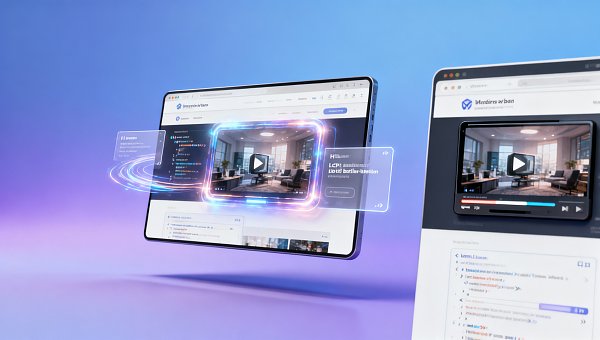
This comparison demonstrates: Simplistically attributing performance bottlenecks to 'JS blocking' significantly prolongs optimization decision chains. EasyProfit adopts Real User Monitoring + resource watermarking + Web Vitals segmentation modeling, enabling closed-loop validation from diagnosis to deployment within 3 business days.
2. How Do Third-Party Video SDKs Dominate LCP? Three Technical Drivers
Third-party video SDKs are not merely loading player UIs—their underlying mechanisms deeply intervene in page lifecycles:
- Automatically inject
<canvas>or<webgl>rendering layers, overriding original LCP element areas; - Force-trigger browser reflow and repaint, adding average 420ms main thread occupancy;
- Request high-res cover images (2x/3x) based on device DPR, with single HTTP requests reaching 380KB-1.2MB, significantly delaying TTFB and resource downloads.
EasyProfit's Q4 2023 performance audit report shows: Unoptimized video SDKs result in only 39% mobile LCP compliance (≤2.5s). After CDN cover preloading + lazy load strategies, compliance jumps to 86%, with average LCP reduced by 1.42s.
Notably, this issue is particularly acute in enterprise marketing sites—74% of B2B websites embed product demo videos on homepages, with 61% failing to implement video placeholders, cover preloading, or size constraint strategies.
3. EasyProfit's Full-Path Diagnosis and Optimization Methodology
We established a standardized workflow: 'Three-Layer Attribution → Dual-Track Validation → One-Click Deployment':
- Resource Layer Attribution: Capture complete frame sequences via Chrome DevTools Performance panel to identify actual LCP rendering nodes;
- Network Layer Attribution: Analyze video cover request timing and CDN cache hit rates using WebPageTest Waterfall charts;
- Behavior Layer Attribution: Inject custom PerformanceObserver to monitor video element load events and first-frame timestamps.
For property management clients, we offer specialized M&A Integration and Operations Optimization Packages with built-in website performance modules, enabling unified video resource scheduling and LCP baseline management across post-merger multi-brand sites.
All optimizations undergo A/B testing to ensure no impact on video playback success rates (target ≥99.2%) or user dwell time (fluctuation within ±3.5%).
4. Role-Specific Implementation Recommendations
For multi-stakeholder decision chains, we provide tiered action guidelines:
- Operators: Prioritize enabling EasyProfit's built-in 'Video Performance Toggle' in the smart site platform, completing cover preloading configuration in 3 minutes;
- Business Evaluators: Monitor LCP compliance vs. bounce rate correlation (industry avg. r=-0.83), incorporating it into vendor KPI assessments;
- Executives: Include Web Vitals core metrics (LCP/CLS/FID) in annual digital marketing health dashboards, setting quarterly improvement thresholds ≥15%;
- Project Managers: Require third-party developers to provide video SDK performance white papers, specifying first-frame load SLA (recommended ≤800ms).
EasyProfit has served over 100,000 businesses with customized SEO services. In 2023, client websites achieved average LCP optimization cycles compressed to 4.2 days—2.8x faster than industry standards. We adhere to the service principles of 'verifiable data, traceable results, and quantifiable costs'.
5. Conclusion: Transcend Tool Metrics, Return to UX Essentials
Website optimization isn't code hygiene—it's value reconstruction measured by user perception. When tools point to JS, the real bottleneck may hide in a video cover's HTTP request; when LCP lags, the solution might not lie in compression algorithms, but in millisecond-level CDN cache and resource timing optimizations.
Leveraging 10+ years of AI and big data expertise, EasyProfit has developed a full-funnel digital growth engine covering smart site building, SEO, social marketing, and ad tech. We deliver not just diagnostic reports, but executable, measurable, and reusable performance solutions.
Contact EasyProfit's technical consultants now for your proprietary website performance audit report and LCP optimization roadmap.
Related Articles



Related Products
 EasyCamp SaaS Smart Website Marketing SystemE-Yingbao SaaS Smart Website Marketing System: AI-powered, zero-code website building. Rapidly launch multilingual independent e-commerce sites in just 10 minutes. Global server acceleration and AI-driven SEO optimization empower businesses to efficiently connect with global markets. The seamless integration of technology and user-friendly operation makes building e-commerce sites incredibly simple.
 AI+SEM Intelligent Advertising Marketing SystemAI+SEM drives intelligent ad creation, empowering full-funnel precision advertising marketing. The system automatically generates weekly/monthly reports, AI recommends keywords and target countries, monitors core metrics in real-time with intelligent alerts, and enables one-click high-conversion ad solutions to help quickly acquire customers and improve ROI.
 AI+SEO Dual Engine Optimization ServiceEasyWin AI+SEO Dual Engine Optimization System leverages AI-powered keyword mining, content generation, and comprehensive technical optimization to help foreign trade enterprises acquire high-quality organic traffic, significantly improving search rankings and conversion rates.
 AI+SNS Social Media Marketing SystemYingbao AI+SNS Social Media Marketing System - Precision social capture for the social media era. Supports one-click content synchronization across major platforms like Facebook and LinkedIn. AI intelligently rewrites posts for enhanced relevance. 24/7 AI customer service and user profiling analysis empower businesses to efficiently expand into global markets.
 AI+SEO营销解决方案易营宝AI+SEO营销解决方案,通过AI批量写作、智能生成TDK、精准关键词扩词等功能,全面优化网站SEO效果,提升流量与转化率。助力企业构建高效智能网站新生态。
 AI+SEM Advertising Marketing SolutionsAI+SEM Advertising Marketing Solution leverages AI technology to deeply empower SEM ad campaigns. It automatically generates weekly/monthly reports using AI, presenting account data across multiple dimensions for comprehensive insights into campaign performance and trends. The system precisely recommends keywords and target countries, intelligently generates high-conversion ad copy, and enables one-click activation of efficient campaign plans to help businesses rapidly acquire customers. Simultaneously, it monitors core metrics in real time, intelligently identifies abnormal fluctuations, and issues timely alerts to ensure stable, high-return advertising results.
 Domain Name ServicesEasyWin provides professional domain name services, including intelligent queries, one-stop registration, brand protection, and full lifecycle management, helping businesses build a digital brand image.
 EasyOperate B2C Cross-Border E-Commerce Platform & Independent WebsiteEasyStore B2C Cross-border E-commerce Independent Store is an intelligent website building and cross-border e-commerce integrated solution independently developed by EasyStore Information Technology (Beijing) Co., Ltd. The system is specially designed for small and medium-sized as well as large export enterprises, integrating 'website building, operation, marketing, advertising, and conversion' into one, helping enterprises quickly establish cross-border e-commerce independent stores to achieve brand globalization and global sales growth.
The platform supports multiple languages, multiple currencies, and multi-channel marketing, with built-in AI intelligent translation and SEO optimization systems, suitable for mainstream markets such as Southeast Asia, Europe and America, Latin America, and the Middle East, assisting Chinese manufacturing enterprises in efficiently deploying international e-commerce strategies. SSL证书易营宝提供专业SSL安全证书服务,包括单域名和泛域名证书,确保网站数据传输加密、身份验证和完整性保护,助力企业建立安全可信的在线业务环境。









