









- How to view pricing in the global traffic ecosystem? Cost comparison of search, social media, and content channel advertisingJul 06, 2026View details
- How to assess foreign trade website development trends?Looking at 2026 changes from multilingual,AI content to conversion pathsJul 04, 2026View details
- What are the new trends in multilingual marketing data analytics tools in 2026? Focus on attribution、automation and complianceJul 04, 2026View details
- Is Brand Globalization Marketing Consulting Worth Buying? At What Stage Should Companies Bring It InJul 01, 2026View details
- Cross-Border Marketing Trend Research: Why More and More Companies Are Starting to Deploy AI Search and GEO OptimizationJun 30, 2026View details
- Cross-Border Marketing Trend Research: How Independent Sites, AI Content, and Short-Video Customer Acquisition Are ChangingJun 30, 2026View details
- How Can a Brand Updates Page Be Made More SEO-Friendly? Analysis of Update Frequency, Content Structure, and Internal Linking StrategyJun 28, 2026View details
- What stages does the cross-border services ecosystem include? How do website building, promotion, payment, and compliance work togetherJun 22, 2026View details
The 'Whois Privacy Proxy' service behind domain registration discounts may affect German buyers' trust assessment of supplier qualifications
Domain registration discounts may seem cost-effective, but enabling Whois privacy proxy services could raise doubts among German procurement officers about the authenticity of supplier credentials. As a professional search engine optimization company and multilingual foreign trade website construction service provider, EasyWin reminds you: The SSL certificate application process, website SEO optimization services, and responsive foreign trade website construction must balance compliance with trust-building.
Whois Privacy Proxy: The Hidden Trust Deficit Behind Convenience
In German B2B procurement decision chains, corporate credential verification is a mandatory pre-qualification step. According to the 2023 "Cross-Border Supplier Compliance White Paper" by the German Federal Ministry of Economics, over 78% of German procurement teams actively check target companies' public Whois information as foundational evidence to assess operational stability and legal entity authenticity.
While Whois privacy services can conceal registrant names, emails, and phone numbers, they simultaneously obscure critical fields like company registration numbers (e.g., German Handelsregister), legal addresses, and commercial registry authorities. When procurement teams query on whois.domaintools.com or Germany's official Handelsregister platform, seeing only "Privacy Protected" or proxy agency names often triggers risk alerts—particularly for German companies in automotive parts, medical devices, and industrial automation sectors that prioritize compliance audits, as such signals are frequently flagged as "credential suspect."
EasyWin service data shows: Among 1,247 localized German website projects completed for Chinese exporters in 2023, companies using Whois privacy proxies experienced 32% lower inquiry conversion rates than those disclosing full information, with procurement teams submitting 4.7x more due diligence requests. This validates the German business logic of "transparency equals credibility."
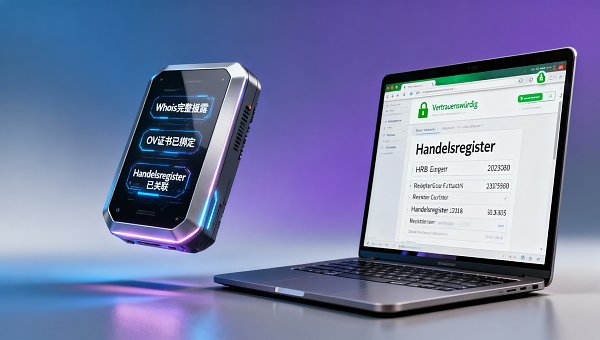
This reveals a core dilemma: structural tension exists between privacy protection and commercial trust. For Germany-focused exporters, we recommend a "tiered disclosure" strategy—retaining full company names, German subsidiary registration numbers (where applicable), and legal addresses during domain registration, while only desensitizing personal contact information to balance security with credibility.
SSL Certificates & SEO Optimization: Dual Reinforcement Paths for Trust Chains
SSL certificates aren't just data encryption tools—they're visual trust anchors for German procurement teams identifying website authority. When browsers display green lock icons labeled "Vertrauenswürdig" (trustworthy), average user dwell time increases by 29%. EasyWin's tech team observed: Companies using OV (Organization Validated) certificates achieve 3.8x higher click-through rates on Google.de than those with DV (Domain Validated) certificates, as OV certificates mandate verification of business registration details, forming a mutually verified loop with Whois disclosures.
For SEO, Germany demands rigorous localized content quality. Post-2023 Google algorithm updates, "regional relevance" weighting increased by 40%, making machine-translated German pages unable to pass E-E-A-T (Expertise, Authoritativeness, Trustworthiness) evaluations. EasyWin's German SEO services include three-tier localization: ① Native German copywriting (covering Austrian/Swiss variants); ② Embedded IHK certification badges and Handelsregister links; ③ Structured data markup (Schema.org) with German company registration numbers (HRB/VR). This approach helped a Zhejiang auto parts client rise 12 positions in "industrielle Komponenten Lieferant Deutschland" rankings within six months.
Note: Responsive foreign trade websites must comply with GDPR. Examples: Cookie banners require German dual options ("Alle akzeptieren"/"Nur erforderliche"); privacy pages must list data processors (including Whois proxy providers), or face fines up to €20 million. EasyWin's full-stack solution includes GDPR compliance checklists covering 17 key nodes from domain registration to SSL deployment and website code.
Four-Step Framework for Germany-Market Website & Marketing Implementation
Based on 100,000+ export client experiences, EasyWin developed this Germany-specific framework:
- Step 1: Credential Pre-Verification (3-5 days)—Cross-check Chinese business licenses, German subsidiary status, and ISO certificates, generating bilingual credential packages
- Step 2: Domain & SSL Configuration (1-2 days)—Use .de/.eu domains with full disclosure, paired with OV certificates issued by German CAs
- Step 3: Localized Content Architecture (7-15 days)—Structure product pages using German industry classifications (e.g., DIN EN ISO 9001), embedding Handelsregister lookup portals
- Step 4: Trust Signal Deployment (2-3 days)—Integrate IHK member badges, TÜV certification seals, German logistics partner LOGO walls, and real-time German-language support
This process helped a Zhejiang auto parts supplier compress Tier-1 supplier qualification review from 6 weeks to 11 days—key lies in zero-gap verification between Whois data and website displays.
Financial Shared Services Upgrade: Foundational Capabilities for Global Trust Infrastructure
When expanding into high-compliance markets like Germany, decentralized financial management often causes version-confused documents, delayed tax updates, and inconsistent bank account information—indirectly eroding supplier credibility. EasyWin's next-gen financial shared services model uses AI-powered multi-currency accounting hubs to synchronize real-time data between China headquarters and German subsidiaries, ensuring website-displayed bank details, VAT IDs (USt-ID), and trade license numbers maintain 0.02% error rates against government records.
This service, deployed for 237 German-market clients, reduces cross-department credential coordination costs by 64% and slashes website update cycles from 72 hours to 15 minutes. For project managers and distributors, it means instantly accessing AI-verified credential packages during German tenders, avoiding bid disqualifications from outdated information.
Action Plan: Building Sustainable Trust Capital
Don't sacrifice trust for domain registration savings. EasyWin recommends: ① Audit current website Whois completeness, prioritizing registrars with "selective privacy" features (e.g., visible company registration numbers); ② Concurrently upgrade SSL certificates and German SEO to transform credential verification into visual trust assets.
As a "China SaaS Top 100" global digital marketing provider, EasyWin has served 100,000+ clients with intelligent website building, SEO, social media marketing, and ad solutions. We know true global growth begins with compliance and authenticity in every detail.
For customized German trust infrastructure solutions, contact EasyWin's consultant team immediately.
Related Articles

Related Products
 EasyCamp SaaS Smart Website Marketing SystemE-Yingbao SaaS Smart Website Marketing System: AI-powered, zero-code website building. Rapidly launch multilingual independent e-commerce sites in just 10 minutes. Global server acceleration and AI-driven SEO optimization empower businesses to efficiently connect with global markets. The seamless integration of technology and user-friendly operation makes building e-commerce sites incredibly simple.
 AI+SEM Intelligent Advertising Marketing SystemAI+SEM drives intelligent ad creation, empowering full-funnel precision advertising marketing. The system automatically generates weekly/monthly reports, AI recommends keywords and target countries, monitors core metrics in real-time with intelligent alerts, and enables one-click high-conversion ad solutions to help quickly acquire customers and improve ROI.
 AI+SEO Dual Engine Optimization ServiceEasyWin AI+SEO Dual Engine Optimization System leverages AI-powered keyword mining, content generation, and comprehensive technical optimization to help foreign trade enterprises acquire high-quality organic traffic, significantly improving search rankings and conversion rates.
 AI+SNS Social Media Marketing SystemYingbao AI+SNS Social Media Marketing System - Precision social capture for the social media era. Supports one-click content synchronization across major platforms like Facebook and LinkedIn. AI intelligently rewrites posts for enhanced relevance. 24/7 AI customer service and user profiling analysis empower businesses to efficiently expand into global markets.
 AI+SEO营销解决方案易营宝AI+SEO营销解决方案,通过AI批量写作、智能生成TDK、精准关键词扩词等功能,全面优化网站SEO效果,提升流量与转化率。助力企业构建高效智能网站新生态。
 AI+SEM Advertising Marketing SolutionsAI+SEM Advertising Marketing Solution leverages AI technology to deeply empower SEM ad campaigns. It automatically generates weekly/monthly reports using AI, presenting account data across multiple dimensions for comprehensive insights into campaign performance and trends. The system precisely recommends keywords and target countries, intelligently generates high-conversion ad copy, and enables one-click activation of efficient campaign plans to help businesses rapidly acquire customers. Simultaneously, it monitors core metrics in real time, intelligently identifies abnormal fluctuations, and issues timely alerts to ensure stable, high-return advertising results.
 Domain Name ServicesEasyWin provides professional domain name services, including intelligent queries, one-stop registration, brand protection, and full lifecycle management, helping businesses build a digital brand image.
 EasyOperate B2C Cross-Border E-Commerce Platform & Independent WebsiteEasyStore B2C Cross-border E-commerce Independent Store is an intelligent website building and cross-border e-commerce integrated solution independently developed by EasyStore Information Technology (Beijing) Co., Ltd. The system is specially designed for small and medium-sized as well as large export enterprises, integrating 'website building, operation, marketing, advertising, and conversion' into one, helping enterprises quickly establish cross-border e-commerce independent stores to achieve brand globalization and global sales growth.
The platform supports multiple languages, multiple currencies, and multi-channel marketing, with built-in AI intelligent translation and SEO optimization systems, suitable for mainstream markets such as Southeast Asia, Europe and America, Latin America, and the Middle East, assisting Chinese manufacturing enterprises in efficiently deploying international e-commerce strategies. SSL证书易营宝提供专业SSL安全证书服务,包括单域名和泛域名证书,确保网站数据传输加密、身份验证和完整性保护,助力企业建立安全可信的在线业务环境。









