









- What stages does the cross-border services ecosystem include? How do website building, promotion, payment, and compliance work togetherJun 22, 2026View details
- How will email marketing costs change in 2026Jun 22, 2026View details
- The China-US tariff arrangement has reached a preliminary consensus, and the trade association will be establishedJun 15, 2026View details
- Should overseas brand marketing start with ads or contentJun 21, 2026View details
- What determines B2C cross-border e-commerce website development costs? A breakdown of features, interfaces, and deployment methodsJun 17, 2026View details
- China-Morocco zero-tariff access, a breakthrough in the cost of Moroccan goods exports to ChinaJun 11, 2026View details
- What signal should be released for the suspension of exports to JapanJun 10, 2026View details
- China's May LNG imports rebounded, with increased volumes from Russia and Canada filling the Middle East supply gapJun 10, 2026View details
Why Is There Such a Big Difference in Domain Registration Prices, and What Should You Look for Behind Low Prices
Why do domain registration prices vary so much? For financial approvers, a low price does not necessarily mean greater savings. Renewal fees, hidden charges, service guarantees, and brand risks all need to be clearly accounted for. Only by understanding the price differences can every website-building investment be spent where it truly creates value.
Domain registration pricing is shifting from “promotional competition” to “full lifecycle cost competition”
In the past, many companies focused mainly on the first-year quoted price when purchasing a domain, choosing whichever option was cheapest. But in the past two years, one clear change has emerged: the gap in domain registration prices on the market has grown wider and wider, with prices as low as a few yuan and as high as several hundred yuan existing at the same time, even though they appear to have the same extension and the same registration term. This is not simply a channel price difference, but rather a sign that domain services are evolving from a single registration action into a comprehensive service that includes renewals, DNS resolution, security, compliance, after-sales support, and operational support.
For financial approvers, this change is especially worth paying attention to. That is because a website is no longer just a display card, but the foundational entry point for marketing lead generation, brand engagement, overseas promotion, advertising campaigns, and data accumulation. Once a domain is chosen incorrectly, it may affect the launch schedule of the official website, search indexing efficiency, ad review approval, email system stability, and may even create the risk of losing brand assets. In other words, while domain registration pricing appears on the surface to be a procurement cost issue, it has in fact become a risk control issue within a company’s digital investment.
Why market differences in domain registration pricing are becoming increasingly obvious even for the same type of domain registration
First, platform strategies differ. Some platforms attract traffic with extremely low first-year prices, aiming to recover profits through renewals, value-added services, or bundled packages; others treat domains as the entry point for long-term customer operations, so their initial prices are not pushed too low, but they provide more stable services and more transparent renewal mechanisms.
Second, the value differentiation among extensions is significant. Mainstream generic extensions, regional extensions, and industry-specific extensions differ in registry policies, resource scarcity, compliance requirements, and market recognition, so differences in domain registration pricing naturally exist. This is especially true for overseas business, where the extension rules, real-name verification, and DNS resolution environment in different countries and language markets may all affect the final cost.
Third, service content is being repriced. Nowadays, more and more service providers package capabilities such as privacy protection, DNS resolution, anti-hijacking support, SSL certificate coordination, and enterprise website integration into their services. It may seem like you are only buying a domain, but in reality you are buying whether it can be put into operation smoothly. If a low-priced domain frequently encounters DNS resolution issues, slow ticket responses, or complex migration processes afterward, then the low price exists only on the quotation sheet.
From the trend perspective, domain registration pricing will not simply converge in the future, but will continue to stratify: low-price entry-level, standard service, and global marketing coordination models will coexist. If companies still approve purchases only based on the lowest quote, decision-making errors will become larger and larger.
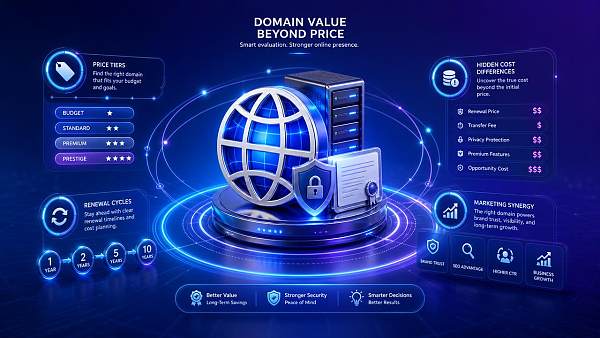
Behind low prices, what truly affects the budget is not the registration fee, but renewals and hidden charges
The signal most easily overlooked in financial approval is the structural issue of “cheap in the first year, expensive afterward.” Many companies only see domain registration prices of dozens of yuan or even lower when initiating a project, but fail to simultaneously verify renewal standards, transfer-out fees, privacy protection fees, certificate binding fees, and the scope of after-sales support. By the time the second-year renewal arrives, actual spending may have doubled, while the domain has already been tied to the website, email, business cards, and promotional materials, leaving almost no room for easy replacement.
A more realistic situation is that a domain does not exist independently. It is closely related to official website construction, SEO optimization, advertising landing pages, social media homepage redirects, corporate email, and data monitoring tools. If a company chooses an unstable service provider just to save a few dozen yuan, the labor and time costs caused later by migration, reconfiguration, DNS failure, or certificate expiration are often far higher than the initial price difference.
Therefore, a more reasonable approval approach is not to compare “who is the cheapest,” but to calculate the “three-year total cost of ownership.” This includes registration fees, renewal fees, necessary value-added items, operations and maintenance coordination costs, and switching costs. This method of evaluation is becoming a common trend among more mature companies when purchasing domains.
From website building to marketing, the criteria for judging domain registration pricing have already changed
Under the trend of integrated website + marketing services, a domain is no longer just a matter for the technical department, but a foundational procurement item jointly involving the marketing department, sales department, and finance department. Especially when companies expand into segmented overseas markets, whether a domain is suitable for localized communication, compatible with local search engines, and convenient for the later expansion of multilingual websites will all affect the return on investment.
For example, when some companies enter the Russian-speaking market, they do not just need a registrable address, but also need to build a complete entry point around local user search habits, language adaptation, and website trust mechanisms. At that time, domain selection becomes linked with multilingual website building, SEO deployment, certificate configuration, and local search optimization. One-stop services such as Russian industry website development and marketing solutions are more suitable for companies that want to simultaneously consider Russian website development, Yandex optimization tools, AI intelligent translation, .ru domain registration, and automatic SSL certificate application. For finance teams, the value of such bundled solutions lies not in the lowest price for a single item, but in reducing fragmented procurement and repeated communication.
Which types of organizations are most easily affected by fluctuations in domain registration pricing
Different companies are sensitive to different aspects of domain registration pricing, but the following types of scenarios are particularly affected.
Among them, the biggest challenge for financial approvers is not “understanding domain technology,” but whether they can establish the correct framework for judging costs. As long as they grasp the four variables of cycle, risk, coordination, and substitutability, they can quickly identify unreasonable low prices.
In the coming period, these are the signals to focus on when judging domain registration pricing
First, see whether the service provider emphasizes long-term stability rather than only limited-time promotions. The more mature the enterprise service market becomes, the more it values continuous operations rather than one-time transactions.
Second, see whether it supports coordination with website building, SEO, and marketing tools. In the future, official websites will be more deeply embedded in the customer acquisition chain. If a domain cannot smoothly connect with the website, security certificates, search optimization, and advertising tracking, the significance of a low price is limited.
Third, look at overseas and niche market capabilities. As more and more companies expand cross-border business, domain registration pricing will be increasingly influenced by localized service capabilities. Especially in markets such as Russian-speaking regions, Southeast Asia, and the Middle East, supporting services for local-language website building, regional extensions, and search ecosystems will become important points of differentiation.
Fourth, examine management permissions and risk control mechanisms. A domain is a company’s digital asset, and ownership, operation logs, expiration reminders, anomaly protection, and transfer procedures all affect asset security. A low price combined with chaotic management means extremely high long-term risk.
What evaluation method is now more suitable for financial approvers to adopt
Under the current trend, it is recommended to upgrade domain registration price approval from “unit price verification” to “checklist-based review.” The decision can be made in the following order: first confirm the domain’s purpose, whether it is for a brand official website, a marketing landing page, or an overseas market site; then check whether the extension matches the business positioning; after that verify the first-year price, renewal price, value-added service fees, and transfer rules; finally evaluate whether the service provider has website-building, SEO, and ongoing operational support capabilities.
If the company itself has already entered the stage of international market expansion, it is even more advisable to prioritize service providers that can integrate domain, website, and marketing resources. Although this approach may not secure the lowest domain registration price, it can significantly reduce communication, operations and maintenance, and trial-and-error costs. Taking integrated service providers such as Yiyingbao Information Technology (Beijing) Co., Ltd., which specialize in intelligent website building, SEO optimization, social media marketing, and advertising placement, as an example, their value lies in helping companies form a closed loop from entry-point assets to traffic growth, rather than splitting domain procurement into an isolated action.
See the price clearly, but understand the risk even more clearly
Returning to the core question: why do domain registration prices vary so much? The answer is not complicated, because what companies are buying today is no longer an isolated registration action, but a digital infrastructure asset that will continuously affect the brand, official website, marketing, and business expansion. Behind the price differences are promotional strategies, extension value, service depth, and methods of risk allocation.
For financial approvers, what truly matters is not obtaining the lowest quote, but ensuring that the budget is invested in a sustainable, manageable, and collaborative solution. If a company is evaluating domain procurement, it is worth focusing on these questions: Are renewals transparent? Are there hidden charges? Can the service provider support subsequent website building and marketing? Is the domain suitable for the target market and long-term brand use? When these questions are clarified in advance, domain registration pricing becomes truly comparable, and website-building investment is more likely to generate long-term returns.
Related Articles
 Are you really hitting the right target with Google FB for truck bed exports?
 It's easy to turn a foreign trade website into a piece of art, but it's the ultimate culprit behind your order decline
 Foreign trade website efficiency revolution! Yiyingbao component upgrade + inquiry optimization, inquiries surge!



Related Products
 EasyCamp SaaS Smart Website Marketing SystemE-Yingbao SaaS Smart Website Marketing System: AI-powered, zero-code website building. Rapidly launch multilingual independent e-commerce sites in just 10 minutes. Global server acceleration and AI-driven SEO optimization empower businesses to efficiently connect with global markets. The seamless integration of technology and user-friendly operation makes building e-commerce sites incredibly simple.
 AI+SEM Intelligent Advertising Marketing SystemAI+SEM drives intelligent ad creation, empowering full-funnel precision advertising marketing. The system automatically generates weekly/monthly reports, AI recommends keywords and target countries, monitors core metrics in real-time with intelligent alerts, and enables one-click high-conversion ad solutions to help quickly acquire customers and improve ROI.
 AI+SEO Dual Engine Optimization ServiceEasyWin AI+SEO Dual Engine Optimization System leverages AI-powered keyword mining, content generation, and comprehensive technical optimization to help foreign trade enterprises acquire high-quality organic traffic, significantly improving search rankings and conversion rates.
 AI+SNS Social Media Marketing SystemYingbao AI+SNS Social Media Marketing System - Precision social capture for the social media era. Supports one-click content synchronization across major platforms like Facebook and LinkedIn. AI intelligently rewrites posts for enhanced relevance. 24/7 AI customer service and user profiling analysis empower businesses to efficiently expand into global markets.
 AI+SEO营销解决方案易营宝AI+SEO营销解决方案,通过AI批量写作、智能生成TDK、精准关键词扩词等功能,全面优化网站SEO效果,提升流量与转化率。助力企业构建高效智能网站新生态。
 AI+SEM Advertising Marketing SolutionsAI+SEM Advertising Marketing Solution leverages AI technology to deeply empower SEM ad campaigns. It automatically generates weekly/monthly reports using AI, presenting account data across multiple dimensions for comprehensive insights into campaign performance and trends. The system precisely recommends keywords and target countries, intelligently generates high-conversion ad copy, and enables one-click activation of efficient campaign plans to help businesses rapidly acquire customers. Simultaneously, it monitors core metrics in real time, intelligently identifies abnormal fluctuations, and issues timely alerts to ensure stable, high-return advertising results.
 Domain Name ServicesEasyWin provides professional domain name services, including intelligent queries, one-stop registration, brand protection, and full lifecycle management, helping businesses build a digital brand image.
 EasyOperate B2C Cross-Border E-Commerce Platform & Independent WebsiteEasyStore B2C Cross-border E-commerce Independent Store is an intelligent website building and cross-border e-commerce integrated solution independently developed by EasyStore Information Technology (Beijing) Co., Ltd. The system is specially designed for small and medium-sized as well as large export enterprises, integrating 'website building, operation, marketing, advertising, and conversion' into one, helping enterprises quickly establish cross-border e-commerce independent stores to achieve brand globalization and global sales growth.
The platform supports multiple languages, multiple currencies, and multi-channel marketing, with built-in AI intelligent translation and SEO optimization systems, suitable for mainstream markets such as Southeast Asia, Europe and America, Latin America, and the Middle East, assisting Chinese manufacturing enterprises in efficiently deploying international e-commerce strategies. SSL证书易营宝提供专业SSL安全证书服务,包括单域名和泛域名证书,确保网站数据传输加密、身份验证和完整性保护,助力企业建立安全可信的在线业务环境。









