









- What stages does the cross-border services ecosystem include? How do website building, promotion, payment, and compliance work togetherJun 22, 2026View details
- How will email marketing costs change in 2026Jun 22, 2026View details
- The China-US tariff arrangement has reached a preliminary consensus, and the trade association will be establishedJun 15, 2026View details
- Should overseas brand marketing start with ads or contentJun 21, 2026View details
- What determines B2C cross-border e-commerce website development costs? A breakdown of features, interfaces, and deployment methodsJun 17, 2026View details
- China-Morocco zero-tariff access, a breakthrough in the cost of Moroccan goods exports to ChinaJun 11, 2026View details
- What signal should be released for the suspension of exports to JapanJun 10, 2026View details
- China's May LNG imports rebounded, with increased volumes from Russia and Canada filling the Middle East supply gapJun 10, 2026View details
Choosing a domain registration service platform or an agent: the difference is more than just price
When purchasing domain registration services, the difference between platforms and agents goes far beyond price; it also involves compliance, renewals, management efficiency, and subsequent marketing synergy. Choosing the right cooperation method is crucial for laying a solid foundation for your business's website development and growth.
For procurement personnel, a domain name may seem like just a basic element in website construction, but it actually impacts the launch cycle of a company's official website, brand asset ownership, overseas market deployment, DNS stability, and the efficiency of subsequent SEO and advertising. Especially in the context of integrated website and marketing services, choosing the wrong domain registration service often leads to additional communication and hidden costs in areas such as renewal processes, access control, real-name authentication, and certificate configuration.
Since its establishment in 2013, Yiyingbao Information Technology (Beijing) Co., Ltd. has continuously served enterprises' global growth scenarios, providing full-chain support around intelligent website building, SEO optimization, social media marketing, and advertising. For procurement departments, judging whether to use a platform model or an agency model should not only focus on the first year's fee, but should also be examined from three levels: asset security, operational synergy, and long-term total cost.
The core differences between platforms and agents can be seen in the four dimensions that procurement professionals care about most.
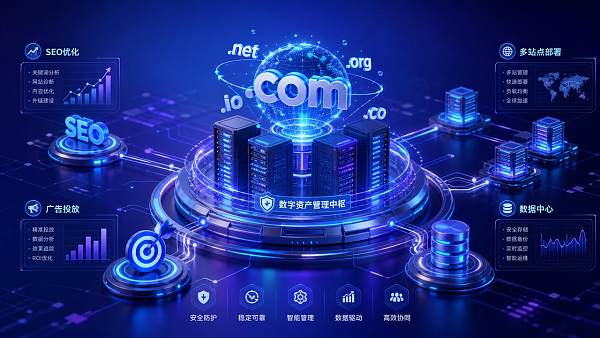
When purchasing domain registration services, many companies' first reaction is to compare the first-year registration price, which can range from tens to hundreds of yuan. However, from a purchasing perspective, the comparison period should be extended to 1 year, 3 years, or even 5 years. This is because the true cost of a domain name usually consists of four parts: registration, renewal, management, migration, and risk management, rather than a single price.
The platform model is more like standardized procurement.
Platforms typically offer features such as a unified console, self-service registration, bulk renewal, DNS resolution, and certificate application, making them suitable for businesses with more than one official website, multiple brand sites, or cross-border operations. For teams with 10, 20, or even 50 domains, platform-based management is more efficient in terms of permission allocation and ledger maintenance, reducing the risk of human error in missing renewals.
The agency model is more service-oriented.
Agents typically assist with registration suggestions, document submission, real-name verification, DNS configuration, and troubleshooting, making them suitable for small and medium-sized enterprises lacking dedicated IT or marketing support staff. Especially when the procurement goal is not just to buy a domain name, but to simultaneously advance website building, SEO implementation, and overseas campaign preparation, the agent model can save 2-4 weeks of internal coordination time.
Procurement decisions should not be based solely on the initial order quote.
While lower prices are common for the first year, procurement should focus more on factors such as renewal price fluctuations, transfer restrictions, whether management authority rests with the company, the clarity of invoices and contracts, and whether multi-department collaboration is supported. If the company subsequently plans to integrate website redesign, search engine optimization, and overseas advertising accounts, the seamless integration of the domain registration service with these processes is often more crucial than a 20% discount.
The table below is helpful for procurement personnel to quickly determine the differences between the two models during the project initiation or price comparison stage.
If a company is only registering a single brand domain name, platform procurement is not complicated. However, if it involves multiple regional markets, multiple distribution sites, and collaboration among subsidiaries, the value of the agency model in process integration becomes significantly amplified. When procuring domain registration services, the optimal solution is often not "which is cheaper," but rather which better matches the company's organizational capabilities.
When purchasing domain registration services, which hidden risks are most easily overlooked?
Based on experience with website launches, domain names are digital assets, but many risks lie outside of asset management. If procurement personnel only check the price and domain name type, they often overlook potential usage obstacles that may arise over the next 1-3 years. Especially when running a website, landing page, SEO-optimized page, and SEM campaign page simultaneously, even a small problem can impact the entire marketing chain.
Risk 1: Unclear registration entity and control.
The most typical problem is that domain names are registered with personal email addresses, verified by former employees, or held by agents without clear transfer rules. For procurement purposes, at least three things must be confirmed: whether the registration entity is a company, whether the management email address can be transferred, and whether the transfer code is obtainable. Otherwise, migration costs will be amplified when subsequent redesigns or service providers are changed.
Risk 2: Lack of transparency in renewal mechanisms
Many companies only pay attention to the promotional price for the first year, but overlook the fact that the price reverts to the original price from the second year onwards, and in some cases, the renewal price is more than double the registration price. When comparing domain registration services, procurement personnel should at least check the cost range for the next 2-3 renewal cycles, and confirm whether there are reminder mechanisms 7 days, 15 days, and 30 days before the expiration date, as well as whether there are additional fees for overdue redemption.
Risk 3: Inconsistent DNS integration with websites and advertising systems
Domain registration isn't the end of the process; it also involves configuring A records, CNAME records, MX records, TXT records, and more. Website deployment, corporate email, SSL certificates, search engine verification, and advertising landing page tracking all rely on accurate DNS resolution. If the registration platform only sells the domain and doesn't assist with troubleshooting, the internal team might waste 24-72 hours handling technical details before and after launch.
Risk 4: Lack of an integrated marketing perspective
For businesses focused on customer acquisition, domain names are also crucial for brand consistency, site credibility, conversion tracking, and organic search indexing. If domain registration services are disconnected from website building, SEO, and advertising, issues such as disorganized URL structures, 301 redirects, and scattered landing pages can easily arise, impacting subsequent conversion rates.
In practice, many companies handle domain name, website, and advertising optimization within the same service cycle. For example, after the site goes live, using an AI+SEM advertising marketing solution to provide keyword and country recommendations can reduce wasted advertising due to inconsistencies in site structure and domain name configuration, and timely detection of conversion fluctuations through core metric monitoring.
How can procurement personnel establish a set of practical selection criteria?
To ensure a solid procurement process for domain name registration services, it is recommended to establish an evaluation model based on four dimensions: assets, processes, collaboration, and response. This not only facilitates price comparisons but also helps establish unified standards during bidding, price inquiries, and supplier selection, reducing biases arising from decisions based solely on experience.
Six key inspection items recommended for verification
- Whether the domain name belongs to the enterprise entity and whether clear registration information can be provided.
- Does it support batch renewal, batch DNS resolution, and hierarchical access control, suitable for managing 5 or more domains?
- Is there a work order or dedicated service mechanism? Can the normal response time be controlled within 4 hours or 1 business day?
- Does it provide supporting assistance such as real-name authentication, DNS resolution, certificates, and search verification?
- Does it support future integration with website building, SEO, advertising accounts, and data statistics tools?
- Are the contract, invoice, renewal notice, and transfer rules clearly defined to avoid future disputes?
If the procurement project involves both website rebuilding and overseas deployment preparation, it is recommended to extend the evaluation of the supplier's capabilities to the integrated level of website + marketing services, rather than treating the domain name as an isolated IT item.
The table below can serve as a base version of the procurement evaluation checklist and is suitable for use during supplier communication, quotations, and internal reviews.
This table shows that the procurement evaluation of domain registration services should at least cover four categories: compliance, cost, technology, and service. If any one of these is missing, it may manifest as website delays, traffic loss, or management chaos.
A 3-step decision-making method suitable for procurement personnel
- First, clarify the purpose: is it a single official website, multiple brand websites, or an overseas marketing network?
- Recalculation cycle: Don't just look at the first year, but at least consider the total cost over 1-3 years.
- Finally, consider collaboration: confirm whether it needs to be integrated with website building, SEO, and advertising.
For businesses still in the stage of brand expansion overseas or multi-channel customer acquisition, service providers with marketing synergy capabilities are more valuable. YiYingBao, leveraging artificial intelligence and big data capabilities, has long served website building and global digital marketing scenarios, enabling the integration of domain names, official websites, search engine optimization, and advertising execution under a unified business objective, reducing post-purchase coordination costs.
From website building to customer acquisition, why does domain name selection affect subsequent conversion rates?
From a procurement perspective, domain registration is often seen as a front-end action; however, from an operational perspective, it continuously impacts website authority accumulation, brand consistency, link placement standardization, and data attribution quality. Especially when a company needs to complete 2-3 growth initiatives within a year, such as website redesign, SEO content deployment, and SEM testing, the domain management method directly determines execution efficiency.
A stable domain name system can bring at least three types of benefits.
First, it reduces access losses caused by parsing errors, expired certificates, and redirection problems. Second, it ensures stable search engine crawling and page indexing paths. Third, it facilitates unified configuration of advertising accounts, statistical tools, and form systems. For the procurement department, this means more controllable project delivery and easier acceptance of supplier service performance.
Domain name services and marketing growth are not two separate things.
When businesses begin to prioritize lead generation efficiency, domain names are no longer just IT assets, but rather part of their marketing infrastructure. For example, when advertising campaigns require the rapid generation of high-converting ad copy, the identification of keyword fluctuations, and the monitoring of campaign performance across different countries, stable site access and clear landing page paths are prerequisites. In this context, a service package that balances domain management and marketing synergy often offers greater long-term value than purchasing individual domains separately.
For businesses looking to improve campaign feedback speed, they can also learn more about AI+SEM advertising and marketing solutions. These solutions use AI to generate weekly and monthly reports, keyword suggestions, anomaly alerts, and country recommendations, helping procurement and business teams to more quickly verify whether the site and traffic channels are compatible.
Choosing between a platform and an agent for domain registration services essentially means choosing how your company will manage its digital assets over the next 1-3 years. Platforms are better suited for teams with strong self-management capabilities and a large domain portfolio; agents are better suited for companies that prioritize delivery efficiency and want to integrate website building and marketing efforts. For procurement personnel, what's truly worth comparing isn't a single price quote, but rather compliance clarity, renewal predictability, service response speed, and the ability to synergize with future growth.
If you are choosing a suitable domain registration service for your website development, brand upgrade, or global marketing strategy, we recommend creating a comprehensive evaluation checklist as early as possible and making a decision based on your business plan for the next 12 to 36 months. To learn more about our integrated website building and marketing collaboration solutions, please contact us immediately for customized advice and solutions tailored to your specific needs.
Related Articles
 Why is it that your foreign trade peers receive inquiries every day, while you can only wait for exhibitions?
 Foreign trade websites "look good but don’t convert"? Yiyingbao’s global language automatic adaptation, inquiries surge!
 Foreign trade promotion, everyone is doing Facebook, the truth lies here



Related Products
 EasyCamp SaaS Smart Website Marketing SystemE-Yingbao SaaS Smart Website Marketing System: AI-powered, zero-code website building. Rapidly launch multilingual independent e-commerce sites in just 10 minutes. Global server acceleration and AI-driven SEO optimization empower businesses to efficiently connect with global markets. The seamless integration of technology and user-friendly operation makes building e-commerce sites incredibly simple.
 AI+SEM Intelligent Advertising Marketing SystemAI+SEM drives intelligent ad creation, empowering full-funnel precision advertising marketing. The system automatically generates weekly/monthly reports, AI recommends keywords and target countries, monitors core metrics in real-time with intelligent alerts, and enables one-click high-conversion ad solutions to help quickly acquire customers and improve ROI.
 AI+SEO Dual Engine Optimization ServiceEasyWin AI+SEO Dual Engine Optimization System leverages AI-powered keyword mining, content generation, and comprehensive technical optimization to help foreign trade enterprises acquire high-quality organic traffic, significantly improving search rankings and conversion rates.
 AI+SNS Social Media Marketing SystemYingbao AI+SNS Social Media Marketing System - Precision social capture for the social media era. Supports one-click content synchronization across major platforms like Facebook and LinkedIn. AI intelligently rewrites posts for enhanced relevance. 24/7 AI customer service and user profiling analysis empower businesses to efficiently expand into global markets.
 AI+SEO营销解决方案易营宝AI+SEO营销解决方案,通过AI批量写作、智能生成TDK、精准关键词扩词等功能,全面优化网站SEO效果,提升流量与转化率。助力企业构建高效智能网站新生态。
 AI+SEM Advertising Marketing SolutionsAI+SEM Advertising Marketing Solution leverages AI technology to deeply empower SEM ad campaigns. It automatically generates weekly/monthly reports using AI, presenting account data across multiple dimensions for comprehensive insights into campaign performance and trends. The system precisely recommends keywords and target countries, intelligently generates high-conversion ad copy, and enables one-click activation of efficient campaign plans to help businesses rapidly acquire customers. Simultaneously, it monitors core metrics in real time, intelligently identifies abnormal fluctuations, and issues timely alerts to ensure stable, high-return advertising results.
 Domain Name ServicesEasyWin provides professional domain name services, including intelligent queries, one-stop registration, brand protection, and full lifecycle management, helping businesses build a digital brand image.
 EasyOperate B2C Cross-Border E-Commerce Platform & Independent WebsiteEasyStore B2C Cross-border E-commerce Independent Store is an intelligent website building and cross-border e-commerce integrated solution independently developed by EasyStore Information Technology (Beijing) Co., Ltd. The system is specially designed for small and medium-sized as well as large export enterprises, integrating 'website building, operation, marketing, advertising, and conversion' into one, helping enterprises quickly establish cross-border e-commerce independent stores to achieve brand globalization and global sales growth.
The platform supports multiple languages, multiple currencies, and multi-channel marketing, with built-in AI intelligent translation and SEO optimization systems, suitable for mainstream markets such as Southeast Asia, Europe and America, Latin America, and the Middle East, assisting Chinese manufacturing enterprises in efficiently deploying international e-commerce strategies. SSL证书易营宝提供专业SSL安全证书服务,包括单域名和泛域名证书,确保网站数据传输加密、身份验证和完整性保护,助力企业建立安全可信的在线业务环境。









