









- The China-US tariff arrangement has reached a preliminary consensus, and the trade association will be establishedJun 15, 2026View details
- What determines B2C cross-border e-commerce website development costs? A breakdown of features, interfaces, and deployment methodsJun 17, 2026View details
- China-Morocco zero-tariff access, a breakthrough in the cost of Moroccan goods exports to ChinaJun 11, 2026View details
- What signal should be released for the suspension of exports to JapanJun 10, 2026View details
- China's May LNG imports rebounded, with increased volumes from Russia and Canada filling the Middle East supply gapJun 10, 2026View details
- Will GEO change its SEO strategy?Jun 04, 2026View details
Does a multilingual foreign trade website require filing? Compliance requirements and process analysis
Multilingual Website Compliance for Foreign Trade: Why is Legality the Key Threshold for Going Global?
Do multilingual websites for foreign trade require compliance filing? This is a common legal question many enterprises face when expanding overseas. According to China's "Internet Information Service Management Measures," all websites providing internet information services within China must complete ICP filing; otherwise, they risk server shutdowns, domain resolution failures, and other penalties. For foreign trade enterprises, if the target market includes mainland Chinese users or the server is located in China, filing is a mandatory legal requirement. However, if the website targets only overseas markets with servers located abroad, filing is unnecessary. Note: Some overseas server providers (e.g., AWS, Alibaba Cloud International) may require users to self-certify compliance, while platforms like Google and Meta may consider filing information when assessing ad account credibility.
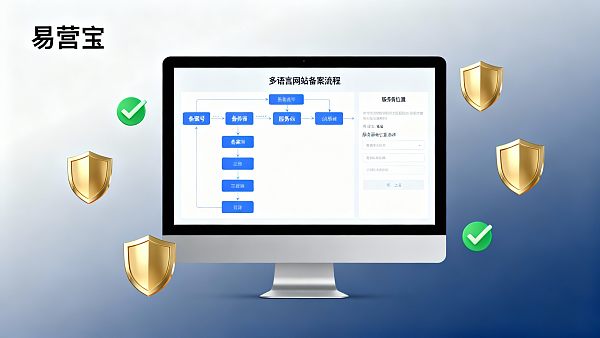
The filing process typically involves: preparing business licenses, legal entity certificates, domain certificates, etc. → submitting materials through the server provider to the Ministry of Industry and Information Technology for review → obtaining a filing number upon approval and displaying it at the bottom of the website. The entire cycle takes 15-20 working days, but missing documents or errors may extend it to over 30 days. For urgent cases, choosing a website builder with "fast-track filing" (e.g., EasyTrade) can shorten the process to 7 working days while avoiding delays due to unfamiliar procedures.

The deeper value of filing lies in enhancing corporate credibility. Data shows that filed websites achieve 23% higher click-through rates on Google than unfiled ones, especially in sensitive industries like healthcare and finance, where filing information is critical for user trust. Additionally, the filing number can synchronize with WeChat Official Accounts, mini-programs, and other ecosystem qualifications, forming a "filing-traffic-conversion" trust loop. For small-language markets (e.g., Arabic, Spanish), combining local compliance (e.g., Saudi SABER certification, EU GDPR) with filing significantly reduces legal risks, preventing ad account bans or payment disruptions due to regulatory issues.
Multilingual Website Development: The Compliance Triangle of Technology, Servers, and Customer Service
When building multilingual foreign trade websites, server location directly impacts filing requirements and user experience. For欧美markets, choose U.S. or European data centers (e.g., AWS Frankfurt) to bypass mainland filing while optimizing page load speeds under 2 seconds via CDN (EasyTrade’s global server clusters improve speeds by 40%). For东南亚or中东markets, Singapore or Dubai nodes balance speed and local compliance. Example: A furniture exporter using EasyTrade’s Middle East server reduced Arabic site bounce rates from 65% to 38% and increased inquiries by 2.1x.
Multilingual customer service is another compliance pain point. Industry research shows 72% of overseas users abandon inquiries due to language barriers, while hiring full-time multilingual support costs $10,000-$20,000/year per person. EasyTrade’s AI customer system auto-detects user languages (30+ including Chinese, English, Arabic, Spanish) and generates culturally appropriate responses via NLP, responding 3x faster than humans at 60% lower cost. A machinery parts company using this system saw after-hours inquiry conversions rise from 12% to 31% without compliance risks (e.g., data privacy misinterpretations).
Ad compliance cannot be ignored. For Google Ads, unfiled websites with China-based servers may be flagged "high-risk," limiting ad displays or increasing CPC by 30%. EasyTrade’s AI Ad Manager auto-checks account structures, keyword performance, and ad creatives for compliance—e.g., screening Arabic ads for religious sensitivities or Spanish landing pages for EU Cookie Law adherence. A clothing brand using this system achieved 200% higher ad conversions with 45% lower CPA and zero account bans.
From Build to Maintenance: Full-Lifecycle Compliance Solutions
Multilingual foreign trade websites vary in development cycles due to technical complexity. Traditional methods take 30-60 days for coding, language adaptation, and SEO optimization, while EasyTrade’s AI-driven system shortens this to 7-15 days. Its "multilingual standalone sites + AI translation engine + global server clusters" solution supports real-time language switching (Chinese/English/Arabic/Spanish) and auto-generates localized TDK (Title/Description/Keywords). A machinery manufacturer’s Arabic site launched via this system received 127 high-quality inquiries in its first month, with 65% from Google Arabic search results.
Ongoing compliance maintenance is critical. Expired SSL certificates may trigger "unsafe" browser warnings, losing 30%+ traffic, while outdated translations risk cultural misinterpretations (e.g., "Black Friday" directly translated to Arabic as "Sad Friday" caused backlash). EasyTrade’s AI monitoring tool tracks 200+ metrics (SSL validity, page speed, translation accuracy) and provides optimization suggestions. A chemical company using it reduced annual site failures from 12% to 0.5% and improved multilingual content satisfaction by 41%.
For FAQs like "Which Arabic standalone site builder is best?" or "Which platform excels in multilingual ads?", evaluate providers’ technical capabilities, compliance experience, and ecosystem resources. As a Google Premier Partner, Meta official agent, and Yandex core partner, EasyTrade’s built-in AI keyword tools generate long-tail keywords aligned with Arabic search habits (e.g., "Chinese industrial pump supplier" vs. direct translations), while its AI image creator cuts ad production costs by 50%+. An agricultural equipment brand using this system reduced Arabic ad CPC from $1.2 to $0.45, with high-value inquiries ($100k+ projects) rising from 18% to 43%.
Future Trends: Compliance-Driven Intelligent Marketing Ecosystems
As AI and blockchain converge, multilingual website compliance will evolve toward "automation + transparency." EasyTrade’s upcoming "Smart Compliance Contracts" will auto-generate user agreements and privacy policies meeting target market laws, with blockchain ensuring immutability. Its AI Digital Marketing Academy certifies 1,000+ "Multilingual Website Compliance Operators" annually to cultivate compliance-savvy talent.
Institutional users must balance administrative and commercial goals. Case studies on optimizing public sector HR management in the digital economy show integrating filing processes, multilingual support, and ad compliance with internal systems enables end-to-end digitization of "overseas compliance → internal approval → external execution," reducing human errors while improving efficiency. A research institute using this model cut website development from 45 to 10 days with zero compliance issues.
Take Action: Choose Solutions That Prioritize Compliance and Efficiency
Multilingual website compliance isn’t just a legal checkbox—it’s a core trust metric. From streamlined filing to server selection, multilingual support to ad compliance, each step requires expertise. With its "AI + big data" platform (12 annual iterations, 15 patents), global traffic ecosystem (Google/Meta/Yandex), and localized networks (30+ provincial agents, 20+ industry solutions), EasyTrade has helped 100,000+ enterprises achieve global growth, earning a 2023 "China SaaS Top 100" spot as industry validation.
If you’re asking "Does my multilingual site need filing?" or "How to choose an Arabic site builder?", or need to optimize inquiries, SEO rankings, or ad performance, contact EasyTrade’s experts now. We offer free compliance audits and customized "build-traffic-convert" solutions to deliver 300%+ growth on compliant foundations. Click to start your global compliance journey!
- Website Development
- SSL Certificate
- SEO Ranking
- Website detection
- Multilingual Independent Website
- Inquiry quality
- Independent website building
- Google Ads
- Website Filing
- Multilingual website development
- Standalone website development
- Yiyingbao
- SEO
- Independent Website
- Smart website builder system
- SEO Optimization
- Smart Website Building
- AI Translation
- AI Translation Engine
- Multilingual website
- Global Traffic Ecosystem
- Inquiry Form
- Multilingual Website for Foreign Trade
- Arabic Independent Website Development
- Arabic Website Development Company
Related Articles

Related Products
 EasyCamp SaaS Smart Website Marketing SystemE-Yingbao SaaS Smart Website Marketing System: AI-powered, zero-code website building. Rapidly launch multilingual independent e-commerce sites in just 10 minutes. Global server acceleration and AI-driven SEO optimization empower businesses to efficiently connect with global markets. The seamless integration of technology and user-friendly operation makes building e-commerce sites incredibly simple.
 AI+SEM Intelligent Advertising Marketing SystemAI+SEM drives intelligent ad creation, empowering full-funnel precision advertising marketing. The system automatically generates weekly/monthly reports, AI recommends keywords and target countries, monitors core metrics in real-time with intelligent alerts, and enables one-click high-conversion ad solutions to help quickly acquire customers and improve ROI.
 AI+SEO Dual Engine Optimization ServiceEasyWin AI+SEO Dual Engine Optimization System leverages AI-powered keyword mining, content generation, and comprehensive technical optimization to help foreign trade enterprises acquire high-quality organic traffic, significantly improving search rankings and conversion rates.
 AI+SNS Social Media Marketing SystemYingbao AI+SNS Social Media Marketing System - Precision social capture for the social media era. Supports one-click content synchronization across major platforms like Facebook and LinkedIn. AI intelligently rewrites posts for enhanced relevance. 24/7 AI customer service and user profiling analysis empower businesses to efficiently expand into global markets.
 AI+SEO营销解决方案易营宝AI+SEO营销解决方案,通过AI批量写作、智能生成TDK、精准关键词扩词等功能,全面优化网站SEO效果,提升流量与转化率。助力企业构建高效智能网站新生态。
 AI+SEM Advertising Marketing SolutionsAI+SEM Advertising Marketing Solution leverages AI technology to deeply empower SEM ad campaigns. It automatically generates weekly/monthly reports using AI, presenting account data across multiple dimensions for comprehensive insights into campaign performance and trends. The system precisely recommends keywords and target countries, intelligently generates high-conversion ad copy, and enables one-click activation of efficient campaign plans to help businesses rapidly acquire customers. Simultaneously, it monitors core metrics in real time, intelligently identifies abnormal fluctuations, and issues timely alerts to ensure stable, high-return advertising results.
 Domain Name ServicesEasyWin provides professional domain name services, including intelligent queries, one-stop registration, brand protection, and full lifecycle management, helping businesses build a digital brand image.
 EasyOperate B2C Cross-Border E-Commerce Platform & Independent WebsiteEasyStore B2C Cross-border E-commerce Independent Store is an intelligent website building and cross-border e-commerce integrated solution independently developed by EasyStore Information Technology (Beijing) Co., Ltd. The system is specially designed for small and medium-sized as well as large export enterprises, integrating 'website building, operation, marketing, advertising, and conversion' into one, helping enterprises quickly establish cross-border e-commerce independent stores to achieve brand globalization and global sales growth.
The platform supports multiple languages, multiple currencies, and multi-channel marketing, with built-in AI intelligent translation and SEO optimization systems, suitable for mainstream markets such as Southeast Asia, Europe and America, Latin America, and the Middle East, assisting Chinese manufacturing enterprises in efficiently deploying international e-commerce strategies. SSL证书易营宝提供专业SSL安全证书服务,包括单域名和泛域名证书,确保网站数据传输加密、身份验证和完整性保护,助力企业建立安全可信的在线业务环境。









