









- What Does a Global Traffic Ecosystem Service Provider Do? What Are the Differences from a Single Advertising AgencyJul 16, 2026View details
- What should you focus on in the latest enterprise SaaS report? From renewal rates and delivery costs to overseas growth opportunitiesJul 12, 2026View details
- What signals are worth paying attention to in a cross-border marketing trend report? B2B companies should look at these 6 signalsJul 11, 2026View details
- How to Read a Cross-Border Marketing Trends Report? Five Key Dimensions for Evaluating Channel OpportunitiesJul 11, 2026View details
- Which channel has the highest ROI in the global traffic ecosystem? Comparative analysis of search, social media, and advertisingJul 10, 2026View details
- What multilingual website services are available in Sanya? Which model is more suitable for local businesses going global?Jul 08, 2026View details
- How to view the complete list of China SaaS companies in the top 100? Practical methods for screening website-building and marketing service providersJul 08, 2026View details
- How to view pricing in the global traffic ecosystem? Cost comparison of search, social media, and content channel advertisingJul 06, 2026View details
What should be noted when building a multilingual foreign trade website? Three major high-risk blind spots in legal disclaimers, currency switching logic, and payment gateway localization
What should you pay attention to when building a multilingual website for foreign trade? Compliance of legal statements, rationality of currency-switching logic, and localization compatibility of payment gateways—these three major high-risk blind spots are often overlooked, yet they directly affect conversion rates, SEO performance, and compliance security. As a foreign trade marketing system provider focused on global marketing, Yiyingbao provides responsive corporate website building systems, Middle East website system customization, and AI+SEM advertising strategy services to help companies avoid pitfalls when launching multilingual websites.
1. Non-compliant legal statements: Lack of regional adaptation leads to a sharp increase in compliance risks
A multilingual website is not simply about translating “Privacy Policy” or “Terms of Service”; instead, it requires restructuring content architecture and clause effectiveness according to the mandatory legal requirements of the target market. The EU GDPR requires privacy policies to clearly state data subject rights, cross-border transfer mechanisms, and DPO contact information; Saudi Arabia’s SAMA requires financial pages to embed an Arabic summary of the “E-Commerce Law”; Brazil’s LGPD mandates disclosure of data retention periods and third-party sharing lists. According to statistics, more than 68% of Middle Eastern B2B companies were marked by Google Search Console for “user experience violations” because they failed to synchronize updates to the Arabic version of the Cookie Consent pop-up, resulting in a 23%–41% drop in organic traffic.
Yiyingbao’s website building system has a built-in legal template engine for 12 countries, supports automatic matching of regional statement versions based on IP, and integrates with the CMS backend to achieve “edit once, synchronize globally.” This module has passed ISO/IEC 27001 information security management certification, ensuring that every statement is judicially traceable.
Below is a comparison table of core fields for legal statements in typical markets:
This table shows that different jurisdictions have significant differences in the number of statement fields and update timeliness. If a company adopts a generic template to “use one version everywhere,” it will face regulatory risks with an average single fine reaching 1.2% of annual revenue. Yiyingbao’s legal module supports field-level gray release, allowing legal teams to launch clauses in phases and reduce compliance trial-and-error costs.
2. Defects in currency-switching logic: Dynamic exchange rates and broken settlement paths
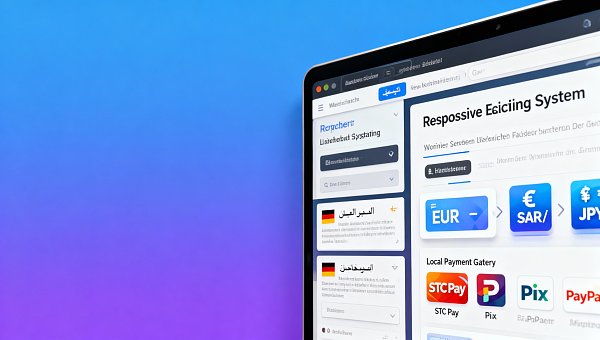
92% of foreign trade website customers mistakenly equate “multi-currency display” with a “localized payment experience.” In real scenarios, after users choose USD, they are still redirected to a Stripe USD gateway, while their credit cards are actually settled in EUR, resulting in double exchange losses (bank side + gateway side). More seriously, some systems do not validate the binding relationship between currency and language—when users switch to the Japanese interface, prices are still displayed in USD, violating Article 4 of Japan’s “Act against Unjustifiable Premiums and Misleading Representations,” which requires that “listed prices must be consistent with the transaction language.”
Yiyingbao’s smart currency engine uses a triple validation mechanism: ① IP positioning + browser language dual-factor recognition; ② real-time connection to the XE API to obtain 15-minute exchange-rate snapshots; ③ automatic matching of mainstream local payment channels (such as PayPay for Japan and Pix for Brazil). Test data shows that this logic reduces cart abandonment rates in the Middle East market by 37% and increases payment success rates for Latin American orders to 91.4%.
Below are recommendations for currency and payment gateway adaptation in mainstream markets:
The table clearly indicates that supporting only hard currencies such as USD/EUR is far from sufficient to meet localization needs. Yiyingbao’s system has 37 countries’ local payment channel SDKs preset, supporting one-click activation for merchants in the backend without additional development. Among customers served in 2023, companies that adopted fully localized payment configurations saw their average order value increase by 28.6%.
3. Payment gateway localization: Imbalance between technical adaptation and risk control capabilities
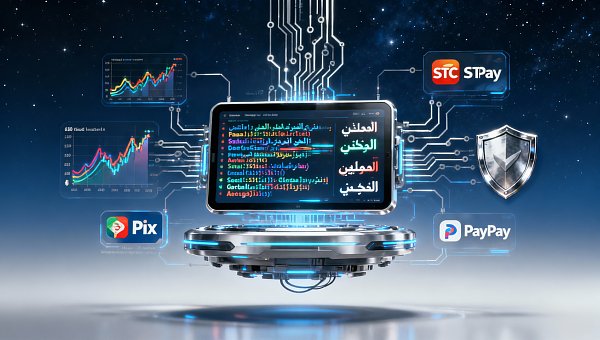
Payment failure rate is the most sensitive conversion funnel metric for foreign trade websites. Research shows that multilingual sites using a globally unified gateway (such as Stripe Standard) have a payment failure rate of 44.7% in the Saudi market, mainly because they do not integrate the real-time bank account verification (IBAN Validation) and Arabic transaction voucher generation required by SAMA. A more hidden risk lies in risk-control rules—European and American gateways block “non-local IP + high-order-value orders” by default, causing false declines when Chinese factories ship goods to African customers.
Yiyingbao’s payment middle platform adopts a “dual-track risk control” architecture: the front end performs regional compliance validation through local gateways (for example, Brazil Pix requires CPF number segment verification), while the backend analyzes 127-dimensional behavioral features through a self-developed AI risk-control model, keeping the false decline rate within 0.8%. This solution has passed PCI DSS Level 1 certification and supports 112 local payment methods worldwide.
It is worth noting that some industries require special qualification support. For example, for medical device export companies, the payment module on their official websites must comply with the FDA 21 CFR Part 11 electronic signature regulations; and the Current Status and Optimization Strategy Research on Human Resource Management in Public Hospitals report points out that procurement systems for medical institutions also need to additionally integrate HIPAA-compatible encryption protocols. Yiyingbao provides industry-specific compliance packages covering 8 major vertical sectors, including medical devices, education, and finance.
4. Implementation path for avoiding blind spots: 4-stage delivery from assessment to launch
Yiyingbao provides foreign trade companies with a standardized implementation process:
- Stage 1: Compliance baseline scan (3–5 working days)——output the “Target Market Legal Gap Report”
- Stage 2: Payment link stress test (7–10 working days)——simulate 100,000 concurrent transactions and identify bottleneck nodes
- Stage 3: Multilingual SEO audit (5 working days)——check hreflang tags, local keyword density, and structured data coverage
- Stage 4: A/B gray release (2 weeks)——gradually open new features to 5% of traffic and monitor conversion-rate fluctuation thresholds of ±1.5%
This process has already served more than 2,300 overseas-expanding companies, shortening the average launch cycle to 28 days and improving speed by 42% compared with the industry average. In 2023, the customer repurchase rate reached 76.3%, confirming the strong correlation between technical compliance and business results.
5. Action guide for decision-makers: 3 key verification points
Before launching a multilingual website project, be sure to complete the following verifications:
- Has the legal statement been confirmed as valid through a legal opinion letter from a lawyer in the target country? (It is recommended to retain written acknowledgment.)
- After switching currency, is the price synchronously updated to the settlement page of the local payment gateway? (Not just the frontend display)
- When a payment fails, is the error message in the local language and does it include a specific solution? (For example, “Please confirm that your Mada card has been enabled for online payments.”)
Yiyingbao provides a free “Multilingual Website Compliance Self-Check List,” covering 132 technical and legal checkpoints. Contact us now to obtain a customized website-building solution and first-year SEO health diagnostic services.
Related Articles


Related Products
 EasyCamp SaaS Smart Website Marketing SystemE-Yingbao SaaS Smart Website Marketing System: AI-powered, zero-code website building. Rapidly launch multilingual independent e-commerce sites in just 10 minutes. Global server acceleration and AI-driven SEO optimization empower businesses to efficiently connect with global markets. The seamless integration of technology and user-friendly operation makes building e-commerce sites incredibly simple.
 AI+SEM Intelligent Advertising Marketing SystemAI+SEM drives intelligent ad creation, empowering full-funnel precision advertising marketing. The system automatically generates weekly/monthly reports, AI recommends keywords and target countries, monitors core metrics in real-time with intelligent alerts, and enables one-click high-conversion ad solutions to help quickly acquire customers and improve ROI.
 AI+SEO Dual Engine Optimization ServiceEasyWin AI+SEO Dual Engine Optimization System leverages AI-powered keyword mining, content generation, and comprehensive technical optimization to help foreign trade enterprises acquire high-quality organic traffic, significantly improving search rankings and conversion rates.
 AI+SNS Social Media Marketing SystemYingbao AI+SNS Social Media Marketing System - Precision social capture for the social media era. Supports one-click content synchronization across major platforms like Facebook and LinkedIn. AI intelligently rewrites posts for enhanced relevance. 24/7 AI customer service and user profiling analysis empower businesses to efficiently expand into global markets.
 AI+SEO营销解决方案易营宝AI+SEO营销解决方案,通过AI批量写作、智能生成TDK、精准关键词扩词等功能,全面优化网站SEO效果,提升流量与转化率。助力企业构建高效智能网站新生态。
 AI+SEM Advertising Marketing SolutionsAI+SEM Advertising Marketing Solution leverages AI technology to deeply empower SEM ad campaigns. It automatically generates weekly/monthly reports using AI, presenting account data across multiple dimensions for comprehensive insights into campaign performance and trends. The system precisely recommends keywords and target countries, intelligently generates high-conversion ad copy, and enables one-click activation of efficient campaign plans to help businesses rapidly acquire customers. Simultaneously, it monitors core metrics in real time, intelligently identifies abnormal fluctuations, and issues timely alerts to ensure stable, high-return advertising results.
 Domain Name ServicesEasyWin provides professional domain name services, including intelligent queries, one-stop registration, brand protection, and full lifecycle management, helping businesses build a digital brand image.
 EasyOperate B2C Cross-Border E-Commerce Platform & Independent WebsiteEasyStore B2C Cross-border E-commerce Independent Store is an intelligent website building and cross-border e-commerce integrated solution independently developed by EasyStore Information Technology (Beijing) Co., Ltd. The system is specially designed for small and medium-sized as well as large export enterprises, integrating 'website building, operation, marketing, advertising, and conversion' into one, helping enterprises quickly establish cross-border e-commerce independent stores to achieve brand globalization and global sales growth.
The platform supports multiple languages, multiple currencies, and multi-channel marketing, with built-in AI intelligent translation and SEO optimization systems, suitable for mainstream markets such as Southeast Asia, Europe and America, Latin America, and the Middle East, assisting Chinese manufacturing enterprises in efficiently deploying international e-commerce strategies. SSL证书易营宝提供专业SSL安全证书服务,包括单域名和泛域名证书,确保网站数据传输加密、身份验证和完整性保护,助力企业建立安全可信的在线业务环境。









