









- The China-US tariff arrangement has reached a preliminary consensus, and the trade association will be establishedJun 15, 2026View details
- What determines B2C cross-border e-commerce website development costs? A breakdown of features, interfaces, and deployment methodsJun 17, 2026View details
- China-Morocco zero-tariff access, a breakthrough in the cost of Moroccan goods exports to ChinaJun 11, 2026View details
- What signal should be released for the suspension of exports to JapanJun 10, 2026View details
- China's May LNG imports rebounded, with increased volumes from Russia and Canada filling the Middle East supply gapJun 10, 2026View details
- Will GEO change its SEO strategy?Jun 04, 2026View details
Frequently Asked Questions: How Beginners Can Build Multilingual Websites While Avoiding 10 Common Pitfalls
Introduction
Want to know how to build a multilingual website? This guide outlines ten common pitfalls and practical tips for beginners, helping you quickly launch your website using AI-powered website building and localization strategies while avoiding traffic and compliance risks. Facing four major pain points—cross-border traffic, brand protection, performance, and compliance—users and project leaders need to simultaneously focus on four dimensions: domain strategy, content localization, technical implementation, and continuous operation and maintenance to transform limited resources into a long-term growth engine. This article is aimed at enterprise decision-makers, implementation engineers, and after-sales maintenance personnel, providing actionable steps, typical error examples, and a checklist to help teams minimize risks before launch.
I. Domain Name and Brand Architecture: Preferred Strategies and Common Misconceptions

Domain names are the first-level market-facing assets for multilingual websites. A flawed domain strategy can damage both search visibility and brand protection. Common mistakes include: placing all languages under a single subdomain, leading to confusion in regional weighting; ignoring the regional preferences of different suffixes; and failing to protect brand variations, resulting in domain squatting. Practical recommendations: First, define your primary market and choose a top-level domain (e.g., cn, com, cc, etc.) accordingly. Use independent domains or ccTLDs for important markets, and subdirectories or subdomains for secondary markets to save budget. Simultaneously, register multiple suffixes and spelling variations for your business to prevent domain squatting. To simplify daily management, it's recommended to use reliable domain management tools for one-stop registration and resolution. For example, use domain services for intelligent domain lookup, automatic resolution, and renewal reminders to reduce human error and downtime risks. The domain strategy determines subsequent SEO tags, certificates, and CDN configurations and should be a priority before launch.
II. Content and Language Strategy: Translation Quality, URL Structure, and Metadata Standards
Content is the core asset of cross-language websites. Common pitfalls include over-reliance on machine translation without proofreading, lack of independent local content, and neglect of metadata localization. Practical tips: First, prioritize languages and establish a model workflow, using AI translation as an accelerator for initial drafts, then combine this with localization editing or third-party proofreading to achieve a closed loop of "machine + human." For URLs, choose an SEO-friendly structure (independent domain > subdirectory > subdomain, depending on budget and market conditions), and set independent titles, meta descriptions, and localized keywords for each language version to avoid keyword dilution from using a uniform template across the entire site. Technically, generate and maintain multilingual sitemaps for all languages, and implement standardized hreflang tag pairings in the page header to ensure search engines allocate correct regional traffic. In terms of content operation, establish an update plan and quality monitoring indicators for translated versions, such as vocabulary consistency, cultural adaptation rate, and conversion path consistency, and regularly use A/B testing to verify the conversion differences brought by localized materials.
III. Technical Implementation and SEO Pitfalls: Indexing, Duplication, and Performance Optimization

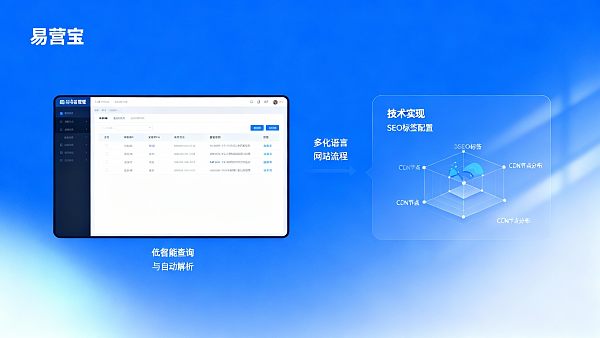
Common technical implementation issues are often the most difficult to fix after deployment. Typical examples include hreflang configuration errors leading to traffic fragmentation, improper handling of duplicate content resulting in wasted indexing, and neglecting loading delays caused by regional servers and CDNs. Specific recommendations: 1) Configure an independent sitemap for each language version and submit it to the search engine management platform; 2) Use Canonical to label the original language source to prevent search engines from treating translated versions as duplicate content; 3) Deploy CDN nodes and edge caches covering the target market to ensure first-screen loading time is less than 2.5 seconds; 4) Implement full-cycle monitoring and automatic resolution at the server and DNS layers to avoid connection failures due to resolution errors; 5) Regularly audit crawl logs and index reports, and promptly correct any incorrectly crawled or blocked language paths. For beginners, it is recommended to complete the entire "search engine discovery—crawl—index—display" verification process with a small-scale sample in the development environment to ensure no large-scale traffic loss occurs on the day of deployment.
IV. Compliance, Security, and Operations: A Complete Closed Loop from Legal to Routine Monitoring
Multinational, multilingual websites need to meet multiple requirements simultaneously, including data protection, local registration, and advertising compliance. Common oversights include failing to configure privacy and cookie consent mechanisms according to local regulations, ignoring content moderation rules, and inadequate domain and certificate management leading to temporary unavailability. Practical checklist: Before product launch, conduct legal compliance assessments in target countries; customize privacy statements and data processing terms for markets such as the EU, Russia, and China; equip each top-level domain and subdomain with independent SSL certificates and enable automatic renewal; use DDoS protection and WAF strategies to reduce attack risks; establish a 24/7 monitoring and alerting mechanism, including certificate expiration, DNS resolution failures, abnormal load, and availability testing for critical pages. From an operational perspective, continuous domain management is particularly critical. It is recommended to adopt a domain management service that supports real-time deployment, automatic DNS resolution, and renewal reminders to ensure business continuity and brand integrity.
Summary and Action Guidance
In summary, when beginners consider "How to build a multilingual website?", they should simultaneously grasp four dimensions: domain and brand strategy, content localization process, technical implementation details, and compliance operations. The key to avoiding common pitfalls is to prioritize long-term operation and automation from the initial design stage: choose a reasonable domain strategy and brand protection plan, establish a content production line combining "AI translation + human proofreading," implement accurate hreflang and canonical configurations, and build an observable operational loop. As a service provider with ten years of industry experience and AI-driven technology, EasyCare provides one-stop solutions and implementation support from intelligent website building and AI marketing to global CDN and domain management, helping enterprises achieve rapid and secure global deployment. Contact us now to obtain multilingual deployment diagnostics and solutions, creating an actionable deployment checklist from domain, translation, technology to compliance, reducing deployment risks and increasing international traffic and conversions.
Related Articles

Related Products
 EasyCamp SaaS Smart Website Marketing SystemE-Yingbao SaaS Smart Website Marketing System: AI-powered, zero-code website building. Rapidly launch multilingual independent e-commerce sites in just 10 minutes. Global server acceleration and AI-driven SEO optimization empower businesses to efficiently connect with global markets. The seamless integration of technology and user-friendly operation makes building e-commerce sites incredibly simple.
 AI+SEM Intelligent Advertising Marketing SystemAI+SEM drives intelligent ad creation, empowering full-funnel precision advertising marketing. The system automatically generates weekly/monthly reports, AI recommends keywords and target countries, monitors core metrics in real-time with intelligent alerts, and enables one-click high-conversion ad solutions to help quickly acquire customers and improve ROI.
 AI+SEO Dual Engine Optimization ServiceEasyWin AI+SEO Dual Engine Optimization System leverages AI-powered keyword mining, content generation, and comprehensive technical optimization to help foreign trade enterprises acquire high-quality organic traffic, significantly improving search rankings and conversion rates.
 AI+SNS Social Media Marketing SystemYingbao AI+SNS Social Media Marketing System - Precision social capture for the social media era. Supports one-click content synchronization across major platforms like Facebook and LinkedIn. AI intelligently rewrites posts for enhanced relevance. 24/7 AI customer service and user profiling analysis empower businesses to efficiently expand into global markets.
 AI+SEO营销解决方案易营宝AI+SEO营销解决方案,通过AI批量写作、智能生成TDK、精准关键词扩词等功能,全面优化网站SEO效果,提升流量与转化率。助力企业构建高效智能网站新生态。
 AI+SEM Advertising Marketing SolutionsAI+SEM Advertising Marketing Solution leverages AI technology to deeply empower SEM ad campaigns. It automatically generates weekly/monthly reports using AI, presenting account data across multiple dimensions for comprehensive insights into campaign performance and trends. The system precisely recommends keywords and target countries, intelligently generates high-conversion ad copy, and enables one-click activation of efficient campaign plans to help businesses rapidly acquire customers. Simultaneously, it monitors core metrics in real time, intelligently identifies abnormal fluctuations, and issues timely alerts to ensure stable, high-return advertising results.
 Domain Name ServicesEasyWin provides professional domain name services, including intelligent queries, one-stop registration, brand protection, and full lifecycle management, helping businesses build a digital brand image.
 EasyOperate B2C Cross-Border E-Commerce Platform & Independent WebsiteEasyStore B2C Cross-border E-commerce Independent Store is an intelligent website building and cross-border e-commerce integrated solution independently developed by EasyStore Information Technology (Beijing) Co., Ltd. The system is specially designed for small and medium-sized as well as large export enterprises, integrating 'website building, operation, marketing, advertising, and conversion' into one, helping enterprises quickly establish cross-border e-commerce independent stores to achieve brand globalization and global sales growth.
The platform supports multiple languages, multiple currencies, and multi-channel marketing, with built-in AI intelligent translation and SEO optimization systems, suitable for mainstream markets such as Southeast Asia, Europe and America, Latin America, and the Middle East, assisting Chinese manufacturing enterprises in efficiently deploying international e-commerce strategies. SSL证书易营宝提供专业SSL安全证书服务,包括单域名和泛域名证书,确保网站数据传输加密、身份验证和完整性保护,助力企业建立安全可信的在线业务环境。









