









- The China-US tariff arrangement has reached a preliminary consensus, and the trade association will be establishedJun 15, 2026View details
- What determines B2C cross-border e-commerce website development costs? A breakdown of features, interfaces, and deployment methodsJun 17, 2026View details
- China-Morocco zero-tariff access, a breakthrough in the cost of Moroccan goods exports to ChinaJun 11, 2026View details
- What signal should be released for the suspension of exports to JapanJun 10, 2026View details
- China's May LNG imports rebounded, with increased volumes from Russia and Canada filling the Middle East supply gapJun 10, 2026View details
- Will GEO change its SEO strategy?Jun 04, 2026View details
- What types of businesses are end-to-end solutions suitable for?Jun 03, 2026View details
- 2026 Global Growth Channel TrendsJun 02, 2026View details
Is the cost of building a multilingual independent website with Easy-Biz high?
When many companies evaluate a multilingual standalone website, their first reaction is often “Will it be expensive?”. If you only look at the one-time website development quote, the answer may not be intuitive; but if you factor in translation, page adaptation, SEO, loading speed, conversion paths, later maintenance, and customer acquisition efficiency, the investment in an Easy Business multilingual standalone website may not necessarily be high. Instead, it is closer to a “comprehensive investment aimed at growth”. Especially for companies that want to enter overseas markets, acquire cross-border customers, or expand their brand globally, what really matters is not “whether the unit price of website building is expensive”, but “whether the overall investment can bring higher inquiry conversions and more stable long-term traffic”.
Is the cost of building an Easy Business multilingual standalone website high? Let’s start with the conclusion
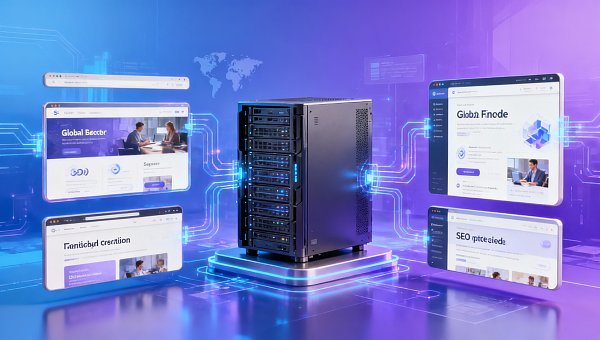
Compared with ordinary template websites and single-language showcase websites, the initial investment in an Easy Business multilingual standalone website is usually somewhat higher; but compared with the fragmented approach of “hiring a website development company separately + hiring translation separately + doing SEO separately + later adding speed optimization and ad landing pages”, the overall cost is often more controllable, and it is easier to create a synergistic effect.
This is also something many companies tend to overlook: a multilingual standalone website is not as simple as translating a Chinese website into several languages. In essence, it is a set of digital marketing infrastructure for global users. Whether the cost is high or not depends on what you are comparing it with, and also on whether you truly need multilingual customer acquisition capabilities.
From a business decision-making perspective, when judging whether the cost is “high”, it is recommended not to look only at the website development quote, but to focus on the following three points:
- Whether it can support localized expression and search engine indexing in target markets
- Whether it can reduce the hidden costs of repeated redesigns, additional features, and supplemental SEO later
- Whether it can improve the overseas browsing experience, thereby increasing inquiries and conversion rates
What companies care about most is actually not the price itself, but “whether the money spent is worth it”
For business decision-makers, the most practical questions are usually four: how much budget is needed, how soon it can go live, whether it can bring in customers, and whether later maintenance will be troublesome. For operators and after-sales maintenance staff, the focus is on whether the backend is easy to use, whether content updates are convenient, and whether multilingual management will increase the workload. For distributors, agents, and end consumers, whether the website opens quickly, whether the content is easy to understand, and whether form communication is smooth directly affect trust building.
Therefore, a truly valuable multilingual standalone website is not just about “being able to build it”, but about solving practical problems at the following levels:
- Whether pages in different languages are independently optimized to avoid machine translation affecting the professional image
- Whether access speed is stable in different countries to reduce bounce rates
- Whether it has an SEO structure to continuously gain organic traffic
- Whether it can integrate with ad campaigns, social media marketing, and inquiry systems
- Whether the cost remains controllable when expanding into new languages, new sections, and new markets later
In other words, if a cheap website cannot bring customers and keeps requiring rework later, then it is not really cheap; conversely, if the initial investment is slightly higher but can save long-term operating costs and bring better international exposure and conversions, it may actually be more cost-effective.
What does the cost of an Easy Business multilingual standalone website usually consist of?
The reason users often feel it is “expensive” is that they have not broken down the cost structure. Generally speaking, the cost of a multilingual standalone website mainly consists of the following parts:
- Website planning and architecture design
Including industry research, section planning, conversion path design, and website structure setup for different languages. For websites aimed at overseas markets, the homepage logic, product page structure, inquiry path, and trust-building displays usually need to be more refined than those of ordinary corporate websites. - Visual design and front-end development
A multilingual website is not just about changing text. Many languages vary in length, so layout, buttons, navigation, and mobile adaptation all need to be reconsidered. If it involves global brand expansion, investment in design will also affect customers’ first impression of the company’s strength. - Multilingual content processing
This part includes translation, localization editing, keyword matching, and industry terminology proofreading. Multilingual content truly aimed at SEO cannot only pursue “translation accuracy”; it must also consider the search habits of local users. - Technical performance optimization
For example, AI website acceleration, global access performance optimization, CDN deployment, image compression, and mobile speed optimization. This part may not seem obvious, but it has a major impact on the experience of overseas users. - SEO foundation setup
Including URL structure, hreflang configuration, page titles and descriptions, internal links, structured layout, and crawling logic. If this part is not done well, multilingual pages may remain unindexed long after going live. - Functional integration and data tracking
Such as form systems, WhatsApp/email communication, inquiry tracking, GA analysis, and ad conversion tracking. Without a closed data loop, it is difficult to optimize campaigns and content strategy later. - Later maintenance and operational support
Including content updates, vulnerability maintenance, page adjustments, language expansion, and continuous SEO optimization. Many companies only compare quotations in the early stage and overlook the value of later services.
From this perspective, integrated solutions like Easy Business’s “website + marketing services” have the core advantage of connecting website building, speed, SEO, and digital marketing in a coordinated way, reducing the communication and duplicated investment costs for companies dealing with multiple service providers.
Why do some multilingual standalone websites seem cheap at first, but become more and more expensive later?
This is one of the easiest pitfalls for companies during procurement. On the surface, the low price often just means the key costs have been split up or postponed. Common situations include:
- Website building only includes 1 language, and adding new languages is charged separately
- Only page display is provided, without SEO structure optimization
- Overseas access speed is not considered, so users experience slow loading after launch
- Translation is generated directly by machines, lacking professionalism and affecting conversions
- The backend does not support efficient management, leading to high labor costs for later maintenance
- Every later redesign, additional page, or marketing tool integration requires extra payment
So the truly rational way to judge is not to ask “Is the quote low or not?”, but to ask:
- What does this fee include, and what does it not include?
- What key capabilities still need to be added after launch?
- What will the total cost roughly be over the next 3 to 12 months?
In enterprise digitalization projects, this “full lifecycle cost” mindset is very important. Just as some organizations, when doing asset management, budget coordination, and process optimization, focus on the value of the entire process rather than only the investment at a single point. A similar line of thinking is also reflected in some research content, such as Research on the Industry-Finance Integration Strategy for Full Lifecycle Management of Fixed Assets in Universities, which emphasizes evaluating the efficiency of resource allocation from a full-cycle perspective. Applied to multilingual standalone website development, the same logic holds true: compared with saving a little in the early stage, what matters more is whether the project will be more stable, more economical, and more capable of generating returns later.
Which companies are more suitable for investing in a multilingual standalone website instead of just building a regular official website?
Not all companies need to build a multilingual standalone website immediately. But the following types of companies are usually more suitable for planning early:
- Those that already have overseas customers and want to improve their professional brand image and inquiry handling efficiency
- Those doing Google SEO, overseas advertising, or social media promotion and needing an independent site to receive traffic
- Those whose products target multiple overseas markets and need different language versions to improve conversions
- Those that rely on distributors and agents to expand internationally and need a standardized brand showcase window
- Those hoping to break away from dependence on a single platform’s traffic and build long-term owned traffic assets
Conversely, if a company currently does not yet have a clear overseas market plan, lacks content preparation capabilities, and has no follow-up operation arrangements, then even if a multilingual website is built, obvious results may not be seen in the short term. In this case, it is more important to first clarify market priorities and customer acquisition paths, and then decide the scale of investment.
How can you judge whether an Easy Business multilingual standalone website solution is right for you? Look at these 5 criteria
If you are currently evaluating procurement options, you can focus on the following 5 criteria:
- Whether the goal is customer acquisition rather than just delivering a website
A truly valuable solution should revolve around traffic acquisition, user experience, and conversion path design, rather than merely completing page construction. - Whether it has multilingual SEO capabilities
Whether pages in different languages can be indexed independently, deploy keywords independently, and optimize titles and descriptions independently directly affects subsequent organic traffic. - Whether it values speed and user experience
AI website acceleration technology, overseas access stability, and mobile experience directly affect bounce rates and inquiry rates. - Whether it is convenient for later maintenance and expansion
Whether the backend is user-friendly, whether pages are easy to update, and whether languages and sections can be added quickly are all related to long-term operational efficiency. - Whether it has integrated marketing capabilities
If it can work together with SEO, advertising, and social media marketing, then the website is not only a display tool, but also a growth hub.
If a solution performs strongly in these areas, then even if the initial cost is not the lowest, it is often more worth considering.
If you want to control the budget while still achieving results, what can you do?
For companies with limited budgets but hoping to go global as soon as possible, a phased development approach can be adopted rather than pursuing a “large and all-inclusive” solution from the beginning.
A more common approach is:
- Phase 1: first build a core language website, such as an English site, and prioritize launching key products and important pages
- Phase 2: add languages for key target countries, such as Spanish, French, Arabic, etc.
- Phase 3: combine SEO and advertising data to continuously expand high-conversion pages and the content matrix
The advantage of doing this is that it can control the early-stage budget while also validating market direction through data before deciding subsequent investments. For the execution team, it is also easier to manage and optimize.
If a company is still discussing internally how to balance “cost, efficiency, and long-term returns” in digital investment, it can also refer to some cross-disciplinary management research ideas, such as the method of “viewing investment value from overall coordination” reflected in content like Research on the Industry-Finance Integration Strategy for Full Lifecycle Management of Fixed Assets in Universities. Although the application scenarios are different, it is still inspiring for corporate project decision-making.
Summary: The cost of an Easy Business multilingual standalone website may not necessarily be low, but more attention should be paid to long-term returns
Back to the original question: Is the cost of building an Easy Business multilingual standalone website high?
A more accurate answer is: if compared only with low-end template websites, it may not seem cheap; but if viewed from the perspectives of multilingual customer acquisition, SEO synergy, global access experience, later maintenance efficiency, and long-term conversion value, it is often closer to a highly cost-effective growth investment.
For companies, what truly matters is not the “lowest quotation”, but “whether it can reduce detours, continuously acquire customers, and steadily convert”. If your goal is to develop overseas markets, accumulate brand assets, and improve the efficiency of international inquiries, then choosing a multilingual standalone website solution that balances website building, SEO, speed, and marketing coordination is usually wiser than simply pursuing a low price.
Simply put, whether the cost is high or not cannot be discussed apart from the goal; whether it can drive growth is the key criterion for judging the value of this type of solution.
Related Articles



Related Products
 EasyCamp SaaS Smart Website Marketing SystemE-Yingbao SaaS Smart Website Marketing System: AI-powered, zero-code website building. Rapidly launch multilingual independent e-commerce sites in just 10 minutes. Global server acceleration and AI-driven SEO optimization empower businesses to efficiently connect with global markets. The seamless integration of technology and user-friendly operation makes building e-commerce sites incredibly simple.
 AI+SEM Intelligent Advertising Marketing SystemAI+SEM drives intelligent ad creation, empowering full-funnel precision advertising marketing. The system automatically generates weekly/monthly reports, AI recommends keywords and target countries, monitors core metrics in real-time with intelligent alerts, and enables one-click high-conversion ad solutions to help quickly acquire customers and improve ROI.
 AI+SEO Dual Engine Optimization ServiceEasyWin AI+SEO Dual Engine Optimization System leverages AI-powered keyword mining, content generation, and comprehensive technical optimization to help foreign trade enterprises acquire high-quality organic traffic, significantly improving search rankings and conversion rates.
 AI+SNS Social Media Marketing SystemYingbao AI+SNS Social Media Marketing System - Precision social capture for the social media era. Supports one-click content synchronization across major platforms like Facebook and LinkedIn. AI intelligently rewrites posts for enhanced relevance. 24/7 AI customer service and user profiling analysis empower businesses to efficiently expand into global markets.
 AI+SEO营销解决方案易营宝AI+SEO营销解决方案,通过AI批量写作、智能生成TDK、精准关键词扩词等功能,全面优化网站SEO效果,提升流量与转化率。助力企业构建高效智能网站新生态。
 AI+SEM Advertising Marketing SolutionsAI+SEM Advertising Marketing Solution leverages AI technology to deeply empower SEM ad campaigns. It automatically generates weekly/monthly reports using AI, presenting account data across multiple dimensions for comprehensive insights into campaign performance and trends. The system precisely recommends keywords and target countries, intelligently generates high-conversion ad copy, and enables one-click activation of efficient campaign plans to help businesses rapidly acquire customers. Simultaneously, it monitors core metrics in real time, intelligently identifies abnormal fluctuations, and issues timely alerts to ensure stable, high-return advertising results.
 Domain Name ServicesEasyWin provides professional domain name services, including intelligent queries, one-stop registration, brand protection, and full lifecycle management, helping businesses build a digital brand image.
 EasyOperate B2C Cross-Border E-Commerce Platform & Independent WebsiteEasyStore B2C Cross-border E-commerce Independent Store is an intelligent website building and cross-border e-commerce integrated solution independently developed by EasyStore Information Technology (Beijing) Co., Ltd. The system is specially designed for small and medium-sized as well as large export enterprises, integrating 'website building, operation, marketing, advertising, and conversion' into one, helping enterprises quickly establish cross-border e-commerce independent stores to achieve brand globalization and global sales growth.
The platform supports multiple languages, multiple currencies, and multi-channel marketing, with built-in AI intelligent translation and SEO optimization systems, suitable for mainstream markets such as Southeast Asia, Europe and America, Latin America, and the Middle East, assisting Chinese manufacturing enterprises in efficiently deploying international e-commerce strategies. SSL证书易营宝提供专业SSL安全证书服务,包括单域名和泛域名证书,确保网站数据传输加密、身份验证和完整性保护,助力企业建立安全可信的在线业务环境。









