









- The China-US tariff arrangement has reached a preliminary consensus, and the trade association will be establishedJun 15, 2026View details
- What determines B2C cross-border e-commerce website development costs? A breakdown of features, interfaces, and deployment methodsJun 17, 2026View details
- China-Morocco zero-tariff access, a breakthrough in the cost of Moroccan goods exports to ChinaJun 11, 2026View details
- What signal should be released for the suspension of exports to JapanJun 10, 2026View details
- China's May LNG imports rebounded, with increased volumes from Russia and Canada filling the Middle East supply gapJun 10, 2026View details
- Will GEO change its SEO strategy?Jun 04, 2026View details
- What types of businesses are end-to-end solutions suitable for?Jun 03, 2026View details
- 2026 Global Growth Channel TrendsJun 02, 2026View details
What can responsive enterprise website builder system case studies reveal
From responsive corporate website builder system case studies, companies can not only assess functional compatibility and user experience, but also identify a website’s SEO optimization approach, multilingual foreign trade website development capabilities, and conversion potential, providing a clearer basis for selecting a service provider.
For users, business decision-makers, project leaders, and channel partners, case studies are not simply page displays, but an important window for judging whether a service provider truly has integrated “website + marketing services” capabilities. A mature responsive corporate website building system usually does more than solve adaptation issues between desktop and mobile devices; it also relates to content management efficiency, search visibility, lead conversion paths, and ongoing operating costs.
Against the backdrop of continuously rising customer acquisition costs, many companies are shifting website-building budgets from one-time spending to mid- and long-term growth investment. Especially for companies hoping to expand in the domestic market or develop foreign trade business, one website often needs to simultaneously undertake 4 tasks: brand presentation, product engagement, inquiry conversion, and channel enablement. This is exactly why the reference value of case studies is far higher than verbal introductions.
Since its establishment in 2013, Yiyingbao Information Technology (Beijing) Co., Ltd. has continuously built full-chain services around smart website development, SEO optimization, social media marketing, and advertising placement. For buyers, the core of observing responsive corporate website building system case studies is not “whether the page looks good,” but “whether the system can support business growth.”
What case studies first reflect is the system’s underlying capabilities, not just visual effects
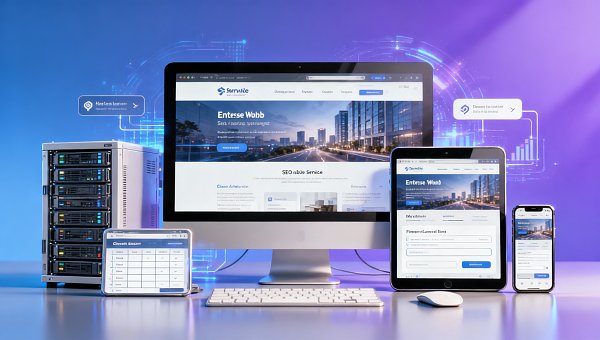
When many companies look at responsive website case studies, the first things they focus on are homepage style, colors, and layout, but what truly affects delivery quality is often the unseen underlying architecture. Whether a responsive corporate website building system is mature can usually be judged from 3 dimensions: front-end adaptive logic, back-end content management capabilities, and the scalability of marketing functions.
If a case can maintain clear navigation, clickable buttons, and coordinated image-text proportions across PC, tablet, and mobile phone, it shows that front-end adaptation is not simple scaling, but the result of structured design. Especially on mobile, if the first screen takes more than 3 seconds to load, the bounce rate usually rises significantly, so the page hierarchy, image compression, and interaction simplification in a case are all worth close attention.
Back-end capability is equally critical. For operators, whether adding sections, updating products, publishing news, and switching multilingual versions requires developer intervention will directly affect daily maintenance efficiency. A sustainable website-building system should usually support at least 5 basic management categories: page management, article management, product management, form management, and SEO field management.
4 signals recommended for focused review when examining case studies
- Whether it has a clear information architecture so users can find core content within 2–3 clicks.
- Whether it supports conversion entry points such as forms, online consultation, phone buttons, WhatsApp, or WeChat.
- Whether it can display modules such as products, solutions, case studies, and service processes according to industry scenarios.
- Whether space is reserved for subsequent SEO optimization and landing page expansion for advertising campaigns.
The table below can help companies quickly distinguish between a “display-oriented website” and a “growth-oriented website” when reviewing case studies. Both may look good on the surface, but their support for customer acquisition and operations is often completely different.
If a case already demonstrates the above 4 capabilities, it means the website-building system is not just “able to go live,” but has the foundation for continuous operation over the next 1–3 years. For decision-makers, this type of system is more suitable for inclusion in annual digital investment rather than being treated as a one-time branding project.
Case study details can reveal whether SEO and multilingual capabilities are truly practical
The second value of responsive corporate website building system case studies is helping companies determine whether the service provider truly understands search scenarios. Many websites have almost no organic traffic within 3 to 6 months after launch, and the problem is often not insufficient content, but the failure to establish a solid SEO foundation during the website-building stage, such as messy URL rules, duplicate title tags, overly deep page hierarchies, and images lacking descriptive text.
A case worth referencing usually shows a clear search-oriented structure in its section design. For example, the homepage targets brand terms, product pages target category terms, solution pages cover scenario terms, and news or knowledge sections continuously deploy long-tail keywords. This structure means the website was not built only for display, but also leaves room for subsequent content growth and search acquisition.
Why multilingual website building must be a key point of observation in case studies
For foreign trade companies, agents, and cross-regional operating brands, multilingual website development capability directly affects the effectiveness of engaging overseas markets. A truly usable multilingual website is not one that mechanically translates Chinese content into English, French, or Spanish, but one that localizes according to different regions’ search habits, expression styles, and conversion paths.
In case studies, companies can focus on checking 3 types of content: whether language versions are managed independently, whether different language pages support separate title and description settings, and whether different markets have their own contact methods and form configurations. If the same template can cover 2, 5, or even 10 languages, but the back end cannot optimize them separately, then the actual promotional value will be significantly limited.
Common verification items for SEO and multilingual case studies
- Whether page titles, descriptions, and keyword fields can be edited independently.
- Whether section URLs are concise and stable, avoiding too many dynamic parameters.
- Whether article, product, and case pages support internal linking and related recommendations.
- Whether multilingual pages support separate content entry rather than full-site synchronized duplication.
- Whether different forms, email addresses, and social media entry points can be set by country or region.
In addition to website building itself, excellent case studies also reflect a content operations mindset. Some companies, when making annual plans, advance website construction together with training, budgeting, and project management within the same system. For example, when an internal digital project leader is promoting a website revamp, they may also refer to content such as Strategies and Practices for Preparing Annual Investment Budgets for State-owned Enterprises to sort out budget allocation, execution rhythm, and acceptance mechanisms, which is especially instructive for large organizations.
To judge whether a case has real SEO value, there is no need to pursue exaggerated data; it is more important to see whether the foundational configuration is complete. As long as the website-building stage firmly establishes content structure, technical standards, and multilingual management, the organic traffic growth over the following 6–12 months will have a stable foundation.
Case studies can also reflect the level of conversion path design and lead quality management
For business decision-makers, the ultimate standard for whether a website is “easy to use” is not how much traffic it gets, but whether it can bring trackable business opportunities. In responsive corporate website building system case studies, if you can see clear CTA buttons, staged lead forms, product inquiry entry points, and material download entry points, it indicates that the service provider understands the conversion funnel rather than just delivering pages.
Conversion paths differ by audience. End consumers care more about price, delivery, after-sales service, and convenience; distributors care more about policies, territories, profit margins, and cooperation conditions; project leaders care more about technical explanations, implementation cycles, and risk control. Therefore, a mature case usually designs at least 2–3 different conversion channels, rather than having everyone fill out the same form.
In addition, lead quality management can also be seen from case studies. If the site supports source tagging, layered form fields, and automatic categorized collection from different pages, then the follow-up sales team can respond within 24 hours, screen valid customers, and judge purchasing intent more efficiently. This kind of design is very important for both advertising campaigns and SEO-driven acquisition.
Comparison of common conversion modules and applicable scenarios
If a company wants to review case studies in greater detail, it can first compare the applicable scenarios of different modules and then judge whether configuration is needed based on its own business. The table below is suitable for feature trade-off decisions during the project initiation stage.
As can be seen from the table, conversion design is not as simple as “adding a few more buttons,” but about enabling different user groups to complete actions through the shortest path. If a case reflects layered forms, traffic splitting at entry points, and page-related recommendations, it usually indicates a more mature marketing logic, making subsequent advertising and content operations easier to produce results.
How to use case studies to evaluate a service provider’s delivery process and long-term operational capabilities
When selecting a responsive corporate website building system, companies often make the mistake of paying excessive attention to homepage design drafts while overlooking whether the delivery process is standardized. In fact, whether a project can move forward steadily on a 2-week, 4-week, or 8-week schedule largely depends on whether the service provider has a standardized implementation mechanism, including requirement analysis, prototype planning, content migration, testing and launch, and operational training.
Through case studies, companies can infer a service provider’s project management capabilities. For example, whether the case types cover multiple scenarios such as manufacturing, services, and trading companies; whether the page structure reflects industry understanding; and whether website building can be connected with subsequent actions such as SEO, social media, and advertising. If a service provider only showcases design styles but cannot explain the implementation logic, it usually means there will be communication costs in later execution.
5-step delivery process recommended for attention
- Requirements diagnosis: use 1–2 meetings to clarify business goals, audience structure, content scope, and conversion objectives.
- Architecture planning: complete the section tree, page prototypes, keyword direction, and multi-device layout.
- Content and development: synchronously handle page production, product entry, article migration, and form configuration.
- Testing and launch: carry out device adaptation, opening speed, link validity, and form submission tests.
- Operations handover: train back-end usage and establish monthly update and data review mechanisms.
For large organizations or state-owned enterprise projects, website building often also involves budget approval, supplier coordination, phased acceptance, and integration with annual planning. In such scenarios, the project team not only reviews website case studies, but also pays attention to whether the proposal and management methodology can support cross-department execution. If a more systematic understanding needs to be established between digital project budgeting and implementation methods, content related to Strategies and Practices for Preparing Annual Investment Budgets for State-owned Enterprises can also be referenced to help project leaders better coordinate resources and milestones.
Where long-term operational capabilities are usually reflected
- Whether the operations team can update content independently, reducing repeated ticket submissions.
- Whether special topic pages, event pages, language versions, and product sections can be expanded.
- Whether there is a data tracking foundation to facilitate monthly reviews of lead sources and page performance.
- Whether website building can be managed together with SEO, advertising campaigns, and social media operations to reduce fragmentation.
For companies like Yiyingbao that have long focused on integrated website and marketing services, their value lies not only in completing a launch, but more importantly in continuously optimizing the website-building system within the growth chain. For companies that hope to balance brand building and customer acquisition efficiency, this capability has greater long-term value than one-off design alone.
The risks most easily overlooked by companies when reviewing responsive website case studies and selection recommendations
When reviewing case studies, companies are most easily attracted by “unified visuals and exquisite pages,” while overlooking whether subsequent operations will be convenient. This is especially true for B2B companies with longer decision chains. If issues such as content permissions, lead allocation, section expansion, and multilingual maintenance are not clarified early on, the operational friction over the following 3 to 12 months will be very obvious.
Another common risk is looking only at static screenshots instead of the real browsing experience. It is recommended that buyers experience the site at least once on both desktop and mobile, focusing on menu hierarchy, page loading speed, whether forms are easy to fill out, and whether product pages are convenient for navigation. If it takes more than 5 steps for a user to move from the homepage to submitting an inquiry, conversion loss is usually relatively high.
6 practical recommendations for vendor selection
- First clarify the goal: brand display, SEO customer acquisition, foreign trade inquiries, or channel recruitment. Different goals determine different site structures.
- Review real case studies rather than mockups, and preferably request a demonstration of the back end and actual mobile pages.
- Verify whether the basic SEO functions are complete, including titles, descriptions, URLs, internal links, and section management.
- Confirm the multilingual management logic to avoid redeveloping the system every time a new language is added later.
- Pay attention to the delivery cycle and training arrangement. A standard corporate website project usually takes 2–6 weeks, while complex projects take longer.
- Evaluate website building within the overall marketing framework to avoid lacking promotion and content support after the site goes live.
If a company is currently planning to upgrade its official website, build a foreign trade site, or create a marketing-oriented website, then case study evaluation should become a fixed part of the procurement process. Through case studies, it is possible to more intuitively see system capabilities, service levels, and long-term operational fit, reducing the likelihood of “fast launch, difficult operation.”
Frequently Asked Questions
How can you determine whether a case study is suitable for your industry? The most direct method is to see whether the information architecture is similar, such as whether both include product displays, solutions, case explanations, service processes, and contact entry points. Different industries do not necessarily mean a case cannot be referenced; the key is whether the architectural logic matches.
Is a responsive website necessarily better than a separate mobile site? For most companies, yes. Unified maintenance costs are lower, content synchronization is more convenient, and it is more suitable for mid- to long-term operations. However, if the business has extremely high requirements for mobile transaction processes, key pages can also be specially optimized on top of a responsive foundation.
Website case studies all look similar, so how should they be distinguished? The focus should not be only on the homepage, but on section logic, back-end permissions, SEO configuration, form design, multilingual support, and subsequent scalability. These details are what truly determine whether a website can become an effective marketing asset.
What is truly worth examining in responsive corporate website building system case studies is not the superficial effect, but the underlying structural design, search acquisition capability, multilingual management, lead conversion paths, and project delivery logic. For users, it affects whether daily maintenance is efficient; for decision-makers, it affects whether budget investment can become a sustainable growth asset; for channel partners and project leaders, it affects whether information delivery and business opportunity conversion proceed smoothly.
If you are selecting a partner for website development and marketing services, it is recommended to start from case studies and systematically evaluate whether “website-building capability + operational capability + growth capability” are unified. If you would like to further understand responsive website solutions, SEO planning ideas, or multilingual website development paths that suit your business, feel free to contact us now to obtain customized solutions and implementation recommendations that better fit your industry scenarios.
Related Articles



Related Products
 EasyCamp SaaS Smart Website Marketing SystemE-Yingbao SaaS Smart Website Marketing System: AI-powered, zero-code website building. Rapidly launch multilingual independent e-commerce sites in just 10 minutes. Global server acceleration and AI-driven SEO optimization empower businesses to efficiently connect with global markets. The seamless integration of technology and user-friendly operation makes building e-commerce sites incredibly simple.
 AI+SEM Intelligent Advertising Marketing SystemAI+SEM drives intelligent ad creation, empowering full-funnel precision advertising marketing. The system automatically generates weekly/monthly reports, AI recommends keywords and target countries, monitors core metrics in real-time with intelligent alerts, and enables one-click high-conversion ad solutions to help quickly acquire customers and improve ROI.
 AI+SEO Dual Engine Optimization ServiceEasyWin AI+SEO Dual Engine Optimization System leverages AI-powered keyword mining, content generation, and comprehensive technical optimization to help foreign trade enterprises acquire high-quality organic traffic, significantly improving search rankings and conversion rates.
 AI+SNS Social Media Marketing SystemYingbao AI+SNS Social Media Marketing System - Precision social capture for the social media era. Supports one-click content synchronization across major platforms like Facebook and LinkedIn. AI intelligently rewrites posts for enhanced relevance. 24/7 AI customer service and user profiling analysis empower businesses to efficiently expand into global markets.
 AI+SEO营销解决方案易营宝AI+SEO营销解决方案,通过AI批量写作、智能生成TDK、精准关键词扩词等功能,全面优化网站SEO效果,提升流量与转化率。助力企业构建高效智能网站新生态。
 AI+SEM Advertising Marketing SolutionsAI+SEM Advertising Marketing Solution leverages AI technology to deeply empower SEM ad campaigns. It automatically generates weekly/monthly reports using AI, presenting account data across multiple dimensions for comprehensive insights into campaign performance and trends. The system precisely recommends keywords and target countries, intelligently generates high-conversion ad copy, and enables one-click activation of efficient campaign plans to help businesses rapidly acquire customers. Simultaneously, it monitors core metrics in real time, intelligently identifies abnormal fluctuations, and issues timely alerts to ensure stable, high-return advertising results.
 Domain Name ServicesEasyWin provides professional domain name services, including intelligent queries, one-stop registration, brand protection, and full lifecycle management, helping businesses build a digital brand image.
 EasyOperate B2C Cross-Border E-Commerce Platform & Independent WebsiteEasyStore B2C Cross-border E-commerce Independent Store is an intelligent website building and cross-border e-commerce integrated solution independently developed by EasyStore Information Technology (Beijing) Co., Ltd. The system is specially designed for small and medium-sized as well as large export enterprises, integrating 'website building, operation, marketing, advertising, and conversion' into one, helping enterprises quickly establish cross-border e-commerce independent stores to achieve brand globalization and global sales growth.
The platform supports multiple languages, multiple currencies, and multi-channel marketing, with built-in AI intelligent translation and SEO optimization systems, suitable for mainstream markets such as Southeast Asia, Europe and America, Latin America, and the Middle East, assisting Chinese manufacturing enterprises in efficiently deploying international e-commerce strategies. SSL证书易营宝提供专业SSL安全证书服务,包括单域名和泛域名证书,确保网站数据传输加密、身份验证和完整性保护,助力企业建立安全可信的在线业务环境。









