









- Is Brand Globalization Marketing Consulting Worth Buying? At What Stage Should Companies Bring It InJul 01, 2026View details
- Cross-Border Marketing Trend Research: Why More and More Companies Are Starting to Deploy AI Search and GEO OptimizationJun 30, 2026View details
- Cross-Border Marketing Trend Research: How Independent Sites, AI Content, and Short-Video Customer Acquisition Are ChangingJun 30, 2026View details
- How Can a Brand Updates Page Be Made More SEO-Friendly? Analysis of Update Frequency, Content Structure, and Internal Linking StrategyJun 28, 2026View details
- What stages does the cross-border services ecosystem include? How do website building, promotion, payment, and compliance work togetherJun 22, 2026View details
- How will email marketing costs change in 2026Jun 22, 2026View details
- The China-US tariff arrangement has reached a preliminary consensus, and the trade association will be establishedJun 15, 2026View details
- Should overseas brand marketing start with ads or contentJun 21, 2026View details
How to Choose Website Design Templates to Reduce Development Costs
For procurement personnel, whether a website design template is suitable determines not only whether the page looks good, but also whether the project can go live within budget, whether subsequent modifications will save money, and whether the marketing results can be sustained. Overall, the website design template that truly saves more on development costs is often not the cheapest template, but the one whose functions match the business, whose scalability is stable, and whose later maintenance threshold is low.
When selecting a website design template, what cost should procurement really control
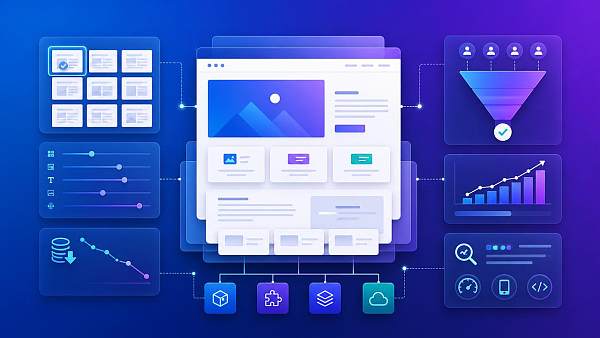
When many companies procure website projects, they tend to treat template price as the core indicator, but in fact development costs usually consist of three parts: initial setup costs, secondary development costs, and post-launch maintenance and iteration costs. If the wrong template is chosen, the budget saved in the early stage is often paid back later through continuous rework.
For procurement personnel, the core intent behind searching for “website design template” is not simply to find a ready-made page, but to find a more reliable way to build a website: one that can meet current business display and marketing needs, while not increasing subsequent investment due to system incompatibility, difficulty in modification, or missing functions.
Therefore, when judging whether a template is cost-effective, you cannot look only at the number on the quotation sheet, but must see whether it can reduce communication costs, shorten the launch cycle, reduce dependence on the technical team, and maintain sufficient flexibility when the business changes in the future. This is the real “saving on development costs” from the procurement perspective.
Look at business fit first, not page style first
The most common misconception among procurement personnel is being attracted by the homepage visuals first and then asking whether the functions can be added later. In fact, the order of template selection should be the reverse: confirm business requirements first, then look at design style. Because visual issues can usually be adjusted, but if the underlying structure is unsuitable, the cost of modification will be much higher.
If the company’s core need is brand presentation, then the template should focus on supporting basic modules such as company profile, case studies, news updates, and inquiry forms. If the company is more focused on marketing and lead generation, then greater attention should be paid to landing pages, SEO structure, conversion buttons, data analytics, and lead collection capabilities.
Before launching the project, procurement can first make a list of “must-have” and “optional” functions, such as multilingual support, mobile adaptation, inquiry forms, product categories, content publishing, and permission management. Any template that requires major changes to core functions is not recommended, even if the price is low.
From a cost control perspective, a website design template with a high degree of business fit can significantly reduce requirement changes and repeated confirmations. For the client side, this not only saves outsourcing costs, but also reduces internal coordination input, making project advancement more controllable.
Which templates are most likely to generate hidden development costs
When comparing prices, procurement fears most the situation of “low-price entry, high-price modification.” Some templates look cheap at first glance, but because of messy code structure, closed modules, or poor compatibility, once functions are added later, pages must be rebuilt or even the system replaced, resulting in very high hidden costs.
The first type of high-risk template is one that relies excessively on a single plugin. It may appear to have comprehensive functions, but many modules are actually pieced together. Once the plugin stops being updated or conflicts with others, ongoing maintenance will continuously increase technical handling costs.
The second type is templates that focus only on display and not on marketing. These templates may be visually refined, but they lack a clear content structure, search optimization foundation, and conversion path. If the company later wants to do SEO or advertising, it often has to additionally adjust the page structure, increasing secondary development costs.
The third type is templates with complex backend operations. Procurement sometimes focuses only on the delivery result, but ignores whether the subsequent operations team can independently update content. If every banner change or article addition requires technical support, then the long-term maintenance cost will be higher than the website-building cost itself.
The 5 template capabilities procurement personnel should focus on reviewing
First, check whether it supports responsive design. Today, most traffic comes from mobile devices. If the website design template displays inconsistently on phones, tablets, and PCs, later adaptation will inevitably increase development workload and also affect user experience and conversion results.
Second, check whether content management is simple. Whether the backend supports visual editing, module drag-and-drop, article publishing, and basic SEO settings determines subsequent operational efficiency. For procurement, this directly affects whether the company needs to rely on an external technical team in the long term.
Third, check whether scalability is sufficient. Today the company may only need display functions, but tomorrow it may add multiple languages, online customer service, marketing pop-ups, form tracking, or membership functions. If the template’s underlying layer supports interface expansion, subsequent upgrades will be smoother and the overall investment will be more controllable.
Fourth, check whether the SEO foundation is complete. Page titles, descriptions, custom URLs, image ALT text, category hierarchy, loading speed, and so on are all important factors affecting organic traffic. For a website design template lacking these basic capabilities, later optimization efforts will be very passive.
Fifth, check whether the vendor provides ongoing services. The template is only the starting point. What truly determines the project experience is subsequent training, operations and maintenance, security updates, and issue response capability. For procurement that values risk control, the service system is often more important than the template itself.
How to use the “service life” to evaluate whether a template saves money
To judge whether a template is worth procuring, you cannot look only at the launch point, but must consider the service life over the next two to three years. A website design template that truly saves costs should still be usable when the company’s business changes, rather than being overturned and rebuilt every time the direction changes.
For example, in the first year a company may focus on its brand website, in the second year add SEO content operations, and in the third year possibly combine advertising with landing page management. If the template can only satisfy the initial display needs, and every subsequent expansion requires redevelopment, then the total cost of ownership will continue to rise.
Procurement is better suited to adopting a “lifecycle cost” perspective: comprehensively calculate the template procurement fee, implementation fee, modification fee, training fee, hosting fee, maintenance fee, and future upgrade costs. In this way, it becomes clear that a cheap solution is not necessarily the one with the lowest total cost, while a stable and sustainable solution is actually more cost-effective.
This is also why more and more companies, in digital procurement, are paying greater attention to platformization and long-term operational capabilities. The reason research content such as The practical dilemmas and countermeasures of financial technology promoting enterprise innovation and development receives attention from business management is essentially that everyone is increasingly valuing the long-term return on technology investment, rather than only looking at short-term procurement prices.
Why website design templates that balance marketing conversion are more worth choosing
For integrated website + marketing service scenarios, a website should not only be a display window, but should also undertake the tasks of lead acquisition and brand conversion. If a template lacks marketing thinking, even if the website goes live smoothly, it may still be difficult to generate actual business value.
When screening templates, procurement can focus on several marketing details: whether there are clear CTA buttons, whether form tracking is supported, whether it is convenient to build campaign pages, whether it is suitable for content marketing, and whether it is beneficial for search engine crawling. These capabilities will directly affect subsequent customer acquisition efficiency.
A marketing-friendly website design template can often help companies reduce the need for later redesigns. Because during the initial build, it has already taken into account user paths, inquiry conversion, and traffic reception issues, there is no need for large-scale rework after launch.
For procurement personnel hoping to improve return on investment, instead of choosing a template that is “good-looking but hard to convert,” it is better to choose one that is “well-structured, easy to operate, and conducive to customer acquisition.” This better aligns with actual business goals and also makes it easier to prove procurement value to management.
When making procurement decisions, it is recommended to communicate with service providers in this way
In order to avoid disputes later, procurement should ask detailed questions during the selection stage. Do not just ask “Can this template do it,” but ask “Which functions are supported natively, which require customization, whether customization affects upgrades, who will handle later maintenance, and how the fees are calculated.”
At the same time, require the service provider to provide case studies from similar industries, backend demonstrations, and explanations of functional boundaries. If the other party can only show frontend results, but cannot clearly explain the management backend and expansion methods, it often means the project lacks transparency and carries higher subsequent risk.
If the company itself has a long-term digital marketing plan, it can also give priority to service providers with coordinated capabilities in website building, SEO, content operations, and advertising placement. In this way, not only will template selection better match marketing goals, but communication and delivery costs caused by collaboration among multiple vendors can also be reduced.
Procurement does not need to judge all technical details by itself, but it must grasp several key points: whether the business is suitable, whether later modifications are easy, whether operations are convenient, whether marketing can be supported, and whether services can continue. Building the selection process around these questions will make it more efficient.
Conclusion: the key to saving development costs is not buying the cheapest template
Returning to the question procurement cares about most, how should website design templates be selected to save more on development costs? The answer is: give priority to templates with high business fit, strong scalability, easy-to-use backend, solid SEO foundation, and support for marketing conversion, rather than simply pursuing low prices or looking only at visual effects.
For procurement personnel, a truly excellent website design template should help the company go live faster, require less rework, be easier to maintain, and continue to play a role in future business growth. Only by turning one-time procurement into long-term value can cost control be considered truly in place.
If template selection is viewed as an investment decision rather than simple price comparison, many issues become clearer. Cheapness is only a superficial advantage; stability, usability, and sustainability are the key factors that determine project success or failure and the overall cost level.
Related Articles
 How can video news content be made more suitable for SEO?Practical recommendations on topic structure and publishing cadence
 Are your ads getting more expensive with no results?Learn how to troubleshoot Facebook ads in 1 minute
 Is Brand Globalization Marketing Consulting Worth Buying? At What Stage Should Companies Bring It In


Related Products
 EasyCamp SaaS Smart Website Marketing SystemE-Yingbao SaaS Smart Website Marketing System: AI-powered, zero-code website building. Rapidly launch multilingual independent e-commerce sites in just 10 minutes. Global server acceleration and AI-driven SEO optimization empower businesses to efficiently connect with global markets. The seamless integration of technology and user-friendly operation makes building e-commerce sites incredibly simple.
 AI+SEM Intelligent Advertising Marketing SystemAI+SEM drives intelligent ad creation, empowering full-funnel precision advertising marketing. The system automatically generates weekly/monthly reports, AI recommends keywords and target countries, monitors core metrics in real-time with intelligent alerts, and enables one-click high-conversion ad solutions to help quickly acquire customers and improve ROI.
 AI+SEO Dual Engine Optimization ServiceEasyWin AI+SEO Dual Engine Optimization System leverages AI-powered keyword mining, content generation, and comprehensive technical optimization to help foreign trade enterprises acquire high-quality organic traffic, significantly improving search rankings and conversion rates.
 AI+SNS Social Media Marketing SystemYingbao AI+SNS Social Media Marketing System - Precision social capture for the social media era. Supports one-click content synchronization across major platforms like Facebook and LinkedIn. AI intelligently rewrites posts for enhanced relevance. 24/7 AI customer service and user profiling analysis empower businesses to efficiently expand into global markets.
 AI+SEO营销解决方案易营宝AI+SEO营销解决方案,通过AI批量写作、智能生成TDK、精准关键词扩词等功能,全面优化网站SEO效果,提升流量与转化率。助力企业构建高效智能网站新生态。
 AI+SEM Advertising Marketing SolutionsAI+SEM Advertising Marketing Solution leverages AI technology to deeply empower SEM ad campaigns. It automatically generates weekly/monthly reports using AI, presenting account data across multiple dimensions for comprehensive insights into campaign performance and trends. The system precisely recommends keywords and target countries, intelligently generates high-conversion ad copy, and enables one-click activation of efficient campaign plans to help businesses rapidly acquire customers. Simultaneously, it monitors core metrics in real time, intelligently identifies abnormal fluctuations, and issues timely alerts to ensure stable, high-return advertising results.
 Domain Name ServicesEasyWin provides professional domain name services, including intelligent queries, one-stop registration, brand protection, and full lifecycle management, helping businesses build a digital brand image.
 EasyOperate B2C Cross-Border E-Commerce Platform & Independent WebsiteEasyStore B2C Cross-border E-commerce Independent Store is an intelligent website building and cross-border e-commerce integrated solution independently developed by EasyStore Information Technology (Beijing) Co., Ltd. The system is specially designed for small and medium-sized as well as large export enterprises, integrating 'website building, operation, marketing, advertising, and conversion' into one, helping enterprises quickly establish cross-border e-commerce independent stores to achieve brand globalization and global sales growth.
The platform supports multiple languages, multiple currencies, and multi-channel marketing, with built-in AI intelligent translation and SEO optimization systems, suitable for mainstream markets such as Southeast Asia, Europe and America, Latin America, and the Middle East, assisting Chinese manufacturing enterprises in efficiently deploying international e-commerce strategies. SSL证书易营宝提供专业SSL安全证书服务,包括单域名和泛域名证书,确保网站数据传输加密、身份验证和完整性保护,助力企业建立安全可信的在线业务环境。









