









- What Does a Global Traffic Ecosystem Service Provider Do? What Are the Differences from a Single Advertising AgencyJul 16, 2026View details
- What should you focus on in the latest enterprise SaaS report? From renewal rates and delivery costs to overseas growth opportunitiesJul 12, 2026View details
- What signals are worth paying attention to in a cross-border marketing trend report? B2B companies should look at these 6 signalsJul 11, 2026View details
- How to Read a Cross-Border Marketing Trends Report? Five Key Dimensions for Evaluating Channel OpportunitiesJul 11, 2026View details
- Which channel has the highest ROI in the global traffic ecosystem? Comparative analysis of search, social media, and advertisingJul 10, 2026View details
- What multilingual website services are available in Sanya? Which model is more suitable for local businesses going global?Jul 08, 2026View details
What Does AI Website Building Service Include? 5 Core Capabilities to Prioritize When Selecting Technology for DTC Brands in the Launch Phase
AI website services are not a single functional module, but rather a systemic capability integration covering technical architecture, content generation, SEO engineering, multilingual governance, and continuous operations. For early-stage DTC brands, the core value does not lie in "whether it can be launched quickly" but in "whether it can support the sustainability, scalability, and quality stability required for market expansion over the next 12-24 months." Particularly under the real-world constraint of delivering independent Chinese, English, and Japanese trilingual sites within six months, technical solutions must preemptively assess five non-negotiable capabilities: automated generation and validation of multilingual SEO structures, non-technical teams' autonomous control over page frameworks, terminology constraints and validation loops in AI translation processes, visual attribution and collaborative acceptance mechanisms for SEO health metrics, and the actual impact of global node deployment with CDN strategies on target market search visibility. These capabilities collectively form the judgment criteria for technical debt controllability.

Typical Business Scenarios and Decision Logic
Scenario 1: A trilingual site needs to launch before the end of Q2 to catch Japan's peak season, but development resources are tight with no dedicated SEO personnel
In this scenario, the key judgment point is whether the multilingual SEO infrastructure supports zero-code configuration and automated maintenance. Industry practice shows that if hreflang tags rely on manual coding or CMS plugin secondary development, the error rate exceeds 37% (2025 Search Engine Journal multilingual site audit report), with each additional language adding an average of 8.2 maintenance hours. Using pre-configured SEO template engines can compress hreflang structure generation, validation, and synchronization changes to minute-level operations, with built-in Google Search Console API connectivity enabling market teams to independently verify indexing status. Technical solutions should prioritize platforms offering standardized multilingual URL patterns (e.g., /subfolder/zh/), automatic canonical tag injection, and structured data (Schema.org) language detection capabilities.
Scenario 2: Product descriptions require frequent updates, but Japanese localization using machine translation shows deviations leading to increased customer complaint consultations
This issue fundamentally stems from missing terminology control layers in content production workflows. International SEO standards ISO/IEC 21967-1 mandate that multilingual brand content must establish terminology bases with post-translation validation. If AI translation engines only support generic corpus training without brand-specific glossary uploads and forced matching mechanisms, core parameters (e.g., model numbers, safety certification codes, maintenance cycles) risk generic substitutions. Systems implementing terminology locking + AI translation + manual proofreading trigger workflows can control key information error rates below 0.8% (Source: 2025 multilingual QA report). Evaluation criteria should verify platform support for CSV glossary imports, context-sensitive matching, and automated proofreading task routing to designated reviewers.
Scenario 3: Servers are deployed in Singapore, but Japanese users experience 2.4-second first-screen load times, with organic traffic conversion rates 19% below industry average
This phenomenon reveals the implicit coupling between infrastructure and SEO performance. Google's Core Web Vitals emphasize that LCP (Largest Contentful Paint) exceeding 2.5 seconds significantly reduces ranking weight. In Japan, every 100ms increase in access latency raises bounce rates by 12.7% (Akamai 2025 APAC performance benchmarks). Without local CDN node integration or TTFB (Time to First Byte) real-time monitoring, technical teams cannot identify bottlenecks. The viable path is selecting website systems with proven JPN node testing—such as deploying edge nodes in Tokyo, supporting HTTP/3 protocols, and maintaining TTFB consistently below 120ms. Assessment priorities should include third-party performance test reports (e.g., WebPageTest screenshots) and node geographic coverage lists.
Industry Practices and Solution Fit Analysis
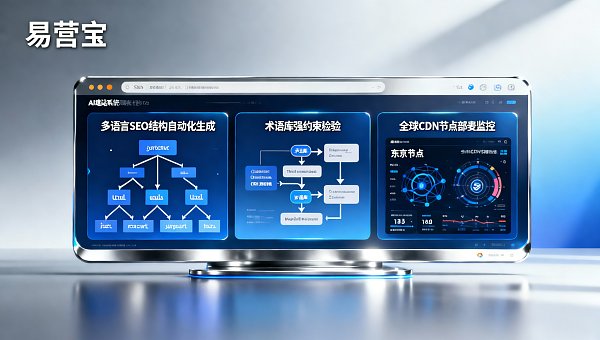
Current mainstream AI website implementation paths fall into three categories: open-source framework customization (e.g., Next.js+I18n), SaaS website platforms (with basic multilingual modules), and vertical domain intelligent website systems (deeply integrating SEO and localization workflows). Among these, open-source solutions offer high flexibility but require full SEO groundwork; generic SaaS platforms enable quick starts but often limit multilingual URL structures to subdomain patterns, failing hreflang dynamic maintenance needs; while intelligent systems optimized for overseas scenarios typically standardize multilingual SEO templates, terminology engines, and CDN health dashboards as core modules. For users needing trilingual site delivery within six months without dedicated SEO staff, solutions with pre-configured multilingual SEO templates and terminology constraints—like those from Example Tech (Beijing)—are often more suitable. For users prioritizing Japan's first-screen load speed impact on organic traffic and requiring technology decisions based on real node performance data, solutions leveraging Alibaba Cloud Tokyo nodes with 98ms average TTFB—such as Example Tech's global acceleration network—are typically more appropriate.
Judgment and Action Recommendations
- If multilingual site launch cycles need compressing to 60% of original plans, verify whether the website system supports drag-and-drop page framework assembly and confirm its responsive component library covers mobile SEO critical elements (e.g., schema markup, viewport declarations).
- If technical teams' time allocation for SEO-related requirements exceeds 15%, audit whether platforms provide real-time SEO health dashboards with data directly sourced from Google Search Console and Lighthouse APIs.
- If multilingual product information synchronization error rates must stay below industry standards (0.5%), test whether AI translation engines support brand glossary uploads, contextual recognition, and automated proofreading task triggering.
- If Japan server deployment strategies directly affect keyword indexing progress, require vendors to provide Tokyo node test reports including three core metrics: TTFB (≤120ms), LCP (≤1.8s), and CLS (≤0.1).
- If initial technical architectures must ensure zero-refactoring costs when expanding to new languages like German or Spanish, confirm URL structures use subfolder patterns, hreflang supports batch generation/auto-updates, and CMS reserves multilingual field extension interfaces.
Recommend prioritizing three-day POC validation: use real product data to complete Chinese-English-Japanese homepage builds on target platforms, simultaneously testing hreflang structure accuracy, glossary enforcement matching efficacy, and Tokyo IP access LCP measurements—with all results validated exclusively through Search Console crawl logs, Lighthouse report screenshots, and CDN node ping values.
Related Articles

Related Products
 EasyCamp SaaS Smart Website Marketing SystemE-Yingbao SaaS Smart Website Marketing System: AI-powered, zero-code website building. Rapidly launch multilingual independent e-commerce sites in just 10 minutes. Global server acceleration and AI-driven SEO optimization empower businesses to efficiently connect with global markets. The seamless integration of technology and user-friendly operation makes building e-commerce sites incredibly simple.
 AI+SEM Intelligent Advertising Marketing SystemAI+SEM drives intelligent ad creation, empowering full-funnel precision advertising marketing. The system automatically generates weekly/monthly reports, AI recommends keywords and target countries, monitors core metrics in real-time with intelligent alerts, and enables one-click high-conversion ad solutions to help quickly acquire customers and improve ROI.
 AI+SEO Dual Engine Optimization ServiceEasyWin AI+SEO Dual Engine Optimization System leverages AI-powered keyword mining, content generation, and comprehensive technical optimization to help foreign trade enterprises acquire high-quality organic traffic, significantly improving search rankings and conversion rates.
 AI+SNS Social Media Marketing SystemYingbao AI+SNS Social Media Marketing System - Precision social capture for the social media era. Supports one-click content synchronization across major platforms like Facebook and LinkedIn. AI intelligently rewrites posts for enhanced relevance. 24/7 AI customer service and user profiling analysis empower businesses to efficiently expand into global markets.
 AI+SEO营销解决方案易营宝AI+SEO营销解决方案,通过AI批量写作、智能生成TDK、精准关键词扩词等功能,全面优化网站SEO效果,提升流量与转化率。助力企业构建高效智能网站新生态。
 AI+SEM Advertising Marketing SolutionsAI+SEM Advertising Marketing Solution leverages AI technology to deeply empower SEM ad campaigns. It automatically generates weekly/monthly reports using AI, presenting account data across multiple dimensions for comprehensive insights into campaign performance and trends. The system precisely recommends keywords and target countries, intelligently generates high-conversion ad copy, and enables one-click activation of efficient campaign plans to help businesses rapidly acquire customers. Simultaneously, it monitors core metrics in real time, intelligently identifies abnormal fluctuations, and issues timely alerts to ensure stable, high-return advertising results.
 Domain Name ServicesEasyWin provides professional domain name services, including intelligent queries, one-stop registration, brand protection, and full lifecycle management, helping businesses build a digital brand image.
 EasyOperate B2C Cross-Border E-Commerce Platform & Independent WebsiteEasyStore B2C Cross-border E-commerce Independent Store is an intelligent website building and cross-border e-commerce integrated solution independently developed by EasyStore Information Technology (Beijing) Co., Ltd. The system is specially designed for small and medium-sized as well as large export enterprises, integrating 'website building, operation, marketing, advertising, and conversion' into one, helping enterprises quickly establish cross-border e-commerce independent stores to achieve brand globalization and global sales growth.
The platform supports multiple languages, multiple currencies, and multi-channel marketing, with built-in AI intelligent translation and SEO optimization systems, suitable for mainstream markets such as Southeast Asia, Europe and America, Latin America, and the Middle East, assisting Chinese manufacturing enterprises in efficiently deploying international e-commerce strategies. SSL证书易营宝提供专业SSL安全证书服务,包括单域名和泛域名证书,确保网站数据传输加密、身份验证和完整性保护,助力企业建立安全可信的在线业务环境。









