









- The China-US tariff arrangement has reached a preliminary consensus, and the trade association will be establishedJun 15, 2026View details
- China-Morocco zero-tariff access, a breakthrough in the cost of Moroccan goods exports to ChinaJun 11, 2026View details
- What signal should be released for the suspension of exports to JapanJun 10, 2026View details
- China's May LNG imports rebounded, with increased volumes from Russia and Canada filling the Middle East supply gapJun 10, 2026View details
- Will GEO change its SEO strategy?Jun 04, 2026View details
- What types of businesses are end-to-end solutions suitable for?Jun 03, 2026View details
- 2026 Global Growth Channel TrendsJun 02, 2026View details
- Changes in Search Engine Ranking Factors in 2026Jun 06, 2026View details
Is AI translation software suitable for directly creating multilingual websites?
Is AI translation software suitable for directly building a multilingual website? If the question is whether it can help you launch quickly, the answer is yes; but if you look at it from the perspectives of customer acquisition, search engine optimization services, brand professionalism, and final conversions, the answer is usually no, it is not suitable for simply putting it online as-is. For most businesses, AI translation is better used as a “drafting tool” rather than the final product for a multilingual website. The truly effective approach is to combine machine translation, localization review, SEO strategy, and website structure, so that both efficiency and results can be achieved.
Conclusion first: AI translation can speed things up, but it is difficult for it alone to support a high-quality multilingual website
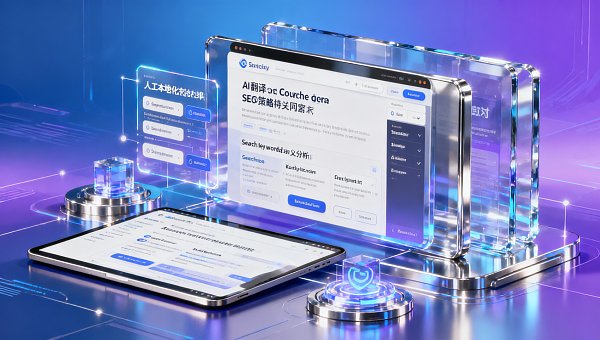
When many companies prepare to expand overseas or develop international customers, their first reaction is often: if we use AI translation software to quickly translate the Chinese website into English, Spanish, German, or other languages, will that be enough to gain overseas traffic?
From an execution standpoint, this approach can indeed save time and content-processing costs in the early stage, and it is especially suitable for the following scenarios:
- There are many product pages, and a basic version needs to be launched first;
- The company wants to quickly test whether a certain overseas market has initial demand;
- The internal content team is limited, so AI is needed to produce multilingual first drafts;
- The website is mainly for information delivery, and short-term requirements for conversion precision are not high.
But the problem is that a multilingual website is not just about “translating the text.” It also involves:
- Whether target users can understand it and are willing to trust it;
- Whether search engines can correctly identify the page topic;
- Whether the search habits of users in different countries are covered;
- Whether the page copy can support inquiries, lead capture, and orders;
- Whether the brand, compliance, and industry terminology are accurate.
In other words, AI translation software is suitable as the “starting point” for a multilingual website, but usually not suitable to serve directly as the “endpoint.”
What business decision-makers should care about most is not how fast the translation is, but whether it works after launch
For business managers, project leaders, and operations teams, the real question is not “Can AI translate it?” but “After it is translated, can it deliver business results?” This is usually reflected in the following areas.
1. Will search engine rankings be affected
The most common issue with pure machine translation is not grammatical errors, but keyword phrasing that deviates from how local users actually search. For example, terms often used in Chinese such as “manufacturer direct sales” or “one-stop solution” may not be how overseas users search. If a page is only translated literally, it may look correct, but still fail to capture real search traffic.
This is also why multilingual websites must combine translation with SEO optimization. Keyword research, URL structure, title tags, meta descriptions, internal linking layout, and page topic consistency all affect improvements in search engine rankings.
2. Will the user experience be compromised
On many AI-translated pages, the problem is not that they are “wrong,” but that they “do not feel like a local website.” For example:
- The wording is stiff, like a manual, rather than marketing copy;
- Button text does not match commonly used local expressions;
- Case studies, qualifications, and service commitments are not rewritten for local audiences;
- Formats for time, currency, units, and contact information do not match local conventions.
These issues directly affect bounce rate, time on page, and willingness to inquire, which in turn affects conversions.
3. Will brand trust and professionalism be damaged
If a company serves B2B customers, distributors, agents, or industries with high professional requirements, language accuracy is especially important. Once technical parameters, contract terms, service descriptions, or after-sales commitments are expressed inaccurately, it becomes more than just a marketing issue, it can also lead to communication costs and even business risks.
For example, content involving intellectual property, cross-border compliance, or specialized technical solutions often cannot rely solely on general translation tools. Topics such as Building an Overseas Patent Risk Early Warning System for Enterprises in the Context of the Digital Economy are highly specialized. If ordinary AI translation is applied directly, inconsistent terminology and inaccurate contextual expression can easily occur, affecting reader understanding and business credibility.
Why “translation accuracy” does not equal “an effective multilingual website”
This is a point that many companies tend to overlook. Language accuracy is only the minimum standard; website effectiveness is the ultimate goal.
A truly valuable multilingual website usually needs to meet four conditions at the same time:
- Readable content: target users can read it naturally, without an obvious machine-generated feel;
- Searchable content: the page is built around the search terms used by local users, rather than direct translation based on Chinese thinking;
- Convertible content: the copy can answer user questions and drive inquiries, registrations, or purchases;
- Manageable content: later updates, version synchronization, and page maintenance are sustainable.
If you only solve part of the “readability” issue while ignoring “searchability” and “convertibility,” then even if the website goes live, it may still be difficult to generate real inquiries.
Which scenarios can directly use AI translation, and which scenarios definitely require manual localization
Not every page needs to be redone at high cost. The key is to distinguish priorities.
Content suitable for AI translation as the main approach
- First drafts of informational articles;
- Basic content with high update frequency and strong timeliness;
- Basic versions of on-site help documents and FAQs;
- Low-cost pages used to test market response.
Content that must be manually prioritized
- Homepage, core product pages, and solution pages;
- Advertising landing pages, inquiry pages, and distributor recruitment pages;
- Brand introductions, qualification descriptions, and case study pages;
- Pages involving contracts, certifications, patents, and compliance statements;
- B2B service content with high order values and high decision-making thresholds.
Simply put, the closer a page is to “closing a deal,” the less it can rely solely on direct AI output.
If you want to control costs while also delivering results, it is recommended to adopt this multilingual website-building approach
For most companies, the most practical solution is neither “fully manual translation” nor “fully AI-generated,” but a layered approach.
Step one: define the target market first, and do not start with too many languages
Do not launch ten or more languages at once just to look “international.” A more reasonable approach is to prioritize 1 to 3 key languages based on customer sources, business opportunities, market size, and competitive conditions.
Step two: localize keywords first, then translate the content
The correct process should be “first research how local users search, then decide how to write,” rather than directly translating Chinese keywords into foreign languages. This approach is closer to real search demand and is also more beneficial for SEO performance.
Step three: use AI first drafts + manual refinement for core pages
Let AI improve efficiency, and let professional editors or localization specialists handle semantic correction, terminology consistency, and marketing expression optimization, so that cost and quality are better balanced.
Step four: support multilingual SEO at the website structure level
In addition to the content itself, the technical structure of the website is also critical, including:
- Independent language directories or independent site structures;
- hreflang tag deployment;
- Standardized management of pages in different languages;
- Synchronization of multilingual URLs, navigation, and sitemaps;
- Page loading speed and mobile adaptation.
This is also why an “integrated website + marketing service” solution is more valuable than a simple translation tool. True multilingual customer acquisition involves not only content production, but also the coordination of website building, optimization, advertising, and ongoing operations.
Step five: keep tracking data after launch, rather than treating it as a one-time delivery
Companies should focus on the following metrics:
- Indexed page volume for each language version;
- Organic search traffic growth;
- Keyword ranking changes;
- Page bounce rate and time on page;
- Inquiry volume, conversion rate, and lead quality.
If you find that some language versions have traffic but no conversions, the problem is often not “whether it was translated,” but rather the content expression, page structure, or CTA design.
Common pitfalls companies face when choosing AI translation for websites
To avoid project rework, the following issues are especially worth noting in advance:
- Treating translation as localization: translation is only language conversion, while localization also includes cultural expression, search habits, and conversion logic;
- Ignoring terminology consistency: inconsistent product names, technical parameters, and service terms weaken professionalism;
- Directly generating the entire site in bulk: it may seem convenient, but later redesign and SEO repair costs are high;
- No manual review: this is especially risky for pages related to distribution recruitment, legal matters, patents, and after-sales service;
- Ignoring the content update mechanism: after the Chinese site is updated, if multilingual versions are not synchronized, information distortion will occur.
If the company is also involved in overseas brand protection, technology export, or intellectual property communication, then professional content pages require even more careful handling. Topics such as Building an Overseas Patent Risk Early Warning System for Enterprises in the Context of the Digital Economy inherently require content not only to be “translated,” but also to be “accurately conveyed.”
How to judge whether your company is suitable for an “AI translation first” approach
You can use a simple standard to judge:
- If your goal is to launch quickly and test the market, AI translation can be used first;
- If your goal is to steadily gain overseas organic traffic, SEO and localization must be combined;
- If your goal is to enhance brand image and drive high-quality inquiry conversions, core pages must be deeply optimized;
- If your content involves professional, compliance, legal, or technical explanations, you cannot rely only on general AI translation.
In other words, AI translation is not unusable, but it cannot be treated as the only solution.
Summary: if a multilingual website is to truly create business value, the key is not “translating fast,” but “doing it right”
Back to the original question: is AI translation software suitable for directly building a multilingual website? The answer is that it is suitable as a basic starting point, but not suitable to directly serve as the final launch standard, especially not for carrying the core tasks of SEO-driven customer acquisition, brand presentation, and high-conversion landing pages.
For business decision-makers, project leaders, and operations teams, a more worthwhile approach is this: use AI to improve content production efficiency, use localization and search engine optimization services to ensure website quality, and use integrated website building and marketing strategies to support long-term growth.
Only when language, technology, search demand, and business conversion are truly connected can a multilingual website move beyond merely “having a foreign-language version” and become a real growth asset that brings in overseas customers.
Related Articles



Related Products
 EasyCamp SaaS Smart Website Marketing SystemE-Yingbao SaaS Smart Website Marketing System: AI-powered, zero-code website building. Rapidly launch multilingual independent e-commerce sites in just 10 minutes. Global server acceleration and AI-driven SEO optimization empower businesses to efficiently connect with global markets. The seamless integration of technology and user-friendly operation makes building e-commerce sites incredibly simple.
 AI+SEM Intelligent Advertising Marketing SystemAI+SEM drives intelligent ad creation, empowering full-funnel precision advertising marketing. The system automatically generates weekly/monthly reports, AI recommends keywords and target countries, monitors core metrics in real-time with intelligent alerts, and enables one-click high-conversion ad solutions to help quickly acquire customers and improve ROI.
 AI+SEO Dual Engine Optimization ServiceEasyWin AI+SEO Dual Engine Optimization System leverages AI-powered keyword mining, content generation, and comprehensive technical optimization to help foreign trade enterprises acquire high-quality organic traffic, significantly improving search rankings and conversion rates.
 AI+SNS Social Media Marketing SystemYingbao AI+SNS Social Media Marketing System - Precision social capture for the social media era. Supports one-click content synchronization across major platforms like Facebook and LinkedIn. AI intelligently rewrites posts for enhanced relevance. 24/7 AI customer service and user profiling analysis empower businesses to efficiently expand into global markets.
 AI+SEO营销解决方案易营宝AI+SEO营销解决方案,通过AI批量写作、智能生成TDK、精准关键词扩词等功能,全面优化网站SEO效果,提升流量与转化率。助力企业构建高效智能网站新生态。
 AI+SEM Advertising Marketing SolutionsAI+SEM Advertising Marketing Solution leverages AI technology to deeply empower SEM ad campaigns. It automatically generates weekly/monthly reports using AI, presenting account data across multiple dimensions for comprehensive insights into campaign performance and trends. The system precisely recommends keywords and target countries, intelligently generates high-conversion ad copy, and enables one-click activation of efficient campaign plans to help businesses rapidly acquire customers. Simultaneously, it monitors core metrics in real time, intelligently identifies abnormal fluctuations, and issues timely alerts to ensure stable, high-return advertising results.
 Domain Name ServicesEasyWin provides professional domain name services, including intelligent queries, one-stop registration, brand protection, and full lifecycle management, helping businesses build a digital brand image.
 EasyOperate B2C Cross-Border E-Commerce Platform & Independent WebsiteEasyStore B2C Cross-border E-commerce Independent Store is an intelligent website building and cross-border e-commerce integrated solution independently developed by EasyStore Information Technology (Beijing) Co., Ltd. The system is specially designed for small and medium-sized as well as large export enterprises, integrating 'website building, operation, marketing, advertising, and conversion' into one, helping enterprises quickly establish cross-border e-commerce independent stores to achieve brand globalization and global sales growth.
The platform supports multiple languages, multiple currencies, and multi-channel marketing, with built-in AI intelligent translation and SEO optimization systems, suitable for mainstream markets such as Southeast Asia, Europe and America, Latin America, and the Middle East, assisting Chinese manufacturing enterprises in efficiently deploying international e-commerce strategies. SSL证书易营宝提供专业SSL安全证书服务,包括单域名和泛域名证书,确保网站数据传输加密、身份验证和完整性保护,助力企业建立安全可信的在线业务环境。









