









- The China-US tariff arrangement has reached a preliminary consensus, and the trade association will be establishedJun 15, 2026View details
- China-Morocco zero-tariff access, a breakthrough in the cost of Moroccan goods exports to ChinaJun 11, 2026View details
- What signal should be released for the suspension of exports to JapanJun 10, 2026View details
- China's May LNG imports rebounded, with increased volumes from Russia and Canada filling the Middle East supply gapJun 10, 2026View details
- Will GEO change its SEO strategy?Jun 04, 2026View details
- What types of businesses are end-to-end solutions suitable for?Jun 03, 2026View details
- 2026 Global Growth Channel TrendsJun 02, 2026View details
- Changes in Search Engine Ranking Factors in 2026Jun 06, 2026View details
Is Responsive Foreign Trade Website Development Suitable for the German Market
Is responsive foreign trade website development suitable for the German market? The answer depends on local user experience, search engine ranking optimization, and compliance capabilities. For companies focused on whether a multilingual foreign trade website can adapt to multiple devices, a website solution that balances SEO and conversion is more critical.
For Chinese companies, the German market is both mature and demanding. Users generally place great importance on page loading speed, information transparency, privacy compliance, and the mobile browsing experience. If a foreign trade website is only “viewable” but cannot adapt stably across mobile phones, tablets, and desktops, it will also be difficult to support inquiry conversion, distributor cooperation, and brand trust building.
Especially under the integrated website + marketing service model, a website is not just a display page, but also the core infrastructure for SEO acquisition, ad landing, social media traffic generation, and sales lead management. For users, business decision-makers, project managers, and overseas channel partners, the choice of website solution will directly affect customer acquisition efficiency over the next 6 months to 12 months.
Since its establishment in 2013, Easy-Biz Information Technology (Beijing) Co., Ltd. has continuously provided full-chain support centered on smart website development, SEO optimization, social media marketing, and advertising placement. For companies hoping to enter the German market, whether responsive foreign trade website development is suitable should not be judged only by development cost, but also by how well it matches localization, technical stability, and ongoing marketing capabilities.
Why the German market is more suitable for building on responsive foreign trade websites
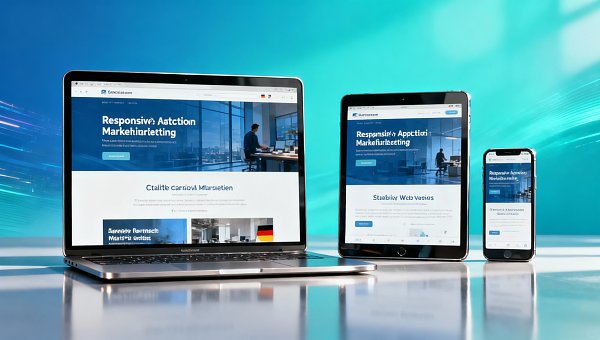
German users usually follow a relatively rational access path: search first, compare next, then inquire. Many industrial goods, equipment, and B2B service customers only enter the inquiry stage after 1 to 3 visits. Therefore, a responsive foreign trade website that can present a consistent content structure across different devices is better able to support a multi-round decision-making process.
From the perspective of device usage habits, the German market does not rely only on PCs. Procurement personnel may use desktops in the office to check specifications, project managers may review case studies on mobile phones while traveling, and end consumers rely more on mobile devices for quick browsing. If pages cannot adapt stably across different resolutions from 360px to 1440px, bounce rates often rise significantly.
The value of a responsive website is not limited to “automatic scaling.” It is more suitable for maintaining a unified URL structure, consolidating SEO authority, and reducing multi-version maintenance costs. For companies planning to launch both German and English sites simultaneously, a unified technical foundation can reduce repetitive work in subsequent content iteration, template updates, and page fixes, typically saving 20% to 35% of maintenance time.
Three direct impacts of responsive website development on the German market
- Improve browsing continuity after users enter from search results, reducing losses caused by messy layouts and accidental button taps.
- Make it easier to uniformly track core conversion events such as SEO, ad placements, form submissions, and phone clicks.
- Reduce the complexity of later operations, making it suitable for simultaneously covering the brand website, product pages, case pages, and inquiry pages.
However, whether it is truly “suitable” still has prerequisites. If a company only creates a simple display site, does not update content, and does not consider German local search habits, then even the best responsive framework will struggle to generate sustained traffic. Truly effective foreign trade website development must consider device adaptation, German content planning, technical performance, and compliance details together.
Which website experience and compliance details matter more to German users
The German market is extremely detail-oriented in judging website professionalism. In addition to whether the page design is clean and organized, users also pay attention to whether contact information is complete, whether the company introduction is clear, whether product specifications are verifiable, whether forms are trustworthy, and whether privacy notices are explicit. These details often determine whether visitors are willing to continue communication after the first visit.
At the technical level, a multilingual foreign trade website should at least focus on 4 basic indicators: first-screen loading time, mobile readability, navigation hierarchy clarity, and form usability. Taking a typical corporate website as an example, the first screen is recommended to be controlled within 2 seconds to 4 seconds as much as possible, the main navigation hierarchy is recommended not to exceed 3 levels, and the core inquiry button should be visible on the first screen or within the second screen.
At the compliance level, German users are relatively sensitive to explanations of data usage. Cookie notices, privacy policies, the display of company information on the contact page, and email subscription statements all affect trust building. If a company plans to run Google Ads long term or conduct remarketing, the website’s basic compliance setup is even more indispensable; otherwise, it will affect ad review and the completeness of data tracking.
Reference table of common experience requirements in the German market
The table below can be used by foreign trade companies to assess whether their current website has the basic conditions to enter the German market, and it also helps project managers align delivery standards with service providers in the early stage of website development.
As can be seen from the table, the German market’s requirements for foreign trade website development are not limited to visual appeal, but rather an integration of “experience, trust, compliance, and efficiency.” If a responsive website is combined with localized content and standardized data collection processes, it will have greater long-term value than a simple template-based site.
Two details that are easily overlooked
First, German buyers often download materials or repeatedly review specification pages, so PDF downloads, product comparison pages, and FAQ pages cannot be available only on the PC side. Second, contact methods should not be limited to one generic form. It is best to add at least 2 communication entry points such as email, phone, or WhatsApp to reduce conversion barriers.
How responsive foreign trade websites can balance SEO and inquiry conversion
When building websites for the German market, many companies tend to separate “being searchable” from “being able to retain customers.” In fact, SEO and conversion design must be planned simultaneously. If the page structure is not crawler-friendly, even highly professional content will struggle to gain organic traffic; if the page only has keywords but lacks trust elements, then even visits brought by rankings will be difficult to turn into effective inquiries.
In responsive foreign trade website development, it is recommended to prioritize the layout of 5 types of core pages: homepage, product or service pages, industry application pages, case pages, and contact pages. For B2B companies, a download center and FAQ pages can also be added. In the early stage, a website is usually recommended to launch with 20 pages to 50 pages of content first, and then gradually expand by keyword topics afterward.
Page elements that balance ranking and conversion
- Titles and descriptions should match the search intent of German users, avoiding content that only states company slogans.
- Product pages should include real information such as specifications, application scenarios, delivery methods, and after-sales explanations.
- Form fields are recommended to be controlled between 4 items and 6 items to reduce the burden of filling them out.
- Each key page should have at least 1 primary conversion action, such as inquiry, download, or demo booking.
From the perspective of marketing execution, the website must be connected with SEO, advertising, and social media lead acquisition. In the integrated practice of website + marketing services, Easy-Biz Information Technology (Beijing) Co., Ltd. usually advances keyword planning, on-site structure, form tracking, and landing page testing within the same project cycle, which is more conducive to traffic validation in the first 3 months and continuous optimization in the following 6 months.
If a company is involved in informational products such as professional consulting, training, and research reports, knowledge resource pages can also be inserted into the content strategy. For example, within the industry insights section, naturally extending to research-oriented content links such as Research on the Development of Internal Control Systems for Public Institutions Based on Risk Prevention and Control helps strengthen the website’s depth of information and topical clustering capability, but the premise is still to remain relevant to the needs of the target audience.
Common testing directions for improving conversion
It is recommended to conduct a small-scale page test every 30 days to 45 days, including button copy, form length, case ordering, first-screen copy, and contact module position. For the German market, a more rational information structure usually earns trust and inquiries more easily than overly sales-driven copy.
What website development and service capabilities companies should look at when making a selection
To judge whether responsive foreign trade website development is suitable for the German market, companies cannot look only at price. What truly affects results is whether the service provider can form a closed loop among website development, content, technology, promotion, and data analysis. For business decision-makers, at least 4 dimensions should be evaluated: technical stability, localization capability, marketing collaboration capability, and follow-up operation and maintenance efficiency.
If only a single website development service is purchased, companies often still need to find an SEO team, an advertising team, and a content team afterward, which leads to relatively high communication costs. In contrast, integrated website + marketing services are more suitable for companies hoping to see phased customer acquisition results within 90 days to 180 days, and are especially applicable to overseas expansion projects in manufacturing, equipment, industrial components, and professional services.
Reference table for choosing website development solutions
The comparison table below can help buyers quickly judge the applicable boundaries of different solutions, avoiding turning German market projects into short-term projects that are “quick to launch but difficult to optimize afterward.”
From the perspective of procurement decisions, the German market is more suitable for a “responsive custom website” or an “integrated website + marketing solution.” The former is suitable for companies that already have an overseas business foundation, while the latter is more suitable for teams that hope to directly operate the website as an overseas customer acquisition system.
6 items recommended for重点 review
- Whether it supports multilingual structure management and future expansion for German, English, and other languages.
- Whether it has capabilities such as page speed optimization, image compression, and code simplification.
- Whether it can deploy form tracking, phone click statistics, and ad conversion monitoring.
- Whether it provides content planning rather than only delivering static pages.
- Whether it includes support for basic compliance pages and notice configuration.
- Whether it has an ongoing operation mechanism, such as monthly optimization, quarterly reviews, and keyword iteration.
Implementation process, pitfalls, and optimization suggestions during execution
A responsive foreign trade website for the German market should usually not take “the pages are finished” as its goal, but rather “sustainable customer acquisition after launch” as the standard. A typical implementation cycle can be divided into 3 stages: early planning for 1 week to 2 weeks, mid-stage production for 2 weeks to 6 weeks, and later testing and optimization for 1 week to 2 weeks. If multilingual content and basic SEO deployment are included, the cycle will be slightly longer.
There are 3 most common misunderstandings in project implementation: first, focusing only on design and not on content, resulting in pages that look good but have no search value; second, focusing only on launch and not on tracking, making it impossible afterward to judge which channels bring inquiries; third, translating without localization, so although German pages exist, their expressions do not match the reading habits of German users.
Recommended implementation process
- Define the market and audience: clarify whether German buyers, distributors, or end users are the primary target.
- Organize the content framework: prioritize planning for the homepage, product pages, case pages, FAQ, and contact page.
- Complete responsive design: cover testing of no fewer than 3 mainstream size categories across mobile, tablet, and PC.
- Deploy tracking and forms: set up key events such as inquiry sources, button clicks, and download behavior.
- Continue optimization after launch: track keywords, bounce rate, inquiry rate, and page dwell time every month.
For project managers, the most practical approach is to divide website acceptance into 3 categories: visual acceptance, functional acceptance, and marketing acceptance. The first 2 categories solve “whether it can be used,” while the third solves “whether it can convert.” If the website is prepared to support topical content, it can also supplement the resource center with knowledge-based pages such as Research on the Development of Internal Control Systems for Public Institutions Based on Risk Prevention and Control to form stronger long-tail content coverage.
FAQ: 4 common questions from companies
1. Does the German market necessarily require a German-language site?
If the target customers are mainly local buyers and channel partners, it is recommended to build at least core pages in German. Even if the site is first launched in English, the German homepage, product pages, and contact page should still be added within 3 months to 6 months to enhance trust and search relevance.
2. Will a responsive website affect SEO performance?
A well-structured responsive design is usually more conducive to unified crawling and concentrated authority. The premise is that page loading, tag structure, content hierarchy, and mobile usability are all handled properly, rather than simply compressing the PC page to display on a mobile phone.
3. How soon can results be seen after the website is built?
If SEO and basic promotion are carried out simultaneously, initial data changes can usually be seen within 4 weeks to 8 weeks, and around 3 months is more suitable for evaluating page performance and inquiry quality. Because the B2B industry has a relatively long decision cycle, it is recommended to observe continuously for at least more than 90 days.
4. Which companies are suitable for prioritizing this investment?
It is suitable for companies that already have export plans, are preparing to expand German customers, need multilingual presentation, and rely on the corporate website to receive inquiries. Especially for companies in manufacturing, equipment, components, engineering services, and professional solutions, priority should be given to improving the responsive foreign trade website foundation.
Returning to the original question, is responsive foreign trade website development suitable for the German market? The answer is yes, but the premise is that it is not an isolated website project, but growth infrastructure jointly driven by localized experience, content planning, compliance setup, SEO layout, and conversion design.
For companies hoping to systematically develop the German market, what is truly worth investing in is not simply creating a site that “can display,” but building a foreign trade marketing hub that can adapt to multiple devices, receive traffic from multiple channels, and support continuous optimization. Relying on the integrated capabilities of Easy-Biz Information Technology (Beijing) Co., Ltd. in smart website development, SEO optimization, social media marketing, and advertising placement, companies can more easily shorten the path from launch to customer acquisition.
If you are evaluating a website development solution for the German market, or hope to upgrade your existing multilingual foreign trade website, it is recommended to sort out your target market, content structure, and conversion path as soon as possible to obtain a customized solution that better suits your current business stage. Contact us now to learn more about solutions and implementation details.
Related Articles


Related Products
 EasyCamp SaaS Smart Website Marketing SystemE-Yingbao SaaS Smart Website Marketing System: AI-powered, zero-code website building. Rapidly launch multilingual independent e-commerce sites in just 10 minutes. Global server acceleration and AI-driven SEO optimization empower businesses to efficiently connect with global markets. The seamless integration of technology and user-friendly operation makes building e-commerce sites incredibly simple.
 AI+SEM Intelligent Advertising Marketing SystemAI+SEM drives intelligent ad creation, empowering full-funnel precision advertising marketing. The system automatically generates weekly/monthly reports, AI recommends keywords and target countries, monitors core metrics in real-time with intelligent alerts, and enables one-click high-conversion ad solutions to help quickly acquire customers and improve ROI.
 AI+SEO Dual Engine Optimization ServiceEasyWin AI+SEO Dual Engine Optimization System leverages AI-powered keyword mining, content generation, and comprehensive technical optimization to help foreign trade enterprises acquire high-quality organic traffic, significantly improving search rankings and conversion rates.
 AI+SNS Social Media Marketing SystemYingbao AI+SNS Social Media Marketing System - Precision social capture for the social media era. Supports one-click content synchronization across major platforms like Facebook and LinkedIn. AI intelligently rewrites posts for enhanced relevance. 24/7 AI customer service and user profiling analysis empower businesses to efficiently expand into global markets.
 AI+SEO营销解决方案易营宝AI+SEO营销解决方案,通过AI批量写作、智能生成TDK、精准关键词扩词等功能,全面优化网站SEO效果,提升流量与转化率。助力企业构建高效智能网站新生态。
 AI+SEM Advertising Marketing SolutionsAI+SEM Advertising Marketing Solution leverages AI technology to deeply empower SEM ad campaigns. It automatically generates weekly/monthly reports using AI, presenting account data across multiple dimensions for comprehensive insights into campaign performance and trends. The system precisely recommends keywords and target countries, intelligently generates high-conversion ad copy, and enables one-click activation of efficient campaign plans to help businesses rapidly acquire customers. Simultaneously, it monitors core metrics in real time, intelligently identifies abnormal fluctuations, and issues timely alerts to ensure stable, high-return advertising results.
 Domain Name ServicesEasyWin provides professional domain name services, including intelligent queries, one-stop registration, brand protection, and full lifecycle management, helping businesses build a digital brand image.
 EasyOperate B2C Cross-Border E-Commerce Platform & Independent WebsiteEasyStore B2C Cross-border E-commerce Independent Store is an intelligent website building and cross-border e-commerce integrated solution independently developed by EasyStore Information Technology (Beijing) Co., Ltd. The system is specially designed for small and medium-sized as well as large export enterprises, integrating 'website building, operation, marketing, advertising, and conversion' into one, helping enterprises quickly establish cross-border e-commerce independent stores to achieve brand globalization and global sales growth.
The platform supports multiple languages, multiple currencies, and multi-channel marketing, with built-in AI intelligent translation and SEO optimization systems, suitable for mainstream markets such as Southeast Asia, Europe and America, Latin America, and the Middle East, assisting Chinese manufacturing enterprises in efficiently deploying international e-commerce strategies. SSL证书易营宝提供专业SSL安全证书服务,包括单域名和泛域名证书,确保网站数据传输加密、身份验证和完整性保护,助力企业建立安全可信的在线业务环境。









