









- What stages does the cross-border services ecosystem include? How do website building, promotion, payment, and compliance work togetherJun 22, 2026View details
- How will email marketing costs change in 2026Jun 22, 2026View details
- The China-US tariff arrangement has reached a preliminary consensus, and the trade association will be establishedJun 15, 2026View details
- Should overseas brand marketing start with ads or contentJun 21, 2026View details
- What determines B2C cross-border e-commerce website development costs? A breakdown of features, interfaces, and deployment methodsJun 17, 2026View details
- China-Morocco zero-tariff access, a breakthrough in the cost of Moroccan goods exports to ChinaJun 11, 2026View details
- What signal should be released for the suspension of exports to JapanJun 10, 2026View details
- China's May LNG imports rebounded, with increased volumes from Russia and Canada filling the Middle East supply gapJun 10, 2026View details
What Can You Learn from Website Analysis in Webmaster Tools, and Which Metrics Matter Most
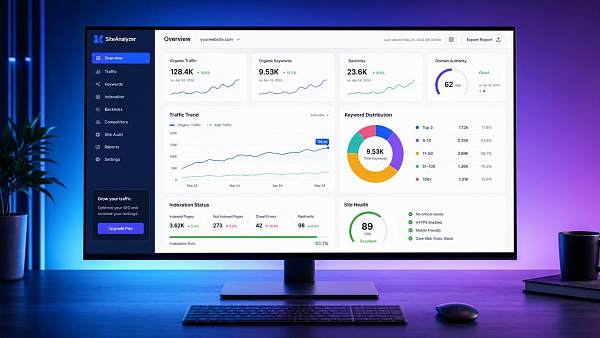
Want to quickly judge whether a website is worth researching? Through webmaster tool website analysis, you can clearly see traffic trends, indexing performance, keyword distribution, and the level of basic optimization. This article will focus on the most practical metrics to help you efficiently understand website data.
What is webmaster tool website analysis, and why is it always used for preliminary evaluation?
When many information researchers first come into contact with website evaluation, they usually start by looking at webmaster tool website analysis. The reason is straightforward: it can help you assess a website’s basic profile in a relatively short time, including domain status, search engine indexing, keyword coverage, on-page optimization traces, and backlink fundamentals. For corporate marketers, SEO practitioners, and competitor research analysts, although this information does not represent the full truth, it is enough to form the first round of screening.
Especially in the integrated website + marketing service scenario, a website is no longer just a display business card, but also a customer acquisition entry point, a brand asset, and a content hub. A website’s performance in webmaster tool website analysis often reflects whether its long-term operations are stable, whether content is continuously updated, whether the technical structure is suitable for search optimization, and whether marketing activities have formed a closed loop.
However, it should also be noted that much of the data provided by webmaster tools consists of estimated values or organized publicly visible information, which is suitable for trend judgment and relative comparison, but not for treating as absolute business performance data. Therefore, the correct way to use it is not to “look at only one number,” but to “see whether multiple metrics validate one another.”
Which metrics in webmaster tool website analysis are the most worth looking at first?
If your time is limited, it is recommended to first focus on five core categories of metrics. They are not the flashiest, but they usually have the strongest evaluative value. The first category is indexing volume and indexing trends. More indexed pages are not always better; what matters is whether the website’s scale matches its indexing, and whether there are issues such as long-term stagnation, sharp declines, or a large number of invalid pages being indexed.
The second category is keyword rankings and keyword database coverage. Here, the focus should be on whether the website covers core industry keywords, long-tail keywords, and question-based search terms. If a website ranks only for a small number of branded terms, it indicates limited organic customer acquisition capability; if non-branded terms are abundant, it usually means the content layout is more mature.
The third category is estimated traffic trends. Estimated traffic may not be precise, but whether it is rising, stable, or declining is often highly valuable as a reference. The fourth category is basic information such as domain age, ICP filing, and website history, which can help you make a preliminary judgment about a website’s stability and credibility. The fifth category is basic page SEO, such as titles, descriptions, H tags, friend links, broken links, and page speed signals, all of which relate to the room for future optimization.
For most researchers, what is truly useful is not “what you saw,” but “what you can infer from this data.” For example, high indexing but low traffic may indicate weak content quality; many keywords but poor conversion may mean the keywords are not precise; an old domain but weak page fundamentals may suggest the website has not been upgraded for many years.
How can you understand the relationship between indexing, keyword database, and traffic without making easy misjudgments?
This is the part of webmaster tool website analysis that is most easily misunderstood. Many people see a large indexing volume and assume the website is doing well; they see a high traffic estimate and assume conversions must also be high. In fact, these three are only correlated, not equal to one another.
A more reasonable way to judge is: first see whether indexing is stable, then see whether the keywords are relevant to the business, and finally see whether the estimated traffic comes from effective keywords. Suppose a website has indexed tens of thousands of pages, but most of its ranking keywords are unrelated to its core business; then its help for customer acquisition may not be significant. Conversely, a website may not have many indexed pages, but if it focuses on high-intent long-tail keywords, it may still have very strong conversion potential.
In practical corporate operations, especially for companies engaged in smart website building, SEO optimization, social media marketing, and coordinated advertising campaigns, more attention is paid to “traffic quality” rather than just “traffic volume.” Digital marketing service providers like Yiyingbao Information Technology (Beijing) Co., Ltd., which have long served global growth needs, usually treat webmaster tool website analysis as an early-stage diagnostic entry point, and then combine search intent, landing page engagement, and conversion paths for a more complete evaluation. Only in this way can you avoid looking only at surface-level data while overlooking real marketing value.
Which metrics are most suitable for competitor research and pre-collaboration evaluation?
If your goal is to research competitors, it is recommended to prioritize industry keyword coverage, content update frequency, ranking page types, and backlink structure. Industry keyword coverage can indicate the breadth of the other party’s SEO strategy; content update frequency can reflect whether operational investment is sustained; ranking page types can reveal whether traffic comes from articles, product pages, topic pages, or case study pages.
If your goal is pre-collaboration evaluation, then you should pay more attention to foundational credibility, such as ICP filing, domain history, website stability, whether branded search results are consistent, and whether there are obvious signs of over-optimization. Some websites may appear to have a large keyword database, but if their page content is repetitive, titles are stuffed with keywords, and friend links are messy, such sites may have short-term visibility but are not necessarily suitable for long-term cooperation.
It is worth mentioning that different industries are sensitive to different data points. For example, corporate service websites place more emphasis on brand trust, case study pages, and solution page performance; while information-based websites care more about indexing scale and update speed. Occasionally, you may also see some research pages related to business decision-making, such as Discussion on Optimization Strategies for Fund Management in Power Enterprises Based on Cash Flow Forecasting. The value of such content does not lie in directly bringing traffic, but in supporting a professional image, capturing segmented search demand, and improving the content matrix.
Is there a table that can quickly help judge common signals in webmaster tool website analysis?
Yes. The table below is suitable for information researchers to quickly review key points, and is especially useful for initial website screening, competitor comparison, or basic judgment before marketing cooperation.
What are the most common misunderstandings when doing webmaster tool website analysis?
The first misunderstanding is looking only at authority-related metrics. Many people are used to first looking at a composite score or authority number, but such metrics are often the result of platform model calculations, suitable for reference but not for making decisions independently. The second misunderstanding is treating estimated traffic as real traffic. Especially in low-frequency industries, regional industries, and B2B industries, the traffic estimates provided by webmaster tool website analysis often only indicate direction.
The third misunderstanding is ignoring page quality. A good keyword database and indexing do not mean the user experience is also good. After entering a website, if the pages are outdated, navigation is confusing, and forms are difficult to use, actual conversion may still be very low. The fourth misunderstanding is ignoring business goals. Some websites pursue brand exposure, some pursue inquiry conversion, and some pursue content accumulation. Under different goals, the understanding of metric priority is also different.
There is also a hidden misunderstanding: treating webmaster tool website analysis as the end point rather than the starting point. Truly effective research often requires continuing to examine search results page performance, key landing page structure, content topic planning, and whether a complete path from traffic generation to conversion has been formed. Even professional pages such as Discussion on Optimization Strategies for Fund Management in Power Enterprises Based on Cash Flow Forecasting should also be understood within the overall content strategy of the website, rather than viewed in isolation.
If you want to further judge whether a website is worth cooperating with or learning from, what else should you review?
After completing basic webmaster tool website analysis, it is recommended to further review four aspects. First, check whether the homepage and core landing pages clearly express service scope, advantages, and action entry points. Second, check whether case studies, customer testimonials, and solutions are authentic and complete, as this affects commercial persuasiveness. Third, check the mobile experience, because a large amount of search and conversion now takes place on mobile devices. Fourth, check whether content and channels work together, for example whether SEO content forms a unified path together with social media, advertising, form collection, and customer service follow-up.
For companies hoping to build a long-term growth system, simply looking at website data is no longer enough; it is also necessary to evaluate the service capabilities behind it. Mature service providers often not only explain the data, but also combine industry, regional markets, and user intent to give optimization priorities. Especially in the context of intensifying global digital marketing competition, technical capability and localization services together are often more important than traffic growth alone.
Conclusion: How should information researchers make good use of webmaster tool website analysis?
For information researchers, the most valuable part of webmaster tool website analysis is not giving a simple conclusion, but helping you ask the right questions faster. You can first use it to judge whether a website has a foundation for continuous operation, then use indexing, keyword database, estimated traffic, domain information, and page optimization status for cross-validation, and finally combine the actual page experience and business goals to arrive at a judgment closer to reality.
If you need to further confirm specific plans, optimization direction, construction cycle, content strategy, campaign coordination, or cooperation models, it is recommended to prioritize communication around these questions: what are the current website’s main customer acquisition channels; do the core keywords match the target customers; which pages bear the conversion tasks; does the technical structure support continuous SEO; and whether website building, optimization, content, social media, and advertising need to be advanced together under an integrated growth framework. Only by using webmaster tool website analysis in this way can you truly move from “looking at data” to “making judgments.”
Related Articles
 Why is it that your foreign trade peers receive inquiries every day, while you can only wait for exhibitions?
 Foreign trade websites "look good but don’t convert"? Yiyingbao’s global language automatic adaptation, inquiries surge!
 Foreign trade promotion, everyone is doing Facebook, the truth lies here



Related Products
 EasyCamp SaaS Smart Website Marketing SystemE-Yingbao SaaS Smart Website Marketing System: AI-powered, zero-code website building. Rapidly launch multilingual independent e-commerce sites in just 10 minutes. Global server acceleration and AI-driven SEO optimization empower businesses to efficiently connect with global markets. The seamless integration of technology and user-friendly operation makes building e-commerce sites incredibly simple.
 AI+SEM Intelligent Advertising Marketing SystemAI+SEM drives intelligent ad creation, empowering full-funnel precision advertising marketing. The system automatically generates weekly/monthly reports, AI recommends keywords and target countries, monitors core metrics in real-time with intelligent alerts, and enables one-click high-conversion ad solutions to help quickly acquire customers and improve ROI.
 AI+SEO Dual Engine Optimization ServiceEasyWin AI+SEO Dual Engine Optimization System leverages AI-powered keyword mining, content generation, and comprehensive technical optimization to help foreign trade enterprises acquire high-quality organic traffic, significantly improving search rankings and conversion rates.
 AI+SNS Social Media Marketing SystemYingbao AI+SNS Social Media Marketing System - Precision social capture for the social media era. Supports one-click content synchronization across major platforms like Facebook and LinkedIn. AI intelligently rewrites posts for enhanced relevance. 24/7 AI customer service and user profiling analysis empower businesses to efficiently expand into global markets.
 AI+SEO营销解决方案易营宝AI+SEO营销解决方案,通过AI批量写作、智能生成TDK、精准关键词扩词等功能,全面优化网站SEO效果,提升流量与转化率。助力企业构建高效智能网站新生态。
 AI+SEM Advertising Marketing SolutionsAI+SEM Advertising Marketing Solution leverages AI technology to deeply empower SEM ad campaigns. It automatically generates weekly/monthly reports using AI, presenting account data across multiple dimensions for comprehensive insights into campaign performance and trends. The system precisely recommends keywords and target countries, intelligently generates high-conversion ad copy, and enables one-click activation of efficient campaign plans to help businesses rapidly acquire customers. Simultaneously, it monitors core metrics in real time, intelligently identifies abnormal fluctuations, and issues timely alerts to ensure stable, high-return advertising results.
 Domain Name ServicesEasyWin provides professional domain name services, including intelligent queries, one-stop registration, brand protection, and full lifecycle management, helping businesses build a digital brand image.
 EasyOperate B2C Cross-Border E-Commerce Platform & Independent WebsiteEasyStore B2C Cross-border E-commerce Independent Store is an intelligent website building and cross-border e-commerce integrated solution independently developed by EasyStore Information Technology (Beijing) Co., Ltd. The system is specially designed for small and medium-sized as well as large export enterprises, integrating 'website building, operation, marketing, advertising, and conversion' into one, helping enterprises quickly establish cross-border e-commerce independent stores to achieve brand globalization and global sales growth.
The platform supports multiple languages, multiple currencies, and multi-channel marketing, with built-in AI intelligent translation and SEO optimization systems, suitable for mainstream markets such as Southeast Asia, Europe and America, Latin America, and the Middle East, assisting Chinese manufacturing enterprises in efficiently deploying international e-commerce strategies. SSL证书易营宝提供专业SSL安全证书服务,包括单域名和泛域名证书,确保网站数据传输加密、身份验证和完整性保护,助力企业建立安全可信的在线业务环境。









