









- What Does a Global Traffic Ecosystem Service Provider Do? What Are the Differences from a Single Advertising AgencyJul 16, 2026View details
- What should you focus on in the latest enterprise SaaS report? From renewal rates and delivery costs to overseas growth opportunitiesJul 12, 2026View details
- What signals are worth paying attention to in a cross-border marketing trend report? B2B companies should look at these 6 signalsJul 11, 2026View details
- How to Read a Cross-Border Marketing Trends Report? Five Key Dimensions for Evaluating Channel OpportunitiesJul 11, 2026View details
- Which channel has the highest ROI in the global traffic ecosystem? Comparative analysis of search, social media, and advertisingJul 10, 2026View details
- What multilingual website services are available in Sanya? Which model is more suitable for local businesses going global?Jul 08, 2026View details
- How to view the complete list of China SaaS companies in the top 100? Practical methods for screening website-building and marketing service providersJul 08, 2026View details
- How to view pricing in the global traffic ecosystem? Cost comparison of search, social media, and content channel advertisingJul 06, 2026View details
Will a multilingual website for foreign trade affect SEO performance?
Will a multilingual website for international trade negatively impact SEO? The key isn't the number of languages, but rather the website's architecture, translation quality, and technical specifications. Choosing professional search engine optimization services and a suitable platform is crucial to balancing multilingual website development, user experience, and Google SEO optimization.
For companies expanding into overseas markets, the question isn't "whether or not to create a multilingual website," but rather "how to do it without hindering traffic and inquiries." Information researchers are concerned with indexing and ranking logic, business decision-makers focus on return on investment, project managers prioritize delivery timelines and collaboration efficiency, while after-sales and channel teams place greater emphasis on the controllability of subsequent maintenance.
In a website + marketing service integrated scenario, multilingual sites serve as both brand touchpoints and customer acquisition infrastructure. Improper language version expansion can lead to common problems such as duplicate content, incorrect redirects, keyword mismatches, and unindexed pages, which typically surface gradually over 2-8 weeks after launch, directly impacting organic traffic and conversion rates.
Since its establishment in 2013, Yiyingbao Information Technology (Beijing) Co., Ltd. has been providing full-chain services encompassing intelligent website building, SEO optimization, social media marketing, and advertising. For companies seeking to balance localization, technical standards, and growth efficiency, multilingual websites do not inherently harm SEO; the true determinant of success lies in the architecture design, content quality, and continuous operational capabilities.
Why do multilingual websites affect SEO assessments, but not necessarily SEO results?
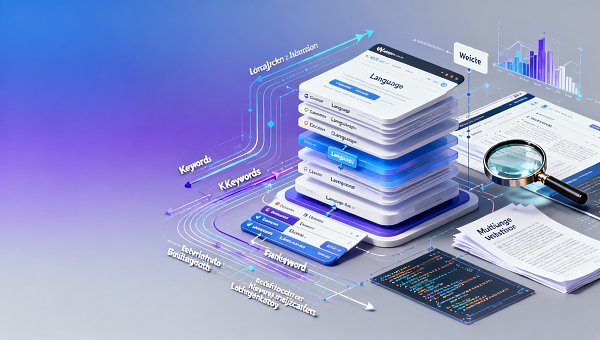
Search engines don't automatically lower a website's ranking just because it's in 3, 5, or 10 languages. They assess whether different language pages serve different users, possess independent value, and have clear language and regional signals. If these fundamentals are done correctly, a multilingual site can actually broaden keyword coverage and improve search visibility in multiple markets.
The problem usually lies at the execution layer. For example, if a Chinese page is directly machine-translated into English, Spanish, and Arabic with the same page structure but no localization of keywords, the result will be a situation where "the language has changed, but the search intent doesn't match." In this case, it's not the number of languages that affects SEO, but rather the content quality and insufficient semantic matching that negatively impact performance.
From a Google SEO perspective, multilingual websites need to meet three criteria simultaneously: first, a clear site architecture; second, accurate technical tagging; and third, content that caters to the search habits of local users. Missing any one of these criteria will lead to decreased crawling efficiency, fragmented indexing, or unstable rankings.
This is especially true for B2B companies. Search terms in fields such as industrial equipment, engineering projects, parts, and after-sales service are often longer and more specific, with common query lengths between 3 and 6 words. If only literal translations are done without considering application scenarios, parameter expressions, and purchasing habits, multilingual website construction can easily become an investment of "pages without traffic."
Four common reasons affecting SEO performance
- The mixed use of directories and subdomains makes it difficult for search engines to determine the language affiliation; for example, the same English content may appear in both the /en/ and en.example structures.
- Using the same title and description across different language versions, and failing to reorganize keywords according to the market, will lead to a decrease in click-through rate and relevance.
- Incomplete configuration of hreflang, canonical, and sitemap may lead to incorrect delivery, incorrect indexing, or page competition after crawling.
- Content updates are out of sync; Language A has 50 product pages, while Language B only has 12 core pages, resulting in an uneven quality signal across the sites.
The table below can help businesses quickly determine whether a multilingual website is "amplifying SEO opportunities" or "creating an SEO burden".
The key conclusion is that multilingualism is not the source of risk; rather, a chaotic approach to implementation is. If companies clearly define language priorities, technical pathways, and content standards during the project initiation phase, they can typically see index improvements and increased exposure of core keywords within 1-3 months of the initial launch.
Key factors influencing the SEO of multilingual websites for international trade: architecture, translation, and technical details.
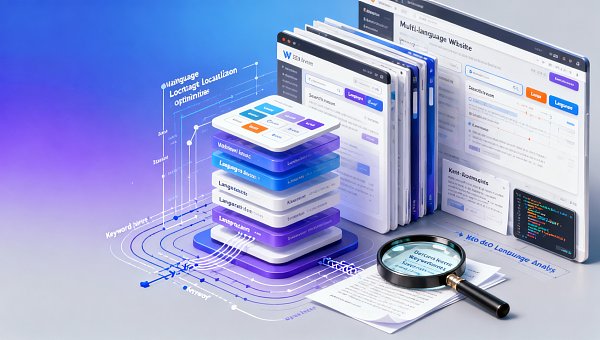
The first issue to address when building a multilingual website is its architecture. For most foreign trade companies, a subdirectory structure, such as /en/, /fr/, /de/, is more conducive to unified management. Subdomains or independent domains should only be considered if the company has an independent marketing team, a dedicated server, or a separate brand strategy. Don't add unnecessary complexity in the early stages just to "look international."
The second key point is translation quality. Translation in the context of SEO is not simply moving sentences from language A to language B, but rather translating search queries, purchasing expressions, and industry terminology into page language that the target market can understand. Especially in industries like machinery, building materials, electronics, and engineering services, even a single parameter unit or application scenario term can affect whether a page appears in accurate search results.
The third key point is technical specifications. Common configurations include at least: hreflang tags, canonical tags, language switching logic, XML sitemap, canonical URLs, and server response speed. For foreign trade websites targeting markets in Europe, the Middle East, and Southeast Asia, it is recommended to keep the first screen loading time within 2-4 seconds; otherwise, bounce rate and crawling efficiency will usually be affected.
Many companies focus their budgets on the visual appeal of their homepage, neglecting the multilingual quality of product detail pages, industry solution pages, and FAQ pages. In reality, B2B inquiries often originate from these "mid-to-late-stage pages." A mature multilingual SEO project should at least cover five basic page types: homepage, core category pages, key product pages, solution pages, and contact pages, before gradually expanding into content assets.
Six key aspects to check when implementing technology
- Does each language version have a separate URL, instead of temporarily switching text via a script?
- Does hreflang have a bidirectional mapping to prevent page A from pointing to page B, while page B does not point back?
- Whether to set a default language page to reduce redirection errors when the region cannot be accurately matched.
- Are image ALT text, breadcrumbs, pagination, and filter pages synchronized locally?
- Does the mobile app retain the complete language switching path to avoid misleading redirects?
- Have the site maps for each language been submitted and reviewed within 7 days of going live?
Translation is not the same as localization
For example, the search intent for "industrial solution" varies across different countries and industries. Some markets prefer "application system," while others prefer "project solution." Without keyword research, simply copying the original content's logic will make it difficult for the page to enter high-relevance traffic pools, even if it gets indexed.
When implementing multilingual projects within an enterprise, the approach to content governance is similar to that of financial governance: the clearer the process, the lower the losses later on. Some project management teams also refer to methodological materials such as research on problems and solutions in enterprise financial management when building budget models for overseas sites, in order to sort out inputs, risks, and phased returns. This approach is also applicable to the construction of multilingual sites.
What kind of multilingual website building and SEO solutions are suitable for different businesses?
Not all companies are suited to launching more than eight languages at once. For companies with concentrated annual export regions and fewer product lines, it's more pragmatic to start with two or three core languages. For companies with broad channels, numerous SKUs, and complex after-sales processes, it's advisable to prioritize building a scalable framework and then gradually add language versions. The key is to match the business pace, rather than blindly pursuing comprehensiveness.
From the perspective of the target audience, information researchers are more concerned with industry keyword coverage and visibility, decision-makers value budget, timeline, and customer acquisition efficiency, while project managers are more concerned with the smoothness of the collaboration process. The advantage of integrating website and marketing services lies in the fact that website building, SEO, content, and placement can be planned in a unified manner, reducing the gap of "website delivery but marketing not keeping up."
Taking common implementation cycles as an example, basic multilingual websites typically require 2-4 weeks to complete the framework construction and launch the first batch of pages; medium-sized projects, if they include keyword research, content rewriting, technical verification, and conversion path design, usually take 4-8 weeks; if they also involve multi-regional advertising landing pages and social media collaboration, they often need to be promoted in 3 stages.
Service providers like YiYingBao, which combine technological innovation with localized services, are better suited to help businesses upgrade "site delivery" to "growth delivery." This is especially true for export-oriented manufacturing companies, where a website is not just a collection of isolated pages, but a digital platform that operates in conjunction with SEO optimization, social media outreach, and advertising.
Comparison of common enterprise types and recommended solutions
If a company is still evaluating whether to expand into multiple languages, it can first choose a path based on business maturity and market complexity. The table below is suitable for the project initiation discussion and budget approval stages.
As the table shows, the number of languages is not the only variable. Whether a content hierarchy, page priority, and keyword strategy can be tailored to business objectives determines whether the investment in multilingual website development truly translates into SEO assets.
Common operational pitfalls, key maintenance points, and conversion suggestions after launching a multilingual website
Many companies consider going live as the end of the project, but this is actually just the beginning of SEO work. Typically, crawling, indexing, keyword exposure, landing page performance, and inquiry paths should be checked 30 days, 60 days, and 90 days after launch. If there is no basic monitoring after 3 months, it becomes difficult to determine whether the problem lies in page quality, technical issues, or incorrect search demand assessment.
The first common misconception is that "all language versions must be completely synchronized." In fact, different markets have different needs, and page pacing should also differ. For an English site, start by covering 30 core pages; for a Spanish site, focus on 12 high-intent pages; and for a German site, prioritize refining the technical parameter pages. This approach is more efficient in terms of resource utilization than mechanical synchronization.
The second misconception is that "translation completes the content." What truly impacts conversion rates includes whether form fields are concise, contact information is clearly displayed, downloadable materials are locally readable, and after-sales instructions are clear. For distributors and end consumers, language comprehension is only the first step; building trust and guiding action are the crucial pre-sale stages.
The third misconception is neglecting continuous expansion. Mature multilingual websites are typically updated monthly, with a frequency of 4-8 articles per month or a batch of key product pages added quarterly. For SEO, continuously adding highly relevant content is often more effective than piling up a lot of low-quality pages at once.
Five recommended maintenance steps after deployment
- Step 1: Check the index status for all language versions, especially the core directory pages and key product pages.
- Step 2: Verify that language switching, redirection, and form submission are working correctly. Mobile devices need to be tested separately.
- Step 3: Review keyword performance in the market and filter out pages with high exposure but low click-through rates for title optimization.
- Step 4: Adjust CTA, download materials, and contact entry points based on inquiry data to shorten the conversion path.
- Step 5: Review the technical items every 30 days, including 404 errors, redirect links, sitemap, and tag configuration.
FAQ: Some of the most frequently asked questions by businesses
If you have a limited budget, how many languages should you focus on first? It's generally recommended to start with 1-3 languages, prioritizing markets with high order volume, stable inquiries, and reliable after-sales service, rather than trying to cover all languages at once.
Does a multilingual website necessarily need a dedicated server? Not necessarily. For most small and medium-sized enterprises, ensuring access speed, stability, and caching strategies is more important first; regional server deployment can be considered a second-stage optimization.
Can machine translation be used for initial launch? It can be used as a draft, but the final page must undergo at least human proofreading, keyword verification, and industry terminology review. This is especially true for modules such as product parameters, installation instructions, and warranty information, where the cost of errors is extremely high.
If a company needs to simultaneously streamline its budget process, investment allocation, and operational efficiency while advancing its overseas business, the team can also use this information as a reference for horizontal management, combining it with research on existing problems and countermeasures in the company's financial management . However, the focus of execution should still be on the synergy between the website and marketing.
How to choose a professional service provider to truly turn a multilingual website into a growth asset.
When choosing a multilingual website building and SEO service provider, businesses should not only compare prices but also consider the completeness of their service scope. A truly suitable team for foreign trade operations should cover at least six modules: website building, content creation, localization, technical optimization, data tracking, and post-operation. Otherwise, once the project enters the second phase, internal issues such as frequent rework and increased costs associated with multiple intermediaries will arise.
For corporate decision-makers, the most valuable thing is not "how many languages have been implemented," but "whether each language serves a specific market and whether it leads to sustainable customer acquisition." If a service provider can only deliver pages but cannot explain keyword strategies, page prioritization, and conversion logic, then SEO results will typically lack stability.
With over 10 years of experience in global digital marketing services, YiYingBao leverages artificial intelligence and big data to create integrated solutions encompassing intelligent website building, SEO optimization, social media marketing, and advertising. For businesses that need to balance efficiency, localization, and future growth, this integrated capability helps shorten the trial-and-error cycle and reduce the common problem of "the website is built, but traffic doesn't keep up."
If you're assessing whether a multilingual website for international trade will impact SEO, the answer is clear: yes, it will, but the direction of that impact depends on your website's development approach. With a well-structured architecture, in-depth translation expertise, robust technology, and continuous optimization, a multilingual website will not only avoid hindering SEO but can also become a crucial entry point into new markets. To further evaluate your language strategy, website design, and optimization path, please contact us immediately for a customized solution and to learn about overseas growth solutions best suited to your company's current stage.
Related Articles

Related Products
 EasyCamp SaaS Smart Website Marketing SystemE-Yingbao SaaS Smart Website Marketing System: AI-powered, zero-code website building. Rapidly launch multilingual independent e-commerce sites in just 10 minutes. Global server acceleration and AI-driven SEO optimization empower businesses to efficiently connect with global markets. The seamless integration of technology and user-friendly operation makes building e-commerce sites incredibly simple.
 AI+SEM Intelligent Advertising Marketing SystemAI+SEM drives intelligent ad creation, empowering full-funnel precision advertising marketing. The system automatically generates weekly/monthly reports, AI recommends keywords and target countries, monitors core metrics in real-time with intelligent alerts, and enables one-click high-conversion ad solutions to help quickly acquire customers and improve ROI.
 AI+SEO Dual Engine Optimization ServiceEasyWin AI+SEO Dual Engine Optimization System leverages AI-powered keyword mining, content generation, and comprehensive technical optimization to help foreign trade enterprises acquire high-quality organic traffic, significantly improving search rankings and conversion rates.
 AI+SNS Social Media Marketing SystemYingbao AI+SNS Social Media Marketing System - Precision social capture for the social media era. Supports one-click content synchronization across major platforms like Facebook and LinkedIn. AI intelligently rewrites posts for enhanced relevance. 24/7 AI customer service and user profiling analysis empower businesses to efficiently expand into global markets.
 AI+SEO营销解决方案易营宝AI+SEO营销解决方案,通过AI批量写作、智能生成TDK、精准关键词扩词等功能,全面优化网站SEO效果,提升流量与转化率。助力企业构建高效智能网站新生态。
 AI+SEM Advertising Marketing SolutionsAI+SEM Advertising Marketing Solution leverages AI technology to deeply empower SEM ad campaigns. It automatically generates weekly/monthly reports using AI, presenting account data across multiple dimensions for comprehensive insights into campaign performance and trends. The system precisely recommends keywords and target countries, intelligently generates high-conversion ad copy, and enables one-click activation of efficient campaign plans to help businesses rapidly acquire customers. Simultaneously, it monitors core metrics in real time, intelligently identifies abnormal fluctuations, and issues timely alerts to ensure stable, high-return advertising results.
 Domain Name ServicesEasyWin provides professional domain name services, including intelligent queries, one-stop registration, brand protection, and full lifecycle management, helping businesses build a digital brand image.
 EasyOperate B2C Cross-Border E-Commerce Platform & Independent WebsiteEasyStore B2C Cross-border E-commerce Independent Store is an intelligent website building and cross-border e-commerce integrated solution independently developed by EasyStore Information Technology (Beijing) Co., Ltd. The system is specially designed for small and medium-sized as well as large export enterprises, integrating 'website building, operation, marketing, advertising, and conversion' into one, helping enterprises quickly establish cross-border e-commerce independent stores to achieve brand globalization and global sales growth.
The platform supports multiple languages, multiple currencies, and multi-channel marketing, with built-in AI intelligent translation and SEO optimization systems, suitable for mainstream markets such as Southeast Asia, Europe and America, Latin America, and the Middle East, assisting Chinese manufacturing enterprises in efficiently deploying international e-commerce strategies. SSL证书易营宝提供专业SSL安全证书服务,包括单域名和泛域名证书,确保网站数据传输加密、身份验证和完整性保护,助力企业建立安全可信的在线业务环境。









