









- What stages does the cross-border services ecosystem include? How do website building, promotion, payment, and compliance work togetherJun 22, 2026View details
- How will email marketing costs change in 2026Jun 22, 2026View details
- The China-US tariff arrangement has reached a preliminary consensus, and the trade association will be establishedJun 15, 2026View details
- Should overseas brand marketing start with ads or contentJun 21, 2026View details
- What determines B2C cross-border e-commerce website development costs? A breakdown of features, interfaces, and deployment methodsJun 17, 2026View details
- China-Morocco zero-tariff access, a breakthrough in the cost of Moroccan goods exports to ChinaJun 11, 2026View details
- What signal should be released for the suspension of exports to JapanJun 10, 2026View details
- China's May LNG imports rebounded, with increased volumes from Russia and Canada filling the Middle East supply gapJun 10, 2026View details
Where to start with SEO for a corporate website for a clearer process
Where should corporate website SEO begin? It is recommended to first sort out the website TDK, domain registration, and responsive website fundamentals, and then combine corporate website development, SEO optimization technology, and user experience optimization to establish a clearer execution process and improve SEO ranking performance and conversion efficiency.
What to do first: Why corporate website SEO should not start by publishing content right away
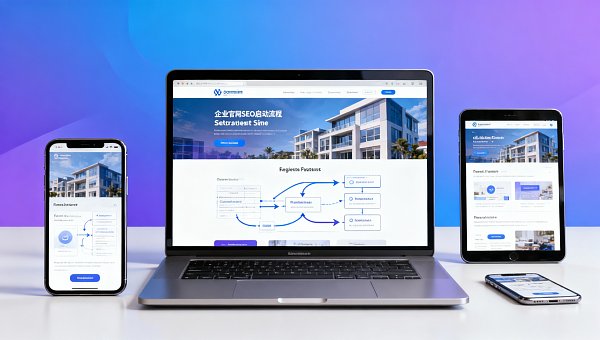
When many companies optimize their official websites, their first reaction is to update news, pile up product pages, and write industry articles. But if the website foundation is not properly built, the more content added later, the higher the rework cost. For users and project owners, the starting point of corporate website SEO is not “publish more,” but to first straighten out the site structure, domain, page standards, and crawlability.
In the integrated website + marketing services industry, a clear process can usually be divided into 4 steps: foundational diagnosis, on-site setup, content deployment, and data iteration. The first 2 steps determine whether search engines can understand the site stably, while the last 2 steps determine traffic quality and conversion efficiency. If the order is reversed, common problems include slow indexing, scattered keywords, and high landing page bounce rates.
For business decision-makers, official website SEO is not a single technical action, but part of the customer acquisition system. It needs to be planned together with website building, content, conversion forms, and customer inquiry paths. Especially for B2B companies, visitors often complete the 3 actions of “understand, compare, and judge” in 1 visit, so page organization must be designed around this process.
Easy B2B Information Technology (Beijing) Co., Ltd. has been deeply engaged in global digital marketing services since 2013, forming a full-chain solution around intelligent website building, SEO optimization, social media marketing, and advertising placement. For companies hoping to advance corporate website development and SEO optimization technology simultaneously, this integrated capability makes it easier to reduce communication loss across teams and shorten the 2–4 week startup coordination period.
Before launching official website SEO, at least 5 basic items should be checked
- Whether the domain is unified: whether there are issues such as parallel use of versions with www and without www, and mixed use of http and https, to avoid authority dispersion.
- Whether the TDK is clear: the homepage, category pages, and product pages should have independent titles, descriptions, and core keywords, and should not be duplicated across the entire site.
- Whether the responsive design is complete: on 3 types of devices—mobile phones, tablets, and computers—navigation, images, and buttons should remain readable and clickable.
- Whether the page hierarchy is reasonable: important pages are recommended to be reachable within 3 clicks, making crawling and user browsing easier.
- Whether the conversion entry points are clear: inquiry forms, phone numbers, instant consultation, document downloads, etc. should include at least 2 effective entry points.
If the above 5 items are not handled first, subsequent keyword layout and content placement will often result in situations such as “traffic without inquiries” or “pages without rankings.” For after-sales maintenance staff and operations executors, spending 3–7 days organizing the fundamentals in the early stage can significantly reduce later redesign and maintenance pressure.
How to arrange the process: How corporate website development and SEO optimization technology can advance simultaneously
Truly efficient corporate website SEO is not about patching optimization after the website goes live, but about writing both search logic and marketing logic into the plan during the website development stage. The advantages of doing so are very direct: less redevelopment rework, more stable site sections, and better content scalability, making it suitable for companies with tight project timelines and controllable budget requirements.
Implementation can usually be divided into 3 stages. Stage 1 is site planning, which usually takes 3–5 working days; Stage 2 is page construction and standards configuration, with a common cycle of 1–2 weeks; Stage 3 is content launch and data monitoring, with the first observation period generally being 30 days. This makes project management easier and also facilitates acceptance responsibility allocation.
The table below is suitable for use in the early stage of corporate website development. It can help the team quickly understand the key nodes, responsible roles, and deliverables in the SEO optimization process, avoiding the disconnect of “website building handled separately, optimization handled separately.”
The value of this type of process table lies in breaking down the improvement of SEO ranking performance into executable nodes. For distributors, agents, or companies with multiple product lines, launch pacing can be further developed separately by brand pages, product pages, and case pages, reducing delays caused by internal approvals and material organization.
Which pages should be prioritized
Not all pages need to go live at the same time. It is usually recommended to first complete these 6 types of pages: homepage, core business pages, product or service pages, about us, case pages, and contact information. This both satisfies search engines’ basic judgment of website completeness and meets users’ trust-building needs during their first visit.
Priority recommendations
- The homepage should first carry brand keywords and core business keywords, solving the question of “who you are and what you do.”
- Business pages should carry high commercial intent keywords, solving the question of “what solutions you can provide.”
- Case pages and FAQ should carry comparison-type searches, helping users complete their pre-purchase judgment.
- The contact page should carry conversion actions and include at least 3 items: phone number, form, and regional information.
If the company has overseas business or cross-language promotion needs, the multilingual architecture should be considered in the early stage of website development. Otherwise, later expansion will affect URL rules, content synchronization, and maintenance efficiency. At this time, it can be combined with Easy B2B AI Translation Center for multilingual website generation and dynamic content synchronization, reducing the maintenance burden caused by repetitive input.
What to look at in procurement and selection: not comparing prices, but comparing execution closed-loop capability
When many companies choose official website development or SEO services, they tend to compare only quotations. But what truly affects results is often whether the execution closed loop is complete. Especially for project managers and decision-makers, it is even more necessary to judge whether the service provider can simultaneously cover technology, content, data, and operational coordination, rather than merely delivering “a good-looking website.”
The value of website + marketing service integration lies in the fact that website building, optimization, advertising placement, and social media can share one set of audience insights and content logic. This usually reduces 2 types of waste: one is repeated page design, and the other is repeated lead collection. For companies with limited budgets but clear growth goals, this is more sustainable than single-point procurement.
The table below is suitable for procurement evaluation. It is not used to judge which one is cheaper, but to help the team clarify 3 types of core indicators: foundational capability, delivery capability, and growth capability. As long as these 3 dimensions are clearly understood, selection will become much clearer.
From a procurement perspective, a truly reliable solution is usually not the lowest-priced one, but the one that can still continue maintenance, expand sections, and add regional sites or language sites over the next 6–12 months. Easy B2B has served more than 100,000 enterprises and, relying on artificial intelligence and big data capabilities, is more suitable for corporate website projects that require long-term growth planning rather than one-time delivery.
When the budget is limited, which capabilities should be retained first
- Retain an expandable section structure to avoid completely redoing navigation when adding new business lines later.
- Retain basic SEO configuration capabilities, including titles, descriptions, link rules, and mobile adaptation.
- Retain trackable forms and inquiry entry points to facilitate later evaluation of lead quality and page performance.
- Retain content update convenience, ensuring that operations staff can steadily update 2–4 batches of core pages each month.
If the company has needs in cross-border e-commerce, B2B foreign trade, or overseas service expansion, the delivery efficiency and compliance of multilingual content should also be included in the selection criteria. For example, capabilities such as translation between 249 languages, dynamic content synchronization, and automatic adaptation to local measurement units and date formats can often significantly reduce the maintenance pressure of cross-language websites.
What are the common misconceptions: Why the results are still unsatisfactory after building an official website and doing SEO
Unsatisfactory corporate website SEO results are usually not caused by a single mistake, but by the accumulation of slight deviations across multiple links. Common situations include overly broad keyword selection, homogeneous page content, chaotic section structure, overly deep conversion entry points, and long-term failure to review after launch. For end consumers and B2B buyers, these problems directly affect trust judgment.
Another frequent misconception is treating “indexing” as “customer acquisition.” A page being indexed is only the first step; afterward, keyword relevance, click intent, dwell time, and inquiry actions still need to be considered. It is usually recommended to conduct 1 page review every 30 days and 1 section-level adjustment every quarter, focusing optimization on high-value pages rather than distributing effort evenly.
For maintenance personnel, the easiest thing to overlook is the content update mechanism. Without a clear person in charge, publishing schedule, and source of materials, even the best website structure will gradually lose effectiveness. It is recommended to establish at least 1 content ledger, managed by 3 categories—products, cases, and FAQs—to ensure continuous information updates.
3 frequent misconceptions and correction directions
Misconception 1: The homepage carries all keywords
The homepage is suitable for carrying brand keywords and core business keywords, but not for stuffing in all long-tail keywords. A more reasonable approach is to assign product keywords, regional keywords, and solution keywords to different category pages and content pages, allowing search engines to understand the division of labor among pages.
Misconception 2: Only building pages, without conversion design
If a page has no inquiry button, document download, quotation request, or case access entry point, then even if SEO ranking performance improves, it will still be difficult to convert into effective inquiries. It is recommended that each core page retain 1–2 clear action entry points.
Misconception 3: Multilingual websites rely on repeated manual maintenance
When companies enter overseas markets, manually translating page by page and synchronizing content by hand can easily lead to inconsistent versions. If there is a need to cover global users, tools such as Easy B2B AI Translation Center can be considered for one-click generation of multilingual websites, human-machine collaborative editing, and improved delivery efficiency under the premise of complying with international data regulations such as GDPR.
FAQ: Where should corporate website SEO begin, and what should be clarified most during execution
If a company is preparing to launch an official website development or optimization project, it is recommended to first clarify the following questions. They are directly related to project timeline, cost control, and subsequent growth space, and they are also closest to the real needs of decision-makers and executors.
How long does it usually take to see basic changes in corporate website SEO?
If the website foundation is complete, page crawling, indexing, and fluctuations in some keywords can usually be seen 2–6 weeks after launch. If the site uses a new domain, the observation period may be longer. It is recommended to focus the first 30 days on technical stability and refinement of core pages, rather than rushing to pursue large-scale ranking growth.
Why is a responsive website one of the starting points of SEO?
Because mobile devices have become an important traffic entry point in most industries. If the mobile layout is misaligned, buttons are hard to tap, or images are too large, it will not only affect user experience, but also page dwell time and conversion. Usually, at least 3 types of devices and 6 basic interactions should be tested, including navigation, forms, image loading, phone dialing, and button click feedback.
When procuring SEO services, should the focus be on ranking promises or process capability?
Process capability should be the greater focus. Because corporate website SEO involves website foundation, content strategy, page optimization, and data analysis, simply promising results cannot reflect process quality. It is recommended to focus on clarifying 4 things: whether diagnosis is done first, whether planning is provided, whether there is a monthly review, and whether other marketing channels can be linked.
What business scenarios are official website SEO more suitable for?
It is suitable for companies with relatively clear product lines, a need for stable customer acquisition, a longer sales cycle, or a need to continuously build brand trust. It is especially applicable to B2B manufacturing, engineering projects, channel招商, after-sales service support, and multi-regional business expansion. Compared with short-term advertising placement, official website SEO is more suitable for continuous accumulation over 6 months or longer.
Why choose us: Turning website building, SEO, and growth execution into a closed loop
For many companies, the real difficulty is not knowing where corporate website SEO should begin, but not knowing who should coordinate it, how to implement it, and how to accept the results. Easy B2B Information Technology (Beijing) Co., Ltd., driven by artificial intelligence and big data as its core force, has long provided integrated services around intelligent website building, SEO optimization, social media marketing, and advertising placement, making it more suitable for companies that need clear processes and long-term growth coordination.
If you are evaluating corporate website development, SEO ranking improvement, multilingual website deployment, or overseas marketing coordination, you may first confirm 5 items: whether the existing website foundation needs redesign, how target keywords should be layered, which core pages should be built first, whether the delivery cycle is 2 weeks or 4 weeks, and who will be responsible for subsequent operation and maintenance. Clarifying these questions in advance will make project advancement smoother.
We recommend conducting a business-goal-oriented diagnostic consultation before the formal launch. You may focus on consulting section planning, TDK configuration, responsive adaptation, multilingual solutions, delivery cycle, customized functions, quotation range, and subsequent operational support. This is not only convenient for selection, but also helps clarify budget input and phased goals.
If you hope to upgrade your website from a “display page” to a “customer acquisition entry point,” or hope that SEO optimization technology can truly serve sales conversion, you can now begin communication around specific matters such as parameter confirmation, solution comparison, launch scheduling, content coordination, and multilingual expansion, so that website development and marketing growth are aligned on the same track from the very beginning.
Related Articles
 Are you really hitting the right target with Google FB for truck bed exports?
 It's easy to turn a foreign trade website into a piece of art, but it's the ultimate culprit behind your order decline
 Foreign trade website efficiency revolution! Yiyingbao component upgrade + inquiry optimization, inquiries surge!


Related Products
 EasyCamp SaaS Smart Website Marketing SystemE-Yingbao SaaS Smart Website Marketing System: AI-powered, zero-code website building. Rapidly launch multilingual independent e-commerce sites in just 10 minutes. Global server acceleration and AI-driven SEO optimization empower businesses to efficiently connect with global markets. The seamless integration of technology and user-friendly operation makes building e-commerce sites incredibly simple.
 AI+SEM Intelligent Advertising Marketing SystemAI+SEM drives intelligent ad creation, empowering full-funnel precision advertising marketing. The system automatically generates weekly/monthly reports, AI recommends keywords and target countries, monitors core metrics in real-time with intelligent alerts, and enables one-click high-conversion ad solutions to help quickly acquire customers and improve ROI.
 AI+SEO Dual Engine Optimization ServiceEasyWin AI+SEO Dual Engine Optimization System leverages AI-powered keyword mining, content generation, and comprehensive technical optimization to help foreign trade enterprises acquire high-quality organic traffic, significantly improving search rankings and conversion rates.
 AI+SNS Social Media Marketing SystemYingbao AI+SNS Social Media Marketing System - Precision social capture for the social media era. Supports one-click content synchronization across major platforms like Facebook and LinkedIn. AI intelligently rewrites posts for enhanced relevance. 24/7 AI customer service and user profiling analysis empower businesses to efficiently expand into global markets.
 AI+SEO营销解决方案易营宝AI+SEO营销解决方案,通过AI批量写作、智能生成TDK、精准关键词扩词等功能,全面优化网站SEO效果,提升流量与转化率。助力企业构建高效智能网站新生态。
 AI+SEM Advertising Marketing SolutionsAI+SEM Advertising Marketing Solution leverages AI technology to deeply empower SEM ad campaigns. It automatically generates weekly/monthly reports using AI, presenting account data across multiple dimensions for comprehensive insights into campaign performance and trends. The system precisely recommends keywords and target countries, intelligently generates high-conversion ad copy, and enables one-click activation of efficient campaign plans to help businesses rapidly acquire customers. Simultaneously, it monitors core metrics in real time, intelligently identifies abnormal fluctuations, and issues timely alerts to ensure stable, high-return advertising results.
 Domain Name ServicesEasyWin provides professional domain name services, including intelligent queries, one-stop registration, brand protection, and full lifecycle management, helping businesses build a digital brand image.
 EasyOperate B2C Cross-Border E-Commerce Platform & Independent WebsiteEasyStore B2C Cross-border E-commerce Independent Store is an intelligent website building and cross-border e-commerce integrated solution independently developed by EasyStore Information Technology (Beijing) Co., Ltd. The system is specially designed for small and medium-sized as well as large export enterprises, integrating 'website building, operation, marketing, advertising, and conversion' into one, helping enterprises quickly establish cross-border e-commerce independent stores to achieve brand globalization and global sales growth.
The platform supports multiple languages, multiple currencies, and multi-channel marketing, with built-in AI intelligent translation and SEO optimization systems, suitable for mainstream markets such as Southeast Asia, Europe and America, Latin America, and the Middle East, assisting Chinese manufacturing enterprises in efficiently deploying international e-commerce strategies. SSL证书易营宝提供专业SSL安全证书服务,包括单域名和泛域名证书,确保网站数据传输加密、身份验证和完整性保护,助力企业建立安全可信的在线业务环境。









