









- Is Brand Globalization Marketing Consulting Worth Buying? At What Stage Should Companies Bring It InJul 01, 2026View details
- Cross-Border Marketing Trend Research: Why More and More Companies Are Starting to Deploy AI Search and GEO OptimizationJun 30, 2026View details
- Cross-Border Marketing Trend Research: How Independent Sites, AI Content, and Short-Video Customer Acquisition Are ChangingJun 30, 2026View details
- How Can a Brand Updates Page Be Made More SEO-Friendly? Analysis of Update Frequency, Content Structure, and Internal Linking StrategyJun 28, 2026View details
- What stages does the cross-border services ecosystem include? How do website building, promotion, payment, and compliance work togetherJun 22, 2026View details
- How will email marketing costs change in 2026Jun 22, 2026View details
- The China-US tariff arrangement has reached a preliminary consensus, and the trade association will be establishedJun 15, 2026View details
- Should overseas brand marketing start with ads or contentJun 21, 2026View details
EU GDPR adds a new AI content disclosure clause: From August 20, B2B official websites must label the source of AI-generated content
Effective from 00:00 on May 20, 2026, the European Data Protection Board (EDPB) will officially implement supplementary guidelines to the General Data Protection Regulation (GDPR), incorporating transparency requirements for AI-generated content into the B2B digital compliance framework for the first time. This policy directly impacts the official website operations practices of Chinese foreign trade enterprises targeting the EU market, with the core driver being that EU buyers are incorporating content credibility into their supply chain trust assessment systems, while unlabeled AI content has become a new compliance risk point and ESG entry threshold.
Event Overview
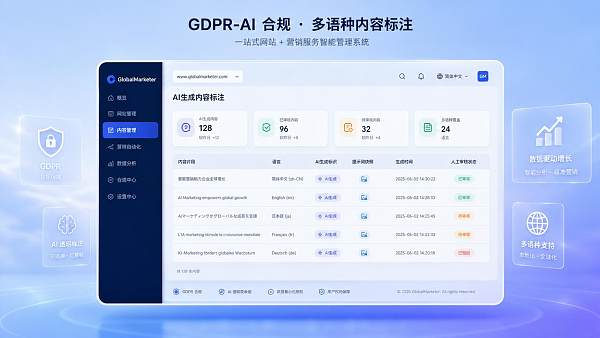
Starting at 00:00 on May 20, 2026, the European Data Protection Board (EDPB) will officially implement supplementary GDPR guidelines requiring all websites targeting EU business customers (including standalone websites of Chinese suppliers) to clearly label AI-generated marketing copy, product descriptions, customer case studies, and SEO content, and to provide verifiable explanations of the content generation chain.
Which Sub-Sectors Will Be Affected
Direct trading enterprises: As the primary point of contact for EU buyers, their official websites serve as the first medium for assessing content credibility. Failure to label AI-generated content as required will result in being systematically flagged as a “low-transparency supplier,” directly affecting inquiry conversion rates and long-term cooperation intentions; some German and Dutch distributors have already embedded labeling compliance into their initial supplier qualification screening processes, and those failing to meet the standards are automatically placed on watch lists.
Raw material procurement enterprises: Although they do not directly operate official websites facing end customers, they provide downstream manufacturers with technical documents, specifications, and compliance statements. If these materials contain AI-generated performance parameters or regulatory interpretations without source-tracing explanations, this may trigger compliance traceability risks across the entire supply chain—especially in highly regulated sectors such as automotive and medical devices, where documents provided by raw material suppliers must meet the dual disclosure obligations of the EU AI Act and GDPR.
Processing and manufacturing enterprises: These businesses commonly rely on AI tools to draft multilingual product manuals, CE certification support texts, and factory audit response materials. Once sections such as “About Us” and “Sustainability Report” on official websites use AI-generated content without labeling, EU buyers may question the authenticity of ESG information disclosure, thereby affecting bargaining power in OEM/ODM order renewal negotiations.
Supply chain service enterprises: Including cross-border website-building service providers, SEO operation agencies, and compliance consulting firms. If their deliverables (such as official website copy packages and SEO content matrices) do not include built-in labeling mechanisms and chain-of-custody evidence modules, they will face customer complaints and contractual performance risks; 3 mainstream website-building SaaS platforms in East China had already urgently launched GDPR-AI labeling plugins on May 18, confirming that response pressure on the service side has been materially transmitted.
Key Focus Areas and Response Measures for Relevant Enterprises or Practitioners
Identify the boundaries of AI content and establish tiered labeling standards
Not all AI-assisted outputs require labeling—only when content is predominantly generated by AI (such as complete product descriptions written by LLMs or automatically generated customer case stories) and has not undergone substantive human rewriting does the disclosure obligation arise. Enterprises need to internally clarify responsibility ownership across the three stages of “generation—editing—publishing” and set mandatory labeling fields in the CMS.
Build a verifiable content generation chain
The EDPB emphasizes “verifiable” rather than “merely declared.” Enterprises need to retain a basic evidence chain: AI tool name and version number, prompt snapshots (prompt), generation timestamps, and human review records (including revision traces). It is recommended to connect blockchain evidence-preservation services with content management systems to avoid the invalidity of after-the-fact supplementary proof.
Synchronously update supplier management agreements and service terms
When foreign trade enterprises entrust third parties to operate their official websites, they must add contractual clauses on AI content disclosure responsibilities, clearly specifying that service providers bear joint liability for labeling compliance; at the same time, they should send formal notices to upstream raw material suppliers/OEM factories requiring that the supporting documents they provide (such as material safety declarations) implement the same labeling logic simultaneously, so as to prevent vertical compliance breakpoints.
Editorial Viewpoint / Industry Observation
Observably, this is not merely a labeling requirement but a structural shift in how B2B trust is technically instantiated: transparency is now being encoded into content infrastructure rather than left to corporate self-reporting. Analysis shows that Chinese exporters with mature CMS governance (e.g., headless architectures with metadata tagging layers) are adapting 3–4 months faster than those relying on template-based WordPress sites — suggesting the real bottleneck lies in legacy tech debt, not AI literacy. From industry perspective, the policy functions less as a penalty mechanism and more as a catalyst for upgrading digital documentation discipline across export supply chains.
Conclusion
The implementation of these supplementary GDPR guidelines marks that AI governance has extended from the consumer side (such as the EU AI Act’s transparency requirements for chatbots) to the B2B commercial infrastructure layer. Its industry significance lies not in adding another review checkpoint, but in driving Chinese enterprises to incorporate the content production process itself into their compliance management systems—this is both a challenge and a crucial opportunity to push official websites from “information display windows” to “trusted digital assets.” Rationally speaking, short-term growing pains are unavoidable, but enterprises with content traceability capabilities will gain a more stable trust premium in the EU market.
Information Source Notes
The Guidelines 02/2026 on AI-Generated Content Transparency under GDPR published on the official website of the European Data Protection Board (EDPB) (final version dated April 15, 2026); the 2026 Update Bulletin on Key Compliance Review Points for EU Buyers issued by the German Federal Ministry for Economic Affairs and Climate Action (BMWK) (May 10, 2026); and the Supplier ESG Digital Credibility Assessment Implementation Rules V2.1 issued by the Dutch ASCI Distribution Alliance (effective May 17, 2026). Pending continued observation: whether the EDPB will launch the first round of cross-border inspections in Q3 2026; and the specific discretionary criteria adopted by data protection authorities (DPAs) in EU member states for the form of “clear labeling” (such as font size, position, and interaction method).
Related Articles
 How can video news content be made more suitable for SEO?Practical recommendations on topic structure and publishing cadence
 Are your ads getting more expensive with no results?Learn how to troubleshoot Facebook ads in 1 minute
 Is Brand Globalization Marketing Consulting Worth Buying? At What Stage Should Companies Bring It In



Related Products
 EasyCamp SaaS Smart Website Marketing SystemE-Yingbao SaaS Smart Website Marketing System: AI-powered, zero-code website building. Rapidly launch multilingual independent e-commerce sites in just 10 minutes. Global server acceleration and AI-driven SEO optimization empower businesses to efficiently connect with global markets. The seamless integration of technology and user-friendly operation makes building e-commerce sites incredibly simple.
 AI+SEM Intelligent Advertising Marketing SystemAI+SEM drives intelligent ad creation, empowering full-funnel precision advertising marketing. The system automatically generates weekly/monthly reports, AI recommends keywords and target countries, monitors core metrics in real-time with intelligent alerts, and enables one-click high-conversion ad solutions to help quickly acquire customers and improve ROI.
 AI+SEO Dual Engine Optimization ServiceEasyWin AI+SEO Dual Engine Optimization System leverages AI-powered keyword mining, content generation, and comprehensive technical optimization to help foreign trade enterprises acquire high-quality organic traffic, significantly improving search rankings and conversion rates.
 AI+SNS Social Media Marketing SystemYingbao AI+SNS Social Media Marketing System - Precision social capture for the social media era. Supports one-click content synchronization across major platforms like Facebook and LinkedIn. AI intelligently rewrites posts for enhanced relevance. 24/7 AI customer service and user profiling analysis empower businesses to efficiently expand into global markets.
 AI+SEO营销解决方案易营宝AI+SEO营销解决方案,通过AI批量写作、智能生成TDK、精准关键词扩词等功能,全面优化网站SEO效果,提升流量与转化率。助力企业构建高效智能网站新生态。
 AI+SEM Advertising Marketing SolutionsAI+SEM Advertising Marketing Solution leverages AI technology to deeply empower SEM ad campaigns. It automatically generates weekly/monthly reports using AI, presenting account data across multiple dimensions for comprehensive insights into campaign performance and trends. The system precisely recommends keywords and target countries, intelligently generates high-conversion ad copy, and enables one-click activation of efficient campaign plans to help businesses rapidly acquire customers. Simultaneously, it monitors core metrics in real time, intelligently identifies abnormal fluctuations, and issues timely alerts to ensure stable, high-return advertising results.
 Domain Name ServicesEasyWin provides professional domain name services, including intelligent queries, one-stop registration, brand protection, and full lifecycle management, helping businesses build a digital brand image.
 EasyOperate B2C Cross-Border E-Commerce Platform & Independent WebsiteEasyStore B2C Cross-border E-commerce Independent Store is an intelligent website building and cross-border e-commerce integrated solution independently developed by EasyStore Information Technology (Beijing) Co., Ltd. The system is specially designed for small and medium-sized as well as large export enterprises, integrating 'website building, operation, marketing, advertising, and conversion' into one, helping enterprises quickly establish cross-border e-commerce independent stores to achieve brand globalization and global sales growth.
The platform supports multiple languages, multiple currencies, and multi-channel marketing, with built-in AI intelligent translation and SEO optimization systems, suitable for mainstream markets such as Southeast Asia, Europe and America, Latin America, and the Middle East, assisting Chinese manufacturing enterprises in efficiently deploying international e-commerce strategies. SSL证书易营宝提供专业SSL安全证书服务,包括单域名和泛域名证书,确保网站数据传输加密、身份验证和完整性保护,助力企业建立安全可信的在线业务环境。









