









- Is Brand Globalization Marketing Consulting Worth Buying? At What Stage Should Companies Bring It InJul 01, 2026View details
- Cross-Border Marketing Trend Research: Why More and More Companies Are Starting to Deploy AI Search and GEO OptimizationJun 30, 2026View details
- Cross-Border Marketing Trend Research: How Independent Sites, AI Content, and Short-Video Customer Acquisition Are ChangingJun 30, 2026View details
- How Can a Brand Updates Page Be Made More SEO-Friendly? Analysis of Update Frequency, Content Structure, and Internal Linking StrategyJun 28, 2026View details
- What stages does the cross-border services ecosystem include? How do website building, promotion, payment, and compliance work togetherJun 22, 2026View details
- How will email marketing costs change in 2026Jun 22, 2026View details
- The China-US tariff arrangement has reached a preliminary consensus, and the trade association will be establishedJun 15, 2026View details
- Should overseas brand marketing start with ads or contentJun 21, 2026View details
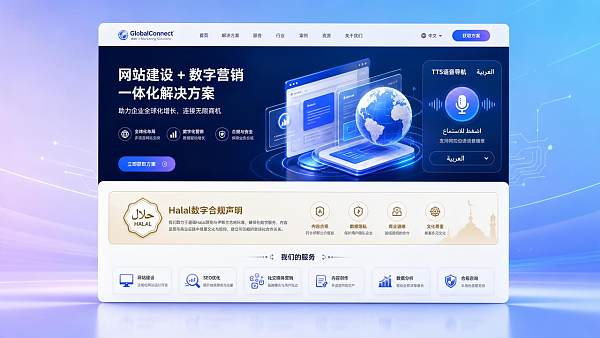
Souq.com New Regulation: Official websites of Chinese suppliers must support Arabic voice navigation and a Halal digital declaration
On May 18, 2026, Souq.com, the largest e-commerce platform in Saudi Arabia (under Amazon MENA), officially implemented the updated provisions of the Technical Specifications for Chinese Supplier Onboarding. This adjustment, for the first time, embeds language interaction capability and religious compliance into the mandatory access standards for suppliers, directly affecting Chinese cross-border e-commerce companies, brands expanding overseas, and digital service enterprises targeting the Middle East market. This move is not an isolated technical upgrade, but a key signal that the Middle East’s localization regulatory logic is extending toward the front end of the digital supply chain—platforms are using technical compliance as leverage to accelerate the alignment of China’s digital infrastructure with the Gulf region’s cultural governance framework.
Event Overview
Souq.com, the largest e-commerce platform in Saudi Arabia (under Amazon MENA), updated the Technical Specifications for Chinese Supplier Onboarding on May 18, mandating that all newly onboarded and renewing Chinese suppliers embed an Arabic TTS voice navigation system on the homepage of their official websites, and prominently display a SASO-certified 'Halal Digital Compliance Statement' on the 'About Us' page. Official websites that fail to meet the standard will not be eligible for homepage exposure or Ramadan promotional resource placements on the platform.
Which Sub-Sectors Will Be Affected
This regulatory adjustment covers the entire chain of cross-border digital fulfillment, and enterprises at different stages will face significantly different impact pathways and response urgency:
Direct Trading Enterprises
This refers to Chinese brand owners or cross-border sellers that conduct B2C exports through their own independent websites. Their official websites are the first touchpoint for platform review and also the core interface where consumers build trust. The absence of voice navigation will directly lead to the closure of traffic entry points; meanwhile, the 'Halal Digital Compliance Statement' is not a simple text posting, but requires SASO-authorized institutions to verify website content (such as whether the payment process contains interest-related prompts, and whether the user data storage location complies with Islamic financial ethics). Therefore, the impact is reflected in both a disruption in customer acquisition capability and a sharp increase in compliance costs.
Raw Material Procurement Enterprises
These are mainly upstream raw material suppliers providing categories such as food, cosmetics, and health products to the Middle East market. Although they do not directly operate official websites, their downstream customers (such as contract manufacturers and brand owners) often upload raw material compliance qualifications as attachments to digital declarations. If the raw materials have not passed Halal certification or lack traceable Halal supply chain proof, this will cause the downstream customer’s website declaration to become invalid, thereby triggering platform review rejection. Therefore, the impact is reflected in increased order transmission risk and the passive extension of certification coordination cycles.
Processing and Manufacturing Enterprises
This includes OEM/ODM factories and customized production service providers. Their official websites are mostly used to showcase production capacity and qualifications, and were previously not channels for strong exposure. Under the new regulation, if a factory appears on a Souq product page as a co-branded party (such as 'directly supplied by XX Guangdong factory'), its official website will be included in the review scope; furthermore, SASO has traceability rights over the authenticity of production process descriptions involved in the 'digital declaration' (such as cleaning agent ingredients and equipment disinfection methods). The impact is reflected in the redefinition of brand endorsement value, while asset-light operating models face pressure from penetrating qualification reviews.
Supply Chain Service Enterprises
This covers localized website-building service providers, Arabic TTS technology providers, SASO compliance consulting agencies, and others. This update has essentially restructured the service demand landscape: standalone translation services are no longer sufficient, and it is now necessary to integrate three capabilities—voice interaction development, Sharia-compliant text review, and certification pathway planning. The impact is reflected in a sharp rise in the industry’s service capability threshold; small and medium-sized service providers without SASO filing cooperation channels or TTS dialect adaptation experience will quickly lose the qualification to undertake projects.
Key Focus Areas and Response Measures for Relevant Enterprises or Practitioners
Prioritize Dual-Track Upgrades to Core Website Capabilities
Simultaneously launch the embedding of the Arabic TTS system (which must support Gulf dialect recognition and natural pause logic) and the drafting of the 'Halal Digital Compliance Statement'. Note: SASO certification is not merely a stamping process; it requires the submission of a full set of digital asset materials, including website architecture diagrams, original user agreement texts, and data processing policies. The average review cycle is 42 working days.
Clarify the Boundaries of Declaration Responsibility to Avoid Cross-Entity Chain Invalidations
If using third-party website-building systems (such as Shopify or Shopee independent site templates), it is necessary to confirm that their Arabic TTS modules have passed Souq’s official whitelist certification; at the same time, information on partners involved in the declaration, including raw materials, logistics, and payment, must be supported by Halal-related commitment letters issued by the corresponding parties. Otherwise, a single weak point will cause the entire site declaration to be marked by the platform as 'unverified'.
Establish a Dynamic Compliance Tracking Mechanism
Souq has explicitly stated that it will subsequently conduct quarterly spot checks on the official website status of onboarded merchants, and the results of these checks will directly affect the weighting of Ramadan resource allocation in the following year. Enterprises are advised to include TTS availability monitoring, the validity period of the declaration page HTTPS certificate, and the validity of redirect links for SASO certification numbers in the routine inspection checklist for IT operations and maintenance.
Editorial Viewpoint / Industry Observation
Observably, this is not a localized technical requirement but a systemic calibration of China’s digital export infrastructure against Gulf regulatory philosophy. The linkage of voice navigation with Halal compliance signals a shift from 'product-level' to 'experience-level' governance — where user interaction flow itself becomes a subject of religious-legal scrutiny. Analysis shows that Chinese enterprises over-index on product certification while under-investing in interface ethics; the current gap lies less in Arabic language capability and more in understanding how Islamic digital jurisprudence interprets data consent, algorithmic transparency, and service architecture. This regulation is better understood as a stress test for China’s cross-border digital sovereignty readiness.
Conclusion
This adjustment by Souq.com is essentially an external manifestation of the deepening awareness of digital sovereignty in the Middle East market. It reminds the industry that outbound compliance is shifting from 'whether products can be sold' to 'how they are seen, trusted, and continuously authorized'. For Chinese enterprises, the short-term task is to overcome technical adaptation and certification implementation, while the long-term task is to internalize the religious and cultural context into the underlying logic of product design and service delivery. Rationally speaking, this is both a threshold and a watershed for identifying enterprises that truly possess deep localization capabilities.
Information Source Notes
- Souq.com Technical Specifications for Chinese Supplier Onboarding 2026 V3.1 (officially published version effective May 18, 2026)
- Saudi Standards, Metrology and Quality Organization (SASO) Digital Halal Compliance Guidance v1.0 (published in December 2025)
- Amazon MENA Supplier Support Center announcement (email notice dated May 10, 2026)
Note: Detailed implementation rules by SASO regarding 'digital halal', the list of supported TTS dialects, and procedures for appeals and review of violations are yet to be disclosed in phases starting from June, and require continued observation.
Related Articles



Related Products
 EasyCamp SaaS Smart Website Marketing SystemE-Yingbao SaaS Smart Website Marketing System: AI-powered, zero-code website building. Rapidly launch multilingual independent e-commerce sites in just 10 minutes. Global server acceleration and AI-driven SEO optimization empower businesses to efficiently connect with global markets. The seamless integration of technology and user-friendly operation makes building e-commerce sites incredibly simple.
 AI+SEM Intelligent Advertising Marketing SystemAI+SEM drives intelligent ad creation, empowering full-funnel precision advertising marketing. The system automatically generates weekly/monthly reports, AI recommends keywords and target countries, monitors core metrics in real-time with intelligent alerts, and enables one-click high-conversion ad solutions to help quickly acquire customers and improve ROI.
 AI+SEO Dual Engine Optimization ServiceEasyWin AI+SEO Dual Engine Optimization System leverages AI-powered keyword mining, content generation, and comprehensive technical optimization to help foreign trade enterprises acquire high-quality organic traffic, significantly improving search rankings and conversion rates.
 AI+SNS Social Media Marketing SystemYingbao AI+SNS Social Media Marketing System - Precision social capture for the social media era. Supports one-click content synchronization across major platforms like Facebook and LinkedIn. AI intelligently rewrites posts for enhanced relevance. 24/7 AI customer service and user profiling analysis empower businesses to efficiently expand into global markets.
 AI+SEO营销解决方案易营宝AI+SEO营销解决方案,通过AI批量写作、智能生成TDK、精准关键词扩词等功能,全面优化网站SEO效果,提升流量与转化率。助力企业构建高效智能网站新生态。
 AI+SEM Advertising Marketing SolutionsAI+SEM Advertising Marketing Solution leverages AI technology to deeply empower SEM ad campaigns. It automatically generates weekly/monthly reports using AI, presenting account data across multiple dimensions for comprehensive insights into campaign performance and trends. The system precisely recommends keywords and target countries, intelligently generates high-conversion ad copy, and enables one-click activation of efficient campaign plans to help businesses rapidly acquire customers. Simultaneously, it monitors core metrics in real time, intelligently identifies abnormal fluctuations, and issues timely alerts to ensure stable, high-return advertising results.
 Domain Name ServicesEasyWin provides professional domain name services, including intelligent queries, one-stop registration, brand protection, and full lifecycle management, helping businesses build a digital brand image.
 EasyOperate B2C Cross-Border E-Commerce Platform & Independent WebsiteEasyStore B2C Cross-border E-commerce Independent Store is an intelligent website building and cross-border e-commerce integrated solution independently developed by EasyStore Information Technology (Beijing) Co., Ltd. The system is specially designed for small and medium-sized as well as large export enterprises, integrating 'website building, operation, marketing, advertising, and conversion' into one, helping enterprises quickly establish cross-border e-commerce independent stores to achieve brand globalization and global sales growth.
The platform supports multiple languages, multiple currencies, and multi-channel marketing, with built-in AI intelligent translation and SEO optimization systems, suitable for mainstream markets such as Southeast Asia, Europe and America, Latin America, and the Middle East, assisting Chinese manufacturing enterprises in efficiently deploying international e-commerce strategies. SSL证书易营宝提供专业SSL安全证书服务,包括单域名和泛域名证书,确保网站数据传输加密、身份验证和完整性保护,助力企业建立安全可信的在线业务环境。









