









- How to assess foreign trade website development trends?Looking at 2026 changes from multilingual,AI content to conversion pathsJul 04, 2026View details
- What are the new trends in multilingual marketing data analytics tools in 2026? Focus on attribution、automation and complianceJul 04, 2026View details
- Is Brand Globalization Marketing Consulting Worth Buying? At What Stage Should Companies Bring It InJul 01, 2026View details
- Cross-Border Marketing Trend Research: Why More and More Companies Are Starting to Deploy AI Search and GEO OptimizationJun 30, 2026View details
- Cross-Border Marketing Trend Research: How Independent Sites, AI Content, and Short-Video Customer Acquisition Are ChangingJun 30, 2026View details
- How Can a Brand Updates Page Be Made More SEO-Friendly? Analysis of Update Frequency, Content Structure, and Internal Linking StrategyJun 28, 2026View details
- What stages does the cross-border services ecosystem include? How do website building, promotion, payment, and compliance work togetherJun 22, 2026View details
- How will email marketing costs change in 2026Jun 22, 2026View details
When comparing digital marketing service providers, the focus is not on the number of channels
When choosing a digital marketing service provider, the focus is not on how many channels they cover, but on whether they can create a growth loop through technology, data, and localized services.
For business decision-makers, what is truly worth comparing is customer acquisition efficiency, collaboration capability, and long-term ROI.
When evaluating digital marketing service providers, many companies are easily attracted by claims such as “full-channel coverage” and “one-stop managed operations.” But only after entering into cooperation do they realize that more channels do not necessarily mean better results, and may instead lead to scattered budgets, unfocused execution, and fragmented data.
When business decision-makers search for information such as “digital marketing service provider,” their core need is usually not to understand industry concepts, but to judge: what kind of provider should they choose to more steadily generate leads, orders, and sustainable growth.
Therefore, when comparing a digital marketing service provider, the key is not how many platforms it can operate, but whether it has a clear growth methodology, verifiable data capabilities, cross-department collaboration mechanisms, and a level of service depth aligned with business goals.
What companies should really look at first when comparing digital marketing service providers
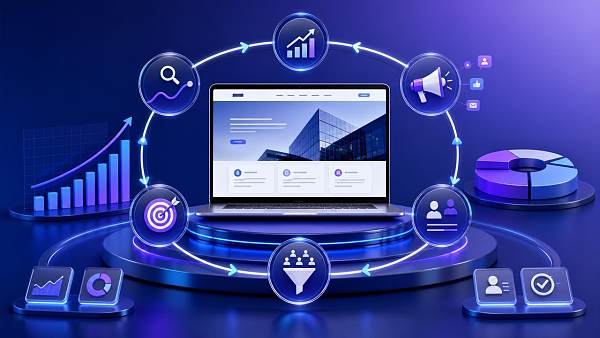
First, check whether the goals are aligned. What companies need is not a vague result like “getting exposure,” but a clear objective: brand growth, sales leads, conversion, or overseas customer acquisition. Different goals require completely different strategies, teams, and budget structures from the service provider.
Second, check whether the evaluation criteria are consistent. Some providers emphasize follower growth, some emphasize clicks, and some emphasize form submissions, but if these metrics cannot be linked to lead quality, customer acquisition cost, and conversion efficiency, then no matter how good the data looks, it may still have little business value.
Third, check whether execution can form a closed loop. If advertising, content, website, SEO, customer service, and sales follow-up are disconnected from one another, problems such as “plenty of traffic but low conversion” and “many inquiries but few deals” will appear. Truly mature service capabilities must ensure that the entire pre-, mid-, and post-funnel process is traceable, attributable, and optimizable.
For corporate management, choosing a digital marketing service provider is essentially choosing a growth collaboration system, rather than simply purchasing execution services for a few channels. Whoever can help a company turn budget into results is more worthy of long-term cooperation.
Why the number of channels is not the core competitive advantage
Having many channels only shows a broad service scope; it does not directly represent strong growth capability. Because every additional channel requires more creative production, account management, data analysis, and strategic adjustment behind it. Without a unified methodology, the more channels there are, the lower the efficiency becomes.
Especially for medium and large enterprises, the common problem is not “there are no channels to use,” but “many channels have been used, yet they have not created synergy.” The official website, search, social media, advertising, and content all move forward separately, and in the end it becomes impossible to determine which part truly contributed to business opportunities, making budget optimization naturally difficult as well.
Some service providers also use “full-platform coverage” to create a sense of security, but what companies truly need is to find the key touchpoints that match their customers’ decision-making journey. For B2B companies, the official website, search, and content may be more important than short-term broad exposure; for branded consumer products, social media seeding and ad coordination may be more critical.
So instead of asking how many channels a service provider can handle, it is better to ask: how do you determine which channels should be prioritized? How do you allocate the budget? How do you verify whether each investment is effective? These questions reflect professionalism far better than a channel list.
To judge whether a digital marketing service provider is reliable, focus on these four capabilities
The first is data capability. A reliable service provider will not just provide result screenshots, but will be able to explain data sources, attribution logic, conversion paths, and optimization actions. What companies should look at is whether it can connect traffic, leads, business opportunities, and deals, rather than only looking at surface-level metrics.
The second is technical capability. Today’s marketing results increasingly depend on website performance, tracking systems, automation tools, content production efficiency, and ad algorithm optimization. Without a technical foundation, many strategies can only remain at the level of manual operation, and scalable growth will be limited.
The third is localized service capability. Whether in domestic multi-regional markets or overseas multilingual promotion, real conversion always happens within the local language and cultural context. Without understanding industry expressions, purchasing habits, and platform rules, even a good plan can easily “look right, but go off track in execution.”
The fourth is collaboration capability. Marketing is not an isolated action by a single department; it often involves branding, sales, customer service, IT, and management decision-making. Excellent digital marketing service providers are often able to drive cross-team collaboration so that data feedback truly enters business decision-making instead of staying only in monthly reports.
What business decision-makers should focus on most is not traffic, but the ROI formation mechanism
When evaluating service providers, many companies are easily attracted by “estimated impressions” and “estimated clicks.” But what management should care more about is: how will this traffic ultimately turn into inquiries, opportunities, and orders? If the mechanism in between is unclear, traffic growth will not necessarily bring revenue growth.
A sustainable ROI model should include at least four parts: whether customer acquisition cost is controllable, whether lead quality is stable, whether sales conversion is traceable, and whether repurchase and long-term value can be continuously amplified. Talking only about acquiring new customers without discussing deals and repurchase usually means the system is incomplete.
For example, in the foreign trade business scenario, many managers care more about inquiry quality, order value, and repeat purchases from existing customers, rather than just website traffic. A truly effective solution should continuously optimize around buyer personas, page experience, multilingual content, and follow-up efficiency.
Taking a full-funnel model such as B2B foreign trade solutions as an example, the value does not lie in the actions themselves, such as “website building, SEO, and advertising,” but in connecting brand awareness, inquiry acquisition, sales follow-up, and order conversion to form a verifiable growth loop.
How to compare service providers to avoid “excitement before cooperation, disappointment after cooperation”
First, when looking at case studies, do not just look at the industry name and partner brands; also ask about the goals, timeline, budget, and final results in the case. A case that looks very impressive may actually have little reference value if its budget is far beyond what you can afford.
Second, check whether the proposal is targeted. Excellent service providers often study the company’s products, customer structure, competitive environment, and historical data before proposing a strategy during the early communication stage. Instead of directly applying a standard template and giving the same channel mix to everyone.
Third, check whether the other party is willing to talk about risks. A truly professional team will not promise “an explosive surge of orders in the short term,” but will clearly explain which results are affected by industry cycles, website foundations, sales follow-up capacity, and market competition, while proposing controllable phased goals.
Finally, check the cooperation mechanism. This includes whether the project lead is stable, whether the reporting frequency is fixed, whether data access is transparent, and whether optimization recommendations are actionable. Many failed partnerships are not because the channels lack value, but because the mechanism design makes it difficult for both sides to achieve efficient collaboration.
Why integrated website and marketing services are becoming increasingly important
In the current environment, a website is no longer just a display window, but one of a company’s most core digital assets. Whether it is SEO, advertising, or content marketing, all of them ultimately need to connect to website experience, conversion paths, and data accumulation.
If website development and marketing operations belong to different vendors, common problems include slow revisions, slow landing page response, inconsistent tracking, and low content publishing efficiency. These issues may seem minor individually, but they continuously reduce advertising conversion rates and search performance, and in the long run they erode budget efficiency.
Therefore, the integration of websites and marketing is receiving increasing attention from companies. When technology, content, advertising, and data analysis collaborate within the same system, it becomes easier to achieve rapid launch, rapid testing, and rapid iteration. For companies pursuing certainty in growth, this model has greater practical value.
Taking a provider deeply focused on integrated website + marketing services as an example, if it can provide high-performance websites, SEO optimization, social media marketing, and ad placement, while also continuously optimizing user touchpoints through AI and big data, then management costs and communication costs for the company will both be significantly reduced.
What signals digital marketing service providers suitable for long-term cooperation usually have
First, they have the ability to continuously invest in technology, rather than relying entirely on manual experience. Because the marketing environment changes very quickly, and platform rules, search algorithms, creative logic, and user behavior are all changing, it is difficult to maintain long-term competitiveness without technical support.
Second, they can provide practical, actionable industry methodologies instead of abstract concepts. For example, in foreign trade promotion, page loading speed, multilingual quality, buyer behavior tracking, and automated ad optimization all offer more decision-making reference value than broadly talking about “brand globalization.”
Third, they can clearly explain phased results. A mature team helps companies distinguish between short-term metrics and long-term metrics, what belongs to current-month optimization, what belongs to quarterly ramp-up, and what belongs to annual asset accumulation. In this way, management can set reasonable expectations and avoid misjudging project value due to cognitive bias.
Fourth, they are willing to share the pressure of results with the company. For example, some service models set clear commitments for inquiry targets, conversion rates, or advertising performance. This kind of results-oriented cooperation model is often more trustworthy than simply selling service items.
Conclusion: when comparing digital marketing service providers, it ultimately comes back to growth results
When choosing a digital marketing service provider, business decision-makers are most easily influenced by “more channels, more cases, and more sales talk.” But what should truly be placed first is whether the other party can build an executable, traceable, and optimizable growth system around the company’s business goals.
In other words, the key is not who operates more channels, but who better understands your customers, your sales path, and your input-output logic. Only when technical capability, data capability, and localized service are truly combined can marketing evolve from a cost item into a growth engine.
If a digital marketing service provider can both understand corporate strategy and connect websites, content, SEO, advertising, and conversion handoff, then what it provides is not just marketing outsourcing, but a set of growth infrastructure for long-term operations.
This is also the judgment standard companies should most insist on when comparing service providers: pay less attention to the superficial question of “how wide the coverage is,” and more attention to the deeper question of “whether results can form a closed loop.” When the comparison dimensions are right, the success rate of cooperation is usually much higher.
Related Articles
 How can video news production be made more efficient?Breaking down the standard process from topic selection to editing
 How to assess foreign trade website development trends?Looking at 2026 changes from multilingual,AI content to conversion paths
 What are the new trends in multilingual marketing data analytics tools in 2026? Focus on attribution、automation and compliance

Related Products
 EasyCamp SaaS Smart Website Marketing SystemE-Yingbao SaaS Smart Website Marketing System: AI-powered, zero-code website building. Rapidly launch multilingual independent e-commerce sites in just 10 minutes. Global server acceleration and AI-driven SEO optimization empower businesses to efficiently connect with global markets. The seamless integration of technology and user-friendly operation makes building e-commerce sites incredibly simple.
 AI+SEM Intelligent Advertising Marketing SystemAI+SEM drives intelligent ad creation, empowering full-funnel precision advertising marketing. The system automatically generates weekly/monthly reports, AI recommends keywords and target countries, monitors core metrics in real-time with intelligent alerts, and enables one-click high-conversion ad solutions to help quickly acquire customers and improve ROI.
 AI+SEO Dual Engine Optimization ServiceEasyWin AI+SEO Dual Engine Optimization System leverages AI-powered keyword mining, content generation, and comprehensive technical optimization to help foreign trade enterprises acquire high-quality organic traffic, significantly improving search rankings and conversion rates.
 AI+SNS Social Media Marketing SystemYingbao AI+SNS Social Media Marketing System - Precision social capture for the social media era. Supports one-click content synchronization across major platforms like Facebook and LinkedIn. AI intelligently rewrites posts for enhanced relevance. 24/7 AI customer service and user profiling analysis empower businesses to efficiently expand into global markets.
 AI+SEO营销解决方案易营宝AI+SEO营销解决方案,通过AI批量写作、智能生成TDK、精准关键词扩词等功能,全面优化网站SEO效果,提升流量与转化率。助力企业构建高效智能网站新生态。
 AI+SEM Advertising Marketing SolutionsAI+SEM Advertising Marketing Solution leverages AI technology to deeply empower SEM ad campaigns. It automatically generates weekly/monthly reports using AI, presenting account data across multiple dimensions for comprehensive insights into campaign performance and trends. The system precisely recommends keywords and target countries, intelligently generates high-conversion ad copy, and enables one-click activation of efficient campaign plans to help businesses rapidly acquire customers. Simultaneously, it monitors core metrics in real time, intelligently identifies abnormal fluctuations, and issues timely alerts to ensure stable, high-return advertising results.
 Domain Name ServicesEasyWin provides professional domain name services, including intelligent queries, one-stop registration, brand protection, and full lifecycle management, helping businesses build a digital brand image.
 EasyOperate B2C Cross-Border E-Commerce Platform & Independent WebsiteEasyStore B2C Cross-border E-commerce Independent Store is an intelligent website building and cross-border e-commerce integrated solution independently developed by EasyStore Information Technology (Beijing) Co., Ltd. The system is specially designed for small and medium-sized as well as large export enterprises, integrating 'website building, operation, marketing, advertising, and conversion' into one, helping enterprises quickly establish cross-border e-commerce independent stores to achieve brand globalization and global sales growth.
The platform supports multiple languages, multiple currencies, and multi-channel marketing, with built-in AI intelligent translation and SEO optimization systems, suitable for mainstream markets such as Southeast Asia, Europe and America, Latin America, and the Middle East, assisting Chinese manufacturing enterprises in efficiently deploying international e-commerce strategies. SSL证书易营宝提供专业SSL安全证书服务,包括单域名和泛域名证书,确保网站数据传输加密、身份验证和完整性保护,助力企业建立安全可信的在线业务环境。









