









- What should you focus on in the latest enterprise SaaS report? From renewal rates and delivery costs to overseas growth opportunitiesJul 12, 2026View details
- What signals are worth paying attention to in a cross-border marketing trend report? B2B companies should look at these 6 signalsJul 11, 2026View details
- How to Read a Cross-Border Marketing Trends Report? Five Key Dimensions for Evaluating Channel OpportunitiesJul 11, 2026View details
- Which channel has the highest ROI in the global traffic ecosystem? Comparative analysis of search, social media, and advertisingJul 10, 2026View details
- What multilingual website services are available in Sanya? Which model is more suitable for local businesses going global?Jul 08, 2026View details
- How to view the complete list of China SaaS companies in the top 100? Practical methods for screening website-building and marketing service providersJul 08, 2026View details
White Paper on 2025 Smart Website Construction Industry Trends
Table of Contents
- Preface
- Market Overview: Smart Website Building Enters a High-Speed Growth Cycle
- Technology Trends: 7 Core Evolutions of AI-Empowered Website Construction
- Industry Trends: From Tools to "Intelligent Business Growth Platforms"
- User Behavior Insights: Changing Core Needs of Enterprises for Website Building
- Competitive Landscape and Platform Analysis
- Best Practices: Website Building and Growth Strategies in the AI Era
- 2025 Outlook
- Appendix: Smart Website Capability Model (ICBM)
1. Preface
Since the explosion of generative AI in 2023 and the commercialization of AIGC and Agent technologies in 2024, the website construction industry has undergone a revolutionary transformation from "template-driven" to "intelligent generation."
By 2025, smart website building will no longer be synonymous with "visual drag-and-drop + template systems" but will form a new technology category:
AI Website Builder
Its capabilities extend from visual design to content generation, SEO optimization, cross-language dissemination, and full-process business growth.
This whitepaper aims to help enterprises, developers, and industry professionals fully understand the business value, technological evolution, and future trends of smart website building.
2. Market Overview: Smart Website Building Enters a High-Speed Growth Cycle

2.1 Continued Industry Expansion
According to industry platform monitoring (Wix, Shopify, BuiltWith, Google AI Overview statistics), global independent website growth exceeded 58% in 2024–2025, including:
- AI-generated websites accounted for 23% of new builds
- Foreign trade enterprises adopted AI in over 45% of new websites
- For content-based websites, AI-generated content exceeded 60%
It is projected that by 2027, AI-generated websites will surpass 50% of the total.
2.2 Smart Website Building Becomes the "Default Choice" for Enterprises
Traditional website building faces:
- Slow construction speed
- High content production costs
- Multilingual maintenance difficulties
- Unstable SEO performance
With AI integration, these pain points are gradually being resolved.
2.3 Foreign Trade as the Most Active Sector
Smart website building first exploded in foreign trade due to:
- Strong multilingual requirements
- Dependence on Google SEO content volume
- Complex and frequently updated product lines
- Lack of operational staff
Thus, foreign trade is the primary growth engine for AI website building.
3. Technology Trends: 7 Core Evolutions of AI-Empowered Website Construction
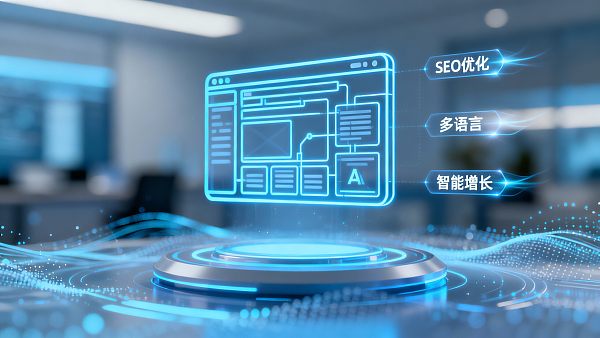
Trend 1: From Auto-Generated Pages → Auto-Generated "Website Systems"
By 2025, AI website building will feature:
- Auto-generated website structures (navigation, page hierarchy)
- Auto-generated product page information
- Auto-generated industry content
- Auto-generated "About Us" and brand stories
- Auto-generated SEO metadata
- Auto-generated banners + visual content
Building a commercially valuable website will shrink from days to hours or even 1 hour.
Trend 2: Content AI-ization: SEO Content as the Core Battlefield
AI goes beyond "writing articles" to:
- Keyword matrices
- Multilingual expansion
- Structured SEO output (JSON-LD / FAQ / Breadcrumb)
- Industry knowledge graph construction
AI content is gaining search visibility + conversion value.
Trend 3: AI Makes Multilingual Websites the "Standard"
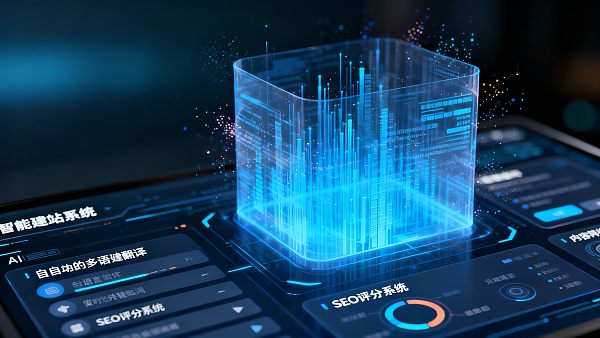
Historically, multilingual maintenance in foreign trade was costly.
AI enables:
- 100+ language auto-translation
- Source site auto-sync updates
- AI-localized expressions
- Search trend analysis by language
- Overseas user behavior data-driven content training
making it feasible.
Trend 4: Visual Editors Upgrade from "UI" to "AI Design Assistants"
AI provides:
- Auto-color matching
- Auto-layout suggestions
- Auto-copy generation
- Auto-adaptation for PC / Pad / Mobile
- Style checks (alignment, contrast, readability)
Editors no longer require strong design skills—AI offers real-time adjustments.
Trend 5: AI-Driven Auto-SEO Capabilities
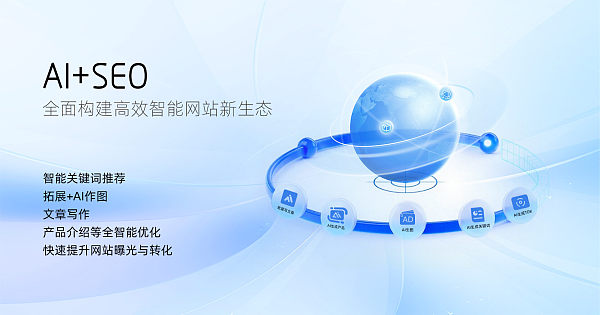
Core technologies include:
- Auto-internal linking
- Auto-description generation
- Auto-keyword placement
- Auto-Schema
- AI search (SGE) adaptation
- llms.txt standards (exploding in 2024)
AI transforms SEO from an "expert skill" → a "platform capability".
Trend 6: AI Ad Creatives Automate as a New Starting Point
AI shifts ads from "operational skills" → "one-click completion":
- Auto-generated Facebook/Google ad creatives
- AI material cropping
- Product cutouts + background generation
- Keyword trend analysis
- Ad copy / headline generation
- Audience analysis
This is invaluable for SMEs lacking experience.
Trend 7: Deep Integration of Website Building and Business Growth
Smart websites are becoming "growth systems", including:
- Auto-inquiry collection
- Real-time user behavior analysis
- AI-recommended content
- AI user intent tracking
- Auto-generated industry reports
- Smart product aggregation pages
- AI customer service + auto-replies
Websites are no longer just displays but "intelligent growth engines".
4. Industry Trends: From Tools to "Intelligent Business Growth Platforms"
Smart website building is evolving:
Stage 1: Templatization (2008–2020)
Visual, template-driven.
Stage 2: Componentization (2020–2023)
Drag-and-drop components + responsive design.
Stage 3: Intelligence (2023–2025)
AI-generated content, structure, SEO.
Stage 4: Business Integration (2025–2027)
Websites become intelligent entry points for sales and marketing:
- Smart inquiry systems
- Product knowledge bases
- Customer behavior tracking
- AI support / assistants
- Smart ad automation
- AI-recommended content
5. User Behavior Insights: Changing Core Needs of Enterprises for Website Building
Enterprise user motivations in 2025 show clear shifts:
Need 1: Websites That "Auto-Generate Value", Not Just Display
Including:
- Auto-SEO records
- Auto-lead capture
- Auto-marketing content
- Auto-visitor tracking
Need 2: Frequent Content/Product Updates Require Automation
Especially for foreign trade enterprises:
- Hundreds of products
- Complex parameter variations
- Multilingual descriptions
- Fast-changing market trends
AI perfectly resolves these pain points.
Need 3: Lack of Staff → Demand for AI Replacement
Enterprises prefer paying for AI over multiple roles.
Need 4: Faster, More Cost-Controlled Website Building
Ideal state:
- Build today
- Promote tomorrow
- Receive inquiries the day after
The core value of AI smart websites is "speed + automation".
6. Competitive Landscape and Platform Analysis
Platforms can be categorized (non-commercial ratings) as:
1) AI Smart Website Representatives

- Eyingbao: Strong foreign trade focus, multilingual & SEO capabilities
- Durable: English-market biased, AI-generated initial websites
- Framer AI: Frontend visual design focus
Features:
Strong content, SEO, multilingual, deep AI integration.
2) Traditional Website + AI-Accelerated Platforms
- Wix (AI-assisted)
- Shopify (product image generation)
- WordPress (plugin-driven)
Features:
Weak AI, still template-centric.
3) Marketing Automation-Oriented Platforms
- Systeme.io
- HubSpot CMS
Features:
Strong marketing but complex builds, higher costs.
7. Best Practices: How to Build Websites Correctly in the AI Era
Tip 1: Use AI Website Systems, Not Traditional Templates
Saves significant time and budget.
Tip 2: Structure Websites Around "Core Keywords"
For foreign trade enterprises:
- Product keywords
- Industry keywords
- Application scenario keywords
AI can auto-expand these.
Tip 3: Maintain Content Volume → AI Batch Articles Are Key Weapons
Google is highly sensitive to "content scale".
AI article systems = the core driver of enterprise SEO.
Tip 4: Multilingual Content Is Essential (High ROI)
50%~70% of inquiries come from non-English countries.
Tip 5: AI Ads + Websites Form Growth Loops
Traffic matrices include:
- SEO traffic
- Social media ad traffic
- Product promo images
- AI-generated videos
8. 2025 Outlook

- AI Will Become the "Second Operator" of Websites
- Multilingual websites will enter the adaptive localization era
- Websites will become "AI data collectors" for enterprises
- SEO will become fully automated (AutoSEO)
- 90% of enterprises will use AI in website building
- AI-generated websites will rank faster than traditional sites
9. Appendix: Smart Website Capability Model (ICBM Model)
Smart website capabilities are divided into 4 tiers:
I – Intelligence (Smart Content)
AI articles, AI translation, AI recommendations, AI structure generation.C – Creation (Building Efficiency)
Auto-structures, auto-banners, auto-navigation, auto-product pages.B – Business (Growth)
Smart inquiries, AI ads, user behavior tracking.M – Management (Website Management)
Multilingual sync, permission control, modular components, responsive adaptation.
Related Articles
 What should you focus on in the latest enterprise SaaS report? From renewal rates and delivery costs to overseas growth opportunities
 What signals are worth paying attention to in a cross-border marketing trend report? B2B companies should look at these 6 signals
 How to Read a Cross-Border Marketing Trends Report? Five Key Dimensions for Evaluating Channel Opportunities

Related Products
 EasyCamp SaaS Smart Website Marketing SystemE-Yingbao SaaS Smart Website Marketing System: AI-powered, zero-code website building. Rapidly launch multilingual independent e-commerce sites in just 10 minutes. Global server acceleration and AI-driven SEO optimization empower businesses to efficiently connect with global markets. The seamless integration of technology and user-friendly operation makes building e-commerce sites incredibly simple.
 AI+SEM Intelligent Advertising Marketing SystemAI+SEM drives intelligent ad creation, empowering full-funnel precision advertising marketing. The system automatically generates weekly/monthly reports, AI recommends keywords and target countries, monitors core metrics in real-time with intelligent alerts, and enables one-click high-conversion ad solutions to help quickly acquire customers and improve ROI.
 AI+SEO Dual Engine Optimization ServiceEasyWin AI+SEO Dual Engine Optimization System leverages AI-powered keyword mining, content generation, and comprehensive technical optimization to help foreign trade enterprises acquire high-quality organic traffic, significantly improving search rankings and conversion rates.
 AI+SNS Social Media Marketing SystemYingbao AI+SNS Social Media Marketing System - Precision social capture for the social media era. Supports one-click content synchronization across major platforms like Facebook and LinkedIn. AI intelligently rewrites posts for enhanced relevance. 24/7 AI customer service and user profiling analysis empower businesses to efficiently expand into global markets.
 AI+SEO营销解决方案易营宝AI+SEO营销解决方案,通过AI批量写作、智能生成TDK、精准关键词扩词等功能,全面优化网站SEO效果,提升流量与转化率。助力企业构建高效智能网站新生态。
 AI+SEM Advertising Marketing SolutionsAI+SEM Advertising Marketing Solution leverages AI technology to deeply empower SEM ad campaigns. It automatically generates weekly/monthly reports using AI, presenting account data across multiple dimensions for comprehensive insights into campaign performance and trends. The system precisely recommends keywords and target countries, intelligently generates high-conversion ad copy, and enables one-click activation of efficient campaign plans to help businesses rapidly acquire customers. Simultaneously, it monitors core metrics in real time, intelligently identifies abnormal fluctuations, and issues timely alerts to ensure stable, high-return advertising results.
 Domain Name ServicesEasyWin provides professional domain name services, including intelligent queries, one-stop registration, brand protection, and full lifecycle management, helping businesses build a digital brand image.
 EasyOperate B2C Cross-Border E-Commerce Platform & Independent WebsiteEasyStore B2C Cross-border E-commerce Independent Store is an intelligent website building and cross-border e-commerce integrated solution independently developed by EasyStore Information Technology (Beijing) Co., Ltd. The system is specially designed for small and medium-sized as well as large export enterprises, integrating 'website building, operation, marketing, advertising, and conversion' into one, helping enterprises quickly establish cross-border e-commerce independent stores to achieve brand globalization and global sales growth.
The platform supports multiple languages, multiple currencies, and multi-channel marketing, with built-in AI intelligent translation and SEO optimization systems, suitable for mainstream markets such as Southeast Asia, Europe and America, Latin America, and the Middle East, assisting Chinese manufacturing enterprises in efficiently deploying international e-commerce strategies. SSL证书易营宝提供专业SSL安全证书服务,包括单域名和泛域名证书,确保网站数据传输加密、身份验证和完整性保护,助力企业建立安全可信的在线业务环境。









