









- Can the average annual growth rate reflect real opportunities in overseas markets?Oct 07, 2026View details
- Which customer acquisition channels will be affected by cross-border marketing trends in 2026?Sep 06, 2026View details
- Which homogenization risks should be considered in an analysis of the AI-powered website building industry?Aug 30, 2026View details
- How Will AI Marketing Trends 2026 Change Advertising Budget AllocationAug 28, 2026View details
- Is the EV SSL certificate market shrinking or upgrading? How should companies assess certificate procurement?Aug 11, 2026View details
- Why the old AMP SEO 2020 practices no longer work and what has changed in current optimization prioritiesAug 02, 2026View details
Should Website Content Translation Be Charged by Word Count or by Page?
When translating website content, should you charge by word count or by page? First consider whether the pricing method may increase the cost of subsequent revisions. For plain-text news pages, help centers, and company profiles, charging by word count is usually easier to calculate. However, for product detail pages and service landing pages containing tables and buttons, calculating only by word count often overlooks layout adjustments, terminology consistency, anchor text handling, and final online checks. As a result, the total price may not necessarily be lower.
When people translate website content for the first time, they often equate “translation volume” with “the number of source-language words.” This approach is suitable only for pages with a simple structure. In practice, the elements that often affect costs are those inconspicuous but essential parts of a page: navigation labels, form prompts, text embedded in images, PDF download buttons, specification tables, URL slugs, SEO titles, descriptions, H tags, breadcrumbs, pagination copy, error messages, and even no-results pages for site searches. If these elements are not included in the initial calculation, additional translation, rework, and re-uploading later will increase both costs and communication time.
Charging by word count is suitable for well-organized content, but not for complex pages
The advantage of charging by word count is that the scope is clear. Once the source-language text is exported, it can be counted directly. It is also easy to track when a paragraph is added or removed. For blogs, news content, case studies, and multilingual knowledge bases, this method is generally reliable. In particular, when page templates are consistent, text is concentrated in the main content editor, and there are few front-end components, charging by word count more closely reflects the actual workload.
However, a website is not a document. A product page may contain only a few hundred words of body text, but also include dimensional specifications, material fields, download forms, color options, tab controls, collapsible FAQs, and multiple call-to-action buttons. The source word count may be low, while the number of processing steps is considerable. For example, metal-processing pages commonly include fields such as “material,” “thickness,” “tolerance,” “surface treatment,” “packaging method,” and “minimum order quantity.” Translating these fields involves more than replacing words. It also requires determining whether units should remain unchanged, whether imperial and metric units should be displayed together, and whether the terminology matches local industry usage. If the page contains tables, the longer English text may cause line wrapping, compressed column widths, and overflow on mobile devices. None of these issues can be reflected by word count alone.
Taking this one step further, in an integrated website and marketing services context, website content translation is often not a one-time delivery. It may be carried out alongside indexing, advertising, and landing-page testing. In this situation, the same term may not be used identically across the entire website. Homepage titles prioritize natural click appeal, technical specification pages emphasize precision, and advertising landing pages need to balance conversion-oriented wording with readability. When charging by word count, if it is not clearly defined whether keyword adaptation and semantic fine-tuning of pages are included, a low price may appear economical while actually excluding the most time-consuming work.
Charging by page is suitable for packaging hidden work together
Charging by page does not simply mean “one price per page.” Reasonable page-based pricing requires distinguishing between page types first. Plain article pages, listing pages, product detail pages, solution pages, form pages, and campaign pages can vary considerably in workload. Whether a page contains modular components, whether each item must be replaced individually in the backend, whether button links need to be checked, and whether multilingual switching logic is involved will all affect the cost.
The advantage of this approach is that it more closely reflects the process of getting a page online. This is especially true for dynamic websites. A page may appear to contain only a few blocks of copy, but behind them are templates, categories, components, and cache refreshes. If the scope is clearly defined when charging by page, it is generally easier to include the following items in the same quotation: page entry, layout corrections, button copy adjustments, suggestions for replacing text in screenshots, basic go-live checks, and synchronized updates to meta information after translation.
This is also where the problem lies. The biggest risk with page-based pricing is an unclear definition of a “page.” Some people count one URL as one page, while others count different language versions using the same template as separate pages. Some also treat pop-ups, form submission success pages, and filter result pages as independent pages. If the scope is not clearly specified before quoting, disputes are more common than with word-count pricing.
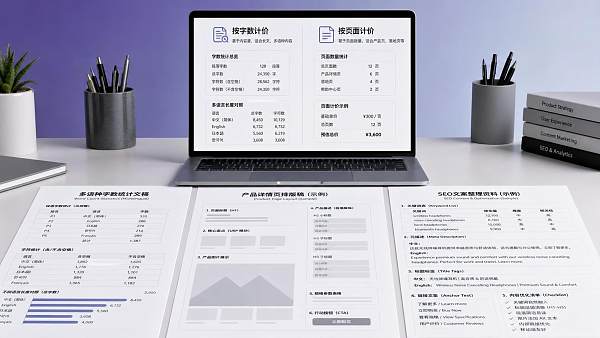
If a page contains multiple types of nested content, it is advisable to break down the calculation first—for example, clarify separately whether the body text, components, tables, SEO fields, text replacement in images, and uploading and publishing are billable. In this way, even if a bundled page-based price is ultimately adopted, it remains clear which costs actually arise outside the translation itself.
What truly creates cost differences is not the pricing label, but the scope of work
In website content translation projects, four types of work are most likely to be underestimated.
- Terminology management. Industries such as machinery, chemicals, electronics, medical devices, and environmental equipment often use the same Chinese term in different contexts with different English equivalents. For example, “处理” may mean treatment, processing, or handling; “型号” may sometimes be model, while in other cases it is closer to part number. If the content is translated quickly by word count alone, terminology can easily become inconsistent across the website.
- Page adaptation. German, French, and Spanish text is often longer than Chinese and English. Navigation labels, buttons, table headers, and filter options may expand. This is particularly noticeable in the first screen on mobile devices. Once a short button wraps onto two lines, it may affect the form submission rate.
- Marketing semantics. In an integrated website and marketing services context, title tags, summaries, short button copy, and form guidance cannot be mechanically translated. If a page is intended to generate leads, the translation often also needs to take search phrasing and reading habits into account.
- Maintenance costs. After the initial translation goes online, websites commonly require new sections, product specification updates, redirects for old pages, and keyword adjustments. If a terminology glossary and style guidelines are not established at the beginning, incremental revisions will become increasingly disorganized.
Therefore, simply comparing “the price per thousand words” with “the price per page” has limited value. A more effective approach is to first confirm the deliverables. As long as the deliverables differ, no unit price can be compared directly.
How to determine which pricing method is more cost-effective
A practical standard is whether the text can be exported in one batch and independently proofread. If it can, charging by word count is usually more suitable. If it cannot, charging by page or using a hybrid pricing model is more reliable.
For example, projects with a complete Chinese-English comparison table, product specifications maintained consistently in tables, and a separate list of SEO fields are more suitable for word-count pricing plus a small amount of publishing labor. Conversely, if content is scattered across a CMS, design files, images, old page caches, and plug-in modules, and translators must locate and verify it at the same time, page-based pricing is more aligned with the actual workload.
Another common situation is that there are “few pages, but each page is substantial.” For example, an industrial equipment website may have a single detail page containing equipment applications, process flows, processing capacity, energy consumption ranges, installation requirements, interface dimensions, maintenance instructions, transport packaging, and a list of optional accessories. The body text may not appear long, but every item requires precise terminology and may even require consistent unit formats and parameter symbols. If the price is forced down based on word count, suppliers often handle only the copyable body text, while the most critical specification sections receive the least thorough review.
For websites requiring long-term maintenance, a hybrid approach is generally more practical: charge by word count for body text, by page for template pages, and separately for text replacement in images, SEO fields, uploading and publishing, and second-round proofreading. This prevents the budget from being raised across the board by “complex pages,” while also ensuring that high-complexity work is not hidden within a low per-word rate.
Some projects also include downloadable materials, white papers, or research-oriented content. The processing logic for on-site pages differs from that for attached documents. For title-based materials such as investment research on environmental protection funds in the energy conservation and environmental protection industry, if the title appears simultaneously on a listing page, detail page, download button, and attachment filename, it cannot simply be translated once as body text. The link text, anchor text, and page context must also be reviewed together to prevent inconsistencies between the on-site display and the downloaded file name.
Key points to clarify when requesting a quotation
First, ask about the source-file format. Is it Word, Excel, a CMS backend export, a Figma copy layer, or must the content be extracted page by page directly from the website? This determines the calculation method and whether content organization work will be required.
Next, ask whether actions related to going online are included. Many translation quotations cover only text delivery and exclude backend entry, style checks, link verification, and language-switching tests. If the website includes forms, inquiry buttons, shopping carts, region switching, or a download center, it is advisable to include the testing scope in the quotation terms.
Then check whether SEO fields are included. Page titles, descriptions, image alt text, URL slugs, and internal anchor text may all require separate handling. For multilingual websites in particular, if only the body text is translated while these fields are left untouched, the page content will be in another language after going online, but the search entry points will remain in the original language, requiring rework later.
Finally, confirm the number of revision rounds. Some quotations appear inexpensive but include only one delivery and exclude terminology corrections and minor page adjustments. Once website content is placed on actual pages, common problems are not necessarily grammatical errors, but overly long buttons, broken table lines, inconsistent fields, and inconsistent naming of similar products. Without a basic revision allowance, the costs saved at the beginning can easily be recovered later through fragmented revisions.
If the current project includes article pages, product pages, and download pages, putting them all under the same pricing method will usually not produce the most reasonable result. Whether website content translation should be charged by word count or by page generally depends on the page structure, terminology difficulty, whether publishing support is required, and whether search and conversion semantics also need to be considered. Clarifying these boundaries in advance gives the quotation real comparative value and makes subsequent costs more manageable.
Related Articles



Related Products
 Yiyingbao SaaS Intelligent Website Building and Marketing SystemYiyingbao SaaS Intelligent Website Building and Marketing System, AI-powered no-code website building, rapid creation of multilingual B2B international websites in 10 minutes, global server acceleration, AI-powered SEO optimization, helping businesses connect efficiently with global markets. The perfect integration of technology and operation makes building an international trade website remarkably simple
 AI+SEM Intelligent Advertising Marketing SystemAI+SEM drives intelligent ad creation, empowering full-funnel precision advertising marketing. The system automatically generates weekly/monthly reports, AI recommends keywords and target countries, monitors core metrics in real-time with intelligent alerts, and enables one-click high-conversion ad solutions to help quickly acquire customers and improve ROI.
 AI+SEO Dual-Engine System Optimization ServicesYiyingbao’s AI+SEO dual-engine optimization system helps foreign trade enterprises acquire high-quality organic traffic through AI-powered keyword research, content generation, and comprehensive technical optimization, significantly improving search rankings and conversion rates.
 AI+SNS Social Media Marketing SystemYingbao AI+SNS Social Media Marketing System - Precision social capture for the social media era. Supports one-click content synchronization across major platforms like Facebook and LinkedIn. AI intelligently rewrites posts for enhanced relevance. 24/7 AI customer service and user profiling analysis empower businesses to efficiently expand into global markets.
 AI+SEO营销解决方案易营宝AI+SEO营销解决方案,通过AI批量写作、智能生成TDK、精准关键词扩词等功能,全面优化网站SEO效果,提升流量与转化率。助力企业构建高效智能网站新生态。
 AI+SEM Advertising Marketing SolutionsAI+SEM Advertising Marketing Solution leverages AI technology to deeply empower SEM ad campaigns. It automatically generates weekly/monthly reports using AI, presenting account data across multiple dimensions for comprehensive insights into campaign performance and trends. The system precisely recommends keywords and target countries, intelligently generates high-conversion ad copy, and enables one-click activation of efficient campaign plans to help businesses rapidly acquire customers. Simultaneously, it monitors core metrics in real time, intelligently identifies abnormal fluctuations, and issues timely alerts to ensure stable, high-return advertising results.
 Domain Name ServicesEasyWin provides professional domain name services, including intelligent queries, one-stop registration, brand protection, and full lifecycle management, helping businesses build a digital brand image.
 EasyOperate B2C Cross-Border E-Commerce Platform & Independent WebsiteEasyStore B2C Cross-border E-commerce Independent Store is an intelligent website building and cross-border e-commerce integrated solution independently developed by EasyStore Information Technology (Beijing) Co., Ltd. The system is specially designed for small and medium-sized as well as large export enterprises, integrating 'website building, operation, marketing, advertising, and conversion' into one, helping enterprises quickly establish cross-border e-commerce independent stores to achieve brand globalization and global sales growth.
The platform supports multiple languages, multiple currencies, and multi-channel marketing, with built-in AI intelligent translation and SEO optimization systems, suitable for mainstream markets such as Southeast Asia, Europe and America, Latin America, and the Middle East, assisting Chinese manufacturing enterprises in efficiently deploying international e-commerce strategies. SSL证书易营宝提供专业SSL安全证书服务,包括单域名和泛域名证书,确保网站数据传输加密、身份验证和完整性保护,助力企业建立安全可信的在线业务环境。









