









- Can the average annual growth rate reflect real opportunities in overseas markets?Oct 07, 2026View details
- Which customer acquisition channels will be affected by cross-border marketing trends in 2026?Sep 06, 2026View details
- Which homogenization risks should be considered in an analysis of the AI-powered website building industry?Aug 30, 2026View details
- How Will AI Marketing Trends 2026 Change Advertising Budget AllocationAug 28, 2026View details
- Is the EV SSL certificate market shrinking or upgrading? How should companies assess certificate procurement?Aug 11, 2026View details
- Why the old AMP SEO 2020 practices no longer work and what has changed in current optimization prioritiesAug 02, 2026View details
Why Does AI Website Translation Easily Lose SEO Keywords?
Meta Title: Why AI Website Translation Easily Loses SEO Keywords
After many websites adopt AI website translation, the pages may look more complete and the grammar may become smoother, but search traffic does not necessarily grow accordingly and may even decline. The most common problem is not that the translation tool is “not smart enough,” but that while processing the page, it weakens, replaces, or directly omits SEO keywords that should have been retained. As a result, users can understand the content, but search engines may no longer accurately understand what the page is actually about.
If you are working on a multilingual website, especially a foreign trade website, cross-border e-commerce store, or product catalog site, remember this first: AI website translation can solve language efficiency issues, but it cannot automatically solve keyword mapping issues. These two things may look similar, but they are actually entirely different levels of work.
Why AI Website Translation Often Translates Keywords Correctly but Not Accurately
When many people create a multilingual website for the first time, they naturally assume that as long as the original text is translated accurately, SEO will be carried over as well. In practice, this is often not the case.
Search engines do not view a page like people do, thinking that it is enough to understand the general meaning. They pay more attention to whether keywords remain consistent, whether the page topic is focused, and whether important fields are aligned. AI translation is good at generating fluent sentences, but it can easily cause problems in the following areas:
- Replacing core terms with synonyms and dispersing keyword concentration
- Polishing the wording according to context and changing frequently searched industry terms into expressions that are searched less often
- Using inconsistent wording across the title, body text, image alt text, URL, and Meta description
- Mistaking product names, model numbers, materials, and application scenarios for ordinary descriptive terms
- Retaining the literal meaning while losing the actual search habits of the local market
Here is a common example. In Chinese, you might write “光伏逆变器厂家.” AI may translate it as “photovoltaic inverter manufacturer,” which is semantically correct. However, if users in the target market more commonly search for “solar inverter supplier” or “solar inverter factory,” the page may be readable, but its search matching can still be off target. The issue is not whether the English is good, but whether the search terms are actually used by users.
This is also why some multilingual pages have normal indexing, average rankings, and few inquiries after going live. A page that “looks like good English” is not necessarily a “good SEO page.”
Where AI Website Translation Most Easily Loses SEO Keywords
If you want to investigate the issue, do not focus on the body text first. The most common problems often occur in several overlooked areas.
The first is the title tag and Meta description. Many systems translate the body text but either leave the title in the original language or allow AI to rewrite it freely. Once the core term in the title is replaced, the topic signal of the entire page becomes weaker.
The second is H tags. In particular, if the original H1 and H2 tags are built around a product term, industry term, or regional term, but become generalized descriptions after translation, rankings are usually affected.
The third is the product specifications section, application scenarios section, and FAQ section. These areas may look like supplementary information, but they often provide coverage for long-tail keywords. Once AI makes extensive changes in order to make the wording sound natural, long-tail keywords can easily be lost.
The fourth is image alt text and internal anchor text. Many people only review visible content and overlook these structured fields. As a result, the main copy is translated, but supporting SEO signals are either not translated at the same time or are translated inconsistently, reducing the overall relevance of the page.
There is also a more hidden issue: the URL slug is not localized, or is automatically converted into a meaningless parameter format. Even if the body text is good, the page topic receives much less guidance from a readable URL.
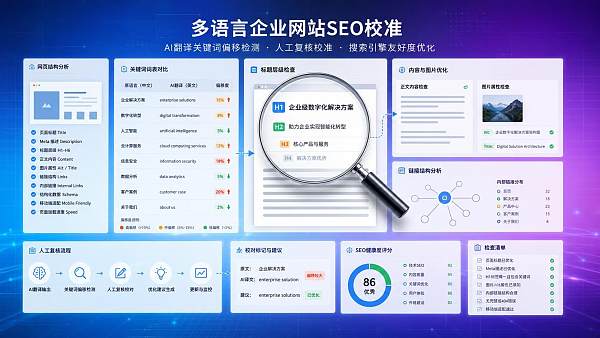
If your website is already live, it is recommended that you first check these five areas: the page title, H1, opening paragraph, product module subheadings, and image alt text. Check whether they revolve around the same group of keywords instead of each using unrelated wording.
Not Every Term Should Be Translated Literally, but Core Terms Must Be Defined in a Keyword List First
A practical experience in multilingual SEO is to define the keywords first and then translate, rather than completing the translation and going back to add SEO afterward.
Many teams follow the opposite process. They first use AI to translate the entire website, and only after all pages are online do they discover that the keywords have shifted and begin reworking the pages one by one. This is usually costly, especially when there are many products and languages.
A more reliable approach is to create a keyword mapping table first. It should include at least three types of content:
- Core product terms: what exactly are you selling
- Commercial-intent terms: how should terms such as manufacturer, supplier, factory, company, and solution be used
- Scenario terms: how should terms such as industry, application, project, OEM, and custom be applied
This step may sound like “adding another layer,” but it actually helps avoid extensive rework later. AI website translation is most vulnerable not when sentences are difficult, but when there are no rules. Without rules, it will use the habits of the language model to “improvise.” Once it improvises, SEO can easily become scattered.
Some industries particularly need this type of keyword list, including machinery, chemicals, medical devices, electronic components, and new energy. The reason is simple: in these industries, a slight difference in wording can indicate a different search intent.
For example, when a new energy company builds an overseas website, its homepage may need to support brand presentation, solution descriptions, supply chain capabilities, and project lead generation at the same time. If such a page focuses only on fluent translation, truly valuable industry terms can become diluted. Websites that first organize their industry terms, technical terms, and scenario terms are more likely to balance readability and indexing performance. Pages focused on solutions, such as photovoltaics and new energy, depend even more on structured expression rather than simple language conversion.
Many People Think Keyword Loss Is a Translation Problem, but It Is Often a Process Problem
This point is particularly important.
If your multilingual website follows the process of “the content team writes in Chinese, the operations team uses one-click AI translation, and the technical team publishes it directly,” the loss of SEO keywords is highly likely. It is not necessarily because anyone has done a poor job, but because the process is missing a necessary step: SEO review after translation.
In actual work, at least three checks should be added:
- Before translation: confirm the primary keyword for each page and avoid putting multiple central terms on one page
- During translation: restrict AI’s ability to rewrite core terms, brand terms, model numbers, and industry terminology
- After translation: check whether the title, H tags, opening paragraph, alt text, and internal link anchor text are consistent
This is why experienced teams do not treat AI website translation as the “final deliverable,” but as a “first-draft engine.” It is responsible for improving efficiency, while people are responsible for calibrating search intent.
Service providers that integrate website development and marketing generally have an advantage in this area because they do not only manage page translation. They also consider website structure, SEO logic, advertising landing pages, and subsequent conversion together. For an integrated platform such as Yiyingbao, which has long provided intelligent website building, multilingual website development, Google SEO optimization, and overseas promotion, the value lies not only in translating pages, but also in ensuring that pages can still be found, understood, and clicked in different markets. The difference between these two outcomes is significant.
When Is AI Website Translation Suitable, and When Should You Avoid Relying on It Completely?
AI website translation is not something that should be avoided. On the contrary, it is highly suitable for the following types of work:
- Batch first-pass translation of product detail pages, basic blog content, and help center pages
- Quickly building the framework of a multilingual website and completing a readable version first
- Batch production for websites that already have a keyword list, terminology database, and page templates
However, if you are working on the following types of pages, it is not recommended that you let AI complete the entire process automatically:
- Homepage
- Core product pages
- High-conversion landing pages
- High-value industry solution pages
- Existing pages that already have rankings and inquiries
The reason is practical: these pages are responsible not only for helping people understand the content, but also for brand positioning, keyword competition, conversion guidance, and regional market matching. Once the keywords shift, the loss may not become apparent immediately, but it will become increasingly difficult to generate traffic later.
For pages that already have organic rankings, be sure to back up the title, description, keyword layout, and main internal links before replacing them with an AI-translated version. Do not erase the SEO assets accumulated over time in a single step.
How Can You Fix the Problem If the Translation Is Already Complete?
Do not rush to rebuild the entire website. Problems on most websites can be fixed in stages.
First, select the 20% of pages with the highest traffic and the most important inquiries. Extract the titles, H1s, opening paragraphs, and main button copy from these pages, and recalibrate them against the target market’s keywords.
Second, create a terminology whitelist. Do not allow AI to rewrite brand names, product names, model numbers, core category terms, or key regional terms freely.
Third, check for pages that are “linguistically correct but search-inaccurate.” The simplest way to judge this is to search for the page’s primary term and see how the pages ranking at the top of the results phrase it. If your wording is obviously too formal, explanatory, or academic, it is probably not the optimal choice.
Fourth, address consistency across the website. If manufacturer, supplier, vendor, and producer all appear on one page while you originally intended to target only one primary term, the wording should be narrowed instead of allowing AI to spread the terms too broadly.
One more reminder: do not revise only the body text while leaving the structural fields untouched. The elements that truly affect how search engines understand a page are often the areas you do not normally open and check.
At this point, the core conclusion is already clear: AI website translation easily loses SEO keywords not because AI cannot translate, but because it defaults to pursuing natural language rather than search matching. Without a keyword list, review process, and page-level strategy, the faster the translation, the faster deviations may accumulate.
When building a multilingual website, the most cost-effective approach is neither “all manual” nor “all AI.” Instead, AI should be used where it can improve efficiency, while keyword decisions, page structure, and search intent should be reviewed by people who understand SEO. This is how AI website translation can genuinely improve efficiency instead of quietly losing traffic in unseen areas.
Frequently Asked Questions
Does a ranking decline after AI website translation always mean that keywords have been lost?
Not necessarily, but keyword shifts are one of the most common causes. Changes to the title, page structure, or URL, as well as broken internal links, may also be involved.
Can SEO problems be solved as long as the content is polished manually?
Not necessarily. Much manual polishing only corrects grammar and tone without reviewing the content against search terms. The page may still be easy to read but difficult to find.
Does keyword research need to be repeated for every language?
If the target markets differ significantly, it is recommended. At minimum, core product terms and commercial-intent terms should be verified separately instead of being copied directly from the original language.
Is AI website translation suitable for launching an entire website with one click?
It is suitable for creating a first version, but not for launching key pages directly without review. The homepage, core product pages, and high-conversion pages should preferably be corrected separately.
Image Placeholder List
img_01: Recommended placement after the section “Where AI Website Translation Most Easily Loses SEO Keywords”; image content: an illustration of key areas for checking titles, H1, opening paragraphs, image alt text, and internal link anchor text on multilingual pages; alt copy: “Illustration of key areas for checking SEO keywords on a multilingual website.”
Recommended Internal Link Anchor Text
- Multilingual website SEO optimization: recommended link to the multilingual SEO service page or tutorial page
- Foreign trade website keyword layout: recommended link to the foreign trade website development or SEO implementation page
- Troubleshooting abnormal Google indexing: recommended link to the technical SEO troubleshooting page
- Content localization for overseas independent websites: recommended link to the website translation or content localization service page
- How to build an industry solution website: recommended link to an industry website development case study or solution page
Recommended Authoritative External Sources
- Official search engine documentation, such as guidelines from Search Central on multilingual and multi-regional websites
- Keyword research methods or international SEO practice materials published by industry SEO tool platforms
- Local industry associations in the target market, official brand technical documentation, or product terminology materials
Related Articles


Related Products
 Yiyingbao SaaS Intelligent Website Building and Marketing SystemYiyingbao SaaS Intelligent Website Building and Marketing System, AI-powered no-code website building, rapid creation of multilingual B2B international websites in 10 minutes, global server acceleration, AI-powered SEO optimization, helping businesses connect efficiently with global markets. The perfect integration of technology and operation makes building an international trade website remarkably simple
 AI+SEM Intelligent Advertising Marketing SystemAI+SEM drives intelligent ad creation, empowering full-funnel precision advertising marketing. The system automatically generates weekly/monthly reports, AI recommends keywords and target countries, monitors core metrics in real-time with intelligent alerts, and enables one-click high-conversion ad solutions to help quickly acquire customers and improve ROI.
 AI+SEO Dual-Engine System Optimization ServicesYiyingbao’s AI+SEO dual-engine optimization system helps foreign trade enterprises acquire high-quality organic traffic through AI-powered keyword research, content generation, and comprehensive technical optimization, significantly improving search rankings and conversion rates.
 AI+SNS Social Media Marketing SystemYingbao AI+SNS Social Media Marketing System - Precision social capture for the social media era. Supports one-click content synchronization across major platforms like Facebook and LinkedIn. AI intelligently rewrites posts for enhanced relevance. 24/7 AI customer service and user profiling analysis empower businesses to efficiently expand into global markets.
 AI+SEO营销解决方案易营宝AI+SEO营销解决方案,通过AI批量写作、智能生成TDK、精准关键词扩词等功能,全面优化网站SEO效果,提升流量与转化率。助力企业构建高效智能网站新生态。
 AI+SEM Advertising Marketing SolutionsAI+SEM Advertising Marketing Solution leverages AI technology to deeply empower SEM ad campaigns. It automatically generates weekly/monthly reports using AI, presenting account data across multiple dimensions for comprehensive insights into campaign performance and trends. The system precisely recommends keywords and target countries, intelligently generates high-conversion ad copy, and enables one-click activation of efficient campaign plans to help businesses rapidly acquire customers. Simultaneously, it monitors core metrics in real time, intelligently identifies abnormal fluctuations, and issues timely alerts to ensure stable, high-return advertising results.
 Domain Name ServicesEasyWin provides professional domain name services, including intelligent queries, one-stop registration, brand protection, and full lifecycle management, helping businesses build a digital brand image.
 EasyOperate B2C Cross-Border E-Commerce Platform & Independent WebsiteEasyStore B2C Cross-border E-commerce Independent Store is an intelligent website building and cross-border e-commerce integrated solution independently developed by EasyStore Information Technology (Beijing) Co., Ltd. The system is specially designed for small and medium-sized as well as large export enterprises, integrating 'website building, operation, marketing, advertising, and conversion' into one, helping enterprises quickly establish cross-border e-commerce independent stores to achieve brand globalization and global sales growth.
The platform supports multiple languages, multiple currencies, and multi-channel marketing, with built-in AI intelligent translation and SEO optimization systems, suitable for mainstream markets such as Southeast Asia, Europe and America, Latin America, and the Middle East, assisting Chinese manufacturing enterprises in efficiently deploying international e-commerce strategies. SSL证书易营宝提供专业SSL安全证书服务,包括单域名和泛域名证书,确保网站数据传输加密、身份验证和完整性保护,助力企业建立安全可信的在线业务环境。









