









- Can the average annual growth rate reflect real opportunities in overseas markets?Oct 07, 2026View details
- Which customer acquisition channels will be affected by cross-border marketing trends in 2026?Sep 06, 2026View details
- Which homogenization risks should be considered in an analysis of the AI-powered website building industry?Aug 30, 2026View details
- How Will AI Marketing Trends 2026 Change Advertising Budget AllocationAug 28, 2026View details
- Is the EV SSL certificate market shrinking or upgrading? How should companies assess certificate procurement?Aug 11, 2026View details
- Why the old AMP SEO 2020 practices no longer work and what has changed in current optimization prioritiesAug 02, 2026View details
Can AI multilingual translation be used directly on a website?
AI-powered multilingual translation is significantly changing the process of website development. In the past, companies creating multilingual websites often faced long translation cycles, high outsourcing costs, and difficulties with version maintenance. Now, with the help of large language models, pages in English, German, Spanish, Arabic, Japanese, and other languages can generate initial drafts in a very short time. Technically speaking, the barrier to launching a website has indeed been lowered. However, for technical evaluators, the real question has never been “Can it be translated?” but rather “Can it go live directly and take responsibility for lead generation, conversion, and brand communication?”
If a website is only an internal testing page, a temporary campaign page, or a low-risk information page, AI-powered multilingual translation can handle a relatively high proportion of the work. However, if the page involves product specifications, industry terminology, compliance descriptions, SEO indexing, or inquiry conversion, the answer is usually not simply “yes” or “no.” The usable boundaries must first be defined.
“Ready to go live” does not mean “ready for commercial use”
When testing AI translation, many teams are misled by a common phenomenon: the sentences appear fluent and there are no obvious reading problems, so they assume the content can be published directly. In reality, whether multilingual website content is ready for commercial use should be evaluated across at least four dimensions:
- Whether the meaning is accurate, especially with regard to product functions, materials, processes, specifications, and delivery methods;
- Whether terminology is consistent and aligned with the company’s existing materials, catalogs, and certification documents;
- Whether the expression conforms to the language habits of the target market, rather than being merely “correct but unlike a local website”;
- Whether the page is search-engine friendly, including its URL, title, meta description, structured information, and hreflang strategy.
In other words, AI-powered multilingual translation solves the problem of “content generation efficiency,” while launching a website involves the question of “business usability.” These are judgments made at different levels.
Three risk points most easily overlooked during technical evaluation
The first type of risk is terminology drift. Industries such as manufacturing, equipment, materials, medical accessories, and electronic components have very high requirements for terminology consistency. AI often performs well when translating at the paragraph level, but across pages, batches, and versions, it can easily produce multiple translations for the same term. This may not be obvious to readers, but it directly affects three outcomes: a decline in the brand’s professional image, weaker SEO keyword consolidation, and increased communication costs between sales teams and customers.
The second type of risk is “literal correctness with business errors.” For example, Chinese expressions such as “support customization,” “processing based on customer drawings,” “delivery time subject to the contract,” and “suitable for high-temperature environments” may be translated into grammatically correct expressions with shifted commercial meanings if the model lacks context. For B2B websites, such errors are more dangerous than ordinary language mistakes because they change the purchasing party’s understanding of the company’s capability boundaries.
The third type of risk is page-level SEO distortion. Many teams only examine the quality of the main-text translation without checking title tags, breadcrumbs, navigation hierarchy, image alt text, anchor text, FAQ modules, product category pages, and filter pages. If these elements retain the source-language structure or are mechanically translated by AI, search engines may have difficulty correctly understanding the page topic. Even if a multilingual website is indexed, it may still lack ranking potential.
Which pages can use direct AI output first, and which should not go live directly
From an implementation perspective, AI translation is not unusable; it simply needs to be applied in layers.
Content suitable for initial direct AI output is generally highly standardized and relatively low risk:
- Company introductions, corporate histories, and news updates;
- Trade show updates and initial drafts of blog articles;
- Routine help pages and basic FAQs;
- Content for the cold start of test-language websites.
Content that is generally not recommended for direct publication without review includes:
- Product parameter pages, technical specification pages, and material description pages;
- Certification, compliance, warranty, and after-sales terms;
- Industry solution pages and application scenario pages;
- Advertising landing pages, key inquiry pages, and high-value keyword pages.
The reason is simple: the former focuses on information delivery, while the latter directly affects trust, conversion, and legal risks. Technical evaluation should not focus only on overall accuracy, but also on the “error tolerance of high-risk fields.” A single error in a critical field may cause losses exceeding the translation costs saved.
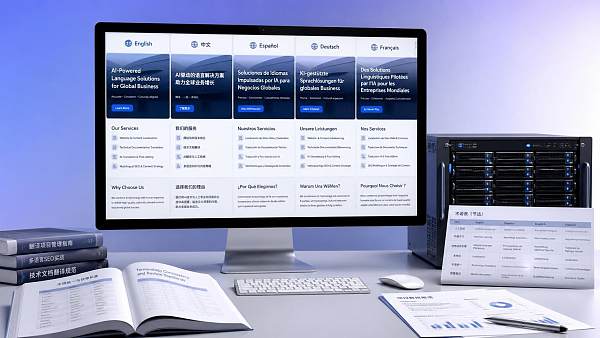
When determining whether AI translation meets the launch standard, the key is not the model name
When selecting a solution, many companies tend to focus on whether the latest model is being used, how many languages are supported, and how fast translation is. These metrics are valuable references, but they are not the standard for launching a website. What truly determines whether a solution is ready for commercial use is whether the following technical processes form a complete closed loop.
1. Does it have a terminology database and style guide?
AI translation without a terminology database is essentially just general-purpose language generation. For a website project, mapping rules should at least be established for brand names, product names, process terminology, industry abbreviations, prohibited words, and competitor comparison terms. A more mature approach is to include core SEO keywords in the controlled terminology list, preventing the model from replacing target keywords on its own in pursuit of natural language.
2. Does it support contextual translation rather than isolated sentence translation?
Website content is not a collection of document fragments but a page system. Navigation, buttons, module headings, product selling points, form copy, and CTA buttons require contextual consistency. If the system translates each field one by one, the style of the same page can easily become fragmented, and the meaning of buttons may even become inconsistent with the main text.
3. Is there an interface for human post-editing?
For any formal website, it is almost impossible for multilingual content to completely bypass human proofreading. The difference lies not in whether human involvement is needed, but in how much human input is required, what content is modified, and whether versions can be tracked. Technically, a usable solution should support page-level editing, field-level write-back, batch replacement, terminology locking, and version synchronization, rather than overwriting the entire page every time a modification is made.
4. Is it compatible with basic multilingual SEO requirements?
At a minimum, the following should be checked:
- Whether independent language URLs are supported;
- Whether hreflang can be configured;
- Whether titles, descriptions, and canonicals can be managed independently by language;
- Whether fields related to keywords can be edited manually;
- Whether language switching through JavaScript is avoided to prevent crawling difficulties.
If these capabilities are missing, even the best translation text will have difficulty delivering the value that a website should provide.
There is another layer of cultural adaptation between “correct translation” and “usable localization”
Technical evaluations often place too much emphasis on accuracy, but launching a website also involves readability and trust. Common Chinese expressions such as “direct factory supply,” “quality guaranteed,” “feel free to contact us,” and “many years of experience” often sound vague and even unconvincing when translated literally for Western B2B websites. Markets such as Arabic-, Japanese-, and German-speaking markets also show significant differences in the degree of politeness, density of professional expression, and order in which information is presented.
This means that if AI-powered multilingual translation only performs “language conversion,” it is still insufficient to directly produce a high-quality international trade website. It is better suited to serving as an initial localization-draft engine rather than a final publishing engine. In particular, the homepage, solution pages, brand pages, and key product pages should be revised from the perspective of the target market instead of receiving only grammatical corrections.
From the broader perspective of enterprise digitalization, this path of “using automation to improve efficiency first, then enhancing resilience through rules and human correction” is not limited to translation. Similar logic applies to website development, marketing automation, and customer operations. When previously evaluating an analysis of the impact of digital transformation on enterprise resilience, many companies also discovered that what truly determines results is not how much manual work is replaced by tools, but whether key processes have been redesigned to be controllable, iterative, and auditable.
Technical evaluators should establish a “tiered page launch” mechanism
Rather than debating whether AI translation can be launched directly across the board, a more practical approach is to establish tiered standards.
One actionable method is to divide pages into three categories: A, B, and C:
- Category A: high-conversion, high-risk pages that must undergo human review and localization optimization;
- Category B: medium-frequency pages that should be quickly proofread by operations staff or industry editors after initial AI translation;
- Category C: low-risk content pages that can be launched quickly after terminology is locked, and then optimized based on data feedback.
The value of this approach is that companies can avoid losing launch speed in pursuit of “high-quality fully manual translation,” while also avoiding exposing risks to real users and search engines through blind “full automation.”
What should be examined during acceptance, rather than examined alone
When accepting an AI-powered multilingual website, it is not enough to sample-check a few paragraphs of the main text. More effective checks generally include:
- Randomly checking parameters, units, model numbers, and certification names on core product pages;
- Checking whether the same terminology is used consistently throughout the website;
- Verifying whether menus, forms, buttons, and breadcrumbs match the purpose of the page;
- Checking whether pages in key languages retain search intent rather than merely providing literal translations;
- Verifying whether SEO configurations at the page source-code level take effect independently;
- Observing differences in bounce rate, time on page, and inquiry conversion after launch.
Many projects perform poorly after launch not because the translation model lacks capability, but because the acceptance criteria are wrong. Teams verify only whether “the language is fluent,” but fail to verify whether “the page can be found, encourage action, and reduce misunderstanding.”
A reasonable conclusion at this stage: it can be used directly in the “launch process,” but should not be equated with “launch completed”
If AI-powered multilingual translation is understood as a production tool for website internationalization, it is already mature enough, particularly for shortening development cycles, supporting multilingual expansion, and reducing initial content costs. However, if it is understood as a final delivery solution requiring no human involvement, most formal websites are not yet ready for that level of use.
For technical evaluators, the most important task is not to determine whether AI translation is “good” or “bad,” but to clarify three things: which pages it suits, which control mechanisms must be added, and what data should be used to verify results after launch. Only by evaluating translation capabilities together with the website system, content management, SEO configuration, and human review processes can AI-powered multilingual translation become more than a feature that appears advanced but is difficult to implement in practice.
Therefore, can AI-powered multilingual translation be used directly for website launch? In terms of the process, yes. In terms of commercial usability and long-term operations, it generally cannot be published directly without conditions. The truly practical answer is: “AI goes first, rules provide constraints, humans ensure quality, and data drives review.” This is closer to the real dividing line between success and failure in a project than simply debating whether machine translation is accurate.
Related Articles



Related Products
 Yiyingbao SaaS Intelligent Website Building and Marketing SystemYiyingbao SaaS Intelligent Website Building and Marketing System, AI-powered no-code website building, rapid creation of multilingual B2B international websites in 10 minutes, global server acceleration, AI-powered SEO optimization, helping businesses connect efficiently with global markets. The perfect integration of technology and operation makes building an international trade website remarkably simple
 AI+SEM Intelligent Advertising Marketing SystemAI+SEM drives intelligent ad creation, empowering full-funnel precision advertising marketing. The system automatically generates weekly/monthly reports, AI recommends keywords and target countries, monitors core metrics in real-time with intelligent alerts, and enables one-click high-conversion ad solutions to help quickly acquire customers and improve ROI.
 AI+SEO Dual-Engine System Optimization ServicesYiyingbao’s AI+SEO dual-engine optimization system helps foreign trade enterprises acquire high-quality organic traffic through AI-powered keyword research, content generation, and comprehensive technical optimization, significantly improving search rankings and conversion rates.
 AI+SNS Social Media Marketing SystemYingbao AI+SNS Social Media Marketing System - Precision social capture for the social media era. Supports one-click content synchronization across major platforms like Facebook and LinkedIn. AI intelligently rewrites posts for enhanced relevance. 24/7 AI customer service and user profiling analysis empower businesses to efficiently expand into global markets.
 AI+SEO营销解决方案易营宝AI+SEO营销解决方案,通过AI批量写作、智能生成TDK、精准关键词扩词等功能,全面优化网站SEO效果,提升流量与转化率。助力企业构建高效智能网站新生态。
 AI+SEM Advertising Marketing SolutionsAI+SEM Advertising Marketing Solution leverages AI technology to deeply empower SEM ad campaigns. It automatically generates weekly/monthly reports using AI, presenting account data across multiple dimensions for comprehensive insights into campaign performance and trends. The system precisely recommends keywords and target countries, intelligently generates high-conversion ad copy, and enables one-click activation of efficient campaign plans to help businesses rapidly acquire customers. Simultaneously, it monitors core metrics in real time, intelligently identifies abnormal fluctuations, and issues timely alerts to ensure stable, high-return advertising results.
 Domain Name ServicesEasyWin provides professional domain name services, including intelligent queries, one-stop registration, brand protection, and full lifecycle management, helping businesses build a digital brand image.
 EasyOperate B2C Cross-Border E-Commerce Platform & Independent WebsiteEasyStore B2C Cross-border E-commerce Independent Store is an intelligent website building and cross-border e-commerce integrated solution independently developed by EasyStore Information Technology (Beijing) Co., Ltd. The system is specially designed for small and medium-sized as well as large export enterprises, integrating 'website building, operation, marketing, advertising, and conversion' into one, helping enterprises quickly establish cross-border e-commerce independent stores to achieve brand globalization and global sales growth.
The platform supports multiple languages, multiple currencies, and multi-channel marketing, with built-in AI intelligent translation and SEO optimization systems, suitable for mainstream markets such as Southeast Asia, Europe and America, Latin America, and the Middle East, assisting Chinese manufacturing enterprises in efficiently deploying international e-commerce strategies. SSL证书易营宝提供专业SSL安全证书服务,包括单域名和泛域名证书,确保网站数据传输加密、身份验证和完整性保护,助力企业建立安全可信的在线业务环境。









