









- Hapag-Lloyd’s $4.2 billion acquisition of ZIM faces a closing delay; ZIM reports third-quarter net profit of $830 millionNov 24, 2026View details
- SCFI falls for a third straight week to 3,503.78 points, with blank sailings on trans-Pacific routes rising to 10Nov 24, 2026View details
- Lazada 11.11 Mega Sale: LazMall Contributes Nearly Two-Thirds of GMVNov 23, 2026View details
- Shein’s European Revenue Falls 16% as Tighter Rules on Low-Value Direct Shipments Take EffectNov 23, 2026View details
- EU Low-Value Parcel Rules Impact Cargo Flows: Air Freight Volume from China to Europe Down 17% in OctoberNov 23, 2026View details
- Indonesia and the EU Sign Comprehensive Economic Partnership Agreement, 90.4% of Tariff Lines to Become Duty-Free ImmediatelyNov 23, 2026View details
Is a responsive self-service website builder suitable for beginners in foreign trade?
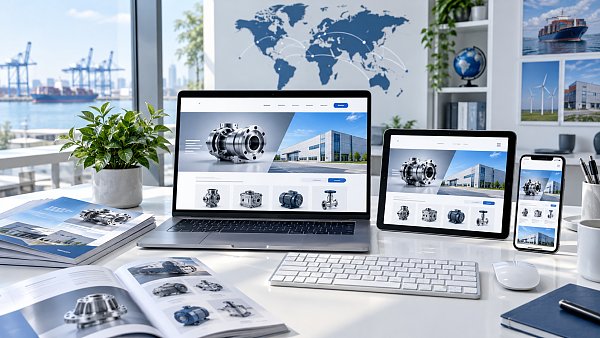
People new to foreign trade often face a seemingly simple yet difficult question: Should they first build their own English website? On one hand, they worry that hiring a web development company is costly and communication is slow; on the other, they fear that a self-built website will “look like a template,” fail to gain the trust of overseas customers, and remain invisible on Google.
So, is a responsive self-service website builder suitable for foreign trade beginners? The answer is not simply “yes” or “no.” If your goal is to quickly have an official foreign trade website that displays properly on mobile phones, tablets, and computers, while reserving more of your budget for products, samples, and customer acquisition testing, it is usually a friendly starting point. However, if you equate “launching a website” with “automatically getting orders,” you may easily be disappointed during subsequent promotion efforts.
What foreign trade newcomers really need is more than just a website that can be opened
For newly established foreign trade companies, factories, or cross-border sellers, a website often serves several roles: a brand profile that lets customers verify that the company genuinely exists, a product catalog for receiving inquiries, a landing page for Google Ads or social media promotion, and a content hub for building organic traffic over time.
This means that website development should involve more than whether the homepage looks good. Overseas buyers may view product specifications on their phones, or arrive at a specific product page through LinkedIn, Facebook, or Google Search. If pages are misaligned on mobile devices, load slowly, or hide contact details too deeply, potential inquiries may be lost as a result.
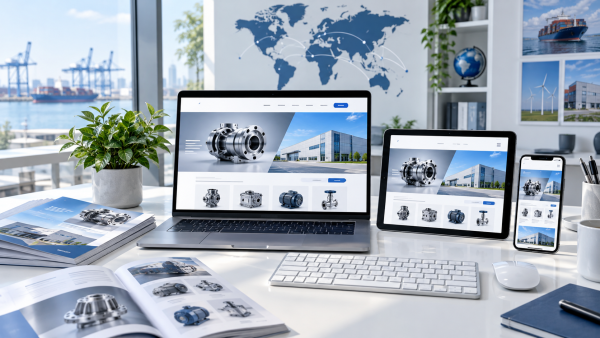
This is where responsive design delivers value: the same website content can automatically adjust its layout according to different screen sizes, without the need to maintain a separate mobile website. For foreign trade beginners without technical staff, this reduces maintenance costs and avoids the hassle of inconsistent content across devices.
What kind of foreign trade beginners are better suited to start with self-service website building?
If any of the following applies to you, self-service website building is usually worth exploring first: your product line is relatively clear, you already have basic English materials or product images, you want to first validate overseas markets and inquiry channels at this stage, someone on your team is willing to spend time organizing content, and your website needs mainly focus on company presentation, product categories, and inquiry forms rather than a complex custom transaction system.
For example, a factory producing hardware accessories, machinery and equipment, packaging materials, or household products can begin by building a basic structure of “Company Profile—Product Categories—Product Details—Application Scenarios—Contact Us.” The key is to clearly explain materials, specifications, minimum order quantities, customization capabilities, lead times, and certifications, rather than pursuing complex animations or dozens of flashy but impractical pages from the start.
For B2B business, a website is more about building trust, qualifying customers, and facilitating communication. A foreign trade marketing website with complete information, clear navigation, and mobile compatibility is often more practical than a visually elaborate website where visitors cannot find an inquiry entry point.
What exactly makes self-service website building “easy”?
Traditional website development often involves multiple stages, including domain names, servers, page design, front-end development, content entry, and ongoing maintenance. Responsive self-service website builders integrate many core functions into a visual backend, allowing users to create an initial website through module drag-and-drop, template application, and page configuration, without having to start by learning code.
What is even more helpful for beginners is that mature systems often provide preset structures such as product detail pages, news pages, download pages, and form pages. What you need to do is place your own business information in the right locations and continuously refine how it is presented. For example, instead of simply writing “high-quality products,” further explain the industries the products are suitable for, the specifications supported, whether OEM/ODM is accepted, and how to obtain a quotation.
However, a “low operational barrier” does not mean content requires no professional judgment. Whether the English matches the reading habits of the target market, whether images convey a genuine product feel, how keywords are placed, and whether pages can be crawled by search engines will all directly affect subsequent website performance.
Multilingual capability and responsiveness should not be merely two boxes to tick
Many people believe that an English version is all a foreign trade website needs. In fact, English is an important international communication language, but it may not cover all target customers. When targeting markets in Europe, the Middle East, Latin America, Russia, Japan, or South Korea, multilingual pages can reduce reading barriers and help brands enter more specific local search scenarios.
However, multilingual capability does not mean directly publishing machine translations of Chinese sentence by sentence. Product names, unit expressions, industry terminology, trade practices, and the tone of inquiries may all differ. It is advisable to first identify core markets, then prioritize English and the languages of those target markets. Key product, company, and service pages should maintain consistent content to avoid having specifications in one language version while another lacks information.
Likewise, responsiveness cannot be judged merely by whether the page has “shrunk.” Test it on a mobile phone in practice: Can the menu be opened? Are product images clear? Can forms be filled out smoothly? Are WhatsApp, email, or phone buttons easy to find? These details matter more than a backend showing “mobile-compatible.”
The four most common pitfalls for foreign trade beginners
- Pitfall 1: Templates determine sales conversions. Templates address page structure and basic visual appeal. Whether customers are willing to contact you still depends on product information, company credentials, and communication efficiency.
- Pitfall 2: A website will receive organic traffic as soon as it goes live. A new site needs to be indexed by search engines, and content must be continuously developed around product keywords, application keywords, and question keywords. SEO is a long-term effort.
- Pitfall 3: The more pages, the better. In the early stage, rather than hastily creating a large number of weak-content pages, it is better to first refine several key product pages and establish clear inquiry paths.
- Pitfall 4: Focusing only on website-building costs and not on ongoing capabilities. Domain binding, speed and security, SEO settings, form management, multilingual maintenance, data analytics, and integration with marketing tools will all affect the subsequent user experience.
Before choosing a system, it is advisable to work backward from promotion needs
Ask yourself first: Where will customers come from to reach the website? If you plan to conduct Google SEO, focus on page titles, descriptions, URL settings, sitemaps, content management, and loading performance. If you plan to run Google or Facebook ads, check whether landing pages can be created conveniently and whether conversion forms can be tracked. If customers mainly come from social media direct messages, the website needs clear contact information and pages that can quickly establish trust.
Taking an AI-driven SaaS platform such as Yiyingbao for businesses expanding overseas as an example, website building is not an isolated process. Its cloud-based intelligent website building, multilingual websites, SEO/GEO optimization, advertising marketing, and social media operation capabilities can be understood as part of the same overseas customer acquisition chain: the website is responsible for receiving traffic and converting it, while search, advertising, social media, and AI search visibility efforts are responsible for generating visits. For beginners unfamiliar with overseas digital marketing, this integrated approach makes it easier to establish an execution direction than simply purchasing a page-building tool.
Of course, whether to choose integrated services still depends on the team’s budget, market stage, and independent operating capabilities. If you are only testing one or two products, you can start with a lightweight website; if you have already identified multiple countries for long-term customer acquisition, you should consider in advance how multilingual content, content operations, and promotion data will connect.
Conclusion: Suitable for getting started, but cannot replace operational capabilities
Is a responsive self-service website builder suitable for foreign trade beginners? For those who want to launch an overseas official website with a low barrier to entry, showcase products quickly, and try digital customer acquisition, the answer is yes. It lowers the technical barrier, allowing entrepreneurs and business personnel to focus more quickly on the market, customers, and products themselves.
But a truly valuable website is not an online brochure that is “built and then left alone.” Treat the website as an overseas business asset that is continuously improved: add content based on customers’ frequently asked questions, observe which product pages receive more visits, optimize inquiry buttons and forms, and then gradually test SEO, advertising, or social media traffic generation. In this way, responsive self-service website building becomes more than just a convenient tool; it can become a reliable digital foundation during the initial stage of foreign trade.
Related Articles
 How can you verify the accuracy of product copy generated by an AI website builder?
 How can you verify page editability in an AI website builder demo?
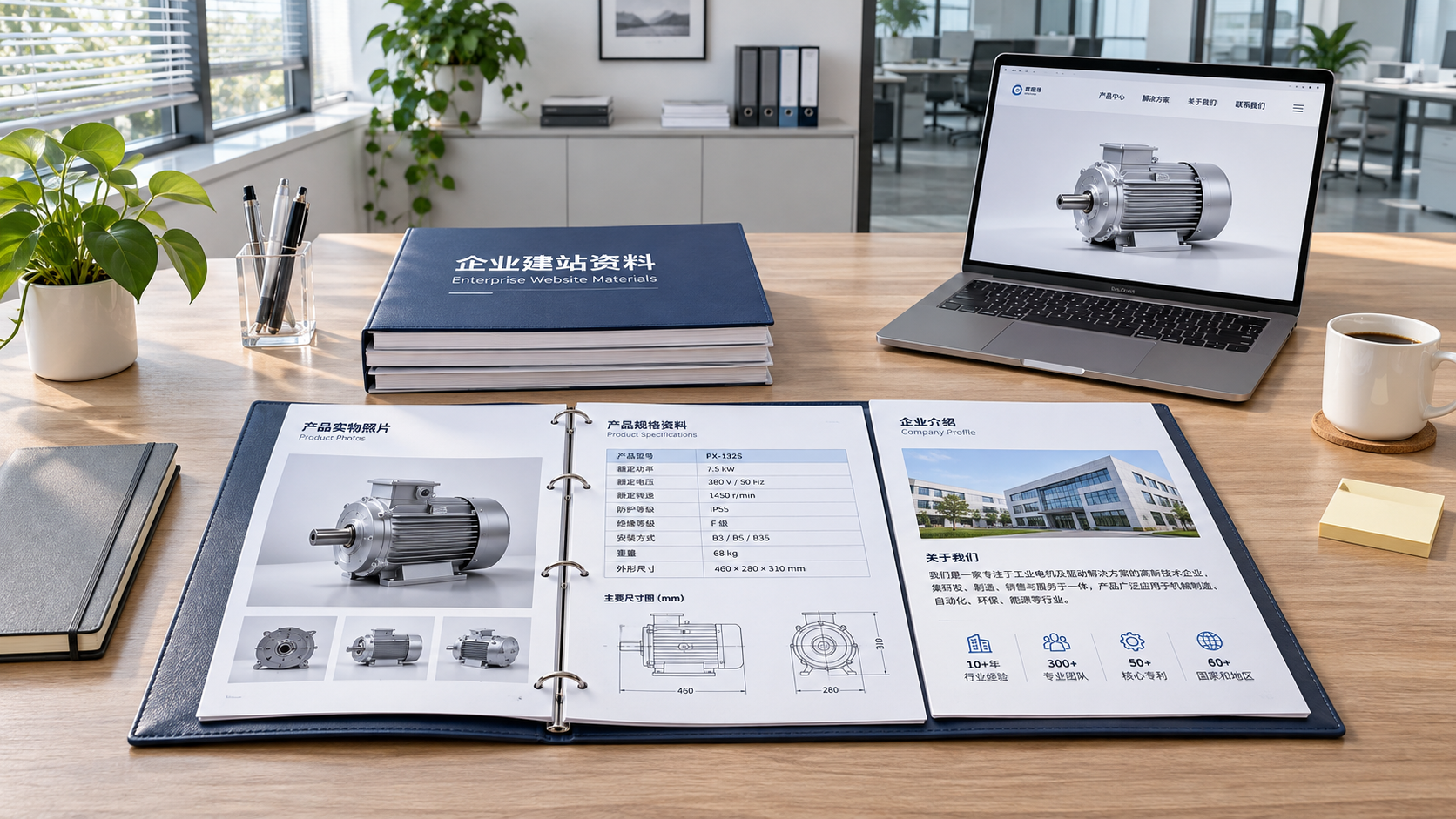
 What do you need to prepare to build a corporate website with the Yiyingbao AI Website Builder?

Related Products
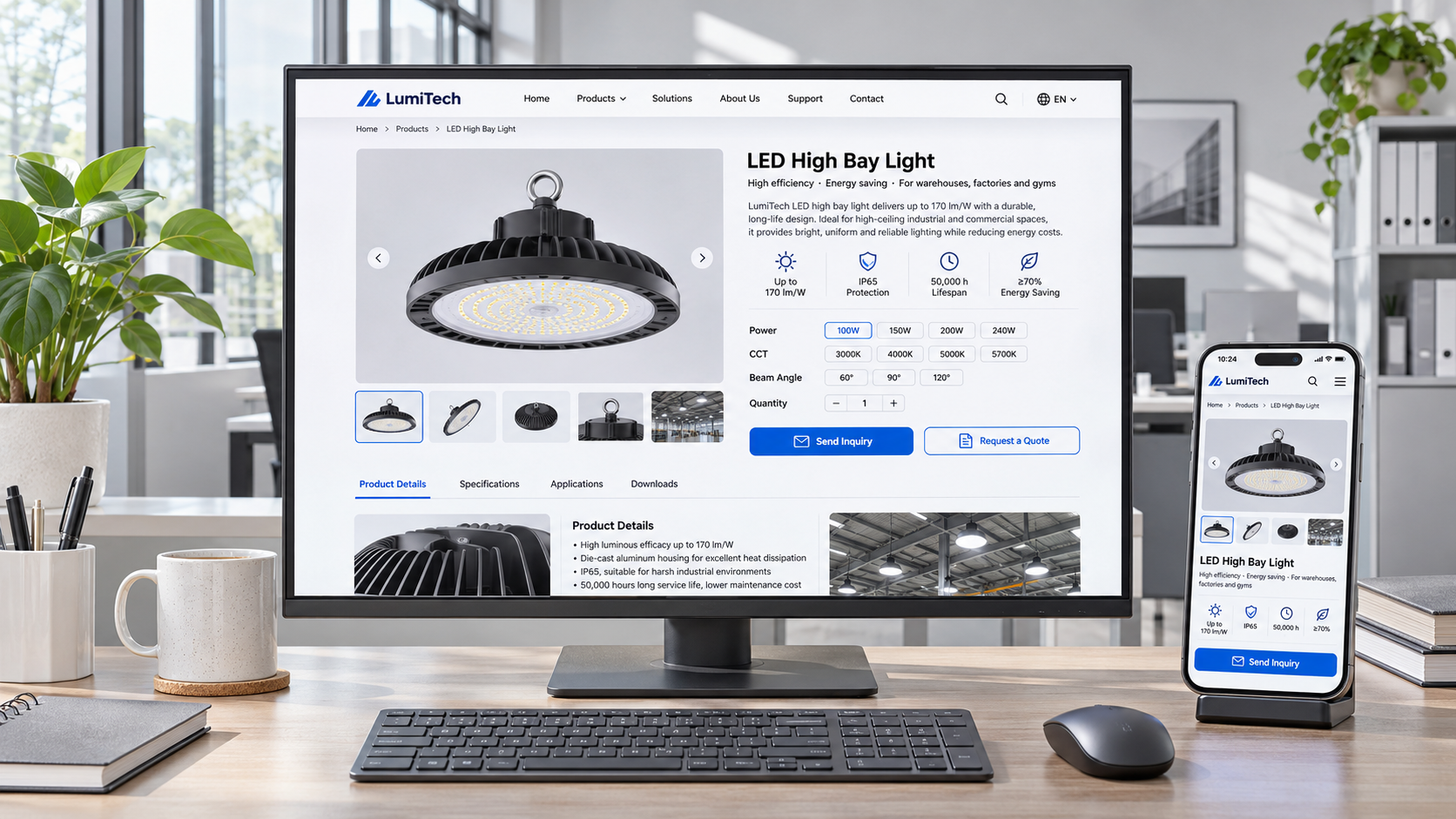
 Yiyingbao SaaS Intelligent Website Building and Marketing SystemYiyingbao SaaS Intelligent Website Building and Marketing System, AI-powered no-code website building, rapid creation of multilingual B2B international websites in 10 minutes, global server acceleration, AI-powered SEO optimization, helping businesses connect efficiently with global markets. The perfect integration of technology and operation makes building an international trade website remarkably simple
 AI+SEM Intelligent Advertising Marketing SystemAI+SEM drives intelligent ad creation, empowering full-funnel precision advertising marketing. The system automatically generates weekly/monthly reports, AI recommends keywords and target countries, monitors core metrics in real-time with intelligent alerts, and enables one-click high-conversion ad solutions to help quickly acquire customers and improve ROI.
 AI+SEO Dual-Engine System Optimization ServicesYiyingbao’s AI+SEO dual-engine optimization system helps foreign trade enterprises acquire high-quality organic traffic through AI-powered keyword research, content generation, and comprehensive technical optimization, significantly improving search rankings and conversion rates.
 AI+SNS Social Media Marketing SystemYingbao AI+SNS Social Media Marketing System - Precision social capture for the social media era. Supports one-click content synchronization across major platforms like Facebook and LinkedIn. AI intelligently rewrites posts for enhanced relevance. 24/7 AI customer service and user profiling analysis empower businesses to efficiently expand into global markets.
 AI+SEO营销解决方案易营宝AI+SEO营销解决方案,通过AI批量写作、智能生成TDK、精准关键词扩词等功能,全面优化网站SEO效果,提升流量与转化率。助力企业构建高效智能网站新生态。
 AI+SEM Advertising Marketing SolutionsAI+SEM Advertising Marketing Solution leverages AI technology to deeply empower SEM ad campaigns. It automatically generates weekly/monthly reports using AI, presenting account data across multiple dimensions for comprehensive insights into campaign performance and trends. The system precisely recommends keywords and target countries, intelligently generates high-conversion ad copy, and enables one-click activation of efficient campaign plans to help businesses rapidly acquire customers. Simultaneously, it monitors core metrics in real time, intelligently identifies abnormal fluctuations, and issues timely alerts to ensure stable, high-return advertising results.
 Domain Name ServicesEasyWin provides professional domain name services, including intelligent queries, one-stop registration, brand protection, and full lifecycle management, helping businesses build a digital brand image.
 EasyOperate B2C Cross-Border E-Commerce Platform & Independent WebsiteEasyStore B2C Cross-border E-commerce Independent Store is an intelligent website building and cross-border e-commerce integrated solution independently developed by EasyStore Information Technology (Beijing) Co., Ltd. The system is specially designed for small and medium-sized as well as large export enterprises, integrating 'website building, operation, marketing, advertising, and conversion' into one, helping enterprises quickly establish cross-border e-commerce independent stores to achieve brand globalization and global sales growth.
The platform supports multiple languages, multiple currencies, and multi-channel marketing, with built-in AI intelligent translation and SEO optimization systems, suitable for mainstream markets such as Southeast Asia, Europe and America, Latin America, and the Middle East, assisting Chinese manufacturing enterprises in efficiently deploying international e-commerce strategies. SSL证书易营宝提供专业SSL安全证书服务,包括单域名和泛域名证书,确保网站数据传输加密、身份验证和完整性保护,助力企业建立安全可信的在线业务环境。









