









- Can the average annual growth rate reflect real opportunities in overseas markets?Oct 07, 2026View details
- Which customer acquisition channels will be affected by cross-border marketing trends in 2026?Sep 06, 2026View details
- Which homogenization risks should be considered in an analysis of the AI-powered website building industry?Aug 30, 2026View details
- How Will AI Marketing Trends 2026 Change Advertising Budget AllocationAug 28, 2026View details
- Is the EV SSL certificate market shrinking or upgrading? How should companies assess certificate procurement?Aug 11, 2026View details
- Why the old AMP SEO 2020 practices no longer work and what has changed in current optimization prioritiesAug 02, 2026View details
How to Choose a Multilingual Website for Foreign Trade: Look at the Translation Process or SEO Structure First
How should you choose a multilingual website for international trade? On the surface, this question seems to compare “translation capabilities” and “SEO capabilities,” but for corporate decision-makers, the real issue is whether the website can continuously bring traffic, inquiries, and brand trust from target markets after launch. If a multilingual website is understood merely as “translating a Chinese website into several languages,” most projects are already heading in the wrong direction from the outset; if you focus only on the technical structure, you may end up with a search-friendly shell that lacks persuasive localized content.
Therefore, the translation process and SEO structure are not mutually exclusive options. The key is to determine which capability the company currently lacks more, and which one is more likely to become an irreversible cost at a later stage.
Whether to examine the translation process or the SEO structure first depends on your website objectives
If the core objective of a multilingual website is brand presentation after exhibitions or allowing existing customers to review materials, translation accuracy and terminology consistency are often more important. However, if the website is responsible for acquiring customers overseas, especially if it relies on Google organic search to generate new inquiries, the SEO structure should generally take priority over the translation process.
The reason is not complicated. Translations can be iterated, content can be rewritten, and localized expressions can be continuously optimized. However, if the underlying website structure does not support multilingual indexing, URL standards, page hierarchy, metadata management, and regional deployment from the beginning, adding these functions later will usually cost more than planning them properly at the outset.
Many companies overlook this during their first website project: the pages may appear to offer English, French, Spanish, or even dozens of language options, but from a search engine’s perspective, these pages may not be independent, identifiable, indexable, or rankable assets. The result is that the company “appears to have gone global but has not actually gained global traffic.”
The translation process determines “whether visitors can understand it,” while the SEO structure determines “whether they can find it”
A common misconception about multilingual websites is treating translation quality and website development quality as the same thing. In reality, they solve different problems.
The translation process mainly addresses three issues: whether terminology is accurate, whether the tone matches industry communication practices, and whether the content fits the reading logic of local buyers. In particular, in B2B fields such as industrial products, equipment, components, and materials, literal translation is often more dangerous than grammatical errors. Buyers may understand the sentences but still fail to understand exactly what specifications you offer, what operating conditions the product is suitable for, or which standards it complies with.
The SEO structure focuses on another set of questions: whether search engines can crawl multilingual pages, whether different language versions conflict with each other, whether the page topic is clear, and whether the website can build authority over the long term. For companies planning to acquire customers continuously through organic search, this is not an optional add-on but the foundation for turning a website into a business asset.
From a decision-making perspective, the translation process affects conversion efficiency, while the SEO structure affects the upper limit of customer acquisition. A website with average translation but a healthy structure still has room for subsequent optimization; a website with a disorganized structure may not receive enough traffic to enter the conversion stage, even if its language is well written.
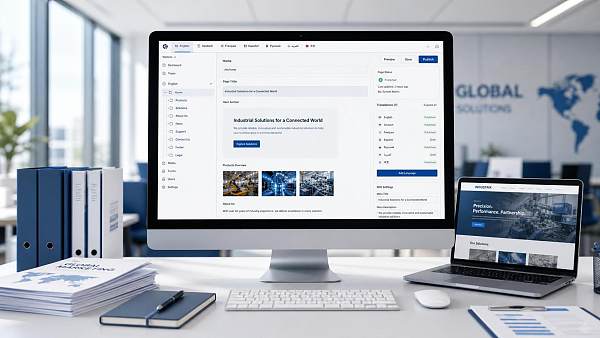
What companies should truly beware of is not poor translation, but a “pseudo-multilingual website”
The most common situation in the international trade website market is not that a website has no multilingual functionality at all, but that it has been made into a “pseudo-multilingual website.” These websites usually have several characteristics:
Language switching depends on a front-end plugin for real-time translation; different languages share the same URL or have a disorganized parameter structure; titles, descriptions, and H tags cannot be set independently for each language; site navigation, breadcrumbs, and product categories have not been restructured for different language markets; and hreflang tags may even be missing or incorrectly configured.
Such solutions can go online quickly and often look impressive in demonstrations, but they are more like visual translation tools than genuine marketing websites designed for overseas markets. For company managers, the greatest risk of such a project is not that it is “not advanced enough,” but that they may believe the basic infrastructure for internationalization has been completed when only the surface presentation has actually been addressed.
Once the company needs to conduct Google SEO, run advertising campaigns, or operate content by region, the original convenient solution becomes a limitation. The most typical consequences are that the website must either be rebuilt from scratch or undergo costly secondary development on the existing system.
Why the SEO structure often needs to be evaluated first
At the selection stage, corporate decision-makers should first ask suppliers how the multilingual website is organized from a search engine’s perspective, rather than asking how many languages they support. The number of languages itself does not equal market coverage capability.
What is truly worth evaluating are the following underlying questions:
Does each multilingual version have an independent and standardized URL? Does the system support setting titles, descriptions, body content, and image alt information separately for pages in different languages? Can hreflang be configured correctly to help search engines identify the relationship between languages and regions? Can sitemaps be generated by language? Do page templates take loading speed, mobile adaptation, and structural clarity into account? Is the backend convenient for long-term updates, rather than requiring extensive repetitive manual work each time another language is modified?
These questions may appear technical, but they are essentially related to operational efficiency. The SEO structure determines whether subsequent content operations can be replicated and whether sustainable growth can be achieved, rather than adding another set of high-cost manual processes every time a new language is added.
For companies whose core objective is acquiring inquiries, the SEO structure is not merely a technical detail for the IT department; it is part of the return on investment of marketing.
The translation process should not be postponed until “launch first and deal with it later”
Emphasizing the priority of the SEO structure does not mean that the translation process can be handled carelessly. Many websites have a sound technical foundation but still deliver unsatisfactory conversion results because the translation process remains at the level of “language conversion” and has not reached the level of “market communication.”
When evaluating translation capabilities, decision-makers should not focus only on whether the provider uses AI translation, human proofreading, or native-speaker review. They should also assess whether the process suits their business type.
For example, in the machinery and equipment industry, the key is not simply translating sentences accurately, but clearly expressing parameter units, product names, applicable industries, certification statements, after-sales commitments, and delivery processes. When targeting the European market, potential risks in compliance-related wording must also be considered. When targeting the Middle East, Latin America, or Russian-speaking markets, business language practices also differ significantly. A genuinely usable multilingual process should include at least a terminology database, accumulated industry language resources, manual optimization of key pages, and a mechanism for subsequent iteration, rather than being a one-time delivery.
If a supplier can only promise to “quickly generate multilingual pages” but cannot explain how it handles industry terminology, localized expressions, and consistency when content is updated, such a solution may be more suitable for low-cost coverage, but not necessarily for companies that rely on their websites to establish professional trust.
From a budget perspective, the most underestimated factor is usually long-term maintenance cost
When comparing solutions, companies often focus on the initial website development fee, but the real difference between multilingual websites usually emerges in subsequent maintenance costs.
With a well-structured system, adding languages, expanding pages, adjusting product categories, and updating articles are relatively smooth processes. With an immature architecture, every newly added market brings another round of duplicated development. For management, this represents two completely different financial models: the former involves sustainable investment, while the latter involves hidden rework.
Internal collaboration costs must also be considered. Multilingual websites often involve multiple parties, including the marketing department, international sales team, technical staff, product documentation team, and management. If backend permissions are disorganized, version management is unclear, translated content cannot be tracked, and page updates depend on repeated communication with an outsourced team, even an inexpensive solution may become costly after one year.
Therefore, when deciding how to choose a multilingual website for international trade, it is worth reframing the question: when the system supports the company’s entry into 3 to 5 markets over the next two years, will the operational and maintenance pressure become unmanageable?
The priorities differ at different stages of a company’s development
Not all companies should choose a solution according to the same criteria.
Companies that are just beginning to explore overseas markets, have relatively few product lines, and have not yet established a stable content operations team are generally better suited to a path of “structure first, with in-depth localization of key pages.” In other words, first establish a sound SEO foundation, then provide high-quality translation and localization for key pages such as the homepage, core product pages, industry application pages, and inquiry pages.
If a company already operates in multiple overseas markets, is advancing advertising and SEO in parallel, and updates content frequently, the focus of selection will shift toward process collaboration capabilities. At this stage, it is not enough to assess whether the website supports multiple languages; it is also necessary to determine whether content production, translation management, page publishing, and data tracking can form a closed loop.
For B2B companies with high average order values and long decision cycles, the website’s role is often not to generate an immediate transaction, but to establish initial trust and screen customer quality. In this situation, translation quality has a more direct impact on conversion, but the prerequisite remains that the pages must first be discoverable by the target market.
When making a decision, ask suppliers not “Can you build it?” but “How will it operate sustainably?”
A mature multilingual website solution should withstand several practical questions:
If German and Arabic are added next year, will the structure need to be rebuilt? If the same product uses different keywords in different markets, does the system support differentiated page strategies? If the company later conducts Google SEO or advertising campaigns, can landing pages be expanded independently? When the original content is updated, how will the multilingual versions be synchronized and managed? If the marketing team wants to maintain the content themselves, is the backend sufficiently easy to use?
These questions are closer to actual business operations than a feature list. Ultimately, companies are not buying “a website that can switch languages,” but a digital infrastructure that supports overseas customer acquisition and long-term brand development.
As for whether to examine the translation process or SEO structure first, the answer is clear: if customer acquisition is the goal, examine the SEO structure first; if the website is primarily for presentation and communication, focus more on the translation process. However, in a truly mature project, the two must ultimately be considered together. Only a website that can be understood by search engines and trusted by target customers can be considered to have truly realized the business value of a multilingual website.
What many international trade companies truly need is not more languages, but the right language versions that can actually generate business results. Recognizing this when selecting a solution is often more important than comparing individual quotations.
Related Articles
Related Products
 Yiyingbao SaaS Intelligent Website Building and Marketing SystemYiyingbao SaaS Intelligent Website Building and Marketing System, AI-powered no-code website building, rapid creation of multilingual B2B international websites in 10 minutes, global server acceleration, AI-powered SEO optimization, helping businesses connect efficiently with global markets. The perfect integration of technology and operation makes building an international trade website remarkably simple
 AI+SEM Intelligent Advertising Marketing SystemAI+SEM drives intelligent ad creation, empowering full-funnel precision advertising marketing. The system automatically generates weekly/monthly reports, AI recommends keywords and target countries, monitors core metrics in real-time with intelligent alerts, and enables one-click high-conversion ad solutions to help quickly acquire customers and improve ROI.
 AI+SEO Dual-Engine System Optimization ServicesYiyingbao’s AI+SEO dual-engine optimization system helps foreign trade enterprises acquire high-quality organic traffic through AI-powered keyword research, content generation, and comprehensive technical optimization, significantly improving search rankings and conversion rates.
 AI+SNS Social Media Marketing SystemYingbao AI+SNS Social Media Marketing System - Precision social capture for the social media era. Supports one-click content synchronization across major platforms like Facebook and LinkedIn. AI intelligently rewrites posts for enhanced relevance. 24/7 AI customer service and user profiling analysis empower businesses to efficiently expand into global markets.
 AI+SEO营销解决方案易营宝AI+SEO营销解决方案,通过AI批量写作、智能生成TDK、精准关键词扩词等功能,全面优化网站SEO效果,提升流量与转化率。助力企业构建高效智能网站新生态。
 AI+SEM Advertising Marketing SolutionsAI+SEM Advertising Marketing Solution leverages AI technology to deeply empower SEM ad campaigns. It automatically generates weekly/monthly reports using AI, presenting account data across multiple dimensions for comprehensive insights into campaign performance and trends. The system precisely recommends keywords and target countries, intelligently generates high-conversion ad copy, and enables one-click activation of efficient campaign plans to help businesses rapidly acquire customers. Simultaneously, it monitors core metrics in real time, intelligently identifies abnormal fluctuations, and issues timely alerts to ensure stable, high-return advertising results.
 Domain Name ServicesEasyWin provides professional domain name services, including intelligent queries, one-stop registration, brand protection, and full lifecycle management, helping businesses build a digital brand image.
 EasyOperate B2C Cross-Border E-Commerce Platform & Independent WebsiteEasyStore B2C Cross-border E-commerce Independent Store is an intelligent website building and cross-border e-commerce integrated solution independently developed by EasyStore Information Technology (Beijing) Co., Ltd. The system is specially designed for small and medium-sized as well as large export enterprises, integrating 'website building, operation, marketing, advertising, and conversion' into one, helping enterprises quickly establish cross-border e-commerce independent stores to achieve brand globalization and global sales growth.
The platform supports multiple languages, multiple currencies, and multi-channel marketing, with built-in AI intelligent translation and SEO optimization systems, suitable for mainstream markets such as Southeast Asia, Europe and America, Latin America, and the Middle East, assisting Chinese manufacturing enterprises in efficiently deploying international e-commerce strategies. SSL证书易营宝提供专业SSL安全证书服务,包括单域名和泛域名证书,确保网站数据传输加密、身份验证和完整性保护,助力企业建立安全可信的在线业务环境。









