









- The U.S. has ended the $800 de minimis exemption for non-postal shipments; express courier packages must be formally declared.Nov 16, 2026View details
- ASEAN Signs Digital Economy Framework Agreement, Moving Toward Harmonized Cross-Border E-Commerce RulesNov 15, 2026View details
- Shenzhen Becomes the First City in Mainland China to Exceed RMB 5 Trillion in Foreign TradeNov 15, 2026View details
- Fujian Announces the First Batch of Provincial-Level Cross-Border E-Commerce Industrial Parks and Key Brands for CultivationNov 14, 2026View details
- Amazon Global Store Announces the Launch of the 2026 Black Friday Global Shopping SeasonNov 14, 2026View details
- CCTV.com Examines APEC’s Role in China’s Foreign TradeNov 12, 2026View details
Why Should You Define the Target Country and Channels First for Cross-Border Independent Website Customer Acquisition
For cross-border customer acquisition through an independent website, why is the first step not website development, but deciding on the target country and channels?
When many companies first build a cross-border independent website, they are most likely to get the sequence wrong: they rush to launch the website first, and only then consider whom to sell to and which channels to use to bring visitors in. On the surface, a website is infrastructure, so building it first seems reasonable. However, in actual projects, if the target country and channels are not determined in advance, the website content, structure, language, and conversion path will most likely need to be redone later.
This is not a minor issue concerning the order of advertising activities; it is the starting point of the entire customer acquisition logic. Users in Germany may care about different things from users in the United States. Landing page copy will also differ depending on whether you use Google Search or Facebook Ads. A website designed for B2B inquiries and one designed for B2C purchases require entirely different conversion approaches. Without deciding on the country, it is impossible to make precise channel judgments; without deciding on the channels, it is difficult for the website to truly serve conversion.
Choosing the country first is not about “selecting a market,” but about avoiding inefficient trial and error
Many companies say that their products are sold globally, so why must they lock in a country first? The issue is that “being theoretically sellable worldwide” and “where it is easier to close deals first” are not the same thing. The most expensive part of acquiring customers through an independent website is often not website development itself, but the ongoing cost of obtaining traffic, screening leads, and optimizing conversions. The more vague the market scope, the more easily the budget becomes diluted.
Choosing the country first can help you assess at least four factors: local search habits, mainstream channels, payment or inquiry preferences, and competitive intensity. For example, some regions rely more on search engines to actively find suppliers, while others respond better to social media seeding and short-video outreach. In some countries, it is suitable to start by testing demand with an English website, while in others, local-language pages must be launched as soon as possible; otherwise, even users who click through may not be willing to submit their information.
For B2B businesses, especially manufacturers and foreign trade factories, country selection often also depends on sample costs, logistics lead times, certification requirements, and the scope of after-sales support. What appears to be a marketing issue often ultimately comes back to delivery feasibility. If a market generates a considerable number of inquiries but the required certifications, payment processes, or local support cannot keep up, even well-executed front-end traffic can easily become stuck later in the process.
When channels are determined early, the website will not end up looking like something “everyone can view, but no one converts on”
The problem with many independent websites is not that the pages look unattractive, but that their conversion logic is too generic. The homepage talks about the brand, the product pages are filled with specifications, and the contact page contains a form. Eventually, the company finds that organic traffic cannot grow, advertising traffic cannot be effectively received, and visitors from social media leave quickly. This type of website is usually not the result of a design mistake; rather, the website was never planned around specific channels in the first place.
If the primary channel is Google SEO, the focus is not how visually full the homepage is, but the website taxonomy, keyword hierarchy, page indexing efficiency, and the ability to expand content continuously. Search users arrive with specific questions, so the pages must provide sufficiently specific answers, including application scenarios, specification limits, purchasing concerns, and even lead-time and customization information.
If the website relies more on Google Ads or Facebook Ads in the early stage, the approach is different. Advertising traffic is expensive to acquire, so landing pages need to be concise, fast, and precise, highlighting selling points and trust-building information while reducing distracting actions. Many teams use SEO pages directly for advertising traffic, or use advertising pages as their long-term corporate websites. As a result, neither approach performs particularly well. This is what happens when channel logic has not been clearly distinguished.
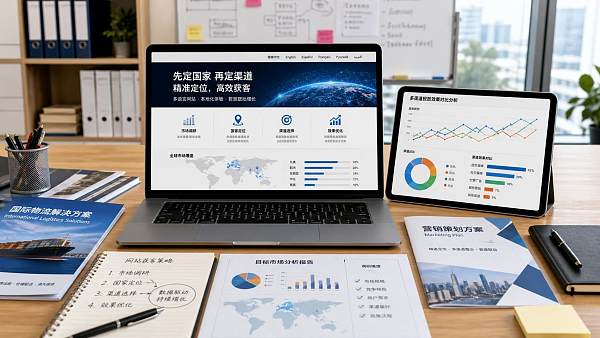
Looking further ahead, different channels also require different data evaluation criteria. Search channels place greater emphasis on indexing, rankings, click intent, and inquiry quality; advertising channels focus more on cost per click, conversion rate, and remarketing efficiency; social media channels often require attention to content engagement, audience profiles, and the accumulation of brand awareness. If the website is not structurally designed around its channels, it will be difficult even to identify the source of problems during subsequent reviews.
The country and channels actually determine what type of independent website you need to build
This point is easy to overlook. Many people treat an “independent website” as a single concept, but in practice it includes at least several common forms: B2B inquiry websites, multilingual corporate websites, B2C brand e-commerce websites, advertising landing pages, and even specialized websites created separately for specific product categories. They are all called websites, but their underlying objectives are completely different.
Consider a common scenario: if you target the North American market and sell highly standardized products that can be purchased online, an e-commerce structure may be more suitable, with an emphasis on the ordering experience, reviews, logistics information, and repeat-purchase mechanisms. If you target industrial buyers in Europe, where the order decision-making process is longer, the website needs clearer product categories, technical documentation, application solutions, and inquiry triggers, rather than simply pursuing a “shopping” feel.
Therefore, the truly mature approach is not to first ask, “Should I build a website?” but rather, “What type of website should I use to receive traffic from which country and which channels?” This is also why integrated website and marketing services are closer to actual business needs than website development alone. The website is only the point of conversion; what truly creates differentiation is the market assessment beforehand and the ongoing operation afterward.
How do you decide which country to target and which channel to launch first?
There is no universal list that applies everywhere, but you can filter options according to business realities. First, assess whether the product meets local demand. This involves not only whether people will buy it, but also the price range, delivery method, and complexity of after-sales service. Second, consider whether your existing team can support the market. For example, which markets can you initially target in English, and if multilingual capabilities are insufficient, should you begin with an English website to validate demand? Third, consider the customer acquisition method and budget cycle: do you want to validate leads more quickly, or are you willing to accept the long-term accumulation required by SEO?
Generally speaking, when the budget is limited and there is an urgent need to validate the market, you can first focus on a small number of countries, use advertising or social media to test demand, and then decide which pages are worth developing for long-term SEO. If the product involves rational purchasing decisions and users repeatedly search and compare options, starting with search content planning is often more stable than broadly distributing advertising. There is no absolute priority here. The key is not to cover too many countries and channels simultaneously at the beginning, as this is most likely to cause data interference and make it difficult for the team to stay focused.
There is also a very practical reminder: do not equate “high traffic” directly with “worth pursuing.” Some markets do have high search volumes, but competition is mature and click costs are also high. Some countries have smaller market sizes but may be more suitable for the delivery capabilities and pricing advantages of the Chinese supply chain. Customer acquisition through an independent website should be evaluated based on overall returns, not exposure figures alone.
Many companies do not fail because they cannot advertise, but because their website and marketing are disconnected
A common situation in the industry is that one company handles website development, another handles SEO, a third handles advertising, and the company manages social media on its own. The division of labor appears clear, but in practice, each party often works independently. The page structure required for SEO was not properly planned during website development; advertising campaigns require rapid page changes, but technical support cannot keep up; traffic generated by social media has no corresponding landing page on the website. In the end, the problem is not that the channels themselves are ineffective, but that the links in the process have been disconnected.
This is why, in recent years, more and more companies have begun to value integrated capabilities spanning website development and promotion. Platforms such as Yiyingbao, which have long provided digital overseas marketing services, essentially offer more than standalone tools. They coordinate intelligent website development, SEO, advertising, and social media operations within the same growth logic. Founded in 2013 and headquartered in Beijing, it has long served foreign trade enterprises, manufacturing factories, cross-border e-commerce sellers, and global brand expansion projects, covering North America, Europe, Southeast Asia, Japan and South Korea, the Middle East, Russian-speaking regions, Latin America, Africa, and other regions. The value of this service framework for companies does not lie in having “more functions,” but in ensuring that after the target market and channels have been determined, the website can follow the strategy instead of holding it back.
Especially today, cross-border customer acquisition involves more than Google Search and traditional advertising. Social media, short videos, and visibility in AI search are also influencing the customer acquisition path. If the website lacks scalability, the cost of subsequently adding multiple languages and landing pages, implementing GEO optimization, and adopting content strategies for different regions will continue to increase.
Before getting started, clarify these questions first
If you are preparing to launch an independent website project, it is worth aligning internally on several key decisions: which country or region you most want to win first; whether customers in that market are more likely to encounter you through search, advertising, or social media; whether the website’s core objective is to generate inquiries, drive purchases, or establish brand credibility; how many languages and types of content updates you can currently support; and whether, during the first six months, you place greater value on short-term validation or long-term organic traffic.
Once these questions have been clarified, the website will not be built as something “large and comprehensive” from the outset. Instead, it will function more like a business tool with a clear direction: pages written for the target market, content designed for the target channels, and data evaluated according to the same set of criteria.
When building a cross-border independent website, the real way to save money and time is usually not to create fewer pages, but to take fewer wrong turns. Determine the country first, then the channels, and only afterward decide how to build the website and develop the content. This sequence may appear slightly slower, but in practice it is often faster, because from day one, every step is closer to generating conversions rather than merely “putting up a website.”
Related Articles
 What Features Should an Inquiry Form on a B2B Export Website Support?
 How Should Customer Conversion Performance Be Measured on a B2B Standalone Website?
 Low inquiry conversion on your international trade website? How to identify form abandonment
Related Products
 Yiyingbao SaaS Intelligent Website Building and Marketing SystemYiyingbao SaaS Intelligent Website Building and Marketing System, AI-powered no-code website building, rapid creation of multilingual B2B international websites in 10 minutes, global server acceleration, AI-powered SEO optimization, helping businesses connect efficiently with global markets. The perfect integration of technology and operation makes building an international trade website remarkably simple
 AI+SEM Intelligent Advertising Marketing SystemAI+SEM drives intelligent ad creation, empowering full-funnel precision advertising marketing. The system automatically generates weekly/monthly reports, AI recommends keywords and target countries, monitors core metrics in real-time with intelligent alerts, and enables one-click high-conversion ad solutions to help quickly acquire customers and improve ROI.
 AI+SEO Dual-Engine System Optimization ServicesYiyingbao’s AI+SEO dual-engine optimization system helps foreign trade enterprises acquire high-quality organic traffic through AI-powered keyword research, content generation, and comprehensive technical optimization, significantly improving search rankings and conversion rates.
 AI+SNS Social Media Marketing SystemYingbao AI+SNS Social Media Marketing System - Precision social capture for the social media era. Supports one-click content synchronization across major platforms like Facebook and LinkedIn. AI intelligently rewrites posts for enhanced relevance. 24/7 AI customer service and user profiling analysis empower businesses to efficiently expand into global markets.
 AI+SEO营销解决方案易营宝AI+SEO营销解决方案,通过AI批量写作、智能生成TDK、精准关键词扩词等功能,全面优化网站SEO效果,提升流量与转化率。助力企业构建高效智能网站新生态。
 AI+SEM Advertising Marketing SolutionsAI+SEM Advertising Marketing Solution leverages AI technology to deeply empower SEM ad campaigns. It automatically generates weekly/monthly reports using AI, presenting account data across multiple dimensions for comprehensive insights into campaign performance and trends. The system precisely recommends keywords and target countries, intelligently generates high-conversion ad copy, and enables one-click activation of efficient campaign plans to help businesses rapidly acquire customers. Simultaneously, it monitors core metrics in real time, intelligently identifies abnormal fluctuations, and issues timely alerts to ensure stable, high-return advertising results.
 Domain Name ServicesEasyWin provides professional domain name services, including intelligent queries, one-stop registration, brand protection, and full lifecycle management, helping businesses build a digital brand image.
 EasyOperate B2C Cross-Border E-Commerce Platform & Independent WebsiteEasyStore B2C Cross-border E-commerce Independent Store is an intelligent website building and cross-border e-commerce integrated solution independently developed by EasyStore Information Technology (Beijing) Co., Ltd. The system is specially designed for small and medium-sized as well as large export enterprises, integrating 'website building, operation, marketing, advertising, and conversion' into one, helping enterprises quickly establish cross-border e-commerce independent stores to achieve brand globalization and global sales growth.
The platform supports multiple languages, multiple currencies, and multi-channel marketing, with built-in AI intelligent translation and SEO optimization systems, suitable for mainstream markets such as Southeast Asia, Europe and America, Latin America, and the Middle East, assisting Chinese manufacturing enterprises in efficiently deploying international e-commerce strategies. SSL证书易营宝提供专业SSL安全证书服务,包括单域名和泛域名证书,确保网站数据传输加密、身份验证和完整性保护,助力企业建立安全可信的在线业务环境。









