









- Can the average annual growth rate reflect real opportunities in overseas markets?Oct 07, 2026View details
- Which customer acquisition channels will be affected by cross-border marketing trends in 2026?Sep 06, 2026View details
- Which homogenization risks should be considered in an analysis of the AI-powered website building industry?Aug 30, 2026View details
- How Will AI Marketing Trends 2026 Change Advertising Budget AllocationAug 28, 2026View details
- Is the EV SSL certificate market shrinking or upgrading? How should companies assess certificate procurement?Aug 11, 2026View details
- Why the old AMP SEO 2020 practices no longer work and what has changed in current optimization prioritiesAug 02, 2026View details
What Core Metrics Should Be Considered When Evaluating the Multilingual Capabilities of an AI Website Builder Platform?
When evaluating the multilingual support capabilities of an AI website-building platform, the easiest pitfall is to treat “how many languages are supported” as the core conclusion. For technical evaluation, the number of languages is only the starting point, not the answer. What truly determines whether an overseas website can go live, be indexed, and continue expanding is often translation quality, URL structure, SEO metadata control, content synchronization mechanisms, and the convenience of subsequent localized operations.
This is especially true in an integrated website and marketing services scenario, where multilingual capabilities cannot be evaluated solely at the page presentation layer. If a platform translates quickly but cannot handle hreflang, cannot assign independent titles and descriptions by language, cannot localize form fields, and cannot synchronize advertising landing pages with the main website, it has only solved the problem of “building the website” and has not addressed the subsequent customer acquisition journey.
First Clarify the Evaluation Subject: Translation Features or Complete Multilingual Website Capabilities
Many platforms package “AI translation” as “multilingual website building.” The difference between the two is substantial. The former is more like a content processing tool, while the latter involves website structure, search engine recognition, front-end presentation, content management, permission collaboration, and subsequent marketing integration. During technical evaluation, it is advisable to break down the question first: does the platform support multilingual content generation, or does it support the independent operation of multilingual websites? If this distinction is not made clear, subsequent parameter comparisons can easily become distorted.
For example, a B2B manufacturing website typically needs more than translations of the homepage and product pages. It may also require industry solutions, downloadable materials, inquiry forms, news centers, case study pages, technical specification tables, and even compliance statements for different regions. If a platform can only translate body text in batches but cannot maintain consistency across page components, fields, navigation, breadcrumbs, file links, and structured information, it cannot be considered a mature multilingual website solution.
Language Quality Should Be Evaluated at Three Levels Rather Than by “Fluency” Alone
The first level is basic readability. Does the page copy show obvious signs of machine translation? Are terms consistent throughout? Do titles, buttons, and navigation items suffer from text overflow or semantic deviations? This level can be assessed through sampling, with particular attention to product specifications, industry terminology, and call-to-action buttons rather than only the brand introduction page.
The second level is business accuracy. A large amount of content on B2B websites is not ordinary everyday language, but instead covers specifications, delivery methods, material descriptions, application scenarios, and after-sales conditions. If AI translation renders “custom processing” in a retail-oriented context or translates “inquiry” as “buy now,” both the user experience and the conversion path will deviate from their intended purpose.
The third level is localized expression. When targeting markets such as Japan, the Middle East, and Latin America, linguistic correctness does not necessarily mean effective communication. Dates, units of measurement, address formats, telephone numbers, currencies, and forms of address all fall within the scope of evaluation. Technically, this concerns whether the content layer and template layer can be configured separately; operationally, it concerns whether the platform supports subsequent manual proofreading and regionalized rewriting.
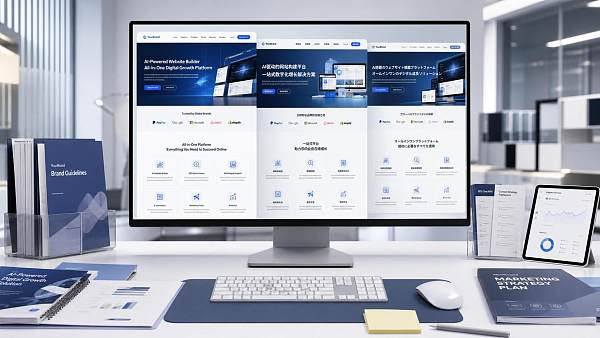
SEO Adaptability Determines Whether Multilingual Pages Can Be Found
In evaluations of the multilingual support capabilities of AI website-building platforms, SEO-related metrics should not be treated as an afterthought. Many platforms appear to have no problems at the page level, yet contain structural deficiencies at the search engine level that are costly to fix later.
Key areas to examine include: whether each language can have an independent URL; whether hreflang is supported; whether titles, descriptions, image alt text, and canonical tags can be edited separately for each language; whether pages in different languages can be indexed independently; whether the sitemap distinguishes between language versions; and whether the system allows individual language pages to be set to noindex or handled through redirects.
There is a common misconception here: a platform may claim to “automatically generate multilingual pages,” while in practice it merely switches language packs on the front end, leaving the URL unchanged and providing no clear multilingual signals in the source code. This model may be convenient for users browsing the site, but it is not necessarily friendly to organic search. Especially when implementing Google SEO, technical evaluators should focus on the page output logic rather than the back-end demonstration interface.
If a company also plans to coordinate advertising, social media traffic acquisition, or AI search visibility initiatives, multilingual content should ideally be integrated with SEO and advertising landing page management. Otherwise, every time a new market is opened, one set of pages and another set of advertising materials must be copied, causing maintenance costs to rise rapidly.
System Scalability Deserves More Attention Than Initial Launch Speed
Many projects plan for only 2 to 3 languages at the initial stage, but six months later, when entering new regions, they suddenly need to expand to 6 or even 10 languages. At this point, the platform’s expansion method becomes critical. During evaluation, pay attention to the following: whether adding a new language requires rebuilding the website; whether templates and components can be reused; whether, after existing content is updated, other language versions can identify differences and synchronize items awaiting translation; and whether multilingual versions support permission allocation and version rollback.
At a more technical level, character sets and layout compatibility must also be considered. Right-to-left display in Arabic, layout expansion caused by long German compound words, and the density issues of Japanese and Korean in buttons and navigation should not be discovered only after launch. A truly mature platform addresses these issues at the component level rather than leaving all responsibility to manual front-end fixes.
For companies with long-term overseas growth plans, system scalability also includes the ability to connect with marketing tools. For example, can form leads be routed into different processes based on language or region? Can advertising landing pages be quickly duplicated while retaining conversion tracking? Will content updates affect existing SEO assets? This is no longer merely a website-building issue, but rather a question of whether website and marketing services can truly operate in an integrated and coordinated manner.
Localization Capabilities Are Often Hidden in the Details
Multilingual does not equal localized, and this is the point that deserves the greatest attention during evaluation. Common technical localization metrics include whether the platform supports multi-currency display, regionalized form fields, contact information for different countries, independent privacy policies, differentiated configurations for logistics or delivery information, and regional replacement of materials such as images, case studies, and certificates.
If the target customers are foreign trade factories or companies expanding their brands overseas, it is also important to examine whether the platform allows content strategies to be separated by market. A North American website may emphasize certifications and delivery efficiency, a European website may focus more on compliance and detailed explanations, while a Southeast Asian website may place greater importance on response methods and channel preferences. A system that can only “translate the entire text with one click” will find it difficult to support this type of differentiated operation.
This is also why many companies are beginning to focus on platforms that integrate website building, SEO, advertising, and social media coordination during the selection process. For platforms such as 易营宝 that have long served overseas markets, the value lies not only in building a multilingual website, but also in considering multi-regional content production, indexing, advertising, and lead acquisition as one continuous process. For technical evaluators, this capability does not need to be presented as a marketing highlight, but it should be reflected in the architecture and delivery logic.
What Should Be Asked Most During Delivery Is Not the Feature List, but the Boundary Conditions
Platform demonstrations usually show their best aspects. What truly differentiates platforms is how they handle edge cases. During evaluation, it is advisable to ask directly about several types of questions: how foreign-language pages are synchronized after the Chinese source website is redesigned; whether the system overwrites manually rewritten language versions with automatic translations; whether the back end can control when pages for certain countries are temporarily excluded from indexing; and whether URLs and tracking codes remain stable when new advertising channels or SEO strategies are introduced later.
If a supplier can only answer “customization is available” without explaining the implementation method, scope of impact, and maintenance cost, this usually indicates that the platform’s capabilities remain at the stage of project-based integration. Conversely, solutions that can clearly explain the content model, relationships among language versions, publishing mechanism, and granularity of SEO controls are often more suitable for building long-term website assets.
Evaluation Can Be Condensed into a Simple Table, but Decisions Should Not Be Based on Scores Alone
However, a simple table can only help with quick screening and cannot replace actual testing. A more reliable approach is to select a group of representative pages for trial creation: choose one product page, one solution page, one form page, and one news page, then examine the translation, indexing structure, page rendering, and back-end editing experience. Whether issues can be exposed during the sample stage is often more informative than a vendor’s PowerPoint presentation.
If a company also needs to balance SEO growth, advertising conversions, and overseas social media operations, the evaluation criteria for a multilingual website-building platform should not be determined solely by IT or procurement. Technology, content, and marketing should review it together at least once. Whether the platform is suitable ultimately depends on whether it can support real international operations, not on how long its language list is.
When drawing conclusions, it may be useful to make the questions more specific: Can this platform support the expansion of target markets over the next two years? Can it ensure that pages in different languages are correctly understood and continuously maintained? Can it connect with subsequent marketing activities? Once these three questions are answered clearly, the evaluation of an AI website-building platform’s multilingual support capabilities can be considered genuinely technical.
Related Articles



Related Products
 Yiyingbao SaaS Intelligent Website Building and Marketing SystemYiyingbao SaaS Intelligent Website Building and Marketing System, AI-powered no-code website building, rapid creation of multilingual B2B international websites in 10 minutes, global server acceleration, AI-powered SEO optimization, helping businesses connect efficiently with global markets. The perfect integration of technology and operation makes building an international trade website remarkably simple
 AI+SEM Intelligent Advertising Marketing SystemAI+SEM drives intelligent ad creation, empowering full-funnel precision advertising marketing. The system automatically generates weekly/monthly reports, AI recommends keywords and target countries, monitors core metrics in real-time with intelligent alerts, and enables one-click high-conversion ad solutions to help quickly acquire customers and improve ROI.
 AI+SEO Dual-Engine System Optimization ServicesYiyingbao’s AI+SEO dual-engine optimization system helps foreign trade enterprises acquire high-quality organic traffic through AI-powered keyword research, content generation, and comprehensive technical optimization, significantly improving search rankings and conversion rates.
 AI+SNS Social Media Marketing SystemYingbao AI+SNS Social Media Marketing System - Precision social capture for the social media era. Supports one-click content synchronization across major platforms like Facebook and LinkedIn. AI intelligently rewrites posts for enhanced relevance. 24/7 AI customer service and user profiling analysis empower businesses to efficiently expand into global markets.
 AI+SEO营销解决方案易营宝AI+SEO营销解决方案,通过AI批量写作、智能生成TDK、精准关键词扩词等功能,全面优化网站SEO效果,提升流量与转化率。助力企业构建高效智能网站新生态。
 AI+SEM Advertising Marketing SolutionsAI+SEM Advertising Marketing Solution leverages AI technology to deeply empower SEM ad campaigns. It automatically generates weekly/monthly reports using AI, presenting account data across multiple dimensions for comprehensive insights into campaign performance and trends. The system precisely recommends keywords and target countries, intelligently generates high-conversion ad copy, and enables one-click activation of efficient campaign plans to help businesses rapidly acquire customers. Simultaneously, it monitors core metrics in real time, intelligently identifies abnormal fluctuations, and issues timely alerts to ensure stable, high-return advertising results.
 Domain Name ServicesEasyWin provides professional domain name services, including intelligent queries, one-stop registration, brand protection, and full lifecycle management, helping businesses build a digital brand image.
 EasyOperate B2C Cross-Border E-Commerce Platform & Independent WebsiteEasyStore B2C Cross-border E-commerce Independent Store is an intelligent website building and cross-border e-commerce integrated solution independently developed by EasyStore Information Technology (Beijing) Co., Ltd. The system is specially designed for small and medium-sized as well as large export enterprises, integrating 'website building, operation, marketing, advertising, and conversion' into one, helping enterprises quickly establish cross-border e-commerce independent stores to achieve brand globalization and global sales growth.
The platform supports multiple languages, multiple currencies, and multi-channel marketing, with built-in AI intelligent translation and SEO optimization systems, suitable for mainstream markets such as Southeast Asia, Europe and America, Latin America, and the Middle East, assisting Chinese manufacturing enterprises in efficiently deploying international e-commerce strategies. SSL证书易营宝提供专业SSL安全证书服务,包括单域名和泛域名证书,确保网站数据传输加密、身份验证和完整性保护,助力企业建立安全可信的在线业务环境。









