









- Can the average annual growth rate reflect real opportunities in overseas markets?Oct 07, 2026View details
- Which customer acquisition channels will be affected by cross-border marketing trends in 2026?Sep 06, 2026View details
- Which homogenization risks should be considered in an analysis of the AI-powered website building industry?Aug 30, 2026View details
- How Will AI Marketing Trends 2026 Change Advertising Budget AllocationAug 28, 2026View details
- Is the EV SSL certificate market shrinking or upgrading? How should companies assess certificate procurement?Aug 11, 2026View details
- Why the old AMP SEO 2020 practices no longer work and what has changed in current optimization prioritiesAug 02, 2026View details
How to Avoid Literal Translation Issues in Localized Content for Russian-Speaking Markets
How to Avoid Literal Translation Issues in Localized Content for Russian-Speaking Markets
Localized content for overseas Russian-speaking markets cannot stop at word-for-word translation. Many companies' Russian websites may appear to contain familiar words throughout, yet local buyers still do not understand what problems the product solves, whether the specifications are reliable, or whom they should contact next. The issue often lies not in Russian grammar itself, but in the failure to localize the source logic, industry terminology, search habits, and page actions together.
This is particularly true for foreign trade manufacturing, equipment, components, and cross-border retail projects. Chinese or English materials typically begin by presenting company strengths and then listing selling points, while users in Russian-speaking markets are more likely to look first for specific models, applications, delivery terms, technical documents, and contact details. Directly translating Chinese promotional copy often results in pages that “say a lot but answer very little.” To avoid literal translation, content teams need to treat translation as a restructuring of information for the local market.
It Is Not Just Sentences That Fail in Literal Translation
Russian has case declensions, gender variations, and relatively complex collocation rules, but grammatical errors are not the most difficult issue. A more common mistake is to transfer Chinese business contexts unchanged. Expressions such as “strong manufacturer,” “quality assurance,” and “one-stop service” are commonplace on Chinese pages, but can appear vague when translated literally. What buyers really want to ask is: Are you a manufacturer or a trader? What specifications are available? Can you provide drawings, manuals, or quotation terms? How is the delivery time confirmed?
Another issue is forms of address and tone. Russian business communication generally maintains a certain level of formality. Website copy, form prompts, and email templates should not simply copy the overly casual tone often used in English, nor should they use stiff machine-translated honorifics. The difference between communication for individual consumers and industrial procurement is even greater: the former can emphasize user experience, delivery, and return policies, while the latter should place technical specifications, compatibility scope, document downloads, and inquiry paths more prominently.
There is also a less visible form of literal translation: inconsistent units, formats, and product naming. Parameters such as dimensions, pressure, power, and temperature must be checked item by item against the original materials and cannot be rewritten by translators based on habit. Models should generally remain recognizable, but product categories, applications, and accessory names need to use terms that local buyers can search for. If the same model appears with different spellings in titles, specification tables, image descriptions, and inquiry forms, subsequent search indexing, advertising matching, and sales follow-up will all become more difficult.
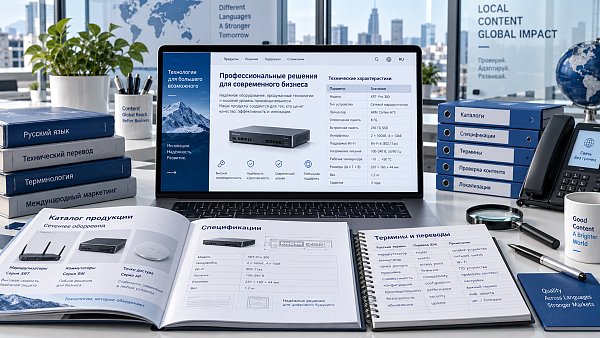
Confirm “Who Is Searching” Before Deciding “How to Write”
Russian-speaking markets are not entirely uniform. Russia, Belarus, Kazakhstan, and other regions all use Russian, but their purchasing habits, logistics conditions, product certification concerns, and common search terms may differ. Before a website goes live, at minimum, confirm the primary countries where leads will be acquired, the actual sales method for the product, and the core task customers need to complete after entering the page. Is it downloading a catalog, submitting an inquiry, booking a demonstration, or placing an order directly? This will determine the order of content on the page.
Taking an industrial equipment page as an example, the homepage does not need to be filled with every technical detail, but the product detail page should avoid containing only a marketing introduction. A more practical structure is to first use one natural Russian sentence to explain the equipment's purpose and applicable operating conditions, then present key specifications, optional configurations, and delivery or service boundaries, and finally provide a clear inquiry entry point. Procurement personnel are unlikely to leave their contact details because of a phrase such as “leading technology,” but they may be willing to continue the conversation because the page clearly states what materials can be provided.
Keywords should also be identified from user tasks rather than simply translating the Chinese product name once. Local users may search by product category, but they may also search by application scenario, fault issue, material type, dimensional specification, or model. In practice, you can first compile commonly used terms from original inquiries, then observe differences in wording by reviewing local search results and competitor pages. The focus here is not on how many times a particular word appears, but on ensuring that page titles, body copy, specification tables, and image descriptions all center on the same product intent.
Change the Translation Process into “Material Verification + Local Adaptation”
Russian content that is genuinely usable is usually not produced by handing all website copy to translators and publishing it at once. Instead, it should be handled in layers. Factual information such as product specifications, models, certification document names, warranty terms, and delivery-time descriptions should first be confirmed in the original version by people who understand the product. Content involving marketing headlines, application scenarios, call-to-action buttons, and advertising materials needs to be rewritten according to Russian expression habits. When these two types of content are mixed in the same proofreading round, the risk of “the copy became natural, but the technical information changed” can easily arise.
It is recommended to establish a glossary at the beginning of the project, at least standardizing brand names, product series, core components, industry abbreviations, model formats, and prohibited translations. For new products without standard Russian names, do not rush to create complex new terms; retain searchable models and add a functional explanation at their first occurrence. Using the same terminology for subsequently added pages, ad groups, and social media posts can reduce inconsistency in on-site wording.
- Do not translate Chinese long sentences by breaking down every word. First determine which information in the sentence is most worth retaining.
- Button copy should correspond to actual actions, such as requesting a quotation, downloading a catalog, or consulting about specifications, rather than using vague wording such as “Learn More Now.”
- Text in images, table screenshots, pop-up prompts, and automated emails should also be included in the proofreading scope, as they often reveal machine-translation traces first.
- After publication, check form fields, telephone formats, email notifications, and landing-page redirects. Natural language does not necessarily mean that the conversion path functions properly.
Websites, Advertising, and Social Media Must Not Speak Separately
Many teams create a Russian version of their website but allow advertising materials to retain English selling points, while social media posts use yet another set of product names. When users enter a landing page from an ad and cannot find the corresponding information, they may question whether the product is the same, and inquiry quality will also decline. Content localization should cover the full journey: whatever question is raised by a search term or advertising promise should be addressed in the hero section and core content of the landing page; social media content can be lighter, but when linking to the website, it should still use consistent product names and page themes.
This is also why website and marketing services need to work together. Yiyingbao has long served multilingual website building, overseas promotion, and content optimization scenarios. Its cloud-based intelligent website building, advertising marketing, and SEO/GEO optimization capabilities are better suited to centrally managing multilingual pages, landing pages, and promotional content. Tools can improve the efficiency of website creation and updates, but they cannot replace judgment about how buyers in Russian-speaking markets communicate. Companies should still clearly define who is responsible for product materials, who reviews terminology, and who adjusts pages based on inquiry feedback.
Before Going Live, Check Whether It Can “Lead to the Next Step”
Before a Russian page goes live, ask someone who was not involved in the translation to conduct a task test: by viewing only the product page, can they identify the product's purpose, main specifications, applicable users, and the next contact method within a short time? If they can only read the brand slogan, the page is still at the translation stage. For B2B websites, an automated reply email and a quotation document should also be spot-checked to ensure that terminology, models, and contact information are consistent throughout.
Avoiding literal translation does not mean changing every Chinese sentence beyond recognition. It means retaining real and accurate business information while explaining it in a way that local customers can understand and search for more easily. When localization for Russian-speaking markets is done well, users will not think that your translation is “beautiful”; they will feel that the website answers exactly what they need to verify and will be willing to continue requesting quotations or placing orders.
Related Articles
Related Products
 Yiyingbao SaaS Intelligent Website Building and Marketing SystemYiyingbao SaaS Intelligent Website Building and Marketing System, AI-powered no-code website building, rapid creation of multilingual B2B international websites in 10 minutes, global server acceleration, AI-powered SEO optimization, helping businesses connect efficiently with global markets. The perfect integration of technology and operation makes building an international trade website remarkably simple
 AI+SEM Intelligent Advertising Marketing SystemAI+SEM drives intelligent ad creation, empowering full-funnel precision advertising marketing. The system automatically generates weekly/monthly reports, AI recommends keywords and target countries, monitors core metrics in real-time with intelligent alerts, and enables one-click high-conversion ad solutions to help quickly acquire customers and improve ROI.
 AI+SEO Dual-Engine System Optimization ServicesYiyingbao’s AI+SEO dual-engine optimization system helps foreign trade enterprises acquire high-quality organic traffic through AI-powered keyword research, content generation, and comprehensive technical optimization, significantly improving search rankings and conversion rates.
 AI+SNS Social Media Marketing SystemYingbao AI+SNS Social Media Marketing System - Precision social capture for the social media era. Supports one-click content synchronization across major platforms like Facebook and LinkedIn. AI intelligently rewrites posts for enhanced relevance. 24/7 AI customer service and user profiling analysis empower businesses to efficiently expand into global markets.
 AI+SEO营销解决方案易营宝AI+SEO营销解决方案,通过AI批量写作、智能生成TDK、精准关键词扩词等功能,全面优化网站SEO效果,提升流量与转化率。助力企业构建高效智能网站新生态。
 AI+SEM Advertising Marketing SolutionsAI+SEM Advertising Marketing Solution leverages AI technology to deeply empower SEM ad campaigns. It automatically generates weekly/monthly reports using AI, presenting account data across multiple dimensions for comprehensive insights into campaign performance and trends. The system precisely recommends keywords and target countries, intelligently generates high-conversion ad copy, and enables one-click activation of efficient campaign plans to help businesses rapidly acquire customers. Simultaneously, it monitors core metrics in real time, intelligently identifies abnormal fluctuations, and issues timely alerts to ensure stable, high-return advertising results.
 Domain Name ServicesEasyWin provides professional domain name services, including intelligent queries, one-stop registration, brand protection, and full lifecycle management, helping businesses build a digital brand image.
 EasyOperate B2C Cross-Border E-Commerce Platform & Independent WebsiteEasyStore B2C Cross-border E-commerce Independent Store is an intelligent website building and cross-border e-commerce integrated solution independently developed by EasyStore Information Technology (Beijing) Co., Ltd. The system is specially designed for small and medium-sized as well as large export enterprises, integrating 'website building, operation, marketing, advertising, and conversion' into one, helping enterprises quickly establish cross-border e-commerce independent stores to achieve brand globalization and global sales growth.
The platform supports multiple languages, multiple currencies, and multi-channel marketing, with built-in AI intelligent translation and SEO optimization systems, suitable for mainstream markets such as Southeast Asia, Europe and America, Latin America, and the Middle East, assisting Chinese manufacturing enterprises in efficiently deploying international e-commerce strategies. SSL证书易营宝提供专业SSL安全证书服务,包括单域名和泛域名证书,确保网站数据传输加密、身份验证和完整性保护,助力企业建立安全可信的在线业务环境。









