









- Can the average annual growth rate reflect real opportunities in overseas markets?Oct 07, 2026View details
- Which customer acquisition channels will be affected by cross-border marketing trends in 2026?Sep 06, 2026View details
- Which homogenization risks should be considered in an analysis of the AI-powered website building industry?Aug 30, 2026View details
- How Will AI Marketing Trends 2026 Change Advertising Budget AllocationAug 28, 2026View details
- Is the EV SSL certificate market shrinking or upgrading? How should companies assess certificate procurement?Aug 11, 2026View details
- Why the old AMP SEO 2020 practices no longer work and what has changed in current optimization prioritiesAug 02, 2026View details
Does German website development require a local German team?
When building a German-language website, many companies immediately ask themselves: Since the target markets are Germany, Austria, and Switzerland, do we necessarily need to work with a local German team for the project to be considered reliable? This judgment may seem reasonable, but in real projects, the answer is usually not so absolute.
What truly affects the results is often not where the team is located, but whether it possesses four capabilities at the same time: understanding the German-speaking business context, knowing how European users assess credibility, being able to build a website structure that can be indexed and promoted, and knowing how to turn traffic into inquiries, leads, or orders. Simply being based in Germany is far from enough. Conversely, a team outside Germany can also deliver a successful project if it has solid capabilities in localization, content, technology, and marketing coordination.
Before asking whether the team is local, first ask what problem you need to solve
People searching for answers to this question are usually not studying linguistics, nor are they simply looking to build a translated website. They are making a purchasing decision: Is a German-language website merely a showcase page, or is it a customer acquisition tool? Is it only intended to provide information when customers request it, or is it designed to support long-term development in the German market? Different objectives require completely different team configurations.
If you only need a website with a German version, the content is relatively standard, and the industry terminology is well established—for example, in typical B2B sectors such as equipment manufacturing, industrial components, and basic chemicals—then the requirement that the team must be based in Germany is not a high priority. Translation quality, page structure, technical SEO, form conversion paths, and subsequent maintenance efficiency are more important.
However, if you are building a high-value brand website, operating a local service business, working in a highly regulated industry, or relying heavily on German-language content marketing, Google organic rankings, and advertising landing-page testing to acquire traffic, then the team’s understanding of local market habits becomes more important. In such cases, whether the team has local German members, collaborating editors, or proofreading resources can directly affect content credibility and conversion performance.
Three areas where “local German teams” are often overestimated
First, being local does not mean understanding cross-border customer acquisition
Many companies assume that German teams understand German users better, so their results must be better. The problem is that website development is neither a purely design project nor simply a translation project. It is a systematic project in which content, technology, marketing, and conversion work together. A team that only knows how to design local websites may not understand the overseas sales process of Chinese manufacturing companies, nor may it be familiar with how to structure a B2B inquiry-generation website.
The most common gap in real business situations is that the language of the pages sounds authentic, but the website has no keyword structure, no indexable architecture, and no lead-capture mechanism. It may not even address the certifications, delivery times, application scenarios, and after-sales capabilities that overseas buyers care about most during the early purchasing stage. Such a website may look “like a German website,” but that does not necessarily mean it can generate leads.
Second, being local does not necessarily mean lower communication costs
Many companies believe that working with a German team will make the project easier. In practice, the opposite is often true. Time-zone differences, language barriers, and gaps in business understanding are common hidden costs. In B2B websites in particular, organizing product materials, confirming content, selecting keywords, and prioritizing pages all require repeated communication. If the service provider does not understand how Chinese companies are organized, project progress may actually slow down.
Moreover, German website development is usually not a one-time delivery. After launch, it may also involve adding content, adjusting SEO, iterating pages, and adapting advertising landing pages. If the day-to-day response mechanism cannot keep up, being “local” has little value.
Third, being local does not necessarily mean being more compliant
This is an area that is easily misunderstood. The German market does place greater emphasis on details such as data protection, information disclosure, cookie management, and corporate identity transparency. However, compliance depends on whether the team has the relevant awareness and implementation experience, not on where its office is located. Some non-local teams that have served the European market for many years may actually incorporate these requirements into their website development processes more systematically.
Of course, when issues involve GDPR, special industry licenses, or the adaptation of legal texts, the specific provisions should still be confirmed by qualified legal professionals. A website service team should not be treated as a legal adviser. If legal support is unavailable for such content, it is recommended to mark it as 【To be verified】 and have the client conduct the final confirmation.
When local German resources are genuinely worth including
Although there is no need to overstate the importance of being local, we should not go to the other extreme either. Local German resources generally offer clear value for the following types of projects:
- Brand websites targeting end consumers, where differences in copy tone, trust-building, and purchasing psychology are more pronounced;
- Projects that rely heavily on German-language content marketing, such as continuously publishing industry articles, case studies, and white papers;
- Businesses with strong geographical characteristics, such as local installation, after-sales networks, and regional partnership recruitment;
- Industries that are particularly sensitive to legal texts, privacy statements, and cookie mechanisms;
- Promotional projects that need to work with German trade fairs, industry associations, and media resources.
In these cases, the more practical approach is usually not to hand everything over to a German team, but to establish a hybrid delivery model: place technology development, SEO architecture, and project management with an integrated team experienced in overseas marketing, while assigning localized copy proofreading, market-expression adjustments, and specific compliance checks to German native-language resources or local partners.
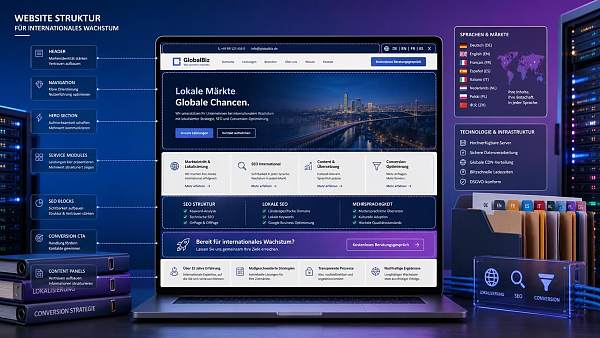
When evaluating whether a team is suitable, focus on these four aspects
1. It is not simply about knowing German, but about understanding German business communication
The biggest problem with German-language websites is usually not incorrect words, but the fact that the copy is “accurate yet unlike commercial website content.” When Chinese source content is translated directly, it can sound lengthy, abstract, and overly sales-oriented, which does not fit the rational German market’s preference for information density and verifiable details.
You can focus on whether the provider knows how to handle the following content:
- Whether product selling points can be rewritten as application value rather than directly translated Chinese promotional language;
- Whether technical specifications, certifications, and delivery capabilities can be clearly presented upfront;
- Whether the company introduction avoids vague descriptions and instead conveys credible information;
- Whether the CTA matches German user habits rather than simply using “Contact us now.”
2. It is not simply about building websites, but about understanding the trust mechanisms of European users
Users in the German-speaking market often make more detailed judgments about credibility. The completeness of contact details, clarity of company information, rigor of page logic, and standardization of downloadable materials can all affect time spent on the site and conversion. B2B buyers in particular often first verify whether you are a supplier worth contacting after entering a website, rather than first judging whether the design looks attractive.
Therefore, a suitable team should know which modules need to be strengthened: corporate qualifications, manufacturing capabilities, case studies, FAQs, service scope, download center, after-sales information, privacy, and data statements. These elements are not merely about “adding pages”; they establish trust before a transaction.
3. It is not simply about launching pages, but about building a structure that can be used for search and advertising
If a German-language website is expected to support long-term customer acquisition, its technical foundation is critical. Many companies focus on translation and visual design in the early stage, only to discover after launch that page titles are disorganized, the URL structure is unreasonable, loading speeds are slow, multilingual tags are handled incorrectly, and form tracking is missing. Even with a traffic budget, such a website will face limitations in subsequent advertising and SEO activities.
This is why an integrated “website + marketing services” team has greater practical value for these projects. A German-language website is not finished once it goes live; it must also support SEO, advertising, social media traffic acquisition, content updates, and even AI search visibility optimization. If the front-end structure does not leave room for these scenarios, subsequent modifications will cost more.
4. It is not about whether the quotation is high or low, but whether the team can iterate continuously
A common purchasing misconception in German website development is to treat it as a one-time web outsourcing project. In reality, as long as your goal is more than simply “having a German page,” and you want to continuously acquire European customers, the project will inevitably extend to content iteration, lead tracking, keyword expansion, and page optimization.
Therefore, instead of focusing on the one-time delivery price, you should examine whether the provider has ongoing operational capabilities, can continuously handle new content, can support advertising landing-page testing, and can adjust the site structure based on search data. Without these capabilities, even if the initial price is low, the website may need to be rebuilt later.
What is a more practical choice for most Chinese companies expanding overseas?
From the perspective of actual delivery efficiency, many Chinese companies are better suited to a model combining “an integrated team experienced in overseas marketing + coordinated German localization resources” rather than simply pursuing a purely local German team. The reason is straightforward: the former usually has a better understanding of the state of Chinese companies’ product materials, decision-making processes, budget boundaries, and customer acquisition goals. It is also easier for such a team to connect website development, SEO, advertising, and social media activities.
Requirements such as multilingual website development, B2B inquiry-generation websites, and coordinated Google SEO and advertising campaigns are not standalone services. A supplier that only provides page design or translation will find it difficult to cover the complete process. In contrast, a service provider with a technical platform, content capabilities, and overseas marketing experience is often better suited to take the lead, while bringing in German proofreading or local consultants according to the complexity of the project.
When evaluating a service provider, you do not need to focus solely on whether it is a German company. More important questions include: What German-market projects has it completed? Does it understand manufacturing or foreign trade industries? Does it have multilingual SEO experience? Can it continue managing content, indexing, and conversion after launch? These questions are more closely related to results than the office address.
Questions you can ask directly before purchasing
- When you build German-language websites, do you directly translate the copy, polish it with native speakers, or rewrite and localize it from scratch?
- Do you have German native-language proofreading resources? Which pages are included in the proofreading scope?
- Will the website structure be planned according to SEO and advertising requirements?
- Will you take into account German users’ habits regarding trust information and privacy statements?
- Can you continue to handle content updates, keyword optimization, and conversion-focused revisions after launch?
- Do you have German-language project cases in similar industries that demonstrate whether the ultimate service objective was showcasing or lead generation?
If these questions cannot be answered, or if the responses consistently focus on “we are in Germany” and “we have local designers,” it basically indicates that the provider is emphasizing an identity label rather than delivery capabilities.
The final question is not whether you need a German team, but how deeply localization should be carried out
Does German website development require a dedicated local German team? For most B2B companies expanding overseas, it is not a mandatory requirement. For some projects that place greater emphasis on content quality, brand communication, and deep local-market development, local resources do offer genuine value. The key is not to treat the team’s geographical location as the standard answer, but to determine whether your project requires deeper language adaptation, compliance support, and market-specific communication.
If the goal is simply to complete a German version of a corporate website, a local team may not be the decisive factor. If you want the website to become a long-term customer acquisition base in the German market, then you need more than “someone who can create German pages.” You need a team that can connect localization, technology, and marketing into one integrated process. At that point, whether the team is actually based in Germany is often no longer the most important question.
Related Articles
Related Products
 Yiyingbao SaaS Intelligent Website Building and Marketing SystemYiyingbao SaaS Intelligent Website Building and Marketing System, AI-powered no-code website building, rapid creation of multilingual B2B international websites in 10 minutes, global server acceleration, AI-powered SEO optimization, helping businesses connect efficiently with global markets. The perfect integration of technology and operation makes building an international trade website remarkably simple
 AI+SEM Intelligent Advertising Marketing SystemAI+SEM drives intelligent ad creation, empowering full-funnel precision advertising marketing. The system automatically generates weekly/monthly reports, AI recommends keywords and target countries, monitors core metrics in real-time with intelligent alerts, and enables one-click high-conversion ad solutions to help quickly acquire customers and improve ROI.
 AI+SEO Dual-Engine System Optimization ServicesYiyingbao’s AI+SEO dual-engine optimization system helps foreign trade enterprises acquire high-quality organic traffic through AI-powered keyword research, content generation, and comprehensive technical optimization, significantly improving search rankings and conversion rates.
 AI+SNS Social Media Marketing SystemYingbao AI+SNS Social Media Marketing System - Precision social capture for the social media era. Supports one-click content synchronization across major platforms like Facebook and LinkedIn. AI intelligently rewrites posts for enhanced relevance. 24/7 AI customer service and user profiling analysis empower businesses to efficiently expand into global markets.
 AI+SEO营销解决方案易营宝AI+SEO营销解决方案,通过AI批量写作、智能生成TDK、精准关键词扩词等功能,全面优化网站SEO效果,提升流量与转化率。助力企业构建高效智能网站新生态。
 AI+SEM Advertising Marketing SolutionsAI+SEM Advertising Marketing Solution leverages AI technology to deeply empower SEM ad campaigns. It automatically generates weekly/monthly reports using AI, presenting account data across multiple dimensions for comprehensive insights into campaign performance and trends. The system precisely recommends keywords and target countries, intelligently generates high-conversion ad copy, and enables one-click activation of efficient campaign plans to help businesses rapidly acquire customers. Simultaneously, it monitors core metrics in real time, intelligently identifies abnormal fluctuations, and issues timely alerts to ensure stable, high-return advertising results.
 Domain Name ServicesEasyWin provides professional domain name services, including intelligent queries, one-stop registration, brand protection, and full lifecycle management, helping businesses build a digital brand image.
 EasyOperate B2C Cross-Border E-Commerce Platform & Independent WebsiteEasyStore B2C Cross-border E-commerce Independent Store is an intelligent website building and cross-border e-commerce integrated solution independently developed by EasyStore Information Technology (Beijing) Co., Ltd. The system is specially designed for small and medium-sized as well as large export enterprises, integrating 'website building, operation, marketing, advertising, and conversion' into one, helping enterprises quickly establish cross-border e-commerce independent stores to achieve brand globalization and global sales growth.
The platform supports multiple languages, multiple currencies, and multi-channel marketing, with built-in AI intelligent translation and SEO optimization systems, suitable for mainstream markets such as Southeast Asia, Europe and America, Latin America, and the Middle East, assisting Chinese manufacturing enterprises in efficiently deploying international e-commerce strategies. SSL证书易营宝提供专业SSL安全证书服务,包括单域名和泛域名证书,确保网站数据传输加密、身份验证和完整性保护,助力企业建立安全可信的在线业务环境。









