









- Can the average annual growth rate reflect real opportunities in overseas markets?Oct 07, 2026View details
- Which customer acquisition channels will be affected by cross-border marketing trends in 2026?Sep 06, 2026View details
- Which homogenization risks should be considered in an analysis of the AI-powered website building industry?Aug 30, 2026View details
- How Will AI Marketing Trends 2026 Change Advertising Budget AllocationAug 28, 2026View details
- Is the EV SSL certificate market shrinking or upgrading? How should companies assess certificate procurement?Aug 11, 2026View details
- Why the old AMP SEO 2020 practices no longer work and what has changed in current optimization prioritiesAug 02, 2026View details
How to Ensure the Quality of Spanish Website Translation
How to Ensure the Quality of Spanish Website Translation
How can the quality of Spanish website construction and translation be ensured? At the beginning, many companies think that simply having someone translate Chinese or English content into Spanish is enough. After the website goes live, however, they discover that the issues go far beyond whether there are grammatical errors. Whether the pages read naturally, whether product selling points may be misunderstood, whether form fields match local conventions, and whether titles and descriptions can balance search visibility and click-through potential all directly affect the quality of inquiries.
Especially when acquiring customers in Latin American or Spanish-speaking foreign trade markets, website translation is not an isolated step. It is closely connected with website structure, keyword placement, conversion paths, and localized expression. Accurate language does not necessarily mean customers are willing to read it; customers understanding the content does not necessarily mean search engines can interpret it easily; and being indexed does not necessarily mean the website can generate qualified business opportunities. The real focus of translation quality control is whether these four goals—accuracy, readability, searchability, and convertibility—can be achieved at the same time.
Before Translating, First Identify Which Spanish-Speaking Market You Need to Target
Spanish covers a wide range of markets. Spain, Mexico, Colombia, Argentina, Chile, and other markets may differ in terminology, business tone, price presentation, and contact preferences. For example, the same industrial product may not be commonly referred to by the same term in different regions. Some markets are more receptive to direct sales-oriented expressions, while others place greater emphasis on technical parameters and delivery information.
This means that before building a Spanish website, companies should first clarify several basic points: Is the website aimed at Spain or Latin America? Is the primary goal B2B inquiries or brand presentation? Will most future traffic come from Google organic search, advertising, or social media? Different objectives require different translation strategies. Category pages, product pages, and blog content designed for search generally cannot be handled through literal translation alone. Content for advertising landing pages, meanwhile, places greater emphasis on calls to action and concise information presentation.
Many translation problems are not essentially caused by insufficient translator skills, but by the lack of clear market definition at the beginning of the project.
Translation Quality Cannot Be Judged Solely by Whether It “Looks Like Spanish”
When reviewing content internally, companies most commonly focus on whether the wording is literally correct. In fact, how to ensure the quality of Spanish website construction and translation involves at least the following aspects:
The first is terminology accuracy. Industry terms, material names, process terms, certification names, shipping terms, and after-sales commitments must not be translated based on assumptions. For manufacturing, machinery, chemical, and electronics websites, an inaccurate technical term can immediately undermine the customer’s confidence in the company’s professionalism. Some terms should be checked against the company’s existing English materials, product catalogs, and specification sheets, and, when necessary, reviewed by someone familiar with the industry.
The second is natural expression. The long slogans, abstract wording, and overly administrative introductions commonly found on Chinese corporate websites often sound awkward when translated into Spanish. Content suitable for overseas pages is generally more direct, has a clearer information hierarchy, contains fewer empty phrases, and presents more facts.
The third is conversion friendliness. For buttons and calls to action such as “Request a Quote,” “Get the Catalog,” “Contact Our Engineers,” and “Download the Specifications,” the wording should not merely correspond literally to the original. It should also take into account whether local users are accustomed to being guided in this way. The same applies to form fields. Whether fields such as name, company, country, telephone country code, tax number, or industry should be retained needs to be determined according to the specific context.
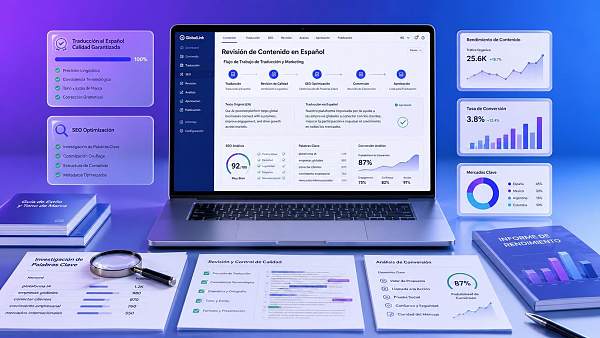
The fourth is search optimization. If page titles, descriptions, category names, product classifications, URL logic, and image alt text are translated too “beautifully” without reflecting common search behavior, ranking performance will usually suffer. Conversely, if keywords are excessively inserted, the page will read poorly. Only by balancing these two aspects can Spanish website content become genuinely usable.
The Pages Most Likely to Cause Problems Are Not the Homepage, but These Detail Pages
The homepage usually receives the most attention and is therefore less likely to contain major errors. The pages more likely to create problems are product detail pages, category pages, technical support pages, case study pages, and inquiry pages. These pages often contain substantial content, are updated frequently, and have repetitive structures. Although they may appear easy to translate, they actually put standardized processes to the greatest test.
For example, if unit formats, decimal notation, dimension order, packaging descriptions, and lead-time statements are inconsistent between the Chinese and Spanish pages of a product specification table, customers may question which version is accurate. Similarly, Chinese FAQ pages often say “Please feel free to contact us if you have any questions,” while Spanish-speaking users may be more concerned with specific information such as minimum order quantities, sample policies, payment methods, shipping ports, and customization availability. This is not simply a matter of translation, but of rewriting and reorganizing content.
Therefore, a reliable process does not involve translating the entire Chinese website first and then publishing it. Instead, standards should be established by page type in advance: which content requires consistent terminology, which pages need to be rewritten for the target market, which elements require separate SEO treatment, and which modules should prioritize conversion.
Spanish Website Translation Should Ideally Be Integrated into the Website Development and Marketing Process
If the translation, website development, advertising, and SEO teams work in isolation, the website often ends up in a common situation: the language is fine and the pages are live, but rankings are difficult to improve, advertising costs per click are high, and lead quality is average. This is not necessarily the fault of any single step. Rather, it is because translation was not managed as part of the marketing assets from the outset.
This is precisely where the value of integrated website development and marketing services lies. Translation is not merely content processing; it should be designed together with website information architecture, keyword research, landing page logic, and social media traffic acquisition paths. For example, a Spanish product term may not have high search volume but may indicate strong purchase intent. In that case, the category name, internal linking structure, and page title should be organized around that term. If a particular type of user comes from advertising, the above-the-fold copy and CTA on the landing page should not simply duplicate the wording used on an organic search page.
Yingyingbao has long provided multilingual website development and overseas marketing services. One particularly relevant aspect is that it considers intelligent website development, SEO optimization, advertising, and social media marketing within the same service framework. For foreign trade companies, this approach is closer to real business processes: rather than first creating a “translated website” and then finding ways to promote it, the company considers indexing, advertising, and conversion requirements during the website development stage. This kind of early coordination is especially cost-effective in geographically diverse Spanish-speaking markets, as it reduces the need for later rework.
How to Establish an Executable Quality Control Mechanism
In practice, translation quality control can be divided into four steps.
First, prepare the terminology. Organize product names, core selling points, materials, processes, application industries, certification documents, and frequently asked questions into a bilingual terminology base. Even if it is incomplete at the beginning, it is much more reliable than “guessing while translating.” The purpose of a terminology base is not to make every sentence rigidly uniform, but to prevent the same product from being referred to by multiple names on different pages.
Next, classify pages by priority. The homepage, About Us page, core product pages, and key landing pages should receive in-depth manual processing first. News, standard blog posts, and long-tail explanatory pages can be handled with AI-generated drafts followed by manual proofreading. This approach improves efficiency while ensuring that human resources are focused on the pages that have the greatest impact on inquiries.
Then conduct native-language proofreading. This step is not limited to checking typos. It also involves reviewing the overall readability, business context, and whether the content follows the comprehension patterns of local users. If the target market is clearly defined as a particular country, the proofreading should also align as closely as possible with the conventions of that market.
Finally, conduct a post-launch inspection. Many issues do not appear in documents but emerge after the content is placed on the website, such as titles being too long and truncated, button text wrapping, table columns overflowing, encoding errors, URLs still using Pinyin, and text in images not being localized. These are all part of translation quality because users see the final page, not the translation draft.
Can AI Be Used? Yes, but It Should Not Be Treated as the Final Answer
Many companies now ask whether multilingual website translation can be completed directly with AI. The answer is yes, but AI is better suited to improving efficiency than to fully replacing quality assessment. AI is highly effective when handling repetitive and highly structured content, such as basic product descriptions, standard page drafts, and bulk metadata generation. However, human judgment is still required when dealing with ambiguous industry terminology, purchasing context, brand tone, and SEO keyword selection.
For an AI-driven enterprise-level SaaS platform such as Yingyingbao, the value is not merely that it “translates faster,” but that it integrates AI into the collaborative processes of website development, content generation, SEO/GEO optimization, and marketing campaigns. The advantage is that translation is no longer an isolated outsourced task, but can be developed into the company’s own multilingual content assets. For companies continuously expanding into overseas markets, this is more important than completing a one-time translation.
When Accepting a Spanish Website, Companies Should Check at Least These Results
If you are accepting a Spanish website, ask fewer questions such as “Has it been translated?” and ask more practical questions instead: Are the terms on the core product pages consistent? Do category names and titles match the search habits of the target market? Are forms, buttons, and contact details localized? Are there obvious signs of machine translation? Do important landing pages retain clear inquiry guidance? Do newly added pages continue to follow the same terminology and writing standards?
If no one can provide clear answers to these questions, it usually means that the project still lacks a genuine quality control mechanism.
Ultimately, ensuring the quality of Spanish website construction and translation cannot be achieved through a single review. It requires coordinated efforts involving market assessment at the beginning, collaborative processes in the middle, and post-launch page acceptance. For companies seeking to acquire customers in Spanish-speaking markets over the long term, translation should be planned together with website development, SEO, advertising, and content operations from the very start. This is how a website becomes more than “an additional language version”; it becomes an overseas website that can truly be seen, understood, and more easily generate business opportunities.
Related Articles


Related Products
 Yiyingbao SaaS Intelligent Website Building and Marketing SystemYiyingbao SaaS Intelligent Website Building and Marketing System, AI-powered no-code website building, rapid creation of multilingual B2B international websites in 10 minutes, global server acceleration, AI-powered SEO optimization, helping businesses connect efficiently with global markets. The perfect integration of technology and operation makes building an international trade website remarkably simple
 AI+SEM Intelligent Advertising Marketing SystemAI+SEM drives intelligent ad creation, empowering full-funnel precision advertising marketing. The system automatically generates weekly/monthly reports, AI recommends keywords and target countries, monitors core metrics in real-time with intelligent alerts, and enables one-click high-conversion ad solutions to help quickly acquire customers and improve ROI.
 AI+SEO Dual-Engine System Optimization ServicesYiyingbao’s AI+SEO dual-engine optimization system helps foreign trade enterprises acquire high-quality organic traffic through AI-powered keyword research, content generation, and comprehensive technical optimization, significantly improving search rankings and conversion rates.
 AI+SNS Social Media Marketing SystemYingbao AI+SNS Social Media Marketing System - Precision social capture for the social media era. Supports one-click content synchronization across major platforms like Facebook and LinkedIn. AI intelligently rewrites posts for enhanced relevance. 24/7 AI customer service and user profiling analysis empower businesses to efficiently expand into global markets.
 AI+SEO营销解决方案易营宝AI+SEO营销解决方案,通过AI批量写作、智能生成TDK、精准关键词扩词等功能,全面优化网站SEO效果,提升流量与转化率。助力企业构建高效智能网站新生态。
 AI+SEM Advertising Marketing SolutionsAI+SEM Advertising Marketing Solution leverages AI technology to deeply empower SEM ad campaigns. It automatically generates weekly/monthly reports using AI, presenting account data across multiple dimensions for comprehensive insights into campaign performance and trends. The system precisely recommends keywords and target countries, intelligently generates high-conversion ad copy, and enables one-click activation of efficient campaign plans to help businesses rapidly acquire customers. Simultaneously, it monitors core metrics in real time, intelligently identifies abnormal fluctuations, and issues timely alerts to ensure stable, high-return advertising results.
 Domain Name ServicesEasyWin provides professional domain name services, including intelligent queries, one-stop registration, brand protection, and full lifecycle management, helping businesses build a digital brand image.
 EasyOperate B2C Cross-Border E-Commerce Platform & Independent WebsiteEasyStore B2C Cross-border E-commerce Independent Store is an intelligent website building and cross-border e-commerce integrated solution independently developed by EasyStore Information Technology (Beijing) Co., Ltd. The system is specially designed for small and medium-sized as well as large export enterprises, integrating 'website building, operation, marketing, advertising, and conversion' into one, helping enterprises quickly establish cross-border e-commerce independent stores to achieve brand globalization and global sales growth.
The platform supports multiple languages, multiple currencies, and multi-channel marketing, with built-in AI intelligent translation and SEO optimization systems, suitable for mainstream markets such as Southeast Asia, Europe and America, Latin America, and the Middle East, assisting Chinese manufacturing enterprises in efficiently deploying international e-commerce strategies. SSL证书易营宝提供专业SSL安全证书服务,包括单域名和泛域名证书,确保网站数据传输加密、身份验证和完整性保护,助力企业建立安全可信的在线业务环境。









