









- Can the average annual growth rate reflect real opportunities in overseas markets?Oct 07, 2026View details
- Which customer acquisition channels will be affected by cross-border marketing trends in 2026?Sep 06, 2026View details
- Which homogenization risks should be considered in an analysis of the AI-powered website building industry?Aug 30, 2026View details
- How Will AI Marketing Trends 2026 Change Advertising Budget AllocationAug 28, 2026View details
- Is the EV SSL certificate market shrinking or upgrading? How should companies assess certificate procurement?Aug 11, 2026View details
- Why the old AMP SEO 2020 practices no longer work and what has changed in current optimization prioritiesAug 02, 2026View details
Can a French website page layout be directly reused for a Chinese-language website?
Meta Title: Can the French Website Layout Reuse the Chinese Website Layout? | Suggestions for Localizing French Website Pages
When many companies build multilingual websites, their first reaction is often: the Chinese website is already well designed, so can the French website simply be translated and use the same page layout? If you search for “Can the French website layout reuse the Chinese website layout?”, what you usually want to confirm is not whether it can be copied, but whether copying it will affect user experience, search performance, and inquiry conversion. The answer is clear: it can be used as a reference, but direct duplication is not recommended.
The differences between French and Chinese websites go beyond language. French users’ reading pace, ways of processing information, expectations regarding page organization, and sensitivity to trust-related information may all affect whether a page layout is effective. A page that looks complete, dynamic, and information-rich in a Chinese context may not have the same effect when used on a French website.
In short: Can the French website layout reuse the Chinese website layout? The framework and general approach can be reused, but the section order, copy length, button wording, trust-related content, and mobile presentation usually need to be adjusted.
Why does a Chinese website perform well while the French website looks fine but delivers mediocre results?
This issue is very common in actual consultations. The page appears error-free, the content has been translated, and the products have been added, yet the French website still has unsatisfactory dwell time, inquiry rates, and form submission rates. The problem is often not whether there is enough content, but how the content is organized.
A common practice for Chinese websites is to place a large amount of information on the homepage: brand introduction, product categories, application scenarios, factory capabilities, news, certificates, videos, customer cases, and contact information are all concentrated on the homepage. This structure is indeed common in some domestic industries, especially manufacturing, foreign trade showcase websites, and traditional corporate websites.
However, after entering a page, French users generally pay more attention to whether the browsing path is clear. They may not be willing to receive too many modules on one screen, nor are they necessarily willing to be repeatedly interrupted by multiple jump buttons. A page is not better simply because it contains more information; it is better when it is easier to understand and makes decision-making easier.
So, can the French website page layout directly reuse the Chinese website layout? Technically, yes. In terms of conversion results, however, the risks are considerable.
Which parts can be reused, and which should not be copied directly?
Let us first discuss the parts that can be reused.
If the information architecture of your Chinese website is already well structured—for example, the section hierarchy is clear, product categories are reasonable, the URL structure is clean, and page components are consistent—these underlying structures can be inherited. Basic pages such as the homepage, product pages, case study pages, About Us, and Contact Us do not necessarily need to be completely redesigned.
However, the following elements are generally not recommended for direct reuse:
- Layouts with excessive information density above the fold
- Long copy based heavily on Chinese expression habits
- Lengthy self-descriptions emphasizing corporate capabilities
- Too many floating customer-service widgets, pop-ups, and scrolling announcements
- Overly generic button copy, such as repeatedly using “Contact Us” or “View Now”
- Image-to-text ratios suited only to Chinese visual habits
French copy is often longer than Chinese copy. A Chinese button labeled “Contact Us” may require a longer expression in French; a concise Chinese selling point may occupy noticeably more space after translation into French. If the layout does not reserve sufficient width and line height, the front end may easily experience compressed buttons, awkward title wrapping, and uneven card heights. Many people assume this is a translation issue, but it is essentially a matter of the page layout not being prepared for French.
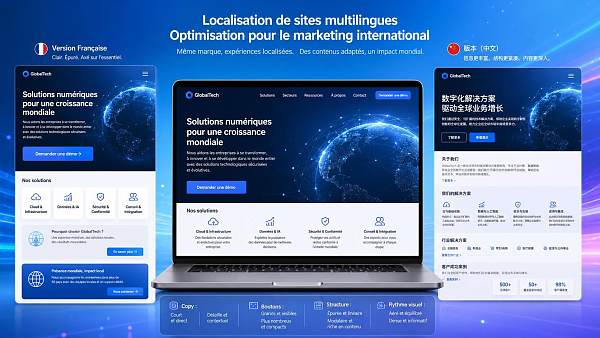
Can the French website layout reuse the Chinese website layout? These four points are key
If you are currently preparing to build a French website, do not rush to decide whether the layout can be reused. First, consider the following four points.
First, consider the purpose of the website.
If you are building a brand showcase website, a higher degree of reuse may be possible because the priority is consistent brand recognition. However, if you are building a B2B inquiry website, landing page, or multilingual website that needs to be indexed for SEO, the layout cannot be designed solely for convenience. When French users arrive from search engines, they rely more on whether the page quickly answers their questions than on how much content the brand wants to display.
Second, consider whether the French market is a genuine priority market for you.
If French is only an additional language version and there are no clear plans for advertising or optimization in the short term, you can initially make light adjustments based on the Chinese website template. However, if you are targeting France, Belgium, French-speaking Canada, or French-speaking Africa for long-term customer acquisition, the page layout should be refined according to the target markets. Otherwise, the time saved at the beginning may later have to be recovered through higher customer acquisition costs.
Third, consider whether your Chinese website is sufficiently mature.
Some companies’ Chinese websites are not actually structured for marketing; they are simply information display pages. In this situation, reusing them for a French website essentially means copying the same problems into another language version. It is generally more cost-effective to clarify the website logic first and then expand into other languages.
Fourth, consider whether SEO is part of your plan.
Many people focus only on visual design and overlook the fact that if a French website is to implement Google SEO, its page structure, heading hierarchy, internal linking, semantic expression, loading speed, and mobile experience cannot simply follow Chinese conventions. Page layout is not merely a design issue; it directly affects crawling, understanding, and conversion.
What do French users care about more, and what do they care about less?
Once this question is understood, it becomes easier to create an effective layout.
French website users generally respond more positively to pages that are clear, restrained, and well structured. They are less likely to appreciate homepages overloaded with messages such as “we are strong,” “we are large,” and “we have many years of experience.” This does not mean such information cannot be included; rather, it should be presented more naturally, for example by establishing trust through case studies, certifications, service processes, and delivery details instead of opening with lengthy slogans.
Another detail is often overlooked: French users are generally willing to read explanatory content, provided that the structure is clear. In other words, they can accept detailed information as long as it is not disorganized. By comparison, the common Chinese website pattern of “short sentences + slogans + multiple buttons” can sometimes make a French page feel incomplete.
Therefore, layout adjustment is not an abstract concept such as “French aesthetics”; it is a reconstruction of the reading path. What should be presented first and what should come next, where evidence should be provided, where action buttons should appear, and how many key points should be displayed on one mobile screen are all more important than whether the page simply looks attractive.
Common misconception: assuming that changing the language means localization is complete
The most common misconception is to understand French website development as a “translated version of the Chinese website.”
Translation is only the first layer. Three other aspects also have a real impact on performance:
- Whether the information architecture has been rearranged according to the target users
- Whether page components accommodate the length of French copy
- Whether conversion actions have been designed according to local user habits
For example, “online consultation” and “scan the QR code to communicate” are often high-frequency actions on Chinese websites. On French websites, however, users are more likely to expect a clear contact form, an email entry point, telephone information, the company address, a description of the service scope, and privacy-related information. If the contact layout still follows the instant-communication approach used on the Chinese website, the user experience may be inappropriate.
Some companies also directly copy the homepage banner image from the Chinese website and simply translate the Chinese headline into French. Although this appears visually consistent, two problems can easily arise: first, the French text may be too long and disrupt the layout; second, the original visual and copy rhythm was designed for Chinese, and the information emphasis changes after French is inserted, making the above-the-fold message ineffective.
When can a layout be reused extensively, and when should it be redesigned?
If your website falls into one of the following categories, a relatively high degree of reuse may be possible:
- A brand website whose core objective is maintaining a consistent image
- A website with a simple structure and relatively few modules
- A French version that serves only as an auxiliary entry point and does not bear the main conversion objectives
- A website with no separate SEO or advertising plans
Conversely, if any of the following situations apply, it is recommended not to take shortcuts:
- You want to acquire customers through French SEO
- You plan to run Google Ads or social media advertising to French landing pages
- You are developing the market in France or other French-speaking regions over the long term
- Your products are complex, the purchasing decision chain is long, and the page needs to explain the offering and build trust
In these circumstances, can the French website page layout directly reuse the Chinese website layout? A more reasonable answer is: do not pursue “direct reuse”; pursue “low-cost restructuring.” Retain the underlying systems and shared components that can be retained, and rearrange the parts that genuinely affect conversion. This creates a better balance between efficiency and results.
If you are preparing to get started, confirm these points first
First, confirm whether your target market is France itself or the broader French-speaking market. Expression habits, contact preferences, and trust factors may differ by region, and these differences can also affect the page layout.
Next, confirm whether the objective of your French website is to showcase your company, generate leads, or promote a particular type of product. Different objectives require different homepage structures. Do not apply a Chinese template before clarifying the purpose of the website.
Finally, assess your team’s capabilities. If your company does not have experience optimizing the structure of multilingual websites, choosing a service team that understands both website development and overseas marketing logic is generally more reliable than simply hiring a translator or a designer. A service provider such as 易营宝, which covers intelligent website development, multilingual website development, SEO optimization, and overseas promotion, is suitable for companies that not only want to create a French website but also hope to promote it, get it indexed, and continuously improve it afterward. The focus is not on “creating a French version,” but on “creating a French website that genuinely works.”
Ultimately, can the French website layout reuse the Chinese website layout? The basic framework can be reused, but “reuse” should not be understood as “copying it exactly.” The experienced approach is generally to retain the system layer and shared modules while reorganizing the page rhythm, content order, and conversion details according to the reading habits of French users. Only then can the resulting website truly look like a website for local users rather than a Chinese website that has merely been translated.
FAQ
1. Does a French website have to look different from a Chinese website?
Not necessarily. The brand visuals can remain consistent, but the information order, button copy, and module density should preferably be adjusted according to French user habits.
2. Will SEO be affected if I only translate the pages without changing the layout?
It may be. In particular, unreasonable heading hierarchy, content readability, mobile experience, and internal linking structure can affect search performance and conversion results.
3. Is it suitable for a B2B manufacturing website to directly reuse the Chinese website layout?
In most cases, direct reuse is not recommended. Manufacturing pages often contain a great deal of information and require the content to be reorganized according to the way French users understand it.
4. Should the homepage of a French website be as concise as possible?
No. The key is not to have “less,” but to be “clear.” Necessary product descriptions, qualifications, case studies, and contact entry points should all be included; they simply need to be arranged in a more orderly way.
5. When building a multilingual website, should design or structure come first?
It is more reliable to assess the structure first. After the target market, page purpose, and conversion path have been determined, the visual design and copy can be developed, which will significantly reduce rework later.
Image Placeholder List
Suggested position: Place it after “Which parts can be reused, and which should not be copied directly?”
Image content: An illustration comparing the layout differences between a Chinese website and a French website, including copy length, buttons, module order, and whitespace treatment
alt text: Illustration of the differences between the French website page layout and the reused Chinese website layout
Suggested Internal Link Anchor Text
- French website development: Suggested link to the multilingual website development service page
- How to build an overseas marketing website: Suggested link to the marketing website专题 page
- Multilingual website SEO optimization: Suggested link to the Google SEO service page
- Localization solutions for foreign trade independent websites: Suggested link to the foreign trade website development solutions page
- Key points in French landing page design: Suggested link to the advertising landing page or content marketing专题 page
Suggested External Authoritative Sources
- Official Google Search Central documentation
- Materials from local e-commerce or digital marketing industry associations in French-speaking regions
- Materials from user-experience research institutions related to internationalization and localization
Related Articles
Related Products
 Yiyingbao SaaS Intelligent Website Building and Marketing SystemYiyingbao SaaS Intelligent Website Building and Marketing System, AI-powered no-code website building, rapid creation of multilingual B2B international websites in 10 minutes, global server acceleration, AI-powered SEO optimization, helping businesses connect efficiently with global markets. The perfect integration of technology and operation makes building an international trade website remarkably simple
 AI+SEM Intelligent Advertising Marketing SystemAI+SEM drives intelligent ad creation, empowering full-funnel precision advertising marketing. The system automatically generates weekly/monthly reports, AI recommends keywords and target countries, monitors core metrics in real-time with intelligent alerts, and enables one-click high-conversion ad solutions to help quickly acquire customers and improve ROI.
 AI+SEO Dual-Engine System Optimization ServicesYiyingbao’s AI+SEO dual-engine optimization system helps foreign trade enterprises acquire high-quality organic traffic through AI-powered keyword research, content generation, and comprehensive technical optimization, significantly improving search rankings and conversion rates.
 AI+SNS Social Media Marketing SystemYingbao AI+SNS Social Media Marketing System - Precision social capture for the social media era. Supports one-click content synchronization across major platforms like Facebook and LinkedIn. AI intelligently rewrites posts for enhanced relevance. 24/7 AI customer service and user profiling analysis empower businesses to efficiently expand into global markets.
 AI+SEO营销解决方案易营宝AI+SEO营销解决方案,通过AI批量写作、智能生成TDK、精准关键词扩词等功能,全面优化网站SEO效果,提升流量与转化率。助力企业构建高效智能网站新生态。
 AI+SEM Advertising Marketing SolutionsAI+SEM Advertising Marketing Solution leverages AI technology to deeply empower SEM ad campaigns. It automatically generates weekly/monthly reports using AI, presenting account data across multiple dimensions for comprehensive insights into campaign performance and trends. The system precisely recommends keywords and target countries, intelligently generates high-conversion ad copy, and enables one-click activation of efficient campaign plans to help businesses rapidly acquire customers. Simultaneously, it monitors core metrics in real time, intelligently identifies abnormal fluctuations, and issues timely alerts to ensure stable, high-return advertising results.
 Domain Name ServicesEasyWin provides professional domain name services, including intelligent queries, one-stop registration, brand protection, and full lifecycle management, helping businesses build a digital brand image.
 EasyOperate B2C Cross-Border E-Commerce Platform & Independent WebsiteEasyStore B2C Cross-border E-commerce Independent Store is an intelligent website building and cross-border e-commerce integrated solution independently developed by EasyStore Information Technology (Beijing) Co., Ltd. The system is specially designed for small and medium-sized as well as large export enterprises, integrating 'website building, operation, marketing, advertising, and conversion' into one, helping enterprises quickly establish cross-border e-commerce independent stores to achieve brand globalization and global sales growth.
The platform supports multiple languages, multiple currencies, and multi-channel marketing, with built-in AI intelligent translation and SEO optimization systems, suitable for mainstream markets such as Southeast Asia, Europe and America, Latin America, and the Middle East, assisting Chinese manufacturing enterprises in efficiently deploying international e-commerce strategies. SSL证书易营宝提供专业SSL安全证书服务,包括单域名和泛域名证书,确保网站数据传输加密、身份验证和完整性保护,助力企业建立安全可信的在线业务环境。









