









- Can the average annual growth rate reflect real opportunities in overseas markets?Oct 07, 2026View details
- Which customer acquisition channels will be affected by cross-border marketing trends in 2026?Sep 06, 2026View details
- Which homogenization risks should be considered in an analysis of the AI-powered website building industry?Aug 30, 2026View details
- How Will AI Marketing Trends 2026 Change Advertising Budget AllocationAug 28, 2026View details
- Is the EV SSL certificate market shrinking or upgrading? How should companies assess certificate procurement?Aug 11, 2026View details
- Why the old AMP SEO 2020 practices no longer work and what has changed in current optimization prioritiesAug 02, 2026View details
Is the Korean website keyword strategy the same as that for a Chinese website?
Is the Korean Website Keyword Strategy the Same as That of a Chinese Website?
Is the SEO keyword strategy for Korean website development the same as that for Chinese websites? If you only want a short answer, it is: no, and the differences go beyond translation. When many companies enter the Japanese and Korean markets, one of the most common mistakes is to directly transfer the keyword approach that has already worked for their Chinese website to their Korean website. They copy the page structure, translate category names literally, and distribute core keywords according to Chinese search habits. As a result, the pages may be indexed, but the traffic is not precise, and they may not even attract search terms with genuine commercial intent.
Ultimately, this is not a question of whether Korean is difficult, but of whether search behavior is different. Chinese users often search using combinations of short keywords, industry terms, and brand terms. Korean users rely more on natural local expressions, word endings, scenario descriptions, and product applications. For companies doing business overseas, generating inquiries from a Korean website requires more than simply presenting the site interface in Korean. The keyword strategy, content organization, and page logic must all be localized together.
The Conclusion First: You Can Learn from a Chinese Website, but You Cannot Copy It Directly
The product categories, customer questions, and sales advantages accumulated on a Chinese website are certainly valuable references. For example, for a company engaged in industrial equipment, electronic components, or cross-border retail, the pages on the Chinese website that generate the most inquiries and the product categories most suitable for dedicated landing pages remain useful experience. This experience does not become completely invalid just because the language changes.
However, keywords cannot be mechanically replicated. There are three main reasons: first, Korean word forms and Chinese are based on entirely different systems; second, when describing their needs, local Korean users may not use the industry terminology familiar to Chinese companies; third, search engines understand pages based not only on individual words, but also on whether the context is natural and resembles that of a local website.
Therefore, the genuinely practical approach is usually to retain the business framework of the Chinese website while rebuilding the keyword mapping for the Korean website. In other words, the product lines can be shared, but the keyword database cannot.
Why Is It Easier to “Translate Correctly but Implement Incorrectly” on a Korean Website?
When many companies conduct Korean SEO for the first time, they first ask a translator to translate their “core keywords.” There is nothing wrong with this action itself. The problem is that it only solves the literal meaning, not the search requirements.
Consider a common scenario: in Chinese, a product term may be relatively fixed, with businesses throughout the industry using the same term. In the Korean environment, however, the same item may have a transliterated form, a translated form, an abbreviated expression, an industry-specific term, and a consumer-oriented term. If you focus only on one literal translation, even a large number of pages may fail to cover mainstream search needs.
There is another, more subtle situation: the term is translated correctly, but the search intent is off target. When Chinese users search for “manufacturer,” “quotation,” “specifications,” or “customization,” their commercial intent is usually clear. Korean users may first search for applications, comparisons, suitable scenarios, or installation methods, and only enter the purchasing stage after understanding the product. In other words, if the keyword layout remains based on the Chinese website’s “product name + manufacturer” approach, the initial traffic entry points will be relatively narrow.
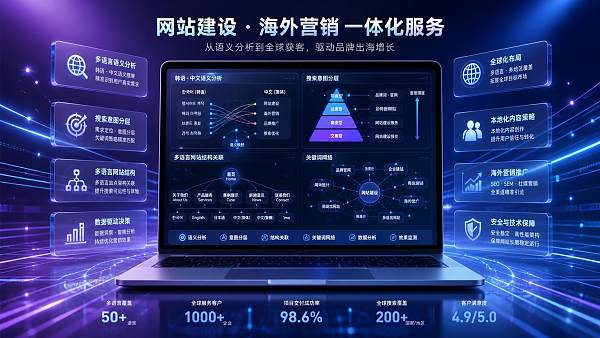
Korean SEO Places Greater Emphasis on Local Expressions, Not Just Grammatical Accuracy
People who build multilingual websites understand that grammatical accuracy does not equal credible content. This is particularly true for Korean websites. Korean users are relatively sensitive to whether page content “looks like it comes from a local website.” If titles, navigation, button copy, or product descriptions contain obvious translationese, clicks and conversions can suffer even if rankings improve.
This is why the question of whether the SEO keyword strategy for Korean website development is the same as that for Chinese websites cannot be answered solely from the perspective of keyword tools. Keywords are only the entry point; the page experience must also be adjusted. For example, how should category names be written more naturally? Should a product page focus more on specifications or applications? Should the FAQ answer purchasing questions or usage questions? All of these factors affect how search engines determine the page topic, as well as how long users stay and whether they submit an inquiry.
In actual projects, a common type of page has an industry term-packed title, while the body consists of translated Chinese materials. The sentences are complete, but there is no local business context. Such a page may appear to contain “a lot of content,” but it actually lacks expressions that can be searched, understood, and converted. A Korean website needs natural language organization rather than keywords distributed evenly across the page.
Which Parts of the Keyword Hierarchy Commonly Used on Chinese Websites Need to Be Changed for Korean Websites?
When conducting SEO for a Chinese website, many companies structure their keywords as “core keywords–product keywords–long-tail keywords–question keywords.” This method remains valid, but when implementing it on a Korean website, an additional step is required: first confirm whether people in the Korean market actually search in these ways at each level.
The core keyword is not necessarily the broad industry term you assume it is. Some generic terms that appear highly authoritative in Chinese may face excessive competition in the Korean environment, or may be too broad in meaning to generate qualified visits. Product keywords should not be selected solely based on literal equivalence. In many cases, specifications, applications, and industry scenarios must be combined to create a page topic closer to real search behavior.
Long-tail keywords are actually more worthy of attention on Korean websites. In particular, for B2B export websites, industrial product websites, and multilingual corporate websites, users often do not search for a brand at the outset. Instead, they search for phrases such as “what scenarios is it suitable for,” “can it be customized,” or “is it compatible with a certain type of equipment.” If a Chinese website is accustomed to placing such content on a single “Frequently Asked Questions” page, a Korean website may be better served by separating it into independent content pages that address different needs.
When Building a Korean Website, Technical Structure Also Affects Keyword Performance
Many companies understand Korean SEO as “translating the copy well,” but after launch they discover that the technical structure is equally important. Page encoding, language-version switching logic, URL hierarchy, mobile loading, internal links, and metadata settings all affect how search engines crawl and identify Korean content.
This is especially important for multilingual websites. If Chinese, English, and Korean pages share one template but the relationships between language versions are not properly handled, search engines may treat the pages as part of duplicate content or may be unable to determine accurately which version corresponds to which market. At this stage, even a highly detailed keyword strategy may have part of its effectiveness offset by technical issues.
This is also why many companies now prefer to work with service teams that understand both website development and marketing when building overseas websites, rather than separating translation, development, advertising, and SEO among different providers. For platforms such as 易营宝, which have long provided integrated services for multilingual independent websites and overseas marketing, the value lies not only in building the website, but also in connecting the front-end page structure, content delivery, ongoing SEO, and advertising traffic. For the Japanese and Korean markets, this integrated approach is usually more reliable than simply creating a “Korean version of a website.”
The Three Most Common Mistakes Made by Companies
The first mistake is equating Korean keyword research with translation. Translation can tell you “how to write this term,” but it cannot tell you “whether users actually search this way.”
The second mistake is copying the categories from the Chinese website. The fact that a category works on a Chinese website does not mean that the content entry points on a Korean website should be the same. The order of information Korean users care about, their reading habits, and the way they build trust are often different from those of Chinese users.
The third mistake is focusing only on traffic rather than conversions. A Korean website may sometimes attract seemingly good visits, but if the keywords are inaccurate, the traffic may be informational rather than purchase-oriented. For foreign trade companies, manufacturing factories, and teams taking brands overseas, what really matters is not whether the pages receive exposure, but whether the right people are brought to the right pages.
If You Are Preparing to Build a Korean Website, How Can You Get Started with the Keyword Strategy?
A relatively reliable approach is usually not to create a large number of pages from the beginning, but to first build a keyword database and page framework that can validate the direction. Core product pages, application scenario pages, FAQ pages, and brand introduction pages should first be developed thoroughly, and then iterated based on indexing, clicks, and inquiries.
When organizing the keyword database, it is recommended to make at least three assessments: Is this term commonly used in Korea? Is the searcher behind the term in the awareness stage or the purchasing stage? Is the term best suited for a category page, product page, or content page? If these three aspects are not clearly distinguished, the more pages are created later, the higher the adjustment cost will be.
If the company also plans to conduct Google SEO, advertising, and social media traffic acquisition at the same time, the keyword strategy must not operate in isolation. In actual operations, SEO keywords, advertising keywords, and landing page keywords often need to validate one another. Platforms such as 易营宝, which offer a website-building system, an AI advertising and marketing system, and an AI+SEO/GEO optimization system, are suitable for companies going overseas because they can place these data points within one continuous chain rather than handling each activity separately. The advantage is that the Korean website is not merely “launched,” but can continuously refine the direction of its keyword strategy.
FAQ: Practical Questions Frequently Asked by Companies
Can a Korean website directly translate the best-performing content from a Chinese website?
It can be used as a reference, but directly copying it is not recommended. In particular, the title structure, question design, and case-study presentation usually need to be rewritten according to Korean users’ search habits.
Do B2B companies also need to create many content pages?
Not necessarily “many,” but they do need to have “clear roles.” Industrial product and manufacturing websites often depend more on a small number of highly relevant pages than on a large volume of articles. The key is whether each page addresses a clear search intent.
Is Korean SEO suitable only for local Korean brands?
No. Chinese companies also have opportunities to attract target search traffic if they get the local expressions, website structure, and traffic delivery right. The challenge is not the company’s country of origin, but how carefully the work is executed.
If your company is preparing to enter the Korean market, the main thing to avoid is not “moving too slowly,” but “making the site look too much like a Chinese website.” Can the Korean website keyword strategy be the same as that of a Chinese website? From a business perspective, it can serve as a reference; from a search strategy perspective, it must be rebuilt. First identify the right keywords, then decide how to build the pages, write the content, and direct the traffic. Only then can the website have a chance of not only being seen, but also being trusted.
Related Articles
Related Products
 Yiyingbao SaaS Intelligent Website Building and Marketing SystemYiyingbao SaaS Intelligent Website Building and Marketing System, AI-powered no-code website building, rapid creation of multilingual B2B international websites in 10 minutes, global server acceleration, AI-powered SEO optimization, helping businesses connect efficiently with global markets. The perfect integration of technology and operation makes building an international trade website remarkably simple
 AI+SEM Intelligent Advertising Marketing SystemAI+SEM drives intelligent ad creation, empowering full-funnel precision advertising marketing. The system automatically generates weekly/monthly reports, AI recommends keywords and target countries, monitors core metrics in real-time with intelligent alerts, and enables one-click high-conversion ad solutions to help quickly acquire customers and improve ROI.
 AI+SEO Dual-Engine System Optimization ServicesYiyingbao’s AI+SEO dual-engine optimization system helps foreign trade enterprises acquire high-quality organic traffic through AI-powered keyword research, content generation, and comprehensive technical optimization, significantly improving search rankings and conversion rates.
 AI+SNS Social Media Marketing SystemYingbao AI+SNS Social Media Marketing System - Precision social capture for the social media era. Supports one-click content synchronization across major platforms like Facebook and LinkedIn. AI intelligently rewrites posts for enhanced relevance. 24/7 AI customer service and user profiling analysis empower businesses to efficiently expand into global markets.
 AI+SEO营销解决方案易营宝AI+SEO营销解决方案,通过AI批量写作、智能生成TDK、精准关键词扩词等功能,全面优化网站SEO效果,提升流量与转化率。助力企业构建高效智能网站新生态。
 AI+SEM Advertising Marketing SolutionsAI+SEM Advertising Marketing Solution leverages AI technology to deeply empower SEM ad campaigns. It automatically generates weekly/monthly reports using AI, presenting account data across multiple dimensions for comprehensive insights into campaign performance and trends. The system precisely recommends keywords and target countries, intelligently generates high-conversion ad copy, and enables one-click activation of efficient campaign plans to help businesses rapidly acquire customers. Simultaneously, it monitors core metrics in real time, intelligently identifies abnormal fluctuations, and issues timely alerts to ensure stable, high-return advertising results.
 Domain Name ServicesEasyWin provides professional domain name services, including intelligent queries, one-stop registration, brand protection, and full lifecycle management, helping businesses build a digital brand image.
 EasyOperate B2C Cross-Border E-Commerce Platform & Independent WebsiteEasyStore B2C Cross-border E-commerce Independent Store is an intelligent website building and cross-border e-commerce integrated solution independently developed by EasyStore Information Technology (Beijing) Co., Ltd. The system is specially designed for small and medium-sized as well as large export enterprises, integrating 'website building, operation, marketing, advertising, and conversion' into one, helping enterprises quickly establish cross-border e-commerce independent stores to achieve brand globalization and global sales growth.
The platform supports multiple languages, multiple currencies, and multi-channel marketing, with built-in AI intelligent translation and SEO optimization systems, suitable for mainstream markets such as Southeast Asia, Europe and America, Latin America, and the Middle East, assisting Chinese manufacturing enterprises in efficiently deploying international e-commerce strategies. SSL证书易营宝提供专业SSL安全证书服务,包括单域名和泛域名证书,确保网站数据传输加密、身份验证和完整性保护,助力企业建立安全可信的在线业务环境。









